Shop
Shop
Filters
Juneteenth marks a legal announcement. On June 19, 1865, enslaved people in Texas learned — two and a half years after the Emancipation Proclamation — that they were legally free. The country treats that announcement as a finish line. These three books treat it as a starting gun.
This thematic discussion kit pairs Octavia Butler's Kindred, Toni Morrison's Beloved, and Isabel Wilkerson's The Warmth of Other Suns around a single argument none of them makes alone: that legal freedom is a threshold, not a destination. That the harm, the memory, and the economic architecture of exploitation did not stop when the law said stop. That the people who lived on the other side of that legal threshold had to reckon with something the law could not touch. This kit was built for the room that wants to ask the harder question — not whether emancipation mattered, but what it left unfinished, and what that unfinished thing has cost the generations who inherited it.
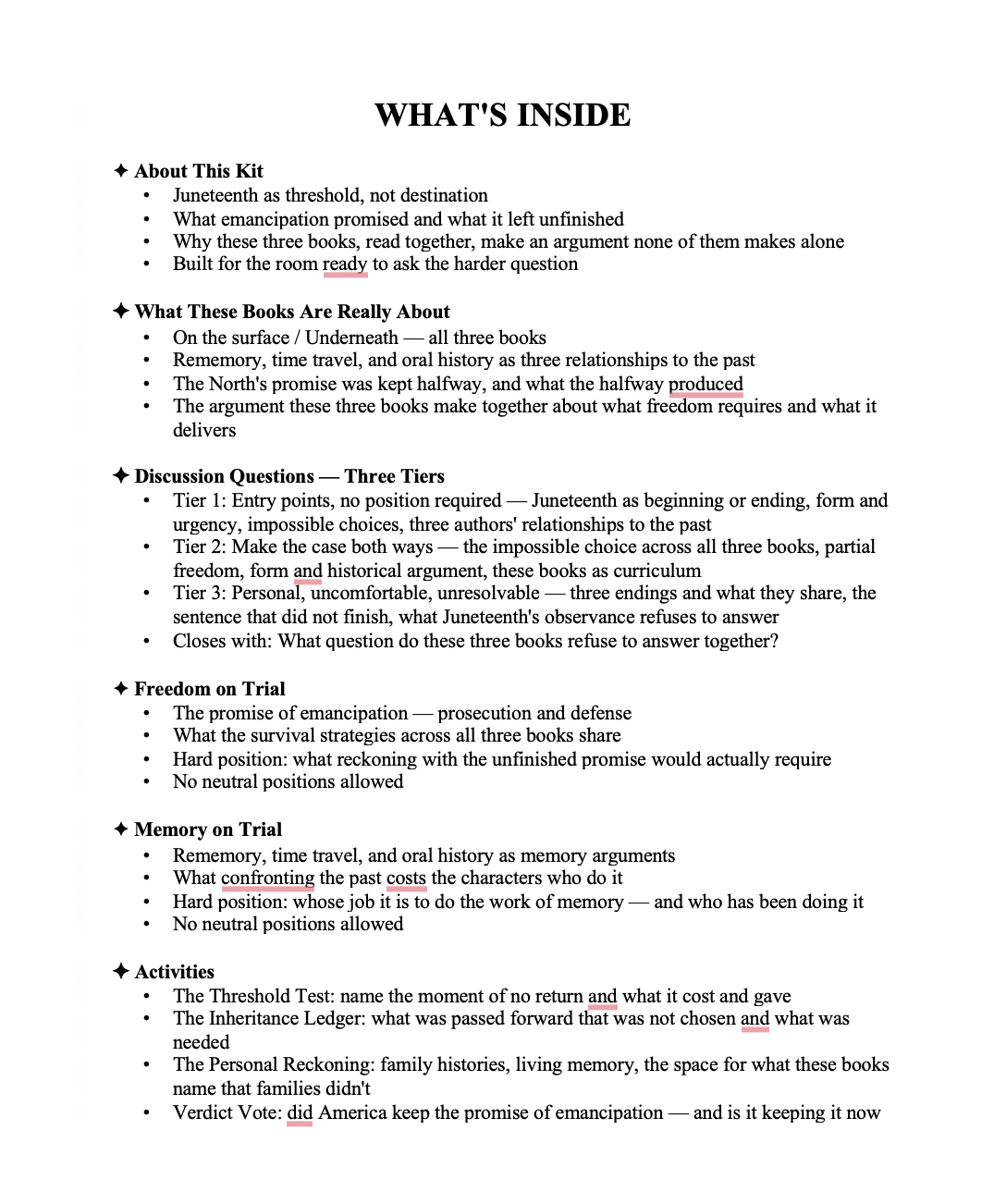
✦ What's Inside
Discussion questions across three tiers — from entry points about Juneteenth as beginning or ending, into prosecution/defense questions on impossible choices, partial freedom, and whether these books should be read as a unified argument — closing with the question all three books refuse to answer together.
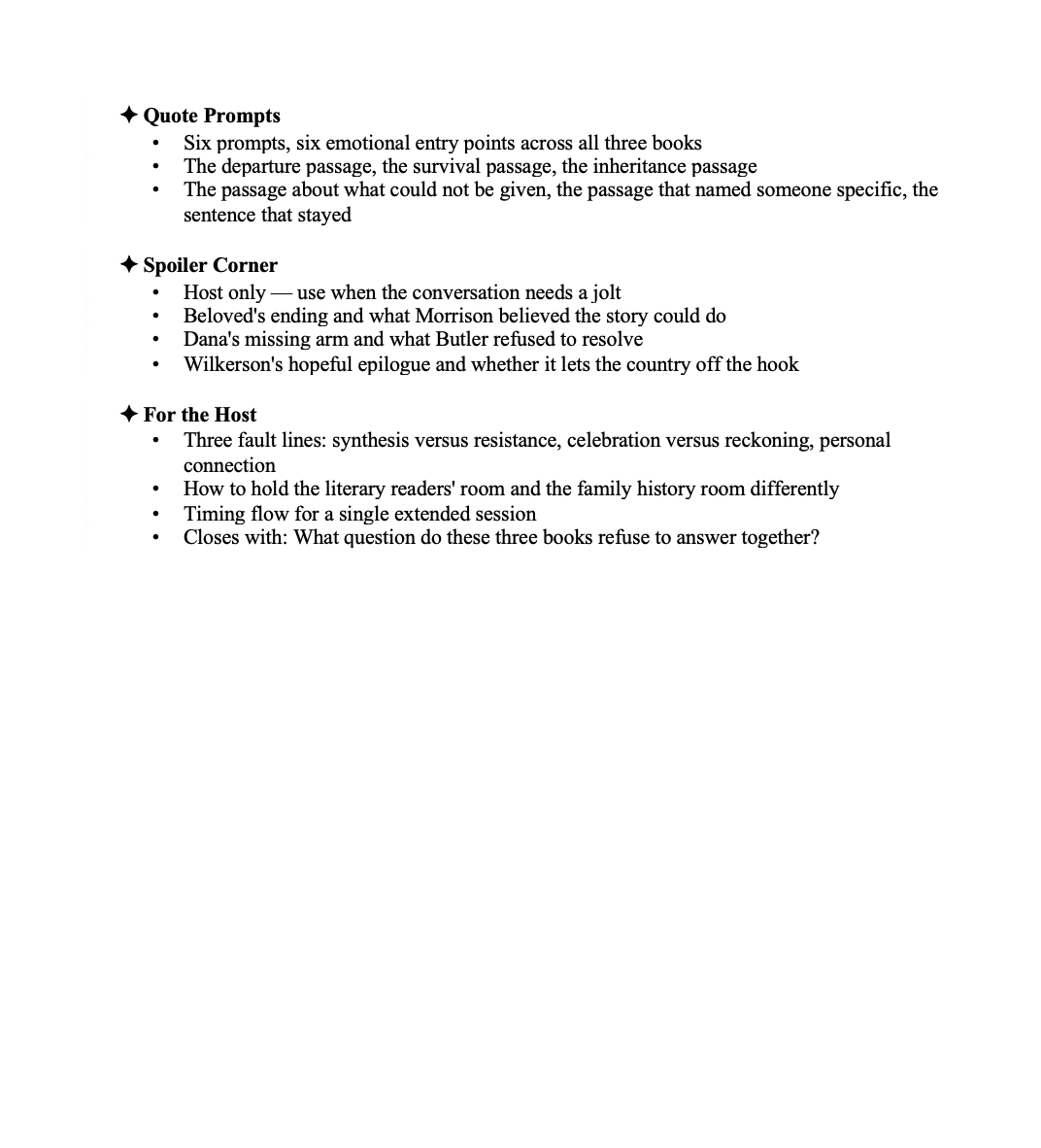
Freedom on Trial: the promise of emancipation, what the survival strategies across all three books share, and what reckoning with that unfinished promise would actually require. Memory on Trial: rememory, time travel, and oral history as three versions of the same argument about what the past does to the present — and whose job it is to do the work of memory.
Four activities: The Threshold Test (the moment of no return, and what it cost and gave); The Inheritance Ledger (what was passed forward that was not chosen); The Personal Reckoning (family histories, living memory, and the space for what these books name that families didn't); and a Verdict Vote with two ballots — whether America kept the promise of emancipation, and whether it is keeping it now.
Six Quote Prompts, a Spoiler Corner with host-only escalation questions on Morrison's triple repetition, Dana's missing arm, and whether Wilkerson's hopeful ending lets the country off the hook. Full facilitation notes, timing flow for an extended session, and a host note for literary readers versus rooms where the Great Migration is family history.
Instant download PDF. Fan-created guide, not affiliated with the authors or publishers. Personal and single-group use.
This is the guide for the room that can hold celebration and reckoning in the same discussion— and is ready to ask what the holiday refuses to answer.
Mary was supposed to be manageable. She was one of thousands in Doro's centuries-long breeding program — monitored, arranged, and expected to be useful. Then she transitioned. Then she built the Pattern. Then she killed him. The satisfaction of that ending is real, and this kit does not shortchange it — but Octavia Butler does not let victory stay simple, and neither does this guide.
This guide is for readers who loved watching Doro finally meet something he couldn't consume, and who are ready to sit with the harder question underneath: If the people inside the Pattern are still ranked, absorbed, and made dependent on a structure they didn't choose, what exactly did the victory change? Butler's argument in Mind of My Mind is sharper than almost anything else in her catalog — rebellion does not automatically produce freedom — and this guide was built to put that argument in front of a room and let them fight about it.
✦ What's Inside
Discussion questions across three tiers — from entry points for the whole room into prosecution/defense questions on Mary's inheritance, transition as capture, Emma's suggestion, Karl and consent, and what Doro's exclusion from the Pattern actually reveals — closing with the questions Butler refuses to answer for you.
Character on Trial: Mary, Doro, and Emma/Anyanwu — hard position questions, prosecution/defense structure, no neutral positions allowed.
System on Trial: The Pattern — rescue versus acquisition, intimate control versus distant control, and what a genuinely free version of the Pattern would require.
Five activities: Verdict Vote on what Mary's victory actually changed; The Transition Question (what it costs to be rescued at your most vulnerable); Mary's Leadership Audit (safety, consent, accountability, necessity, long-term danger); What Doro Misunderstood; and The Pattern Map (family, government, nervous system, church, prison, or empire in embryo — you commit to a frame and defend it).
Six Quote Prompts, a Spoiler Corner with three host-only escalation questions, full facilitation notes, timing flow, and a host note for Wild Seed readers versus first-time Butler readers.
Instant download PDF. Fan-created guide, not affiliated with the author or publisher. Personal and single-group use.
Octavia Butler does not begin Wild Seed in America. She does not begin it in slavery. She begins in 1690 West Africa, with Anyanwu, a three-hundred-year-old Igbo healer and shapeshifter living freely, on her own terms, in the village she has protected for generations. That choice is the novel's first argument: Black existence before the Atlantic world's racial architecture. Before colonization. Before the hierarchy that would follow. Butler plants her story there on purpose.
Then Doro arrives. He is four thousand years old, a survivor who jumps between bodies — consuming each life, moving on — and he has spent those millennia building a breeding program: communities of extraordinary people, carefully selected and paired across generations, working toward something he calls a stronger humanity. He finds Anyanwu and recognizes immediately what she is. He wants her in his program. He wants her children. He wants her.
Most readers find Doro compelling before they find him monstrous. Butler builds that sympathy deliberately — his loneliness is genuine, his affection for Anyanwu is real, his vision has an internal logic that almost makes sense. That is the trap she is laying. Because Doro's breeding program is not revolutionary. It is eugenics: the conviction that some people have the right to decide which bodies are worthy of reproducing, which lives are useful, and which people are expendable in service of a larger project. The state-sponsored forced sterilization of Black women in America, funded by state and federal programs continuing into the 1970s, operated on identical premises. Butler wrote this novel in 1980. She was not writing about the distant past.
This guide was built for the room that is ready to name what Doro's program is — and to reckon with what it means to have spent half the novel sympathizing with the man who built it. It puts his system on trial. It gives Anyanwu the space her survival deserves. It asks the Body Question that Butler embeds in every chapter. And in the Spoiler Corner, it sits with the ending Butler earns: not justice, not accountability, but the possibility of something changing in one relationship — and the question of whether that is enough.
What's Inside
✦ About This Book — Butler starts in West Africa before slavery, before colonization, before racial hierarchy — Why Doro seems revolutionary until he isn't — The eugenics parallel and why it is not science fiction
✦ What This Book Is Really About — Four threads worth following into discussion — The architecture of ownership, bodily autonomy, and the trap of sympathy — Butler's core argument: power without limits eventually treats people as resources
✦ Discussion Questions — Three Tiers — Tier 1: Entry points for the whole room — Tier 2: Doro's framing versus his logic, Anyanwu's compromise as resistance, and bodily autonomy as the novel's central contest — Tier 3: What sympathy for Doro reveals, the eugenics parallel named directly, and whether strength can exist without domination
✦ Character on Trial — Anyanwu and Doro — Prosecution/defense structure — Hard position questions — No neutral positions allowed
✦ System on Trial: Doro's Breeding Program — Eugenics, slavery, and patriarchy as a single architecture — The state-sponsored sterilization of Black women named directly — What systems currently operating Doro would recognize as his own
✦ Activities — Verdict Vote: what Doro's breeding program actually is — The Survival Ledger: what each survival strategy costs and what it preserves — The Power Audit: having power and having freedom are not the same thing — The Body Question: who gets to decide what your body is for
✦ Quote Prompts — Six prompts covering Doro's dangerous tenderness, Anyanwu's transformation, the breeding program's exposed logic, immortal loneliness, Butler's live wire, and Anyanwu's power on her own terms
✦ Spoiler Corner — Host-only escalation questions — Anyanwu's threat and where power actually lives — Whether Doro's emotional capitulation is accountability or something less — Whether love can exist inside a relationship where one person has treated the other as property
✦ For the Host — How this book divides the room along one fault line that matters — Which activities go most personal and need extra time — Timing flow for a 90-minute meeting — Good host note for Butler fans versus first-time Butler readers
Details: Instant download PDF. 20+ pages, print-ready. Licensed for personal and single-group use. This is a fan-created discussion guide and is not affiliated with, endorsed by, or connected to the Octavia Butler estate or any publisher.
Licensing for classrooms, libraries, and educational programs is available. If you plan to use this guide for a class, reading program, or institutional setting, please contact the shop to arrange an appropriate license.
Everyone remembers the cells. Almost no one remembered her.
The Immortal Life of Henrietta Lacks is the story of a scientific miracle — the first human cells to survive and replicate outside the body — and the Black woman they were taken from in 1951, at Johns Hopkins, without her knowledge or consent. Her cells helped build modern medicine and generated billions. Her family grew up in poverty and weren't compensated for over seventy years. This is a book that leaves a room angry. This kit gives that anger somewhere to go.
It's built for the group that wants to argue honestly — about consent, race, medicine, money, and who gets remembered and how. Not a worksheet. A structured, uncomfortable, genuinely good conversation.
Inside the kit:
About This Book and What This Book Is Really About — the argument running underneath the science
Three tiers of discussion questions, from warm-up to the ones you save for when the conversation gets good
Character on Trial — Henrietta, Deborah, and Rebecca Skloot, prosecution and defense, no neutral positions allowed
Four activities, including the Cost Ledger and a Verdict Vote on the 2023 Thermo Fisher settlement
Six quote prompts for six different kinds of readers
A host-only Spoiler Corner for when the room needs a jolt
A full For the Host section — facilitation notes, a timing flow, and guidance for two very different kinds of rooms
Plus an interactive Living Companion (scan the QR code inside) to run live during your meeting
Instant download PDF. Personal and single-group use.
Institutional and educational licensing available; just reach out through the shop.
Tananarive Due did not begin with a story idea. She began with a name — her great-uncle Robert Stephens, who died at the Dozier School for Boys in Marianna, Florida, and was largely forgotten in family memory. The Dozier School operated from 1900 to 2011. Over more than a century, boys — disproportionately Black boys — were beaten, abused, disappeared, and buried in unmarked graves while the institution kept running behind the language of reform, discipline, and correction. Due wrote The Reformatory to pull one forgotten child back from that erasure. What she built in his name is a ghost story that is really a reckoning.
The real horror in this novel is not the haints. It is the system. The Gracetown School for Boys is not an accident — it is a machine, and Due is precise about how machines like it operate: through law, procedure, authority, religion, and the cooperation of ordinary people who know what is happening and keep the institution running anyway. Robert Stephens Jr. is twelve years old when he is sent there for defending his sister from a white boy. The horror begins before he ever reaches the gates, because the world has already decided he is punishable. His sister Gloria fights from the outside with everything she has. The dead boys who never made it out fight from wherever the dead go when institutions refuse to mourn them. This is a novel about what Black childhood costs when the legal system becomes the monster — and about what fiction can do when official history has failed the people it was supposed to record.
This guide was built for the room that is ready to sit with all of it — the horror, the history, the haints, and the harder question underneath: is witness enough when accountability was never available? It names the Dozier School directly. It puts the institution on trial. It gives Gloria the space the novel gives her. And in the Spoiler Corner, it asks the question Due's novel earns the right to ask: what are the dead owed by the living who finally remember them?
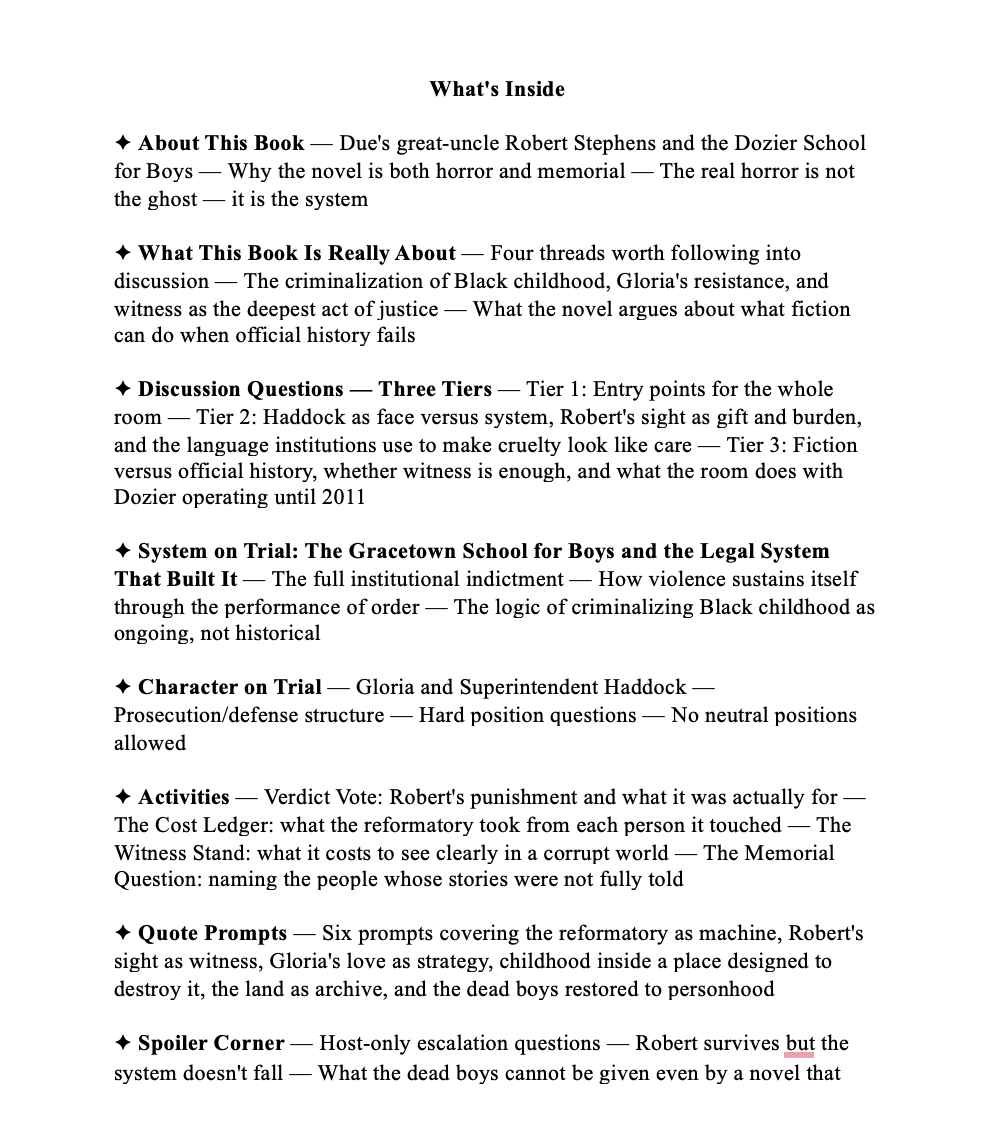
What's Inside
✦ About This Book — Due's great-uncle Robert Stephens and the Dozier School for Boys — Why the novel is both horror and memorial — The real horror is not the ghost — it is the system
✦ What This Book Is Really About — Four threads worth following into discussion — The criminalization of Black childhood, Gloria's resistance, and witness as the deepest act of justice — What the novel argues about what fiction can do when official history fails
✦ Discussion Questions — Three Tiers — Tier 1: Entry points for the whole room — Tier 2: Haddock as face versus system, Robert's sight as gift and burden, and the language institutions use to make cruelty look like care — Tier 3: Fiction versus official history, whether witness is enough, and what the room does with Dozier operating until 2011
✦ System on Trial: The Gracetown School for Boys and the Legal System That Built It — The full institutional indictment — How violence sustains itself through the performance of order — The logic of criminalizing Black childhood as ongoing, not historical
✦ Character on Trial — Gloria and Superintendent Haddock — Prosecution/defense structure — Hard position questions — No neutral positions allowed
✦ Activities — Verdict Vote: Robert's punishment and what it was actually for — The Cost Ledger: what the reformatory took from each person it touched — The Witness Stand: what it costs to see clearly in a corrupt world — The Memorial Question: naming the people whose stories were not fully told
✦ Quote Prompts — Six prompts covering the reformatory as machine, Robert's sight as witness, Gloria's love as strategy, childhood inside a place designed to destroy it, the land as archive, and the dead boys restored to personhood
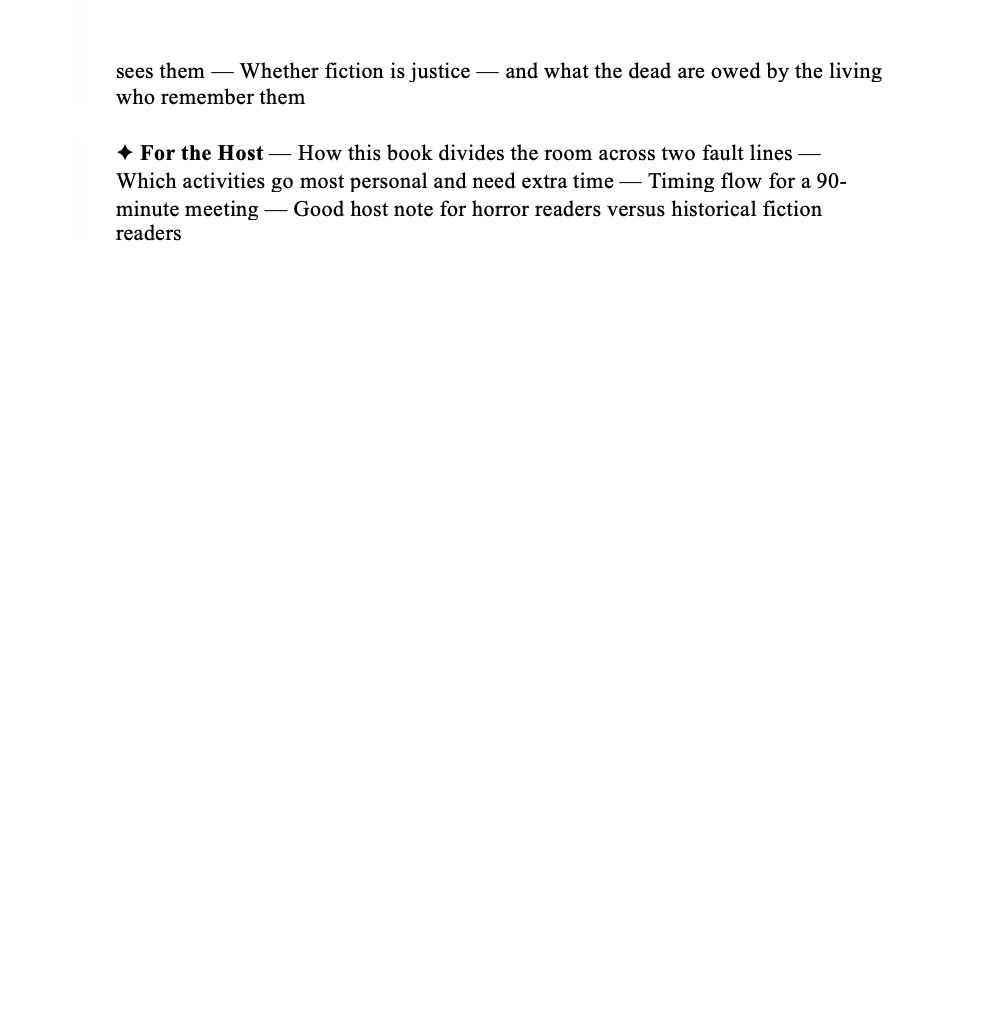
✦ Spoiler Corner — Host-only escalation questions — Robert survives but the system doesn't fall — What the dead boys cannot be given even by a novel that sees them — Whether fiction is justice — and what the dead are owed by the living who remember them
✦ For the Host — How this book divides the room across two fault lines — Which activities go most personal and need extra time — Timing flow for a 90-minute meeting — Good host note for horror readers versus historical fiction readers
Kimberly Jones did not write a protest book. She wrote an indictment — and she built it around a Monopoly game. If you played four hundred rounds and had to hand over every dollar you earned, watched your properties get burned when you started winning, got penalized for resisting, and then got told you simply weren't trying hard enough — how would you win? That question is not rhetorical. It is the architecture of this book, and it is exactly the kind of question a room full of readers needs a guide built specifically to handle.
How We Can Win is short, urgent, and precise — 192 pages that connect slavery, Reconstruction's betrayal, Tulsa, redlining, mass incarceration, and present-day wealth inequality into a single, cumulative argument. Jones is not asking readers to feel bad about history. She is asking them to understand how the rules of American wealth were written, who wrote them, and who has been expected to play fairly ever since. That distinction — between feeling something and understanding something — is where most conversations about this book stall. This guide was built to push past the stall.
The discussion this book generates is not the one most groups expect. The room will not divide between people who believe racism is real and people who don't. It will divide between people who agree with Jones's diagnosis and people who agree with her diagnosis but resist her remedy — and that second conversation is the one worth having. This kit is designed to find that fault line early and follow it all the way to the end.
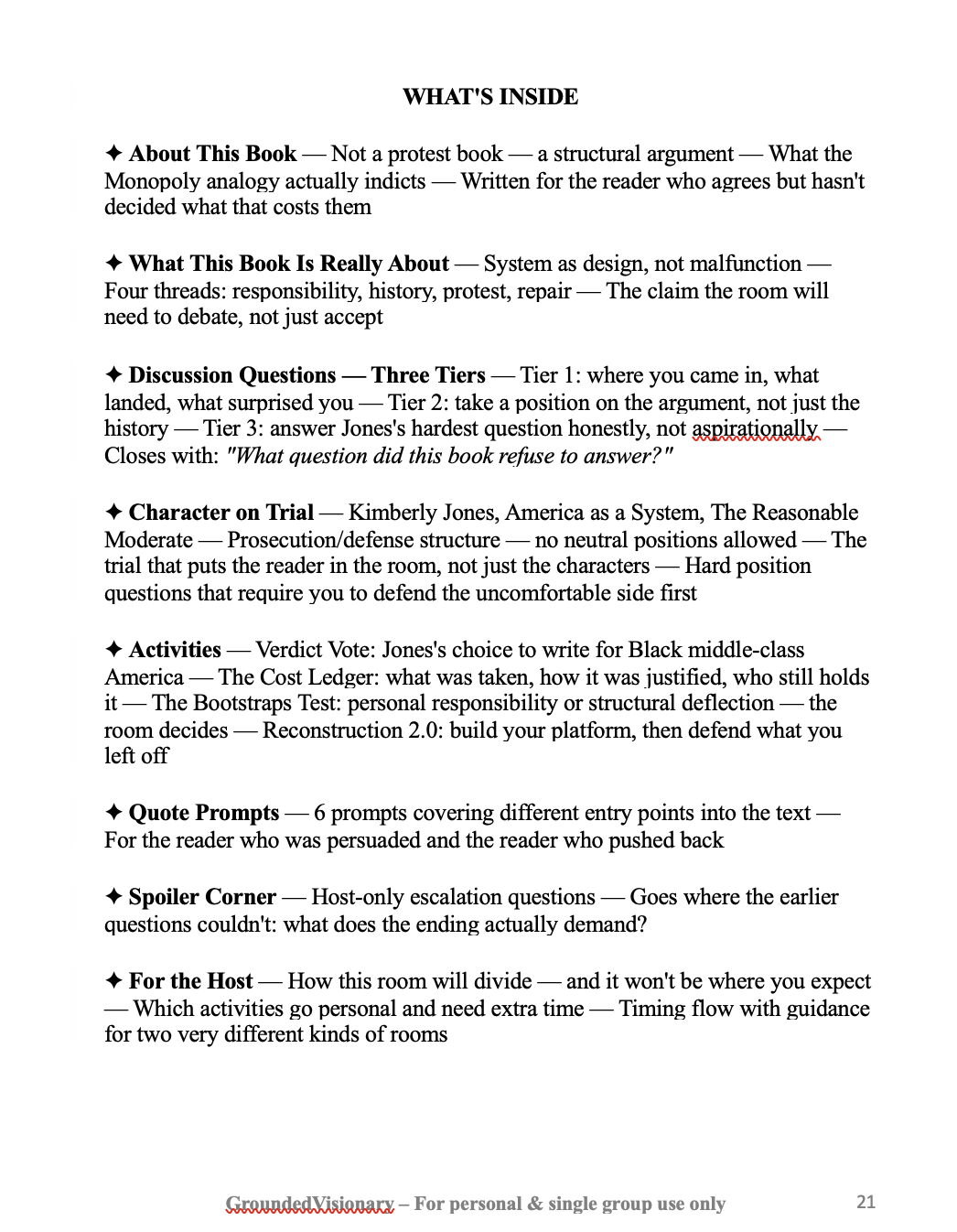
✦ About This Book & What It's Really About — What the Monopoly analogy actually indicts — System as design, not malfunction — The claim the room will need to debate, not just accept
✦ Discussion Questions — Three Tiers — Tier 1: where you came in, what landed, what surprised you — Tier 2: take a position on the argument, not just the history — Tier 3: answer Jones's hardest question honestly, not aspirationally — Closes with: "What question did this book refuse to answer?"
✦ Character on Trial — Kimberly Jones, America as a System, The Reasonable Moderate — Prosecution/defense structure — no neutral positions allowed — The trial that puts the reader in the room, not just the characters — Hard position questions that require you to defend the uncomfortable side first
✦ Activities — Verdict Vote: Jones's choice to write for Black middle-class America — The Cost Ledger: what was taken, how it was justified, who still holds it — The Bootstraps Test: personal responsibility or structural deflection — the room decides — Reconstruction 2.0: build your platform, then defend what you left off
✦ Quote Prompts — 6 prompts covering different entry points into the text — For the reader who was persuaded and the reader who pushed back
✦ Spoiler Corner — Host-only escalation questions — Goes where the earlier questions couldn't: what does the ending actually demand?
✦ For the Host — How this room will divide — and it won't be where you expect — Which activities go personal and need extra time — Timing flow with guidance for two very different kinds of rooms
Details: Instant download PDF. 20+ pages, print-ready. Licensed for personal and single-group use. Fan-created guide — not affiliated with or endorsed by Kimberly Jones or her publisher. Licensing for classrooms, libraries, and educational programs is available — contact the shop to arrange.
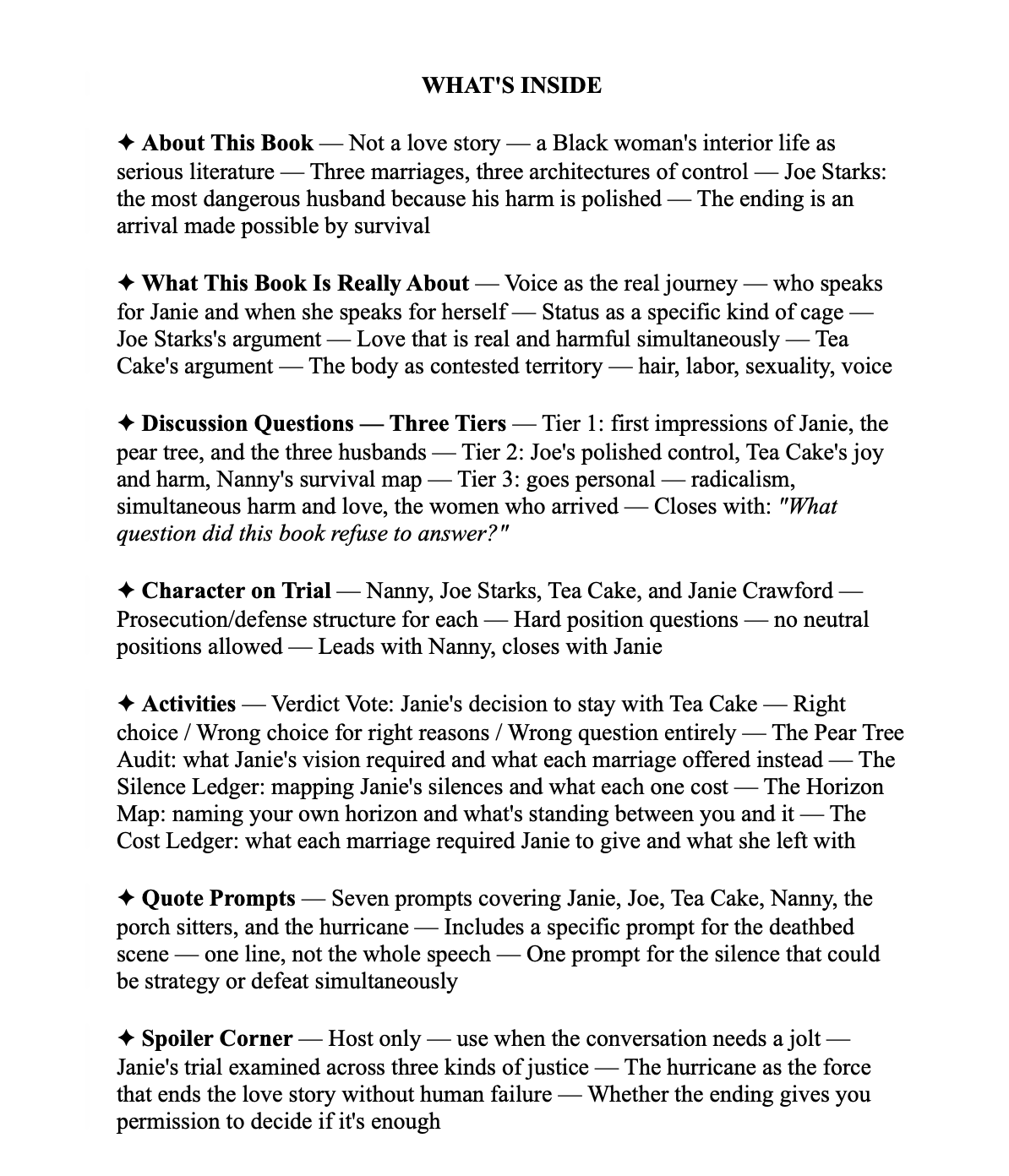
Zora Neale Hurston didn't write a love story. She wrote a Black woman's interior life as the primary subject of serious literature — and in 1937, that was an act of radical insistence. Their Eyes Were Watching God gets summarized as a novel about three marriages and a woman looking for love. This guide was built for the room that wants to talk about what Janie was actually looking for, and what the world kept offering her instead.
Three husbands. Three completely different architectures of control. Logan Killicks offers security without desire — practical, stable, and emotionally deadening. Joe Starks is the most unsettling of the three not because his harm is the most obvious but because it is the most polished — he wraps control in ambition, status, and public respectability, gives Janie a position the rest of Eatonville might envy, and erases her systematically from the inside. Tea Cake is the most complicated — the first person who makes Janie feel like a full human being, whose tenderness and whose violence are both real at the same time, and whom Hurston refuses to simplify into a romantic hero or a villain. This guide does the same.
By the end, Janie returns to Eatonville alone, pulls in her horizon, and claims her story. The novel calls that arrival. This kit was built for the room that wants to examine what the arrival cost is, what it means, and whether the question of whether it was worth it is even the right one to ask.
✦ About This Book — Not a love story — a Black woman's interior life as serious literature — Three marriages, three architectures of control — Joe Starks: the most dangerous husband because his harm is polished — The ending is an arrival made possible by survival
✦ What This Book Is Really About — Voice as the real journey — who speaks for Janie and when she speaks for herself — Status as a specific kind of cage — Joe Starks's argument — Love that is real and harmful simultaneously — Tea Cake's argument — The body as contested territory — hair, labor, sexuality, voice
✦ Discussion Questions — Three Tiers — Tier 1: first impressions of Janie, the pear tree, and the three husbands — Tier 2: Joe's polished control, Tea Cake's joy and harm, Nanny's survival map — Tier 3: goes personal — radicalism, simultaneous harm and love, the women who arrived — Closes with: "What question did this book refuse to answer?"
✦ Character on Trial — Nanny, Joe Starks, Tea Cake, and Janie Crawford — Prosecution/defense structure for each — Hard position questions — no neutral positions allowed — Leads with Nanny, closes with Janie
✦ Activities — Verdict Vote: Janie's decision to stay with Tea Cake — Right choice / Wrong choice for right reasons / Wrong question entirely — The Pear Tree Audit: what Janie's vision required and what each marriage offered instead — The Silence Ledger: mapping Janie's silences and what each one cost — The Horizon Map: naming your own horizon and what's standing between you and it — The Cost Ledger: what each marriage required Janie to give and what she left with
✦ Quote Prompts — Seven prompts covering Janie, Joe, Tea Cake, Nanny, the porch sitters, and the hurricane — Includes a specific prompt for the deathbed scene — one line, not the whole speech — One prompt for the silence that could be strategy or defeat simultaneously
✦ Spoiler Corner — Host only — use when the conversation needs a jolt — Janie's trial examined across three kinds of justice — The hurricane as the force that ends the love story without human failure — Whether the ending gives you permission to decide if it's enough
✦ For the Host — Two fault lines: Tea Cake and Janie's passivity — How to redirect the "was Tea Cake really abusive" conversation — How to use the room's judgment of Janie against itself — Timing flow: 90 minutes, Nanny leads, Janie closes — Two room types: Tea Cake defenders and Janie critics
Details: Instant download — PDF delivered immediately at purchase. 20+ pages, print-ready. Licensed for personal and single-group use. Fan-created discussion guide — not affiliated with or endorsed by Zora Neale Hurston's estate or her publisher.
Licensing for classrooms, libraries, and reading programs is available. If you plan to use this guide in an institutional or educational setting, please contact the shop to arrange an appropriate license.
This kit was built for the room that is ready to talk about what Janie was actually reaching for — and honest enough to ask whether she got there.

Gloria Naylor didn't write a novel about a neighborhood. She wrote a reckoning about what happens to Black women when the world gives them no soft place to land — and then judges how they survive the fall. The Women of Brewster Place gets called a community portrait, a friendship story, a tragedy.
The seven women at the center of this novel arrived at Brewster Place the way people arrive at last resorts: after something else failed, after someone left, after the options narrowed down to this. Mattie Michael, who has lost everything once already and rebuilt it with her hands. Ciel, who disappeared so completely inside her love for Eugene that Mattie had to physically hold her back into her own body. Etta Mae, who understood early that beauty was currency, has been calculating the interest ever since. Kiswana, who chose Brewster Place from a position of privilege and is still learning what it means to inherit a struggle versus select one. Cora Lee, whose relationship to motherhood is more complicated than the judgment the block passes on her. And Lorraine and Theresa — who are not the side plot, not the tragedy, not the lesbian couple in the book, but Naylor's most precise and devastating argument about what communities do to the people they decide don't belong.
This discussion guide puts systems on trial, not characters. The wall goes on trial. The strong Black woman mythology goes on trial. Respectability politics and the silence that makes violence possible go on trial. Because Naylor's argument is structural — these women were failed before they made a single choice — and the guide is built to hold that argument without letting anyone in the room off the hook, including the reader.
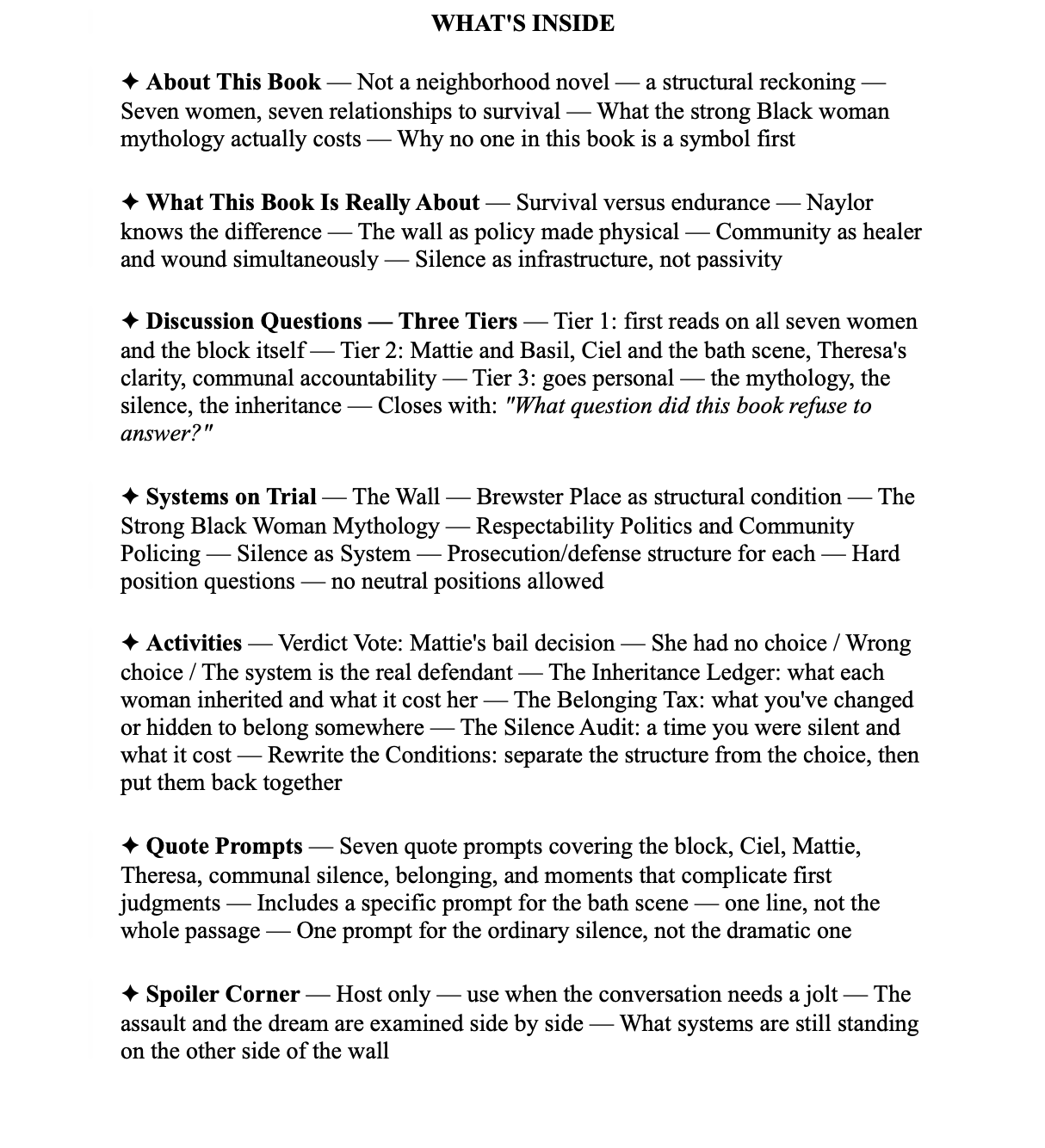
✦ About This Book — Not a neighborhood novel — a structural reckoning — Seven women, seven relationships to survival — What the strong Black woman mythology actually costs — Why no one in this book is a symbol first
✦ What This Book Is Really About — Survival versus endurance — Naylor knows the difference — The wall as policy made physical — Community as healer and wound simultaneously — Silence as infrastructure, not passivity
✦ Discussion Questions — Three Tiers — Tier 1: first reads on all seven women and the block itself — Tier 2: Mattie and Basil, Ciel and the bath scene, Theresa's clarity, communal accountability — Tier 3: goes personal — the mythology, the silence, the inheritance — Closes with: "What question did this book refuse to answer?"
✦ Systems on Trial — The Wall — Brewster Place as structural condition — The Strong Black Woman Mythology — Respectability Politics and Community Policing — Silence as System — Prosecution/defense structure for each — Hard position questions — no neutral positions allowed
✦ Activities — Verdict Vote: Mattie's bail decision — She had no choice / Wrong choice / The system is the real defendant — The Inheritance Ledger: what each woman inherited and what it cost her — The Belonging Tax: what you've changed or hidden to belong somewhere — The Silence Audit: a time you were silent and what it cost — Rewrite the Conditions: separate the structure from the choice, then put them back together
✦ Quote Prompts — Seven prompts covering all seven women — Includes a specific prompt for the bath scene — one line, not the whole passage — One prompt for the ordinary silence, not the dramatic one
✦ Spoiler Corner — Host only — use when the conversation needs a jolt — The assault and the dream are examined side by side — What systems are still standing on the other side of the wall
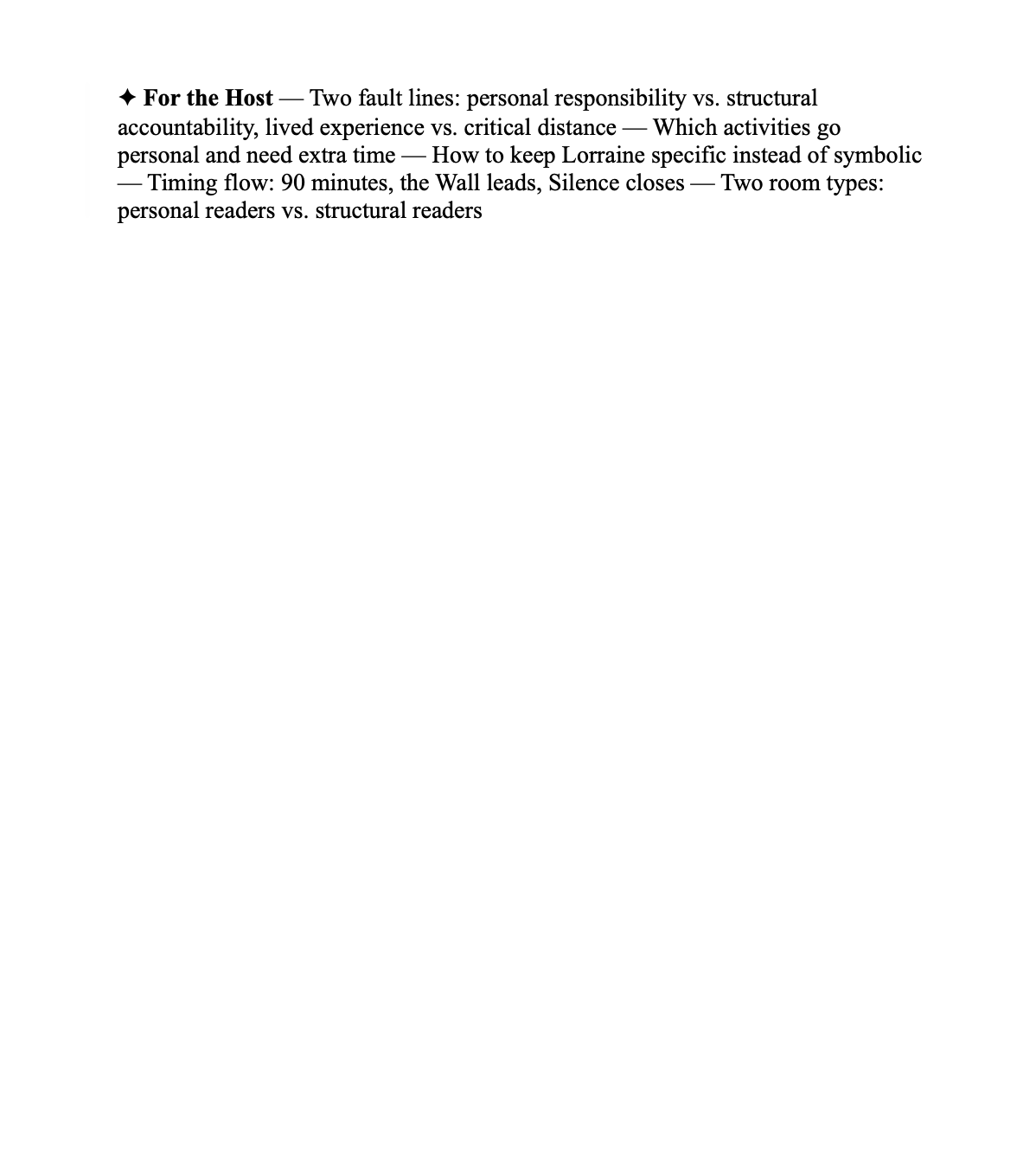
✦ For the Host — Two fault lines: personal responsibility vs. structural accountability, lived experience vs. critical distance — Which activities go personal and need extra time — How to keep Lorraine specific instead of symbolic — Timing flow: 90 minutes, the Wall leads, Silence closes — Two room types: personal readers vs. structural readers
Details: Instant download — PDF delivered immediately at purchase. 20+ pages, print-ready. Licensed for personal and single-group use. Fan-created discussion guide — not affiliated with or endorsed by Gloria Naylor or her publisher.
Licensing for classrooms, libraries, and reading programs is available. If you plan to use this guide in an institutional or educational setting, please contact the shop to arrange an appropriate license.
Terry McMillan didn't write a book about four women looking for love. She wrote a book about what women are taught to sacrifice in exchange for partnership — and what happens when the exchange rate turns out to be a lie. Waiting to Exhale gets filed under girlfriend fiction and left there. This guide was built for the room that knows better.
The four women at the center of this novel — Savannah, Bernadine, Robin, and Gloria — are not four versions of the same character. There are four completely different philosophies about how to survive want. Savannah manages vulnerability with composure that serves more as armor than as a standard. Bernadine built an entire life around a man and a marriage and discovered too late that she had disappeared inside it. Robin is self-aware enough to diagnose every relationship she enters while she is still in it — and enters them anyway, because loneliness has its own logic. Gloria is the anchor, the least performative of the four, the woman who has made peace with the others who are still fighting toward. Together they form a portrait of what it looks like when women are told that waiting — patiently, correctly, quietly — is the path to being chosen.
This kit doesn't start with the fire. It starts with the belief system that made the fire inevitable — and it doesn't let anyone in the room off the hook, including the reader who watched the movie and thought she knew the story. The guide is built for both: the women who read this book in 1992 and carried it for thirty years, and the younger reader who comes in ready to judge these women's choices through a contemporary lens. The best conversation happens when both groups are in the same room, comparing what they received.
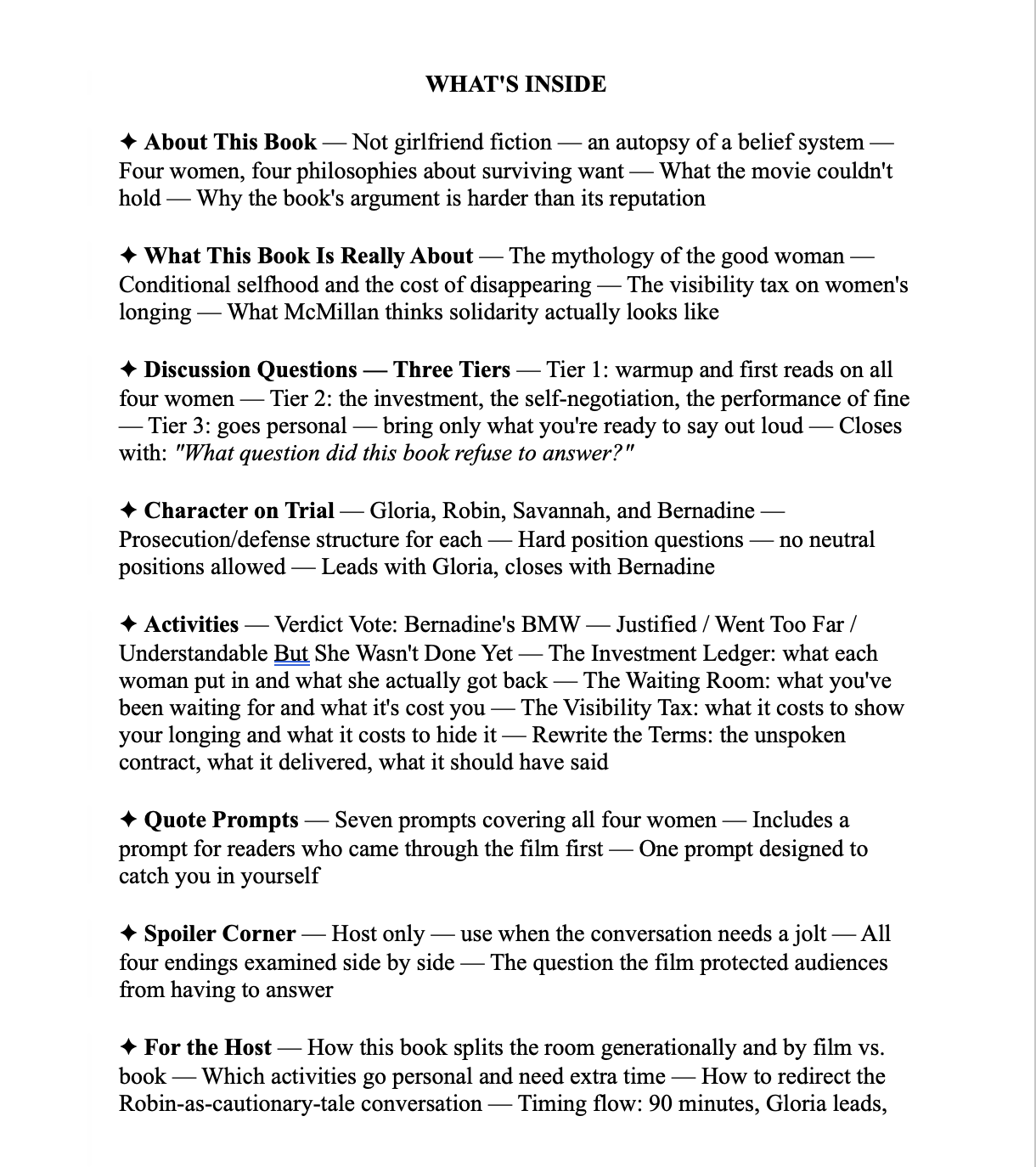
✦ About This Book — Not girlfriend fiction — an autopsy of a belief system — Four women, four philosophies about surviving want — What the movie couldn't hold — Why the book's argument is harder than its reputation
✦ What This Book Is Really About — The mythology of the good woman — Conditional selfhood and the cost of disappearing — The visibility tax on women's longing — What McMillan thinks solidarity actually looks like
✦ Discussion Questions — Three Tiers — Tier 1: warmup and first reads on all four women — Tier 2: the investment, the self-negotiation, the performance of fine — Tier 3: goes personal — bring only what you're ready to say out loud — Closes with: "What question did this book refuse to answer?"
✦ Character on Trial — Gloria, Robin, Savannah, and Bernadine — Prosecution/defense structure for each — Hard position questions — no neutral positions allowed — Leads with Gloria, closes with Bernadine
✦ Activities — Verdict Vote: Bernadine's BMW — Justified / Went Too Far / Understandable But She Wasn't Done Yet — The Investment Ledger: what each woman put in and what she actually got back — The Waiting Room: what you've been waiting for and what it's cost you — The Visibility Tax: what it costs to show your longing and what it costs to hide it — Rewrite the Terms: the unspoken contract, what it delivered, what it should have said
✦ Quote Prompts — Seven prompts covering all four women — Includes a prompt for readers who came through the film first — One prompt designed to catch you in yourself
✦ Spoiler Corner — Host only — use when the conversation needs a jolt — All four endings examined side by side — The question the film protected audiences from having to answer
✦ For the Host — How this book splits the room generationally and by film vs. book — Which activities go personal and need extra time — How to redirect the Robin-as-cautionary-tale conversation — Timing flow: 90 minutes, Gloria leads, Bernadine closes — Two room types: women who read it in 1992 vs. first-time readers
Details: Instant download — PDF delivered immediately at purchase. 20+ pages, print-ready. Licensed for personal and single-group use. Fan-created discussion guide — not affiliated with or endorsed by Terry McMillan or her publisher.
Licensing for classrooms, libraries, and reading programs is available. If you plan to use this guide in an institutional or educational setting, please contact the shop to arrange an appropriate license.
Most books about love begin with romance. This one begins with a definition — and the definition is the argument. bell hooks says love is not a feeling. It is a practice. It is the active choice to extend yourself toward another person's growth through care, respect, trust, honesty, and commitment. If those things are not present, what you have is not love. It may be an attachment. It may be need. It may be habit, fear, or something you were taught to call love because nobody around you had ever seen the real thing either. But it is not love.
That is a hard claim, and Hooks knows it. She is not writing for people who want to feel good about the love they already have. She is writing for people willing to sit with the possibility that much of what they have called love — in their families, their relationships, their friendships, their communities — was something else wearing love's name. What hooks this book, which almost no other writer on love manages, is refusing to let the personal stay personal. The reason so many people struggle to love and be loved is not individual failure. It is systemic. Patriarchy taught men to dominate rather than connect and taught women to accept domination as devotion. Greed built a culture that commodifies intimacy and calls the transaction romance. Self-betrayal gets handed down through generations as the definition of loyalty. Hooks is not interested in helping you navigate those systems more gracefully. She is asking you to dismantle them first.
This kit was built for the room that finished this book, somewhere between convinced and resistant, and knows that both positions are worth examining. Not the room that wants to be validated in what it already believes about love. The room is willing to ask whether what it has been calling love actually meets the standard hooks are setting, and what it would cost to close that gap. That room will be divided. The readers who finish this book feeling vindicated and the readers who finish it feeling implicated are both in there, and the most honest conversation happens when neither side gets to stay comfortable.
What's Inside
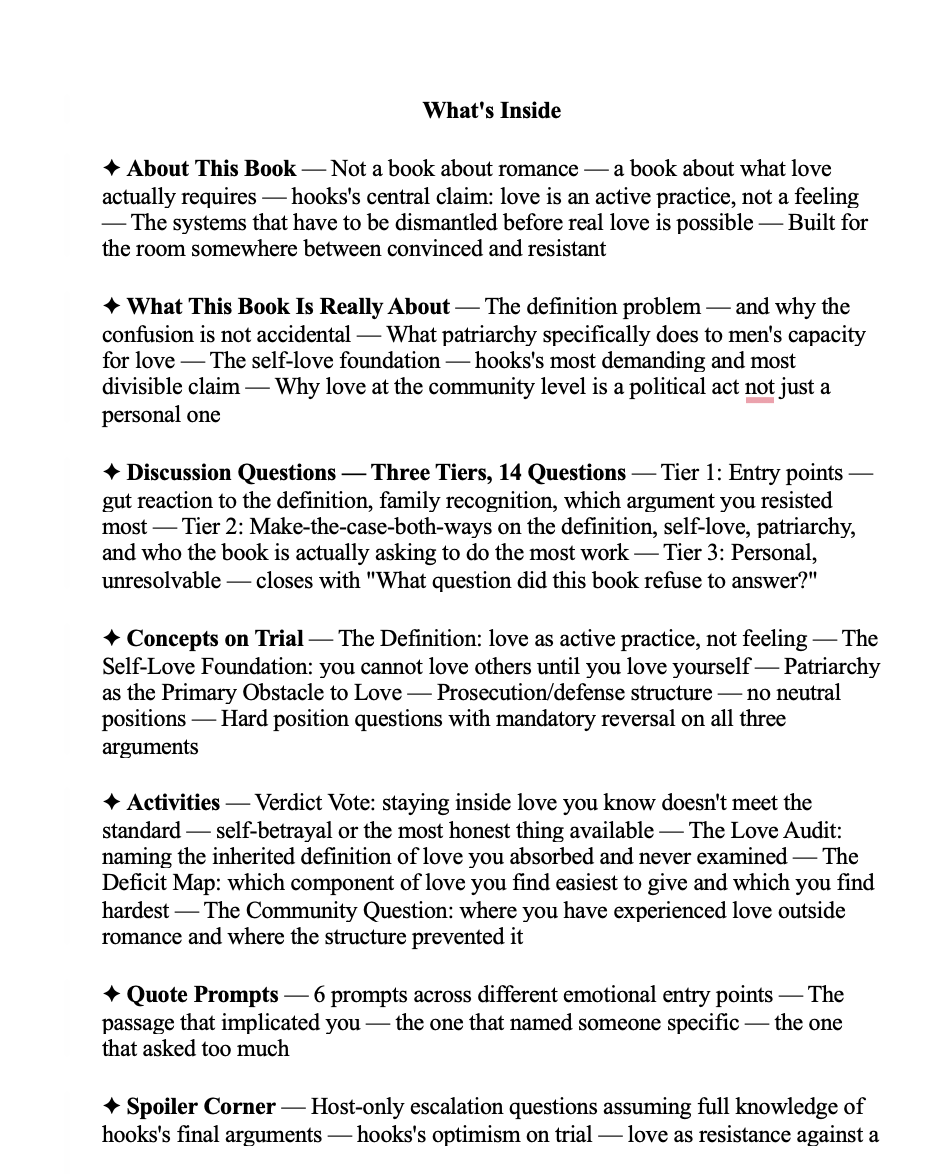
✦ About This Book — Not a book about romance — a book about what love actually requires — hooks's central claim: love is an active practice not a feeling — The systems that have to be dismantled before real love is possible — Built for the room somewhere between convinced and resistant
✦ What This Book Is Really About — The definition problem — and why the confusion is not accidental — What patriarchy specifically does to men's capacity for love — The self-love foundation — hooks's most demanding and most divisible claim — Why love at the community level is a political act, not just a personal one
✦ Discussion Questions — Three Tiers, 14 Questions — Tier 1: Entry points — gut reaction to the definition, family recognition, which argument you resisted most — Tier 2: Make-the-case-both-ways on the definition, self-love, patriarchy, and who the book is actually asking to do the most work — Tier 3: Personal, unresolvable — closes with "What question did this book refuse to answer?"
✦ Concepts on Trial — The Definition: love as active practice not feeling — The Self-Love Foundation: you cannot love others until you love yourself — Patriarchy as the Primary Obstacle to Love — Prosecution/defense structure — no neutral positions allowed — Hard position questions with mandatory reversal on all three arguments
✦ Activities — Verdict Vote: staying inside love you know doesn't meet the standard — self-betrayal or the most honest thing available — The Love Audit: naming the inherited definition of love you absorbed and never examined — The Deficit Map: which component of love you find easiest to give and which you find hardest — The Community Question: where you have experienced love outside romance and where the structure prevented it
✦ Quote Prompts — 6 prompts across different emotional entry points — The passage that implicated you — the one that named someone specific — the one that asked too much
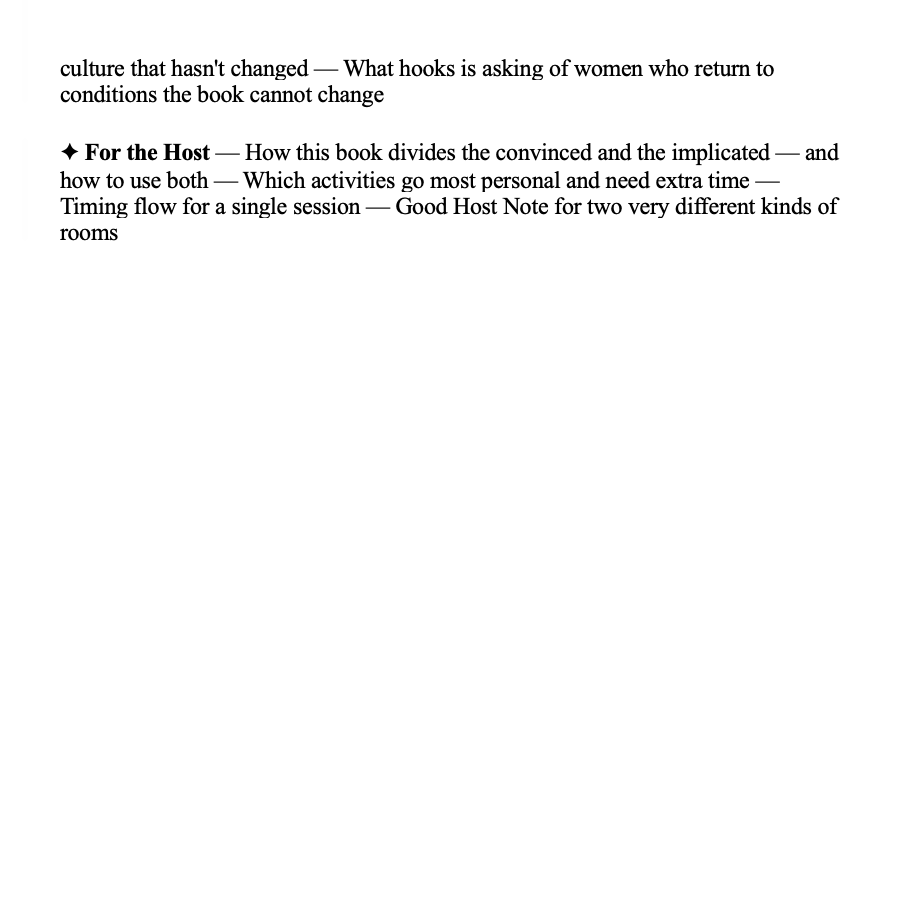
✦ Spoiler Corner — Host-only escalation questions assuming full knowledge of hooks's final arguments — hooks's optimism on trial — love as resistance against a culture that hasn't changed — What hooks is asking of women who return to conditions the book cannot change
✦ For the Host — How this book divides the convinced and the implicated — and how to use both — Which activities go most personal and need extra time — Timing flow for a single session — Good Host Note for two very different kinds of rooms
Details — Instant download PDF — 20+ pages, print-ready — Personal and single-group use — Fan-created discussion guide — Not affiliated with or endorsed by the estate of bell hooks or any publisher
Licensing for classrooms, libraries, and educational programs is available. If you plan to use this guide for a class, reading program, or institutional setting, please contact the shop owner to arrange an appropriate license.
This kit was built for the room that finished All About Love and needed somewhere to put everything it stirred.
Every system in these four books has a story that explains why it works the way it does. Slavery protected the social order. Gilead protected the species. The Black Panther Party protected the revolution. The village of Nakara protected its legacy. The stories are different. The mechanism is the same: women's bodies, labor, silence, and selfhood were the price, and the system made sure the women closest to the cost were the ones explaining why it was necessary.
This kit pairs four books across four genres, four eras, and four very different kinds of rooms. Toni Morrison's Beloved is a ghost story about what slavery did to the interior life of a woman who survived it. Margaret Atwood's The Handmaid's Tale is a dystopian novel about a theocracy that turned women's reproductive capacity into a state resource. Elaine Brown's A Taste of Power is a memoir about leading a revolutionary organization that believed in Black liberation and drew the line at women having authority over men. M.L. Wang's The Sword of Kaigen is a fantasy novel about a woman who buried everything she was to become what a village needed her to be — and what happens when the world breaks open, and the burial becomes impossible to maintain.
None of these women are fighting strangers. Sethe's captor knew her name. Offred's enforcer lived in the same house. Elaine Brown's betrayers called her Comrade. Misaki's silence was maintained by the man she married and the children she raised. That is the specific horror this kit was built around — not oppression from a distance, but the kind that gets into the closest relationships you have and uses them as the delivery mechanism.
The question this kit was built to hold is not whether these women suffered. That is not in dispute. The question is what survival looked like from inside systems that had already occupied the territory closest to them — and whether what each woman chose to do constitutes resistance, accommodation, complicity, or something the English language does not have a clean word for yet. Your book club gets to decide.
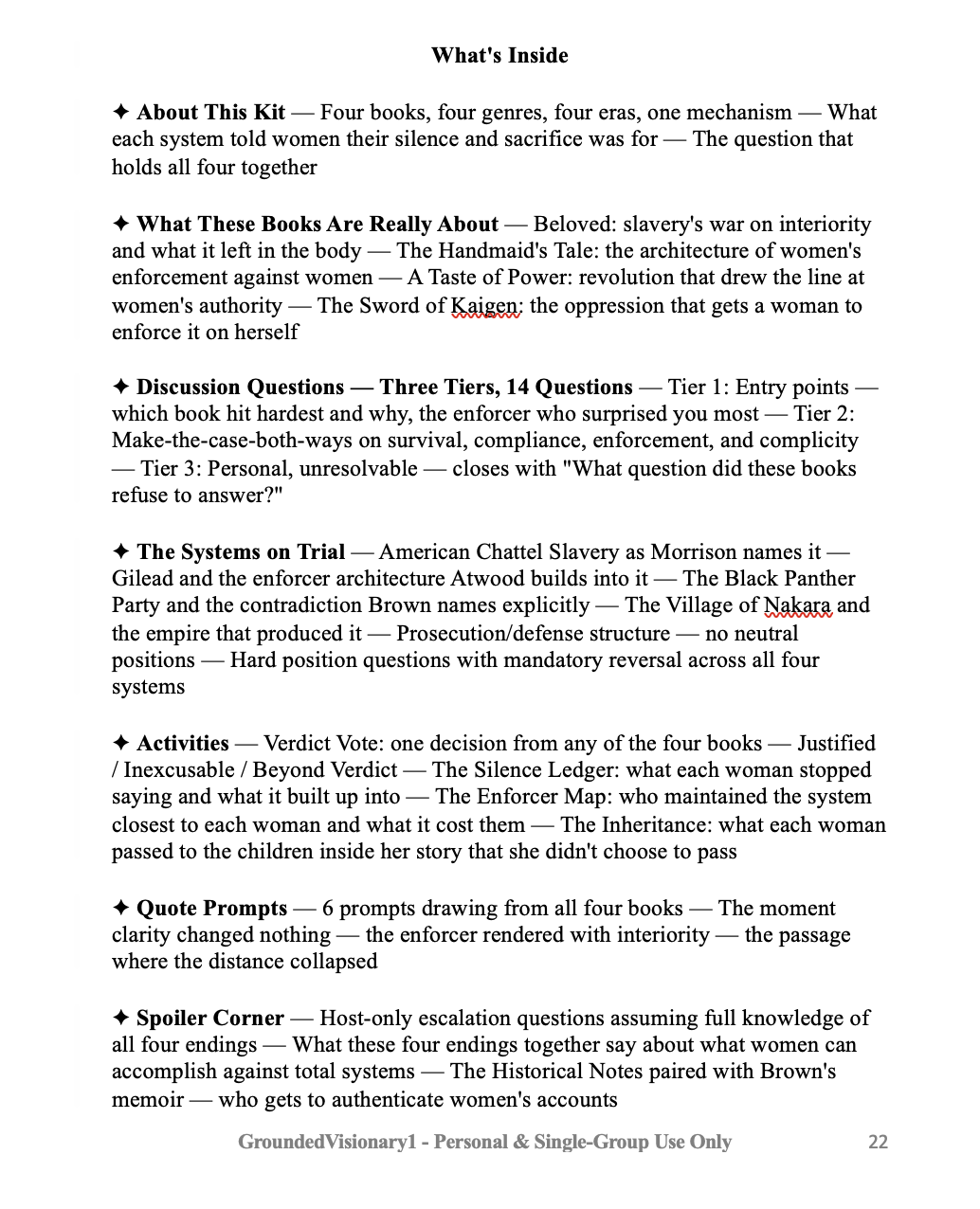
What's Inside
✦ About This Kit — Four books, four genres, four eras, one mechanism — What each system told women their silence and sacrifice was for — The question that holds all four together
✦ What These Books Are Really About — Beloved: slavery's war on interiority and what it left in the body — The Handmaid's Tale: the architecture of women's enforcement against women — A Taste of Power: revolution that drew the line at women's authority — The Sword of Kaigen: the oppression that gets a woman to enforce it on herself
✦ Discussion Questions — Three Tiers, 14 Questions — Tier 1: Entry points — which book hit hardest, the enforcer who surprised you most — Tier 2: Make-the-case-both-ways on survival, compliance, enforcement, and complicity — Tier 3: Personal, unresolvable — closes with "What question did these books refuse to answer?"
✦ The Systems on Trial — American Chattel Slavery, Gilead, the Black Panther Party, and the Village of Nakara — Prosecution/defense structure — no neutral positions allowed — Hard position questions with mandatory reversal across all four systems
✦ Activities — Verdict Vote: one decision from any of the four books — Justified / Inexcusable / Beyond Verdict — The Silence Ledger: what each woman stopped saying and what it built up into — The Enforcer Map: who maintained the system closest to each woman and what it cost them — The Inheritance: what each woman passed to the children inside her story that she didn't choose to pass
✦ Quote Prompts — 6 prompts drawing from all four books — The moment clarity changed nothing — the enforcer rendered with interiority — the passage where the distance collapsed
✦ Spoiler Corner — Host-only escalation questions assuming full knowledge of all four endings — What these four endings say about what women can accomplish against total systems — Who gets to authenticate women's accounts of what was done to them
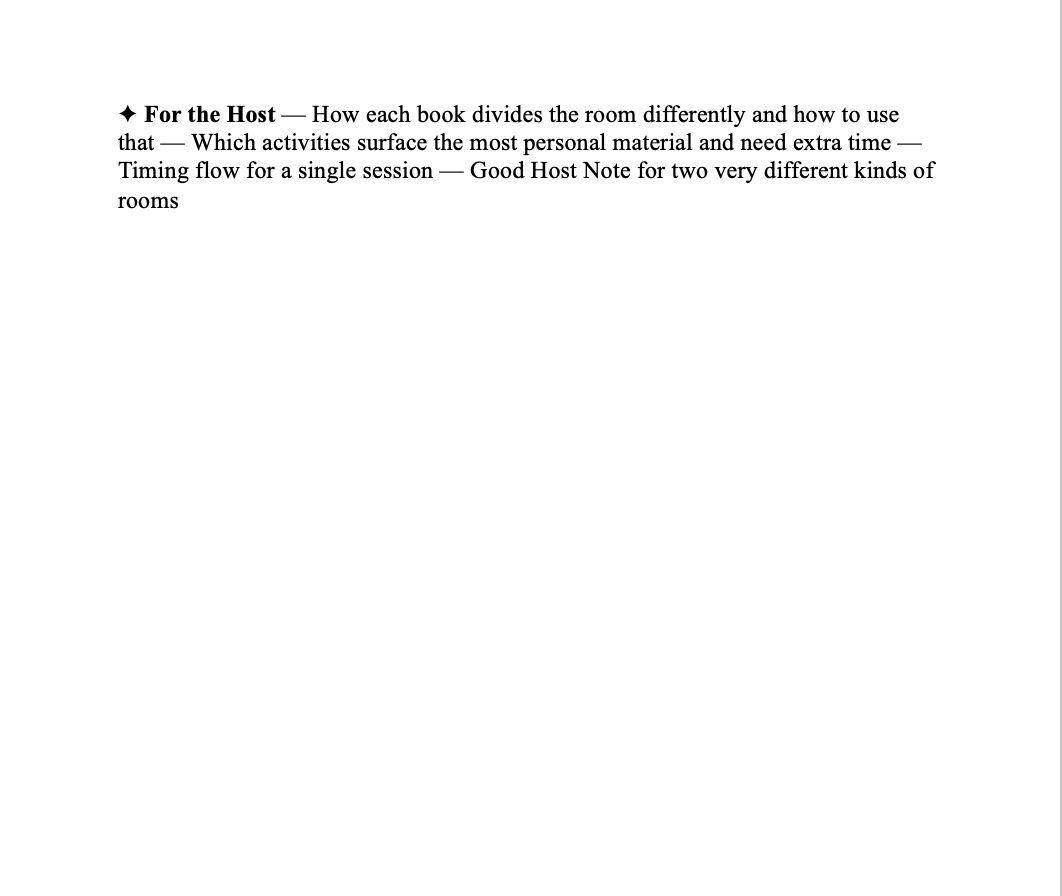
✦ For the Host — How each book divides the room differently and how to use that — Timing flow for a single session — Good Host Note for two very different kinds of rooms
Details — Instant download PDF — Print-ready — Personal and single-group use — Fan-created guide — Not affiliated with or endorsed by any of the authors or their publishers — Individual discussion guides for all four books are available separately in the shop
Licensing for classrooms, libraries, and educational programs is available. If you plan to use this guide for a class, reading program, or institutional setting, please contact the shop owner to arrange an appropriate license.
This kit was built for the room that finished all four books and needed somewhere to put everything they left behind. It was built for the conversation that starts with what these women survived and ends somewhere none of you expected.
Isabel Wilkerson spent fifteen years on this book. She interviewed more than 1,200 people, followed three of them from birth to death, drove one to medical appointments, and sat with another as he was dying in the hospital. None of them lived to see it published. That devotion to three ordinary people is itself an argument — that the Great Migration, one of the largest internal movements of people in American history, belongs to the people who lived it and not just to the historians who cataloged it.
Between 1915 and 1970, six million Black Americans left the South. They left sharecropping, Jim Crow, and the constant threat of racial violence for cities that had never seen them in those numbers and were not always prepared to welcome them. Ida Mae Brandon Gladney left Mississippi in 1937 after watching her husband's cousin be beaten nearly to death over a suspicion that was never proven. George Swanson Starling fled Florida in 1945 in the middle of the night with grove owners threatening to kill him for organizing fruit pickers for better wages. Robert Joseph Pershing Foster drove alone through the desert Southwest in 1953, refused at motel after motel because he was Black, and arrived in Los Angeles with almost nothing and the intention of building everything.
Wilkerson insists these people chose to leave. They were not simply pushed out. They looked at what the South was offering and decided it was not enough. That insistence on agency matters — because it places the responsibility for what made leaving necessary squarely on the system that produced those conditions. And it places the question of what the migrants found when they arrived squarely on the North that promised them something and delivered it halfway
This kit was built for the room where this book was finished, with the specific grief of a story this important being so underreported for so long. It was also built for the room that came to it as family history — one or two generations removed from someone who made this journey and found their own inheritance documented on the page. Both rooms deserve the same conversation. Both rooms are welcome here.
What's Inside:
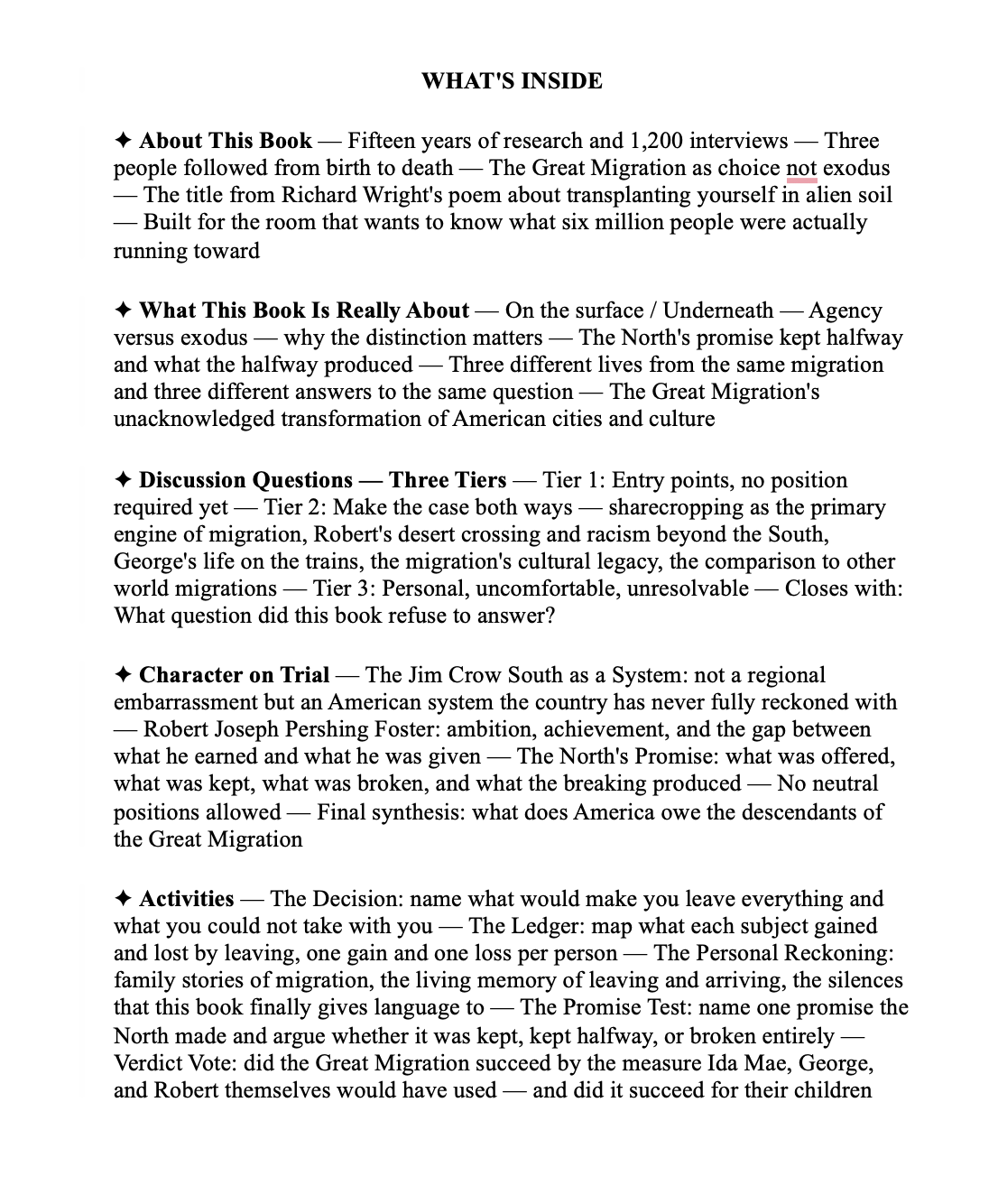
✦ About This Book — Fifteen years of research and 1,200 interviews — Three people followed from birth to death — The Great Migration as choice not exodus — The title from Richard Wright's poem about transplanting yourself in alien soil — Built for the room that wants to know what six million people were actually running toward
✦ What This Book Is Really About — On the surface / Underneath — Agency versus exodus and why the distinction matters — The North's promise kept halfway and what the halfway produced — Three different lives from the same migration and three different answers to the same question — The Great Migration's unacknowledged transformation of American cities and culture
✦ Discussion Questions — Three Tiers — Tier 1: Entry points, no position required yet — Tier 2: Make the case both ways — sharecropping as the primary engine of migration, Robert's desert crossing and racism beyond the South, George's life on the trains, the migration's cultural legacy, the comparison to other world migrations — Tier 3: Personal, uncomfortable, unresolvable — Closes with: What question did this book refuse to answer?
✦ Character on Trial — The Jim Crow South as a System: not a regional embarrassment but an American system the country has never fully reckoned with — Robert Joseph Pershing Foster: ambition, achievement, and the gap between what he earned and what he was given — The North's Promise: what was offered, what was kept, what was broken, and what the breaking produced — No neutral positions allowed — Final synthesis: what does America owe the descendants of the Great Migration
✦ Activities — The Decision: name what would make you leave everything and what you could not take with you — The Ledger: map what each subject gained and lost by leaving — The Personal Reckoning: family stories of migration, the living memory of leaving and arriving, the silences this book finally gives language to — The Promise Test: name one promise the North made and argue whether it was kept, kept halfway, or broken entirely — Verdict Vote: did the Great Migration succeed by the measure Ida Mae, George, and Robert themselves would have used — and did it succeed for their children
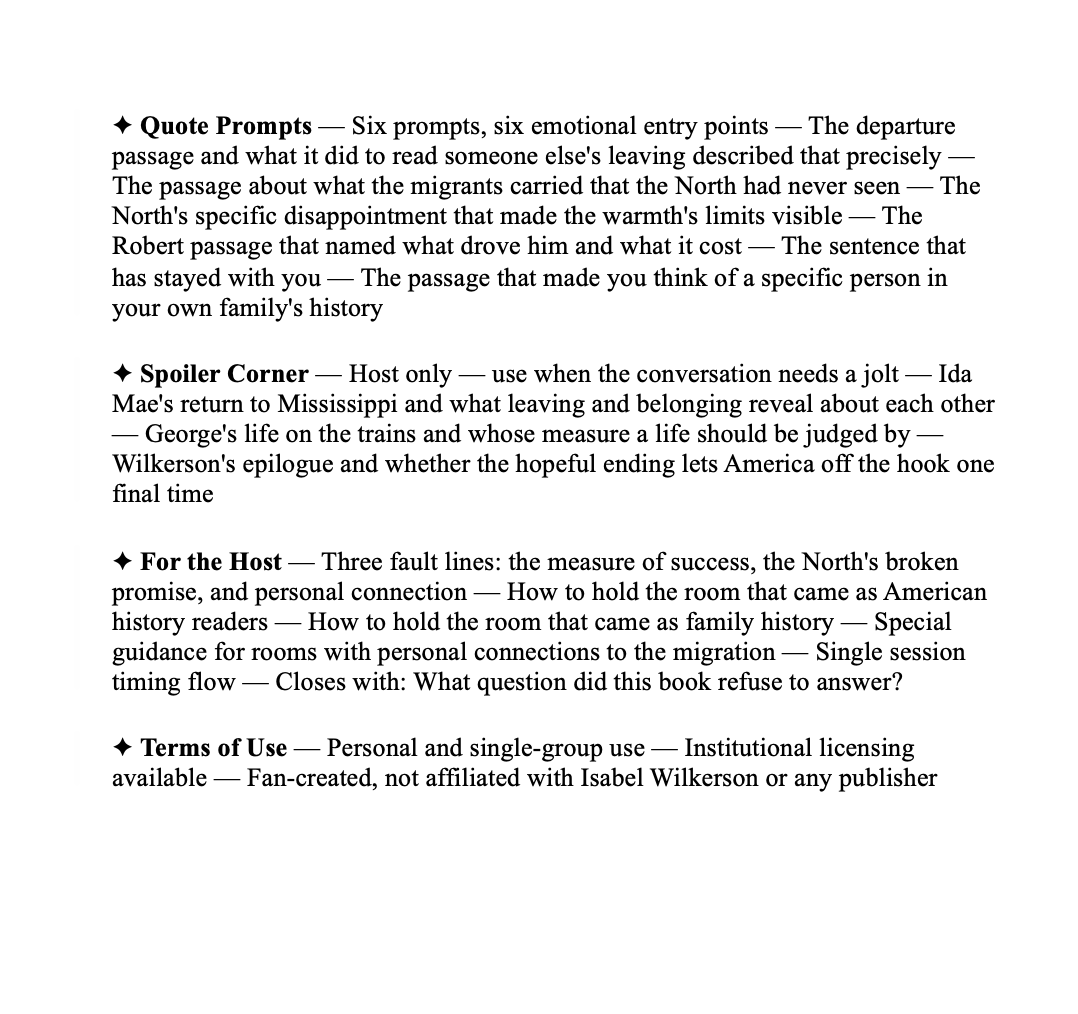
✦ Quote Prompts — Six prompts, six emotional entry points — The departure passage and what it did to read someone else's leaving described that precisely — The passage about what the migrants carried that the North had never seen — The North's specific disappointment that made the warmth's limits visible — The Robert passage that named what drove him and what it cost — The sentence that has stayed with you — The passage that made you think of a specific person in your own family's history
✦ Spoiler Corner — Host only — Full knowledge of the entire book including the epilogue required — Ida Mae's return to Mississippi and what leaving and belonging reveal about each other — George's life on the trains and whose measure a life should be judged by — Wilkerson's epilogue and whether the hopeful ending lets America off the hook one final time
✦ For the Host — Three fault lines: the measure of success, the North's broken promise, and personal connection — How to hold the room that came as American history readers — How to hold the room that came as family history — Special guidance for rooms with personal connections to the migration — Timing flow for a single session
Details: Instant download — PDF format — Personal and single-group use — Fan-created discussion guide — Not affiliated with or endorsed by Isabel Wilkerson or any publisher — Page count: 20+ pages, print-ready
Content note: This guide discusses racial terror and the threat of lynching, the economic exploitation of sharecropping, Jim Crow's specific humiliations, housing discrimination and redlining in the North, and the deliberate concentration of urban poverty. These are not background details — they are Wilkerson's argument. Please consider your group's readiness for this material before purchasing.
Licensing for classrooms, libraries, and educational programs is available. If you plan to use this guide for a class, reading program, or institutional setting, please contact the shop owner to arrange an appropriate license.
This kit was built for the room that finished The Warmth of Other Suns and needed somewhere to put everything the book left in them. It was built for the conversation that starts with what six million people left and ends somewhere none of you expected.
Beloved is not a ghost story. It is an argument that slavery's deepest violence was not physical but psychological, a total war on the right to know yourself, to remember, to love, to want. The ghost that shows up at Sethe's door is not a haunting. It is what happens when trauma this complete refuses to stay in the past.
This is one of the most important novels in the American literary canon, and it is also one of the hardest to discuss without either flattening it into a debate about Sethe's choice or retreating into reverence. Morrison is not asking you to judge Sethe. She is asking you to understand the system that made her decision feel like the only available act of protection. That is a much harder question, and it is the one this book refuses to let you leave behind.
The room this kit was built for is willing to sit with what the novel is actually asking — not to reach a verdict, but to understand what made one necessary. It is the room that can hold Sethe's killing, Baby Suggs's collapsed theology, Paul D's tobacco tin, Denver's slow walk off the porch, and ask what Morrison is saying about survival, memory, love, and what we owe each other when the thing that happened cannot be undone.
The discussion will be divided. Every room that reads this novel eventually has to decide what to do with Sethe, and the readers who arrive wanting to debate her choice and the readers who arrive already devastated by it are both right, and both need somewhere to go. Both positions are in this kit. Neither is dismissed. The goal is not a verdict on Sethe. The goal is to ask what the novel is actually saying.
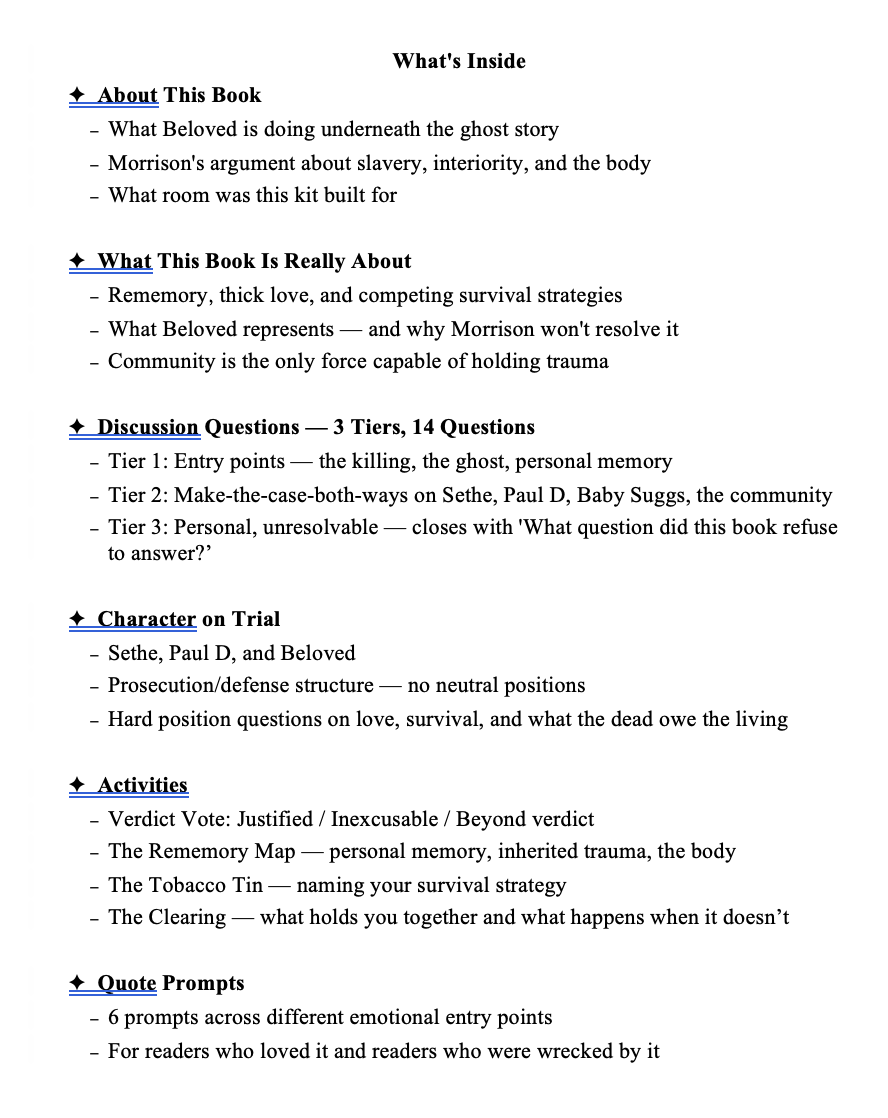
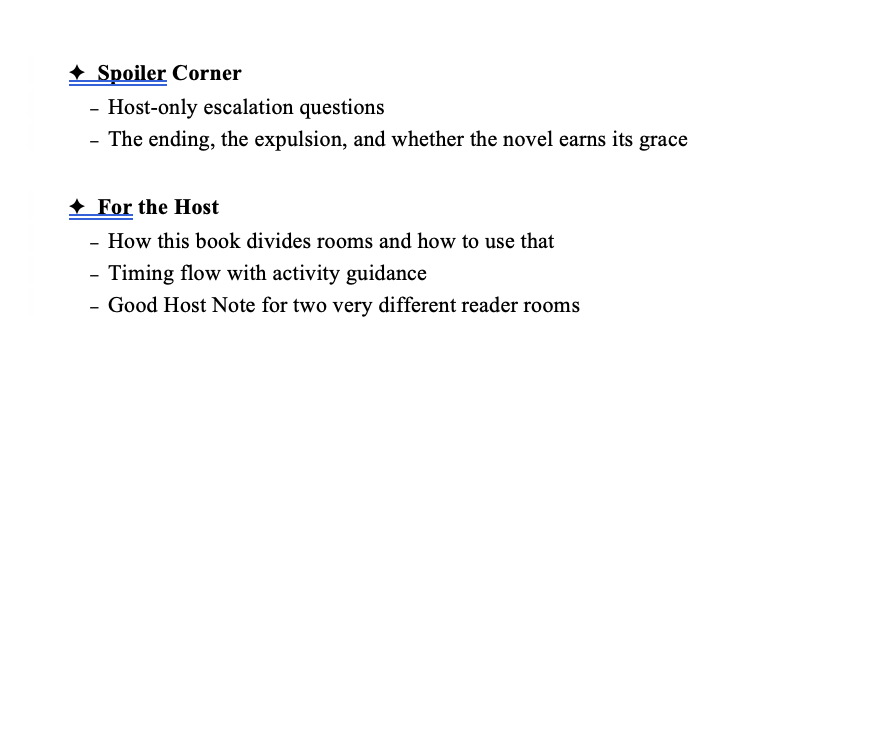
What's Inside
✦ About This Book — What Beloved is doing underneath the ghost story — Morrison's argument about slavery, interiority, and the body — What room this kit was built for
✦ What This Book Is Really About — Rememory, thick love, and competing survival strategies — What Beloved represents — and why Morrison won't resolve it — Community as the only force capable of holding trauma
✦ Discussion Questions — Three Tiers, 14 Questions — Tier 1: Entry points — the killing, the ghost, the slow reveal — Tier 2: Make-the-case-both-ways on Sethe, Paul D, Baby Suggs, and the community — Tier 3: Personal, unresolvable — closes with "What question did this book refuse to answer?"
✦ Character on Trial — Sethe, Paul D, and Beloved — Prosecution/defense structure — no neutral positions — Hard position questions on love, survival, and what the dead owe the living
✦ Activities — Verdict Vote: Justified / Inexcusable / Beyond Verdict — The Rememory Map — personal memory, inherited trauma, the body — The Tobacco Tin — naming your survival strategy — The Clearing — what holds you together and what happens when it doesn't
✦ Quote Prompts — 6 prompts across different emotional entry points — For readers who loved it and readers who were wrecked by it
✦ Spoiler Corner — Host-only escalation questions — The ending, the expulsion, and whether the novel earns its grace
✦ For the Host — How this book divides rooms and how to use that — Timing flow with activity guidance — Good Host Note for two very different reader rooms
Details — Instant download PDF — Personal and single-group use — Fan-created discussion guide — Not affiliated with or endorsed by Toni Morrison, her estate, or her publisher
Licensing for classrooms, libraries, and educational programs is available. If you plan to use this guide for a class, reading program, or institutional setting, please contact the shop owner to arrange an appropriate license.
This kit was built for the room that finished Beloved and needed somewhere to put everything the book left in them.
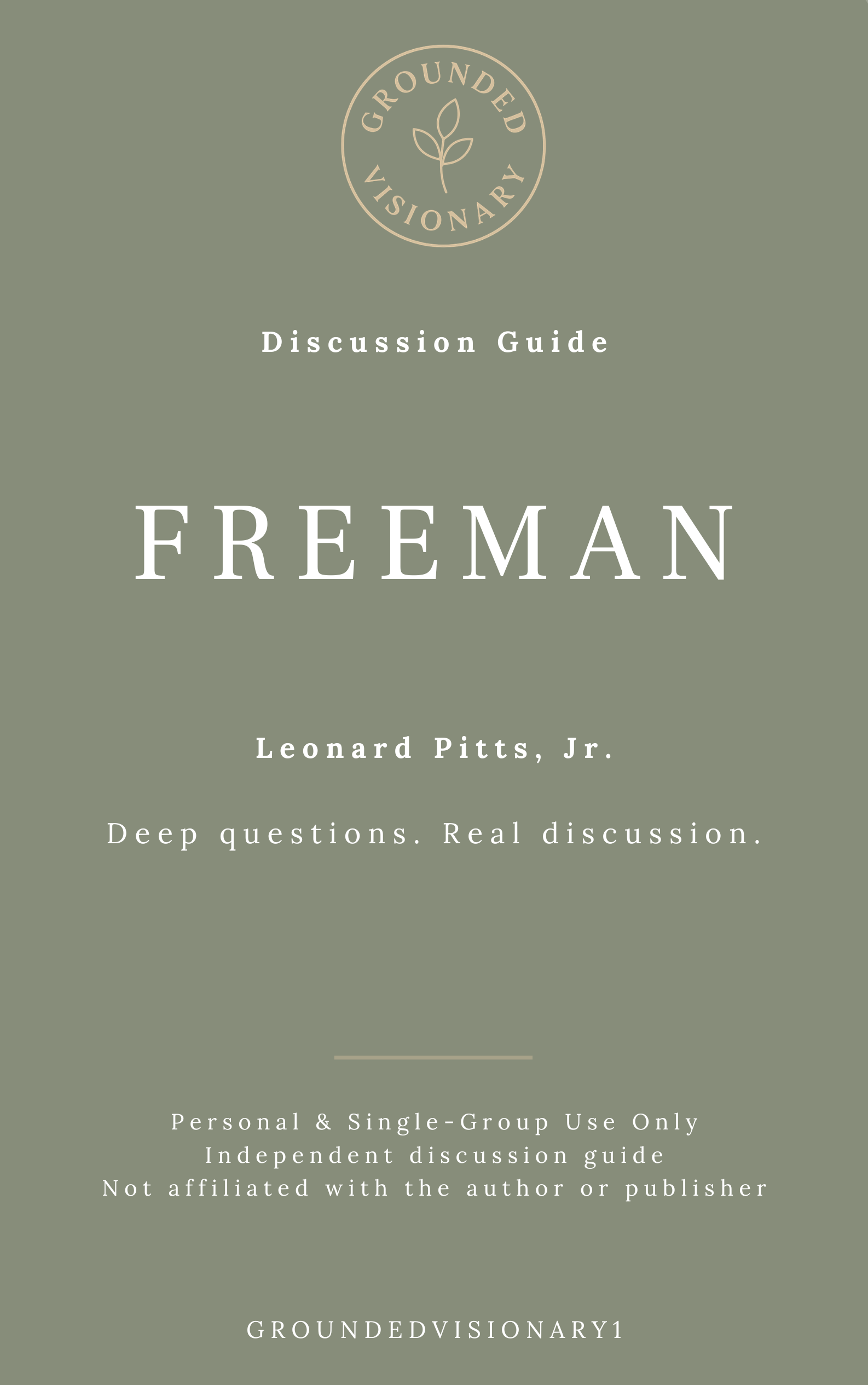
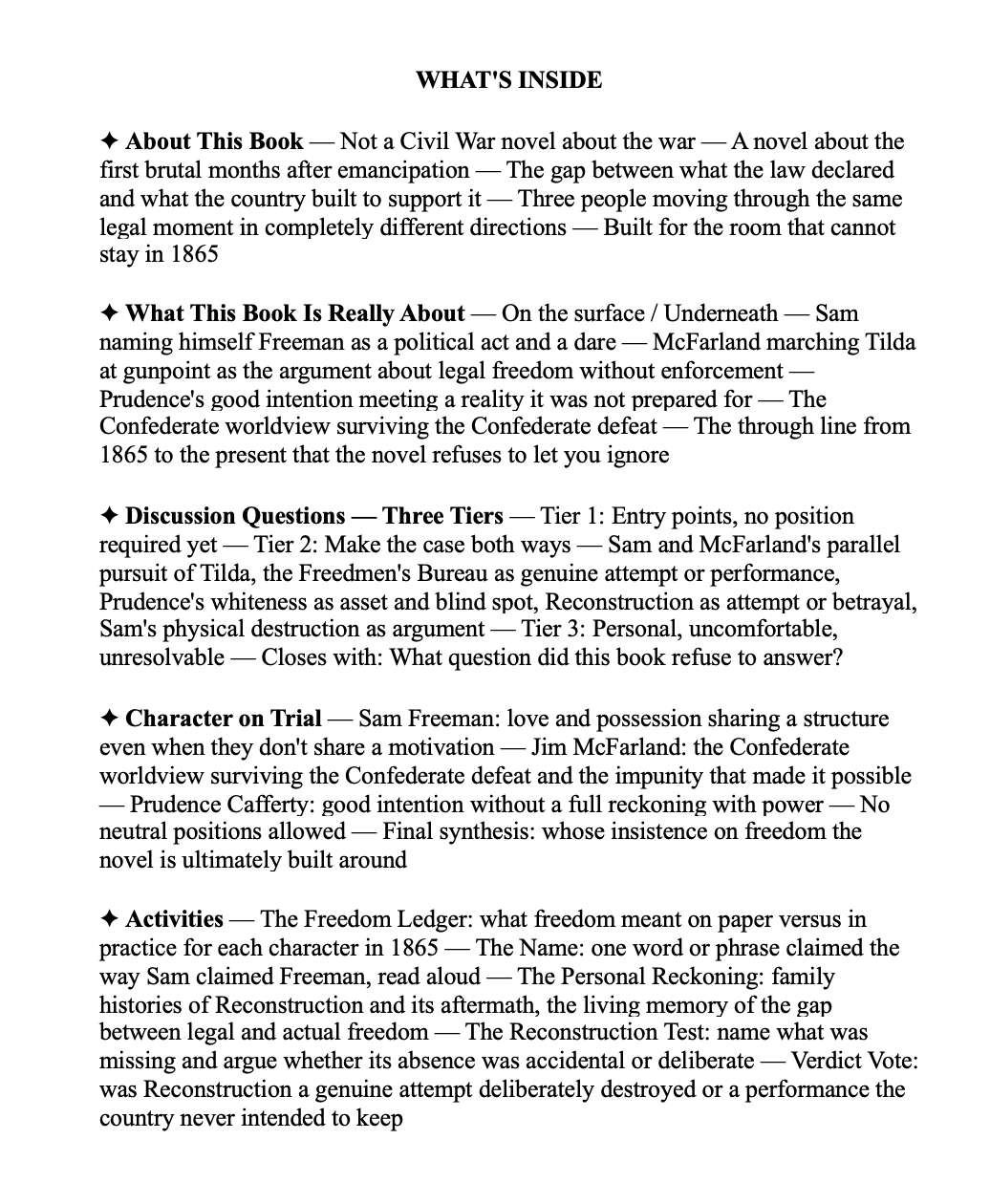
The Emancipation Proclamation declared four million people free. What it did not build was anything to hold that freedom up. No land. No legal protection that was actually enforced. No safety from the men who had owned people and refused to accept that they no longer did. Leonard Pitts Jr. sets his novel in this specific and brutal gap — the first months after Lee's surrender, after Lincoln's assassination, after the law changed and almost nothing else did. Freeman is not a novel about the Civil War. It is a novel about what happened the morning after.
Three people move through this moment in completely different directions. Sam — a formerly enslaved man who took the last name Freeman the day he decided to walk south — leaves his safe haven in Philadelphia and walks a thousand miles through a lawless devastated country to find the wife slavery separated him from fifteen years earlier. Tilda — Sam's wife — is being marched at gunpoint by her former owner toward Arkansas where he believes the old order can still be maintained. Prudence — a wealthy white war widow from Boston — is heading south to honor her abolitionist father's dying wish and open a school for emancipated slaves in a place that has decided it does not want what she is offering.
Pitts is asking one question across all three of them — what does freedom actually mean when it exists on paper but not in practice? When the law has changed and the violence has not. When the men who lost the war are still operating with enough impunity to act as though they won. When a man can name himself Freeman and walk toward that name and lose an arm doing it and keep walking anyway because the alternative is letting slavery have the final word.
This kit was built for the room that finished Freeman sitting with the grief of a novel set at the moment of maximum possibility — before Reconstruction's abandonment, before Jim Crow, before the country made the specific choices it made about what emancipation was actually going to mean. It was built for the conversation that starts in 1865 and cannot stay there.
What's Inside:
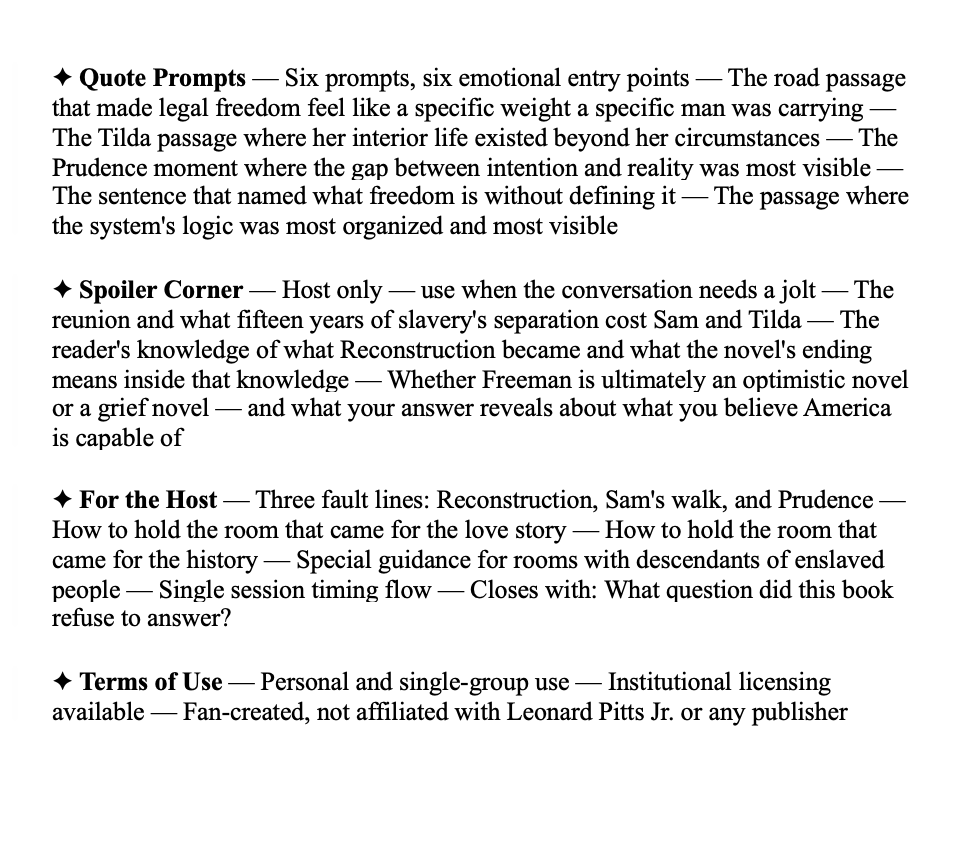
✦ About This Book — Not a Civil War novel about the war — A novel about the first brutal months after emancipation — The gap between what the law declared and what the country built to support it — Three people moving through the same legal moment in completely different directions — Built for the room that cannot stay in 1865
✦ What This Book Is Really About — On the surface / Underneath — Sam naming himself Freeman as a political act and a dare — McFarland marching Tilda at gunpoint as the argument about legal freedom without enforcement — Prudence's good intention meeting a reality it was not prepared for — The Confederate worldview surviving the Confederate defeat — The through line from 1865 to the present that the novel refuses to let you ignore
✦ Discussion Questions — Three Tiers — Tier 1: Entry points, no position required yet — Tier 2: Make the case both ways — Sam and McFarland's parallel pursuit of Tilda, the Freedmen's Bureau as genuine attempt or performance, Prudence's whiteness as asset and blind spot, Reconstruction as attempt or betrayal, Sam's physical destruction as argument — Tier 3: Personal, uncomfortable, unresolvable — Closes with: What question did this book refuse to answer?
✦ Character on Trial — Sam Freeman: love and possession sharing a structure even when they don't share a motivation — Jim McFarland: the Confederate worldview surviving the Confederate defeat and the impunity that made it possible — Prudence Cafferty: good intention without a full reckoning with power — No neutral positions allowed — Final synthesis: whose insistence on freedom the novel is ultimately built around
✦ Activities — The Freedom Ledger: what freedom meant on paper versus in practice for each character in 1865 — The Name: one word or phrase claimed the way Sam claimed Freeman, read aloud — The Personal Reckoning: family histories of Reconstruction and its aftermath, the living memory of the gap between legal and actual freedom — The Reconstruction Test: name what was missing and argue whether its absence was accidental or deliberate — Verdict Vote: was Reconstruction a genuine attempt deliberately destroyed or a performance the country never intended to keep
✦ Quote Prompts — Six prompts, six emotional entry points — The road passage that made legal freedom feel like a specific weight a specific man was carrying — The Tilda passage where her interior life existed beyond her circumstances — The Prudence moment where the gap between intention and reality was most visible — The sentence that named what freedom is without defining it — The passage where the system's logic was most organized and most visible
✦ Spoiler Corner — Host only — Full knowledge of the entire novel required — The reunion and what fifteen years of slavery's separation cost Sam and Tilda — The reader's knowledge of what Reconstruction became and what the novel's ending means inside that knowledge — Whether Freeman is ultimately an optimistic novel or a grief novel
✦ For the Host — Three fault lines: Reconstruction, Sam's walk, and Prudence — How to hold the room that came for the love story — How to hold the room that came for the history — Special guidance for rooms with descendants of enslaved people — Timing flow for a single session
Details: Instant download — PDF format — Personal and single-group use — Fan-created discussion guide — Not affiliated with or endorsed by Leonard Pitts Jr. or any publisher — Page count: 20+ pages, print-ready
Content note: This guide discusses slavery and its violence, lynching, re-enslavement through coercion, racial violence in the post-war South, and the systematic destruction of Reconstruction-era Black progress. These are not background details — they are the argument. Please consider your group's readiness for this material before purchasing.
Licensing for classrooms, libraries, and educational programs is available. If you plan to use this guide for a class, reading program, or institutional setting, please contact the shop owner to arrange an appropriate license
The United States fought two wars during World War II. One was against fascism overseas. The other was the war Black Americans were already fighting at home — against lynching, segregation, economic exclusion, and a legal system that protected white violence and prosecuted Black survival. Leonard Pitts Jr. does not let you forget that both wars were happening simultaneously. This is not a novel about one war. It is a novel about what America asked of three people from the Jim Crow South — and what it cost each of them to answer.
George Simon is an affluent white Marine who survives Pearl Harbor because a Black messman named Gordy pulls him to safety and dies doing it. That debt — a white man alive because a Black man is dead — is what the novel hands George and watches him figure out what to do with. Thelma Gordy is the widow left behind, furious at the Navy for trying to use her husband's death as a recruitment tool for a country that never protected him. Luther Hayes is Thelma's brother who as a child watched his parents be lynched by a mob whose leader was never prosecuted — and who joins the Army not out of patriotism but to avoid prison, and ends up fighting Nazis in Europe with the all-Black 761st Tank Battalion while his own country maintains the racial order the Nazis were trying to export.
Pitts is asking one question across all three of them — what does it take to change someone's mind about race? Not a polite change. Not a theoretical one. The kind of change that costs something. The kind that requires the person changing to reckon with what they were before they changed. This kit was built for the room that finished this novel sitting with the gap between what these three people deserved and what the country delivered — and needed somewhere to put everything the book left in them.
The discussion in this room will divide. Every room that reads this novel eventually has to decide what to think about a white man transformed by a Black man's death and a Black woman's letter who returns home to the same system that produced him — changed inside in ways the novel does not show us challenging outside. Both the prosecution and the defense of his transformation are in this kit. Neither is dismissed. The goal is not to reach a verdict on George Simon. The goal is to ask what change is worth when the system that needed changing is still standing.
What's Inside:
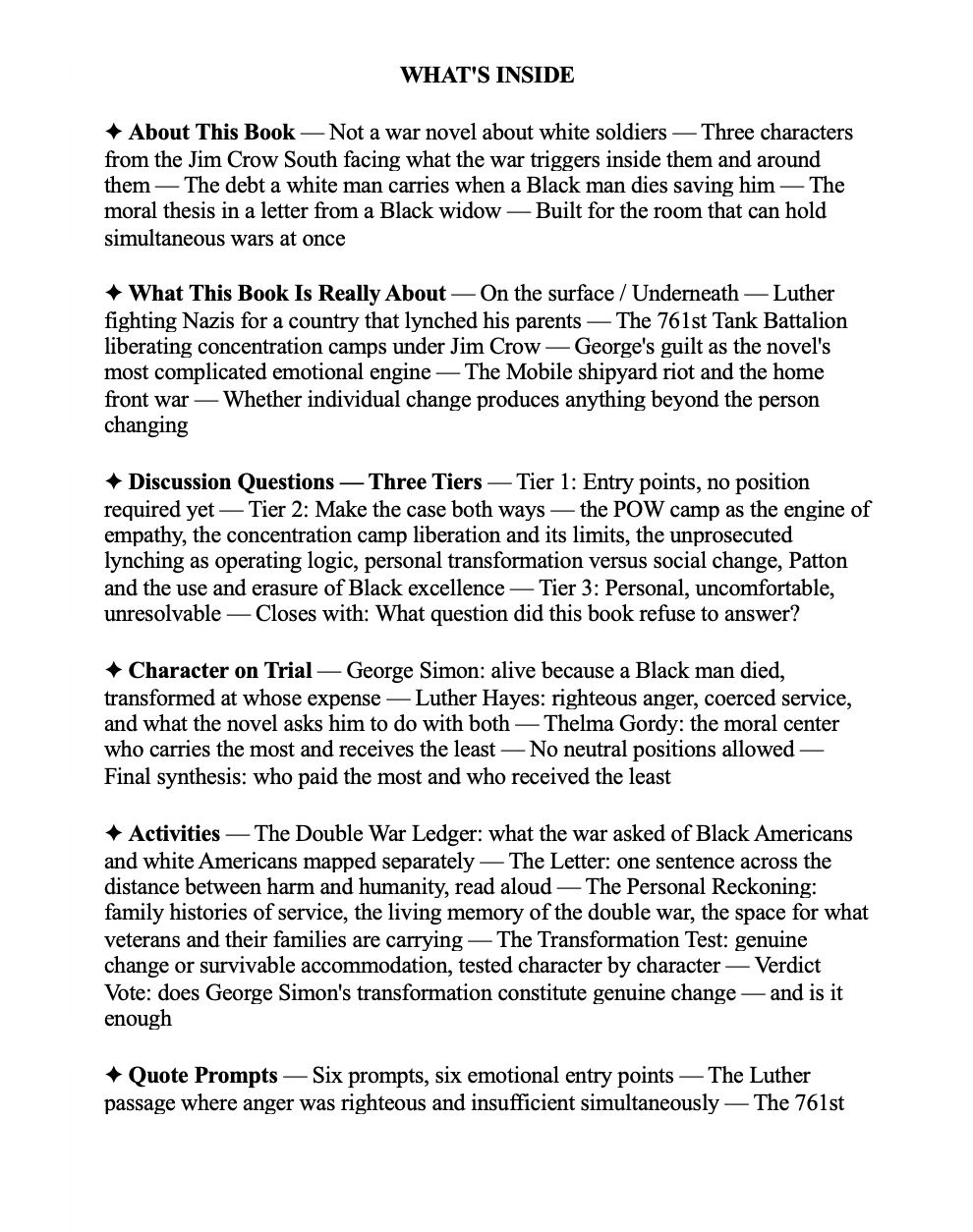
✦ About This Book — Not a war novel about white soldiers — Three characters from the Jim Crow South facing what the war triggers inside them and around them — The debt a white man carries when a Black man dies saving him — The moral thesis in a letter from a Black widow — Built for the room that can hold simultaneous wars at once
✦ What This Book Is Really About — On the surface / Underneath — Luther fighting Nazis for a country that lynched his parents — The 761st Tank Battalion liberating concentration camps under Jim Crow — George's guilt as the novel's most complicated emotional engine — The Mobile shipyard riot and the home front war — Whether individual change produces anything beyond the person changing
✦ Discussion Questions — Three Tiers — Tier 1: Entry points, no position required yet — Tier 2: Make the case both ways — the POW camp as the engine of empathy, the concentration camp liberation and its limits, the unprosecuted lynching as operating logic, personal transformation versus social change, Patton and the use and erasure of Black excellence — Tier 3: Personal, uncomfortable, unresolvable — Closes with: What question did this book refuse to answer?
✦ Character on Trial — George Simon: alive because a Black man died, transformed at whose expense — Luther Hayes: righteous anger, coerced service, and what the novel asks him to do with both — Thelma Gordy: the moral center who carries the most and receives the least — No neutral positions allowed — Final synthesis: who paid the most and who received the least
✦ Activities — The Double War Ledger: what the war asked of Black Americans and white Americans mapped separately — The Letter: one sentence across the distance between harm and humanity, read aloud — The Personal Reckoning: family histories of service, the living memory of the double war, the space for what veterans and their families are carrying — The Transformation Test: genuine change or survivable accommodation, tested character by character — Verdict Vote: does George Simon's transformation constitute genuine change — and is it enough
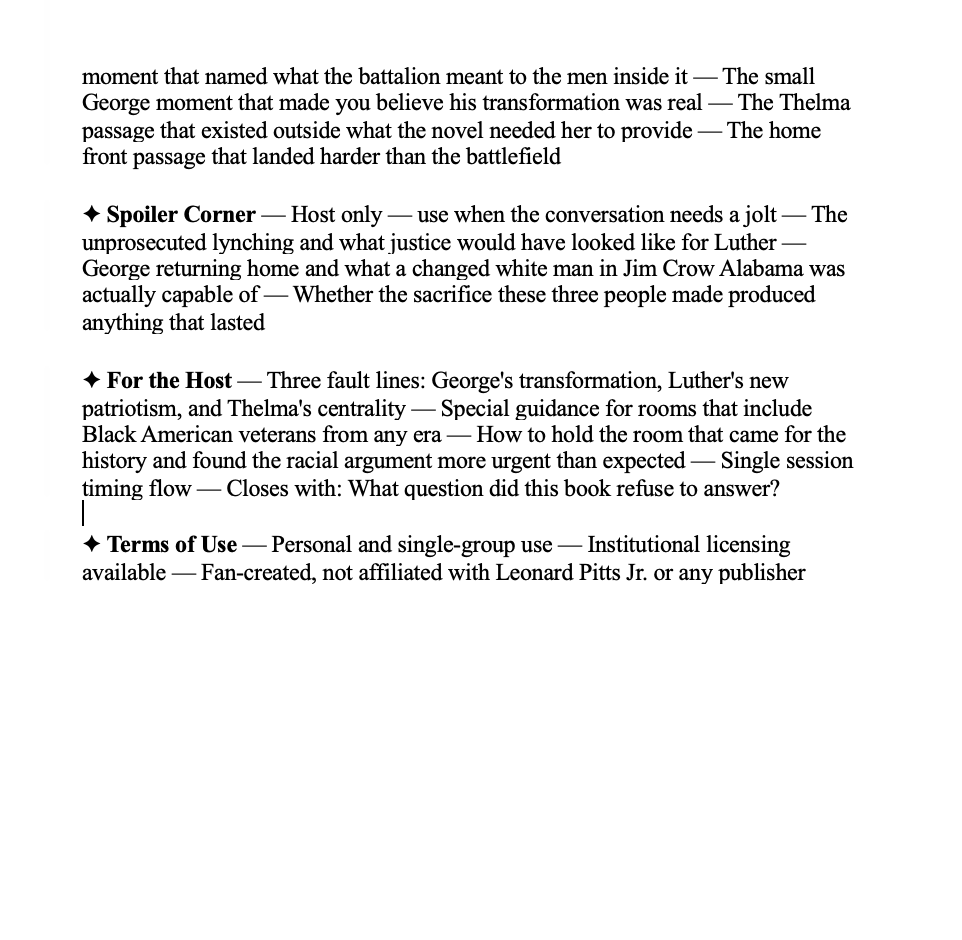
✦ Quote Prompts — Six prompts, six emotional entry points — The Luther passage where anger was righteous and insufficient simultaneously — The 761st moment that named what the battalion meant to the men inside it — The small George moment that made you believe his transformation was real — The Thelma passage that existed outside what the novel needed her to provide — The home front passage that landed harder than the battlefield
✦ Spoiler Corner — Host only — Full knowledge of the entire novel required — The unprosecuted lynching and what justice would have looked like for Luther — George returning home and what a changed white man in Jim Crow Alabama was actually capable of — Whether the sacrifice these three people made produced anything that lasted
✦ For the Host — Three fault lines: George's transformation, Luther's new patriotism, and Thelma's centrality — Special guidance for rooms that include Black American veterans from any era — Timing flow for a single session — How to hold the room that came for the history and found the racial argument more urgent than expected
Details: Instant download — PDF format — Personal and single-group use — Fan-created discussion guide — Not affiliated with or endorsed by Leonard Pitts Jr. or any publisher — Page count: 20+ pages, print-ready
Content note: This guide discusses lynching, racial violence, Japanese POW camp conditions, the Mobile Alabama shipyard race riot, and the liberation of a Nazi concentration camp. These are not incidental to Pitts's argument — they are the argument. Please consider your group's readiness for this material before purchasing.
Licensing for classrooms, libraries, and educational programs is available. If you plan to use this guide for a class, reading program, or institutional setting, please contact the shop owner to arrange an appropriate license.
Red Lip Theology is part memoir, part theology, and entirely testimony. Candice Benbow is building her faith from the fullness of her actual life rather than from the life the church told her she should be living. From the beauty supply store. From Beyoncé. From her queer friends. From her own desire. From her grief. From the red lipstick that Black women have always worn as armor and dignity, and the refusal to be diminished. She is not asking to leave Christianity. She is asking to claim it in its entirety, as a Black woman whose life has been her most honest theological text.
This kit was built for the room that knows exactly what Benbow is talking about. For the woman who is still in the pew and still carrying questions the church never made space for. For the woman who left and is still sorting out what she took with her. For the woman who finished this book thinking about her mother — or her grandmother, or her church mother, or her mentor — and the specific cost that woman paid to pass on faith to her. All three women are in this room. All three deserve space to speak without being managed toward a conclusion.
The discussion will be divided. Not between people who love the church and people who don't — that divide is too simple for what Benbow is doing. It will divide women at different points in their own faith journeys, holding different things from the same institution, with varying levels of peace about what they hold. Both the prosecution and the defense of the Black church are in this kit. Neither is dismissed. The goal is not a verdict. The goal is the honest examination Benbow is modeling — holding up what you were given and deciding consciously what belongs to you.
A note on audience: This guide was written specifically for Black women who have experienced the Black church. It engages Benbow's arguments directly — including her arguments about sexuality, purity culture, and the LGBTQIA+ community — without softening them for a general audience. Please consider your group's readiness for this material before purchasing.
What's Inside:
✦ Content Warning — The shame of unmarried motherhood in the Black church — Sexual shame and purity culture — LGBTQIA+ identity and institutional rejection — Grief and unexpected loss — The specific harm of being told by a faith community that who you are is not acceptable to God
✦ About This Book — Not a systematic theology and not a manifesto — A testimony service in essay form — A mother who kept giving her daughter God through an institution that used God against both of them — The red lip as armor and dignity and the refusal to be diminished — Built for the room that knows exactly what Benbow is talking about
✦ What This Book Is Really About — On the surface / Underneath — The shame asymmetry — the church finds the person it can see and it can always see the woman — What a mother passes to her daughter through a faith that has also hurt her — Grief as the test that reveals what actually holds — The sacred in the spaces the church says God is not
✦ Discussion Questions — Three Tiers — Tier 1: Entry points including the humor that opens what solemnity cannot — Tier 2: Make the case both ways — queer friendships as theological necessity, refusing shame versus building a theology, finding God in secular spaces, grief as teacher or distortion, the difference between what Debra gave and what the church gave — Tier 3: Personal uncomfortable unresolvable — Closes with: What question did this book refuse to answer?
✦ Character on Trial — The Shame of the Unmarried Mother: what the shame was actually protecting and who it was actually serving — The Faith Debra Gave Candice: the same faith grown into fullness or two faiths that share a root but grew in different directions — The Red Lip Theology: permission without direction or the prerequisite for everything else — No neutral positions allowed — Final synthesis: is what Benbow built enough to pass to the next generation the way Debra passed hers to Candice
✦ Activities — The Inheritance Audit: one thing keeping and one thing examining named out loud — The Testimony: one sentence true about your experience of God or the church that the church never made space for read aloud — The Mother: name the woman name the gift name what she paid — The Personal Reckoning: where you are right now in your relationship with the Black church — Verdict Vote: is the faith Debra gave and the faith Candice built the same faith — and is what Benbow built enough to pass on
✦ Quote Prompts — Six prompts six emotional entry points — The passage that made you laugh first and what the laughter opened — The Debra passage where she was most herself — The body passage and what it stirred — The passage where you found God somewhere the church said God was not — The sentence that has stayed with you — The passage that made you think of a specific woman in your life and what she paid
✦ Spoiler Corner — Host only — Full knowledge of the entire book required — What Debra's faithfulness reveals about what she actually believed about God on her own terms — The humor as theological position and as protective distance — Benbow's ending as invitation versus what the church owes the women who kept showing up
✦ For the Host — Three fault lines: where each woman is in her relationship with the church the mother thread and the LGBTQIA+ argument — Special guidance for rooms still fully inside the church — Special guidance for rooms that have largely left — The Testimony as the great equalizer — Timing flow for a single session
Details: Instant download — PDF format — Personal and single-group use — Fan-created discussion guide — Not affiliated with or endorsed by Candice Marie Benbow or any publisher — 20+ pages print-ready
Content note: This guide discusses the shame of unmarried motherhood in the Black church, sexual shame and purity culture, LGBTQIA+ identity and institutional rejection, and grief and unexpected loss. This guide was written specifically for Black women who have experienced the Black church. Please consider your group's readiness for this material before purchasing.
Licensing for classrooms, seminaries, and faith community programs is available. If you plan to use this guide for a class ministry program or institutional setting, please contact the shop owner to arrange an appropriate license.
This kit was built for the room that finished Red Lip Theology and needed somewhere to put everything the book left in them. It was built for the conversation that starts with what the church cost the women who kept showing up and ends somewhere none of you expected.
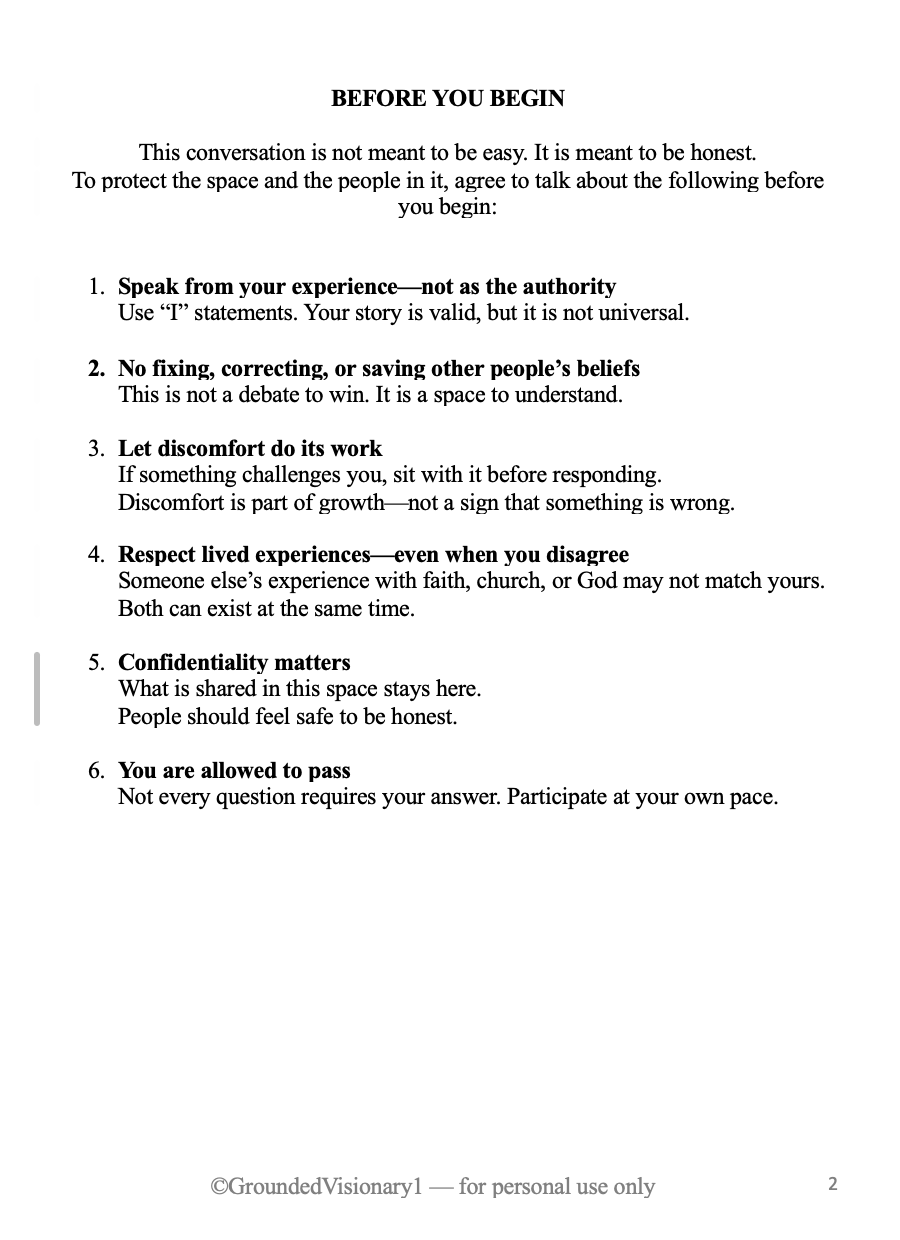
This discussion guide was created for readers of The Day God Saw Me as Black who want to go beyond reflection and into real conversation.
This is not a summary.
This is not a checklist.
This is a structured, thought-provoking experience designed to help individuals and groups wrestle with:
Faith and identity
The role of the Black church
Purity culture and body autonomy
Lived experience vs. traditional theology
What it means to be fully seen by God
Whether you agreed with the book, wrestled with it, or felt challenged by it, this guide gives you the space to process it honestly.
WHAT MAKES THIS GUIDE DIFFERENT
Most discussion guides ask what you think.
This one asks you to examine why you think it.
Inside, you’ll find:
✔ Tiered discussion questions (from accessible → deep → personal)
✔ “Make the case both ways” prompts to encourage real dialogue
✔ “On Trial” sections that challenge systems, not just ideas
✔ Guided activities for reflection, honesty, and group connection
✔ Space for both agreement and disagreement—without shutting either down
This is designed for real conversations—not polite ones.
WHAT’S INCLUDED
30+ pages of structured discussion content
3 levels of discussion questions
Character/System “On Trial” debates
Guided group activities (including The Inheritance Audit)
Reflection prompts and quote exploration
Host facilitation notes (for leading meaningful conversations)
WHO THIS IS FOR
This guide is ideal for:
Book clubs ready for deeper conversations
Women’s groups navigating faith and identity
Readers processing church experiences (past or present)
Anyone engaging with deconstruction, theology, or cultural critique
Facilitators who want structure—not guesswork
HOW TO USE
Use individually for personal reflection
Use in small groups or book clubs
Use in ministry or discussion settings
Use at your own pace—this is not meant to be rushed
IMPORTANT NOTE
This guide engages topics such as:
Church harm and spiritual tension
Purity culture and body autonomy
Identity, race, and theology
It is designed to create space for honest conversation—not to tell you what to believe.
This is more than a printable.
This is a guided conversation experience designed to be revisited, reused, and explored over time.
f you’re ready for a conversation that goes beyond surface-level discussion—
Add this guide to your reading experience.
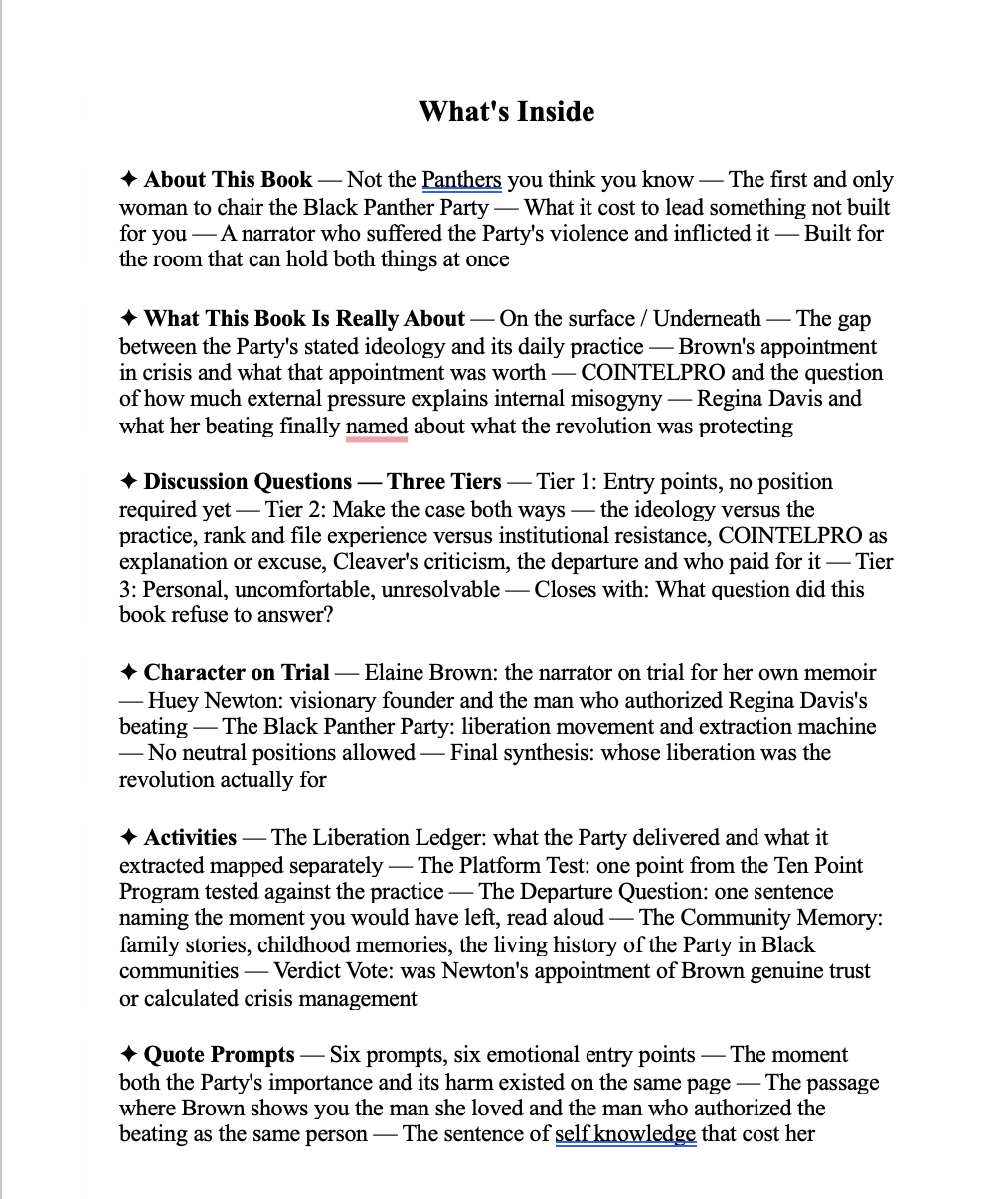
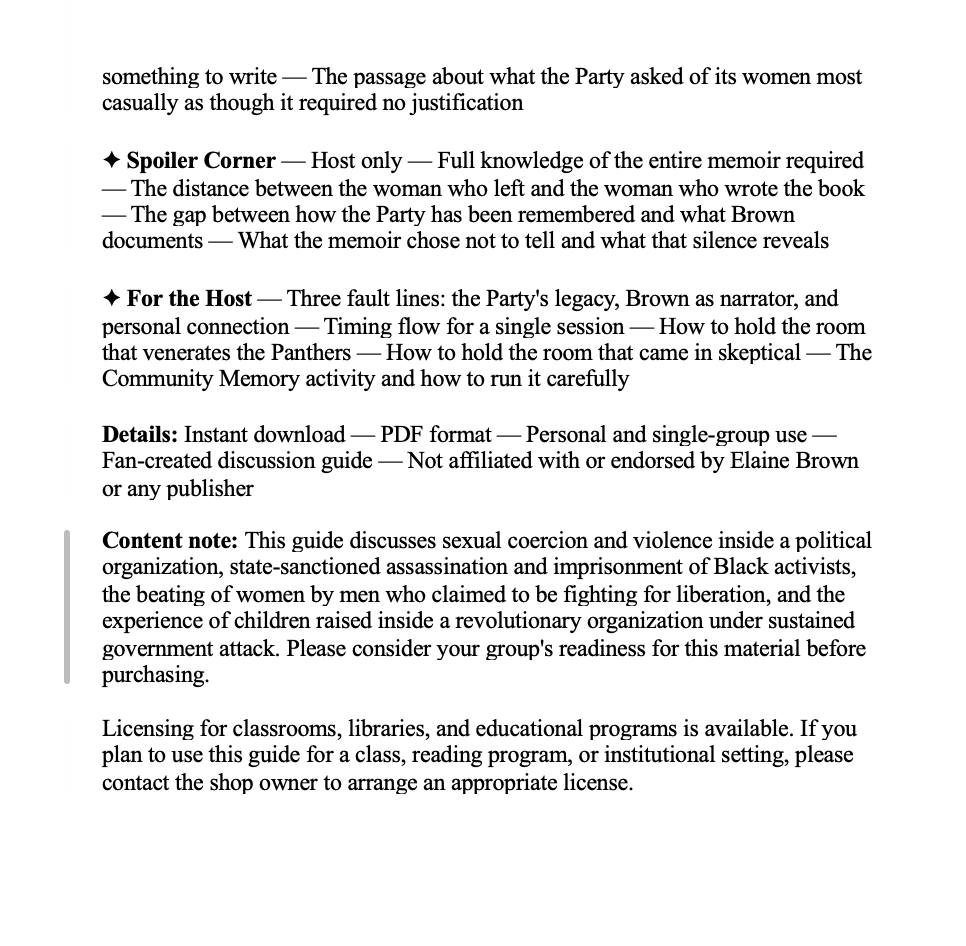
Elaine Brown walked into the Black Panther Party's general assembly in August 1974 and announced her leadership with these words: "I have all the guns and all the money. I can withstand challenge from without and from within. Am I right, Comrade?" She was the first and only woman to chair the Black Panther Party. She would lead it for three years. And she would leave by grabbing her daughter and disappearing — not because the revolution failed but because a woman was beaten for having authority over a man and Huey Newton authorized it and that was the end.
This is not a book about the Black Panther Party the way most people understand the Black Panther Party. It is a book about what it cost to be inside that organization. What it cost to be a woman in a movement that said it believed in liberation while demanding that its women cook, clean, raise children they couldn't spend time with, and accept that a woman who asserted authority was eroding Black manhood. What it cost to rise to the top of that organization and lead it effectively — founding schools, winning mayoral campaigns, expanding community programs — while being told at every level that her leadership was an insult to the men around her.
Brown is not a simple narrator and this kit does not treat her as one. She both suffered the Party's violence and inflicted it. She stayed longer than many readers will think she should have. She left in a way that had costs for the women who remained. The room this kit was built for can hold all of that simultaneously — the genuine importance of what the Black Panther Party built and the genuine harm it did to the women who built it alongside the men whose names history attached to it.
This discussion is going to divide. Every room that reads this memoir eventually has to decide what to do with a revolutionary organization that believed in liberation for some people and extracted the rest. Both positions are in this kit. Neither is dismissed. The goal is not to reach a verdict on the Black Panther Party. The goal is to hold it accountable and understand it at the same time — which is exactly what Brown asks of her readers and exactly what the best book club conversations do.
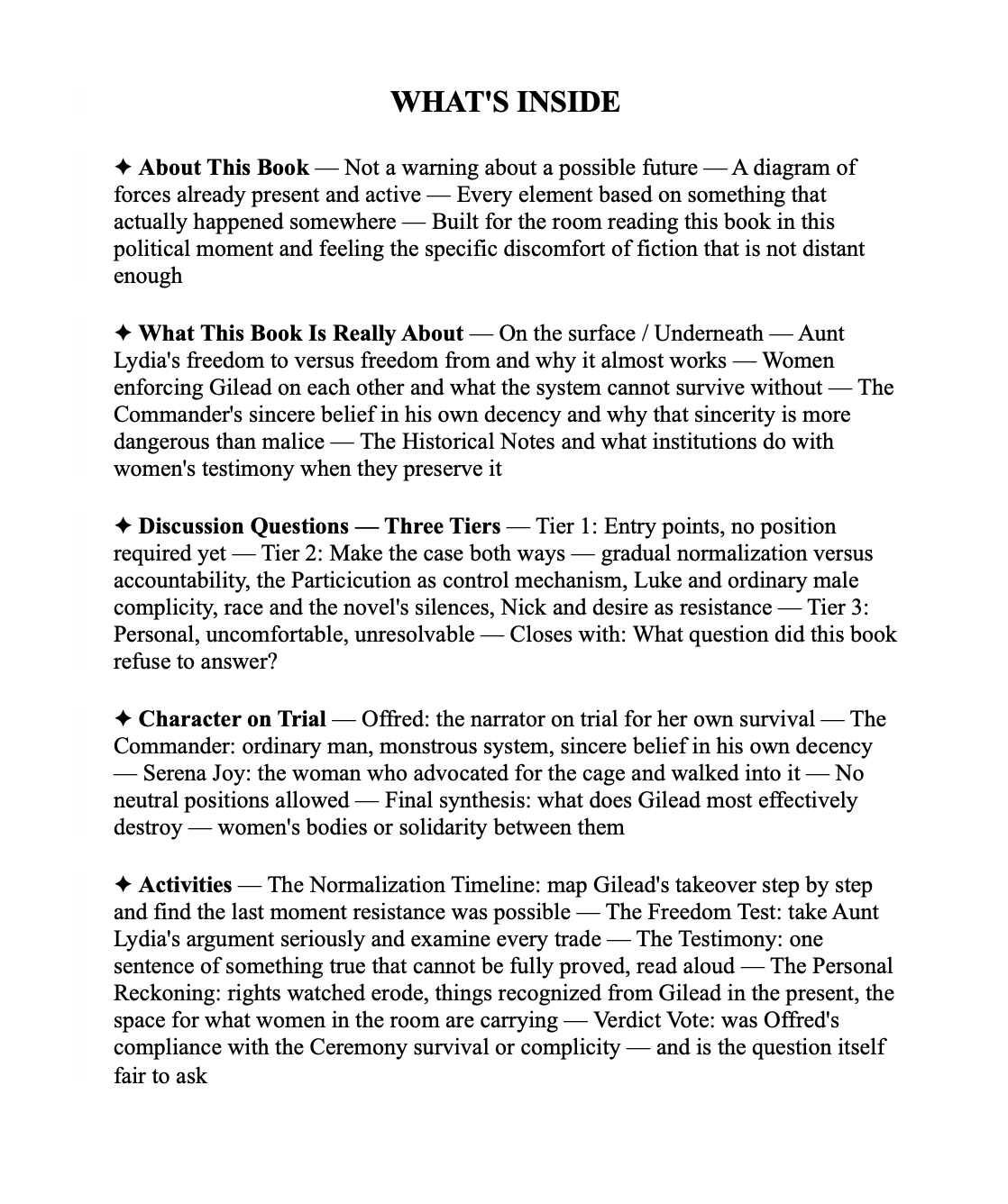
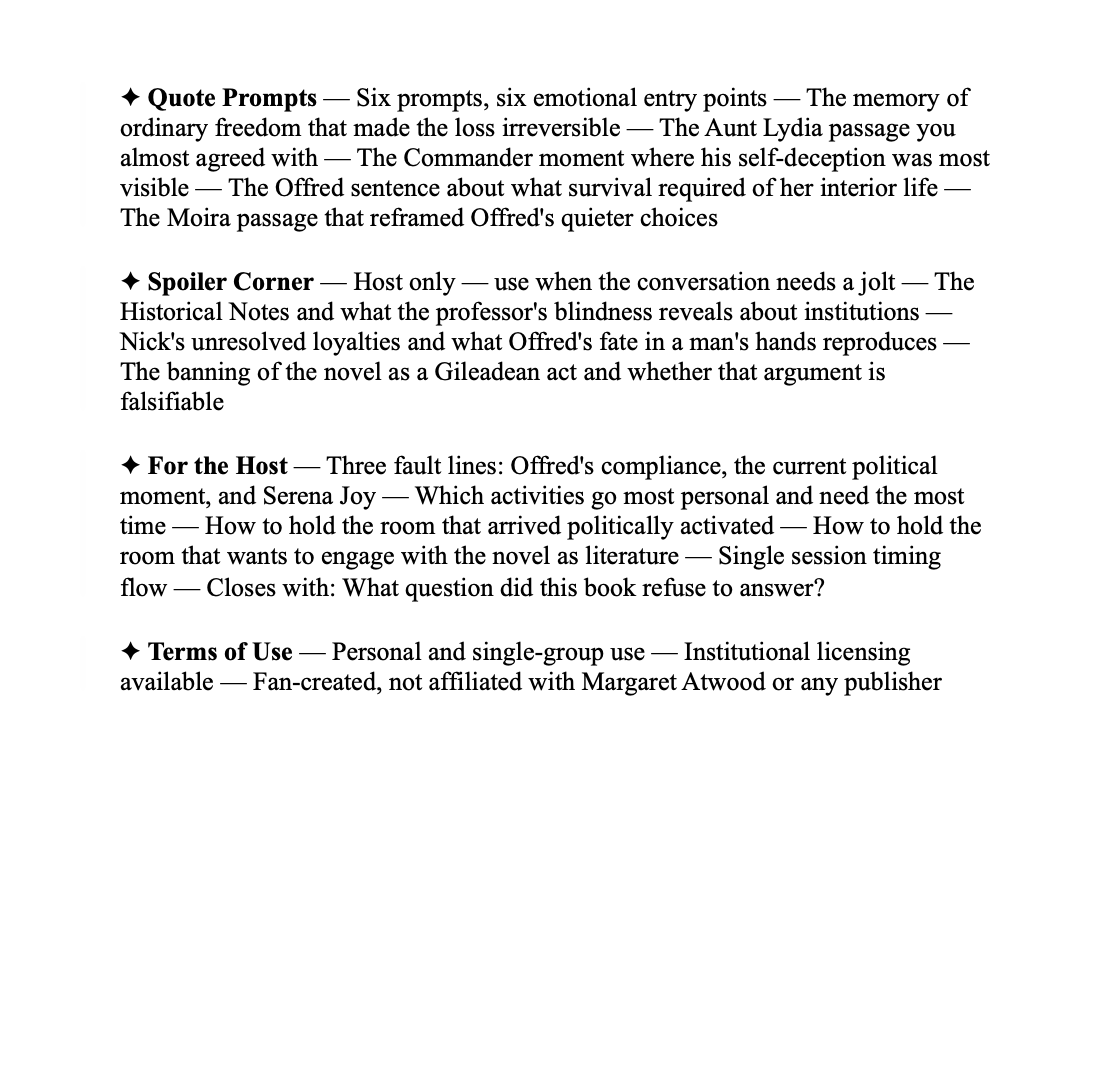
Margaret Atwood wrote this novel in 1985 and carried newspaper clippings to every interview about it. Not because she was proud of the research. Because she needed people to understand that she had not invented anything. Romania's Ceausescu forced women to undergo monthly pregnancy tests. Iran's Islamic revolution reduced women's rights overnight. American slavery's apparatus — the auctions, the assignments, the breeding, the complete legal erasure of personhood — is directly present in Gilead's structure. Atwood's point was not that a society like Gilead could happen. Her point was that it already had — in pieces, in different places, across different centuries — and that the pieces were all still available.
This kit was built for the room reading this book right now in this political moment and feeling the specific discomfort of fiction that is not distant enough. Not the room that wants to be reassured that Gilead is safely fictional. The room that is sitting with the specific unease of a novel that keeps finding new urgency because the forces it diagrams are present and active — the gradual erosion of rights described as protection, the use of religion as a vehicle for power, the women who enforce systems that harm them in exchange for relative safety, and the men who build monstrous things while maintaining a sincere and unshakeable belief in their own decency.
The discussion in this room will divide. Every room that reads this novel eventually has to decide what to think about Offred — a narrator who survives by compliance, who takes small pleasures from the man who rapes her monthly, who has an affair with a man she cannot fully trust, and who tells you she may be constructing her own story. Both the prosecution and the defense of her choices are in this kit. Neither is dismissed. The goal is not to reach a verdict on Offred. The goal is to ask what survival looks like from the inside of a totalitarian system — and whether the question itself is fair to ask of her.

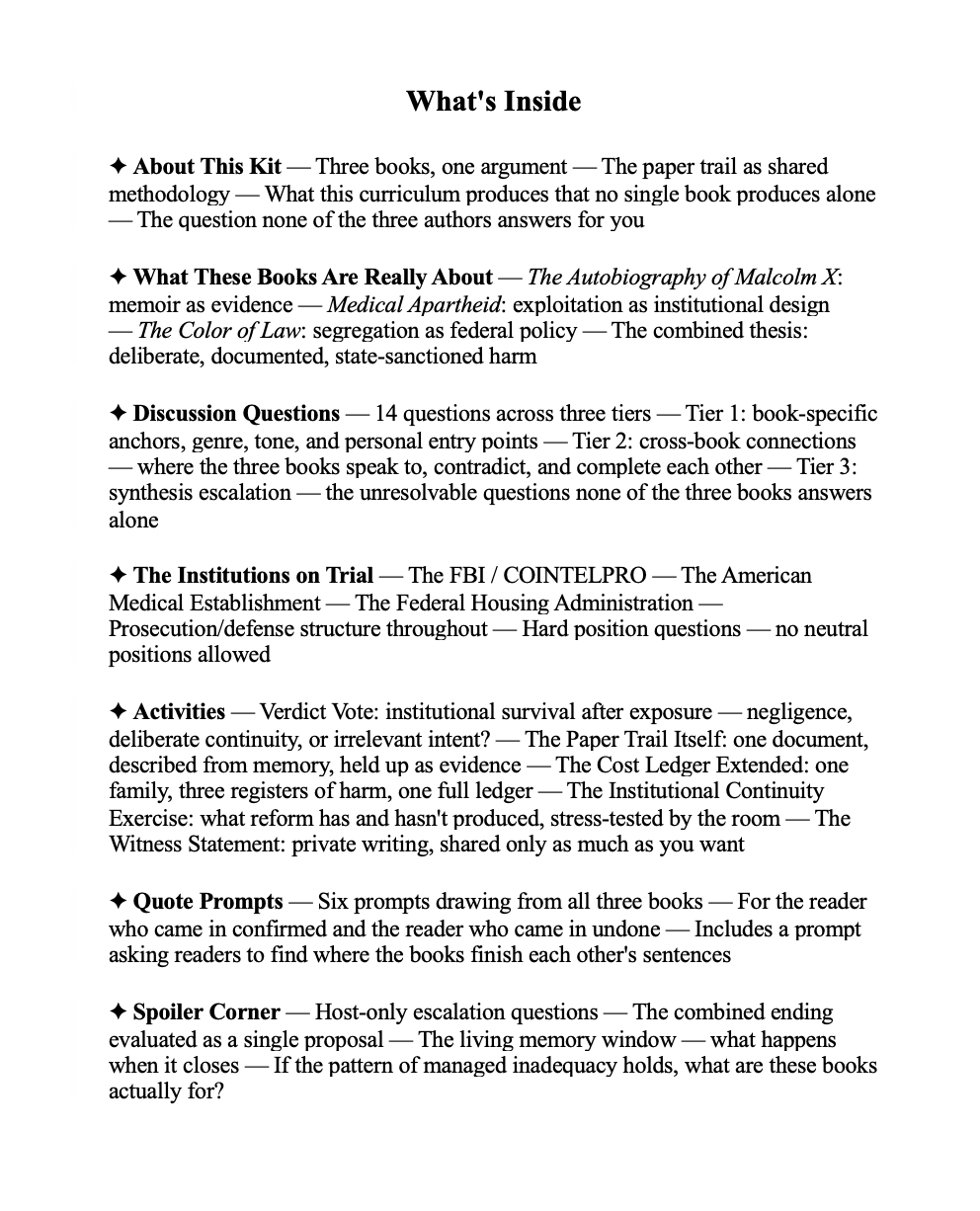
Three books. Three different genres. One continuous argument: the American government — its law enforcement apparatus, its medical institutions, its housing agencies — enacted deliberate, documented harm against Black Americans. Not in a distant past requiring reconciliation. In living memory. With files still in the archives.
The Autobiography of Malcolm X gives you a sense of the surveillance state through one man's extraordinary life. Medical Apartheid gives you four centuries of medical exploitation, documented case by case, institution by institution. The Color of Law gives you the federal paper trail that engineered residential segregation and called it private choice. Read individually, each book makes a complete argument. Read together, they become something none of them is alone: a full prosecution of the American state's deliberate, coordinated, ongoing project of harm — and the question of what we are supposed to do with the fact that it happened.
This kit was built for readers who finished all three books and felt the argument accumulating into something larger than any single volume could contain. It treats these books as a curriculum — cross-book discussion questions that move between all three institutions put on trial, and activities designed to bring the argument out of the archive and into the room.
What's Inside:
✦ About This Kit — The paper trail as shared methodology, and what this curriculum produces that no single book can produce alone
✦ What These Books Are Really About — Book-specific anchors for all three, plus the combined thesis that emerges when they're read together
✦ Discussion Questions — 14 questions across three tiers, from book-specific entry points to the cross-book connections to the unresolvable questions none of the three authors answers alone
✦ The Institutions on Trial — The FBI/COINTELPRO, the American Medical Establishment, and the Federal Housing Administration — prosecution/defense structure, hard positions required, no neutral stances allowed
✦ Activities — Verdict Vote, The Paper Trail Itself, The Cost Ledger Extended, The Institutional Continuity Exercise, and The Witness Statement (private writing, shared only as much as you want)
✦ Quote Prompts — Six prompts drawing from all three books, including one that asks readers to find where the books finish each other's sentences
✦ Spoiler Corner — Host-only escalation questions, including: if the pattern of managed inadequacy holds, what are these books actually for?
✦ For the Host — Facilitation notes for a three-book curriculum, timing flow, and a good host note for two very different kinds of rooms
Details: — Instant download PDF, print-ready — 20+ pages — Personal and single-group use — Fan-created guide, not affiliated with or endorsed by any of the authors or their publishers — Individual discussion guides for The Autobiography of Malcolm X, Medical Apartheid, and The Color of Law are also available separately in the shop
Licensing for classrooms, libraries, and educational programs is available. If you plan to use this guide for a class, reading program, or institutional setting, please contact the shop owner to arrange an appropriate license.
This kit was built for the room that finishes all three books and doesn't know what to do with what they now know — together. That's not a comfortable place to be. It's exactly the right place to start.
A deep dive into how government policy quietly—and intentionally—shaped segregation in America.
Residential segregation was not an accident. It was not the result of private prejudice or individual choices made by millions of people over generations. It was the explicit, documented policy of the United States federal government — and Richard Rothstein has the paper trail to prove it.
The Color of Law is not a polemic. It is a prosecution. Rothstein builds his argument the way a lawyer builds a case — policy by policy, agency by agency, map by map — and by the time he's done, the question is no longer whether this happened. The question is what obligation that history creates in the present. That question is harder. This kit was built to help a room sit with it together.
This guide was built for both rooms — the reader who finishes this book confirmed and the reader who finishes it undone — because the most productive conversation happens when both are present at the same time.
✦ About This Book — why this is a prosecution, not a polemic, and what makes it relentless
✦ What This Book Is Really About — de facto vs. de jure segregation, the wealth-building moment Black families were locked out of, and the accountability question Rothstein refuses to resolve for you
✦ Discussion Questions — 14 questions across three tiers, from personal entry points to the unresolvable questions the book plants and walks away from
✦ Character on Trial — the FHA, FDR, the White Suburban Beneficiary, and the Supreme Court; prosecution/defense structure, hard positions required, no neutral stances
✦ Activities — Verdict Vote, The Cost Ledger, The Map Exercise, The Remedy Room, and The Beneficiary Inventory
✦ Quote Prompts — six prompts covering the reader who came in knowing the history and the reader who didn't
✦ Spoiler Corner — host-only escalation questions including putting Rothstein's own restraint on trial
✦ For the Host — facilitation notes, timing flow, and guidance for two very different kinds of rooms
Details: Instant download. PDF delivered immediately after purchase. 20+ pages, print-ready. Personal and single-group use. Fan-created — not affiliated with Richard Rothstein or his publisher.
For classrooms, libraries, and educational programs — contact the shop for institutional licensing.
Built for the room that finishes The Color of Law and doesn't know what to do with what they now know. That's not a comfortable place to be. It's exactly the right place to start.
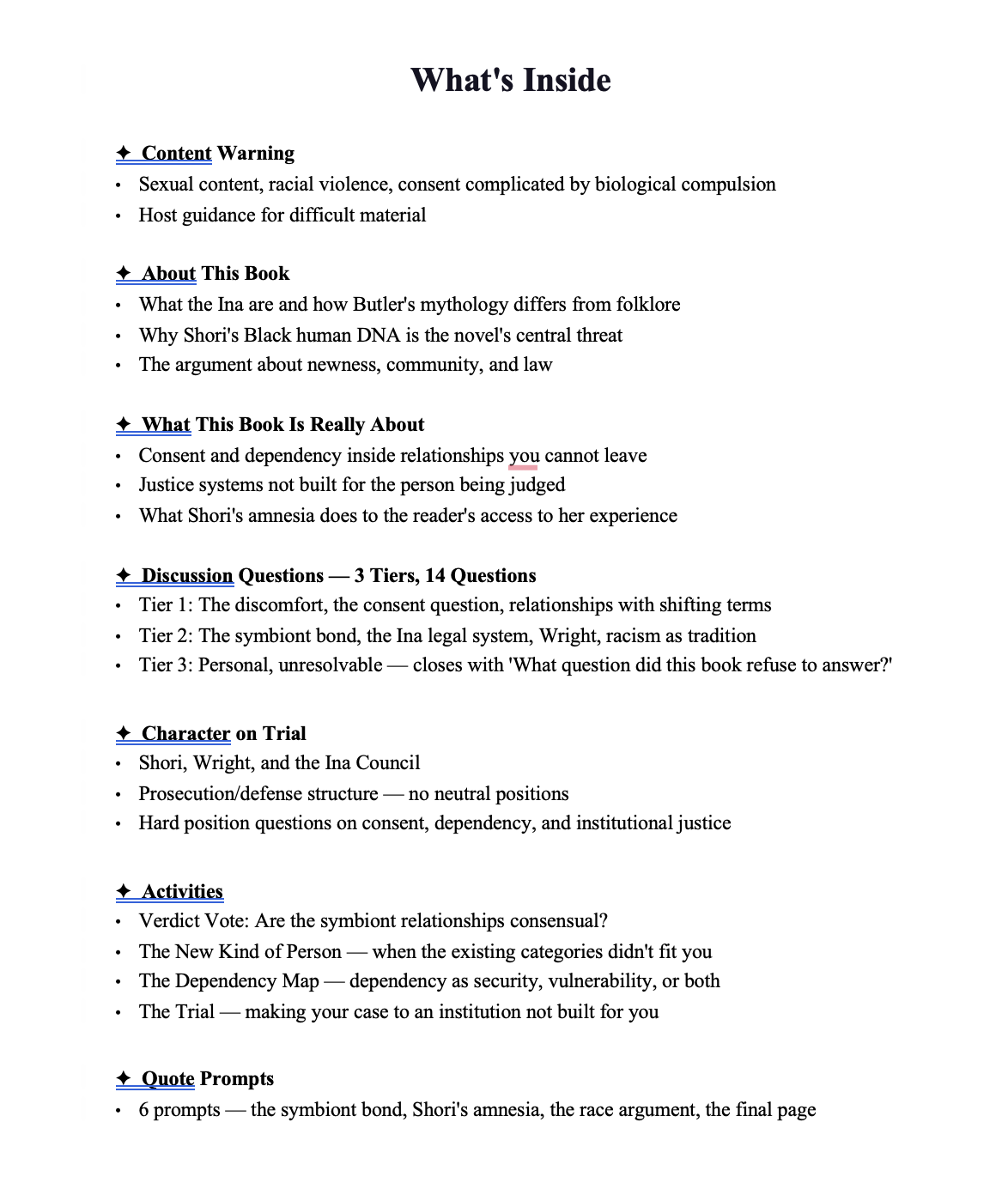
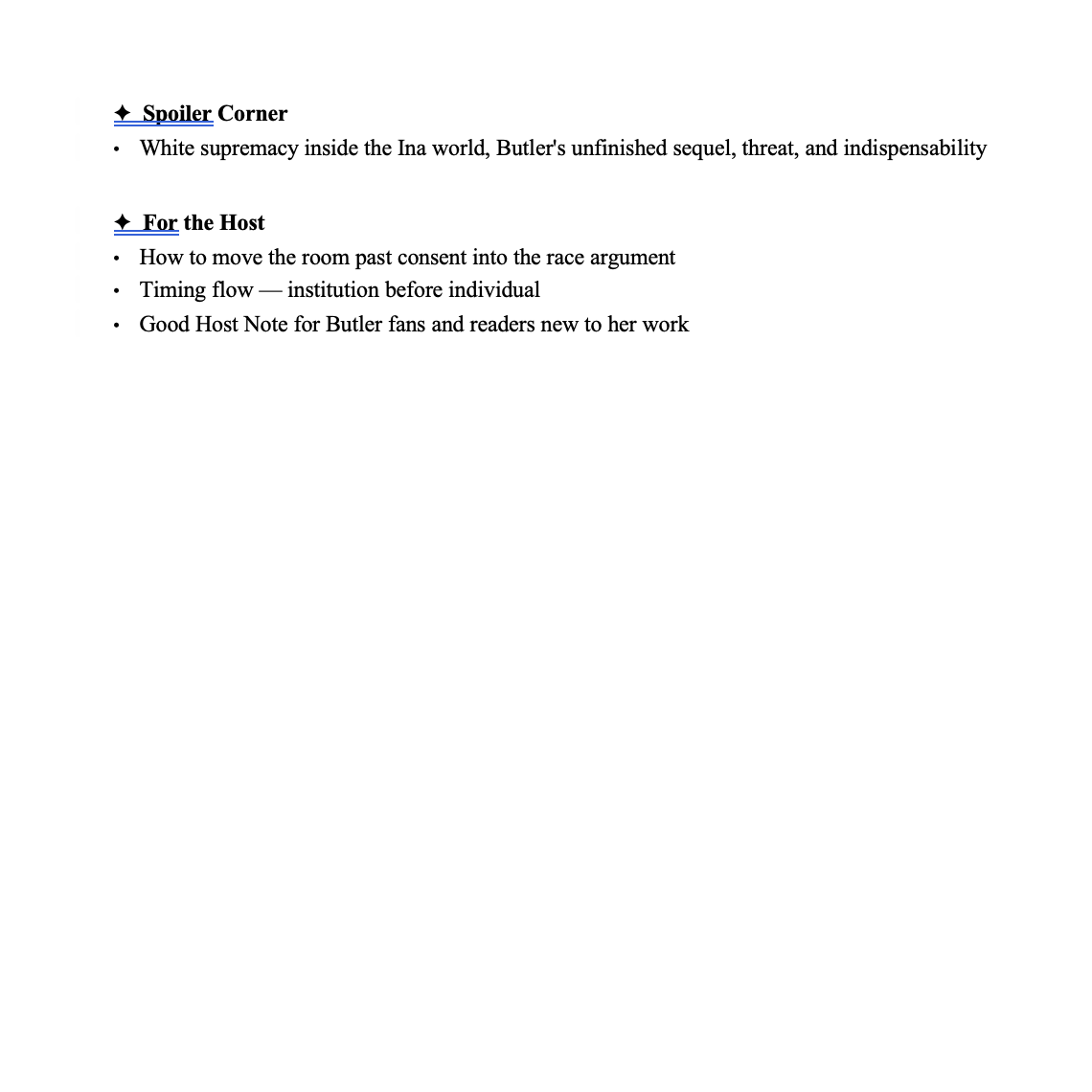
Shori wakes up with no memory, a body that appears to be a ten-year-old girl's, and a hunger she doesn't understand. She is actually 53 years old — a member of an ancient species that bonds with humans for survival. Those bonds are biological, addictive, and for the human, fatal to break. Butler does not frame this as horror. She frames it as a question: what is consent when you cannot survive refusing?
Fledgling is one of Butler's most argued-over novels — not because of the violence, but because she builds a world where the relationship you cannot escape is also the one both parties say they want. Running underneath it is a second argument: Shori's Black human DNA gives her an ability the ancient Ina community wants to destroy, and the institution delivering judgment on her case was never built to protect someone like her. Butler's deepest argument is not about vampires. It's about who a community's laws were written to hold — and who they leave out by design.
This guide puts all of it on the floor. The consent question, the race argument, the Ina legal system itself. It does not resolve what Butler refused to resolve. It gives your group the structure to argue it properly.
✦ Content Warning — sexual content, racial violence, consent complicated by biological compulsion; host guidance included
✦ About This Book & What This Book Is Really About — the Ina mythology, Shori's Black human DNA as the novel's central threat, and Butler's argument about institutions and newness
✦ Discussion Questions — 14 questions across 3 tiers; one question per tier draws from readers' own experience
✦ Character on Trial — Shori, Wright, and the Ina Council; no neutral positions, prosecution/defense structure, hard position questions on consent and institutional justice
✦ Activities — Verdict Vote on the symbiont relationships, The New Kind of Person, The Dependency Map, and The Trial
✦ Quote Prompts — 6 prompts covering the symbiont bond, Shori's amnesia, the race argument, and the final page
✦ Spoiler Corner — host-only escalation questions on white supremacy inside the Ina world and Butler's unfinished sequel
✦ For the Host — how to move the room past consent into Butler's deeper argument; timing flow; guidance for Butler fans and readers new to her work
Details: Instant download. PDF delivered immediately after purchase. 20+ pages, print-ready. Personal and single-group use. Fan-created — not affiliated with the estate of Octavia E. Butler or her publisher.
For classrooms, libraries, and educational programs — contact the shop for institutional licensing.
Built for the room that wants to argue about what Butler was actually doing — not just what happened in the book, but what she was saying about who institutions are built to protect.
Will Smith has spent decades being the most likable man in the room. Will is the book where he stops performing that and starts asking why he needed to in the first place.
This is not a highlight reel memoir. It goes into his father's violence and the patterns Will inherited without knowing it. It goes into the women he loved and tried to reshape. The friendships that ended quietly, with no explanation — just gone. The fear underneath every ambition. The therapy, the ego, the long slow work of learning to actually feel something instead of producing a feeling for an audience. He narrates the audiobook himself, and that precision matters — this reads less like a product and more like a confession that took decades to be ready for.
The questions this book raises — about whether self-awareness changes behavior or just describes it more articulately, about what we inherit from people who hurt us, about what it costs to maintain an image for thirty years — don't get answered cleanly. Your book club gets to finish that work.
✦ About This Book — what this memoir appears to be versus what it's actually doing
✦ What This Book Is Really About — four threads worth following: inherited violence, ambition rooted in fear, the cost of a performed identity, and what late healing actually looks like
✦ Discussion Questions — three tiers built specifically for this book, from warmup through the questions that go somewhere uncomfortable
✦ Character on Trial — Will Smith, Willard Sr., and James Lassiter examined without neutral positions
✦ Activities — Verdict Vote on Willard Sr.'s choice to stay, Performance Audit, Inheritance Inventory, and Ambition Autopsy
✦ Quote Prompts — seven prompts covering the childhood home, the fear, the women, the father material, and the moment the book didn't know it was building toward
✦ Spoiler Corner — host-only escalation questions including who is missing from this book and what their version would sound like
✦ For the Host — facilitation notes, timing flow, and guidance for two different kinds of rooms
Details: Instant download. PDF delivered immediately after purchase. 20+ pages, print-ready. Personal and single-group use. Fan-created — not affiliated with Will Smith or his publisher.
For classrooms, libraries, and educational programs — contact the shop for institutional licensing.
Built for readers who finished this book wondering whether the peace he found at the end actually holds.
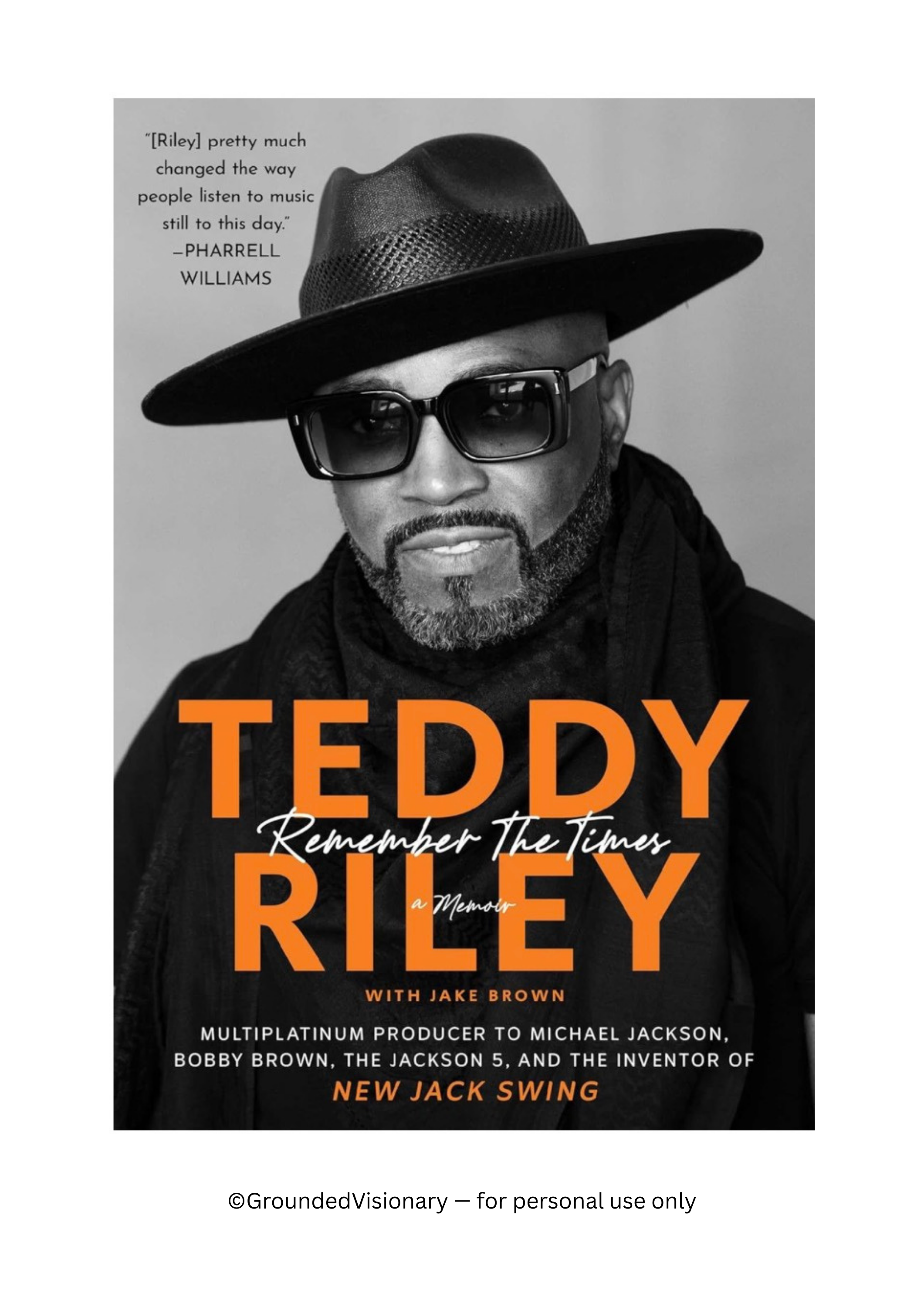
Teddy Riley didn't just make records. He made the sound of an era — New Jack Swing, Guy, Blackstreet, Michael Jackson, the Neptunes before you knew who the Neptunes were. The career is undeniable. The memoir is something more complicated. It tells you almost everything about what he built and not nearly enough about what it cost.
That gap is where the conversation is.
This kit was written for readers who finished Remember the Times with real questions — about credit and ownership, about what the music industry has always done to Black artists specifically, about what it means when a man writes a whole book about his life and still keeps the door mostly closed. The industry history lands. The personal story stays at a distance. Your book club gets to decide what that means and why.
✦ About This Book — context for what this memoir delivers and what it deliberately avoids
✦ Discussion Questions — 14 questions in three tiers, from warmup through the conversations that go somewhere
✦ Quote Prompts — 5 prompts to help every reader find their own moment to bring to the table
✦ Activities — 4 group activities including The Credit Conversation, The Memoir Contract, The Industry Autopsy, and the Verdict Vote
✦ Spoiler Corner — host-only escalation questions for groups that finished and want to go further
✦ For the Host — facilitation notes including specific guidance on the music industry and race conversation, which will go deep fast
Details: Instant digital download. PDF delivered immediately after purchase. Personal and single-group use. Fan-created. Not affiliated with Teddy Riley, Jake Brown, or the publisher.
For classrooms, libraries, and educational programs — contact the shop for institutional licensing.
Built for book clubs, R&B fans, music industry watchers, and anyone who has ever watched someone else take credit for their work.
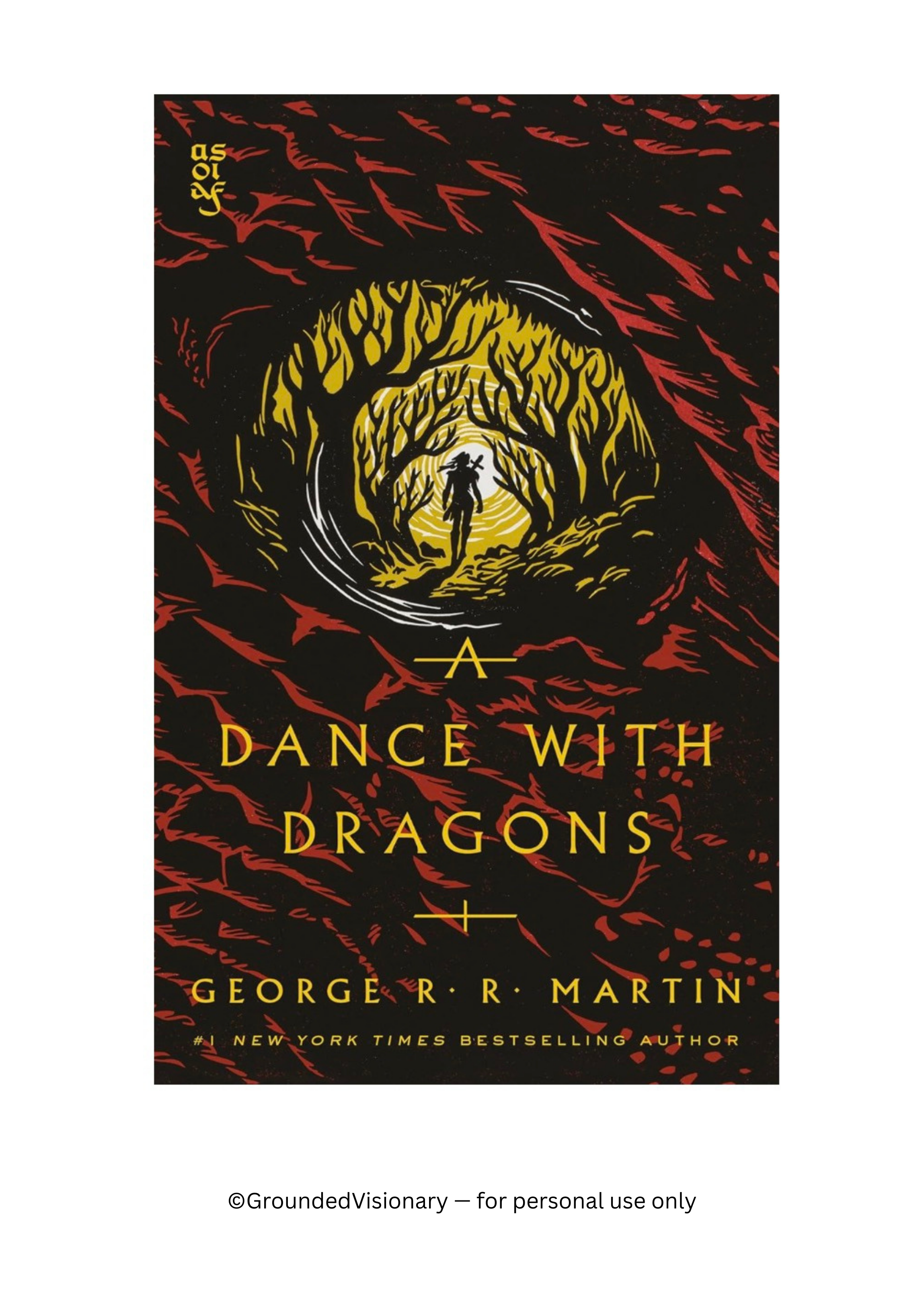
This is the book where the series goes internal.
No more sprawling battles. No more clear sides. A Dance with Dragons is the weight of leadership, the cost of identity, and an existential threat that five books of characters keep finding reasons to ignore. After the Red Wedding, after Cersei's spiral, after everything A Feast for Crows named about what power looks like in the aftermath — this book asks the question none of the characters want to answer: what are you, exactly, when the role you were given and the person you actually are stop being the same thing?
Theon Greyjoy's arc in this book is one of the most devastating things Martin has written — a man dismantled so completely that reconstructing who he was before requires active archaeology. Jon Snow is trying to hold the Wall against an enemy nobody south of it will take seriously, making decisions that cost him the loyalty of the people he needs most. Daenerys is learning that conquering and governing are entirely different skills and she has only one of them. Bran is becoming something the series has not yet named. And the White Walkers are still coming and five books in nobody with actual power is doing anything about it.
This kit was built for the room that finished A Dance with Dragons and has things to say about all of it. Not just the ending. All of it.
✦ What's Inside
✦ About This Book — What makes Book 5 different from everything before it — Why the internal turn is the point not the problem — What this book is actually arguing about identity and leadership
✦ What This Book Is Really About — Identity under pressure — who you are when the role you were given stops fitting — The loneliness of leadership — what it costs to make decisions nobody else will make — An existential threat everyone keeps deferring — and what that says about how humans actually respond to slow catastrophe — What five books of White Walker buildup adds up to if the payoff never comes
✦ Discussion Questions — Three Tiers — Tier 1: Warmup questions to get everyone talking — Tier 2: Questions requiring a position and a defense — Jon's decisions, Daenerys's dilemma, Theon's arc, the threat nobody is watching — Tier 3: Questions that go personal and don't resolve cleanly — Closes with: What question did this book refuse to answer?
✦ Where This Book Leaves You — Series progression questions — where does A Dance with Dragons leave the series — What Jon's ending means — What five books of White Walker buildup adds up to if the remaining books never deliver the payoff
✦ Character on Trial — Theon Greyjoy, Jon Snow, Bran Stark, Daenerys Targaryen — Prosecution/defense structure — Hard position questions with mandatory reversal — No neutral positions allowed
✦ Activities — The Identity Question: map what each major character in this book believes about who they are versus what the evidence actually shows — The Conqueror's Dilemma: make the case that Daenerys's governing failures are inevitable given what she was trained for — then make the case that they're choices she's still making — The Threat We're Not Watching: why five books of characters keep deferring the White Walker threat — and whether that pattern feels familiar outside of Westeros — Verdict Vote: one major decision — Ethical / Unethical / Understandable but wrong
✦ Quote Prompts — Five prompts to help you find the passage worth bringing to the meeting — The moment the internal turn landed hardest — The passage about Theon you're still sitting with
✦ Spoiler Corner — Host only — use when the conversation needs a jolt
✦ For the Host — Facilitation notes and timing flow — The one thread your group will want to skip that you absolutely shouldn't let them — How to hold the room when the unfinished series becomes the conversation
Details — Instant download PDF — Personal and single-group use. No redistribution or resale. — Fan-created guide. Not affiliated with or endorsed by George R.R. Martin, his estate, or any publisher. — Part of the GroundedVisionary ASOIAF Book Club Series — guides for all five books available in the shop. — This kit works best for groups who have read all five books as questions reference events across the full series.
Licensing for classrooms, libraries, and educational programs is available. If you plan to use this guide for a class, reading program, or institutional setting, please contact the shop owner to arrange an appropriate license.
A Feast for Crows is the book that divides ASOIAF readers. Half find the slower pace frustrating — they wanted the war, they got the aftermath. The other half call it the most honest book in the series about what power actually looks like when the noise dies down and you have to figure out what you were fighting for. Both rooms are right. Both rooms need this kit.
This is the book where Martin turns the camera away from the battlefield and points it at the people who survived. What he finds there is not reassuring. Cersei Lannister gets a POV chapter for the first time — and what you discover is that the woman who has been the series' most calculating villain is also capable of spectacular self-deception. Sansa is learning to play the game from the most dangerous teacher available and the book refuses to tell you whether that's survival or corruption. The Tyrell women are doing what the Tyrell women have always been doing and this book finally lets you watch them do it.
The real conversation A Feast for Crows generates is about power in the aftermath — what it looks like when there's no war to organize around, who fills the vacuum, and what the people who spent five books surviving have actually become in the process.
This kit was built for the room that has strong feelings about Cersei, about Sansa, about whether this book earned its pacing. It gives all of that somewhere to go.
✦ What's Inside
✦ About This Book — The war is over and now you have to govern — What the camera finds when Martin points it at the survivors — Why this book divides the series' readers — and why both sides are right
✦ What This Book Is Really About — Cersei's spiral and what her POV chapters reveal about the distance between intelligence and self-awareness — The Tyrell women — what they've always been doing and what it looks like when you finally get to watch — Sansa's slow awakening — survival or corruption, and whether the book thinks those are different things — What power actually looks like when the noise dies down
✦ Discussion Questions — Three Tiers — Tier 1: Warmup questions to get the room talking — Tier 2: Questions that ask readers to take and defend specific positions on Cersei, Sansa, and power in the aftermath — Tier 3: The questions that tend to split rooms and generate real debate — Closes with: What question did this book refuse to answer?
✦ Where This Book Leaves You — Series progression questions connecting Book 4 to where the series is heading — What the survivors have become — and whether the series can recover from naming it
✦ Character on Trial — Cersei Lannister, Sansa Stark, Margaery Tyrell — Prosecution/defense structure — Hard position questions with mandatory reversal — No neutral positions allowed
✦ Activities — The Cersei Case File: map the gap between what Cersei believes about herself and what the evidence in this book actually shows — Power Without a Title: name every character in this book who holds real power without an official claim to it — then ask what that reveals about how power actually works in Westeros — Sansa's Ledger: what Sansa has gained from Littlefinger's training and what it has cost her — and whether the book thinks she knows the difference — Verdict Vote: one major decision — Ethical / Unethical / Understandable but wrong
✦ Quote Prompts — Come to your meeting with one moment that stuck with you — Prompts across different emotional entry points including the Cersei chapters
✦ Spoiler Corner — Host only — use when the conversation needs a jolt
✦ For the Host — Facilitation notes and suggested timing flow — Good host note about the Sansa discussion specifically — it tends to go longer than expected and in directions you didn't anticipate — How to handle the room that spent the whole book waiting for characters who aren't in it
Details — Instant download PDF — 19 pages, print-ready — Personal and single-group use. No redistribution or resale. — Fan-created guide. Not affiliated with or endorsed by George R.R. Martin, his estate, or any publisher. — Part of the GroundedVisionary ASOIAF Book Club Series — guides for all five books available in the shop.
Licensing for classrooms, libraries, and educational programs is available. If you plan to use this guide for a class, reading program, or institutional setting, please contact the shop owner to arrange an appropriate license.
You survived the Red Wedding. Now talk about it.
A Storm of Swords is the book most ASOIAF readers call the best in the series — and the one that hits hardest. But it's not just a shock delivery system. It's an argument. Honor doesn't protect you. Love doesn't protect you. Being right doesn't protect you. Being the protagonist doesn't protect you. Martin has been building toward this argument since the first page of A Game of Thrones and A Storm of Swords is where he stops being subtle about it.
The Red Wedding is the obvious thing. It's not the only thing. This book also gives you Jaime Lannister's hand and everything that happens to your understanding of him after it. It gives you Tywin — the most competent person in the series and the clearest argument Martin makes about what pure strategic intelligence looks like when it operates without anything resembling love. It gives you an ending that changes the shape of the series and a question the next two books will spend a thousand pages not fully answering: if this is how the game of thrones actually works, what is anyone fighting for?
This kit was built for the room that finished A Storm of Swords and needed somewhere to put everything it left in them. The grief. The anger. The deeply uncomfortable realization that Jaime Lannister is more interesting than you wanted him to be. This kit gives all of it somewhere to go.
✦ What's Inside
✦ About This Book — An emotional hostage situation in 1100 pages — Why this is the book the series was always building toward — The Red Wedding, the Jaime reframing, and what Tywin represents
✦ What This Book Is Really About — Honor doesn't protect you — Martin's central argument made undeniable — What the Jaime/Brienne dynamic is actually doing underneath the road trip — Tywin as the series' clearest argument about strategic intelligence without love — What the ending changes about everything that comes after
✦ Discussion Questions — Three Tiers — Tier 1: Warmup questions including "did you see it coming and what did it physically do to you as a reader" — Tier 2: The Red Wedding, guest right, Brienne's honor, the Jaime/Brienne dynamic — Tier 3: Tywin, the series' habit of killing protagonists, whether "best" and "most important" are the same thing — Closes with: What question did this book refuse to answer?
✦ Where This Book Leaves You — Series progression questions connecting Book 3's ending to what's coming in Book 4 — If this is how the game actually works — what is anyone fighting for?
✦ Character on Trial — Robb Stark, Jaime Lannister, Tywin Lannister — Prosecution/defense structure — Hard position questions with mandatory reversal — No neutral positions allowed
✦ Activities — The Redemption Argument: make the case that Jaime Lannister deserves it — then make the case that he doesn't — then ask which argument the book seems to believe — The Red Wedding Autopsy: trace every decision that made it possible — who is responsible and at what point could it have been stopped — The Honor Tax: what honor cost in this book, who paid the most, and whether anyone who survived it came out with their honor intact — Verdict Vote: one major decision — Ethical / Unethical / Understandable but wrong
✦ Quote Prompts — Find the passage from the Red Wedding you still haven't fully shaken — Prompts across different emotional entry points including the Jaime chapters
✦ Spoiler Corner — Host only — for hosts who want to go deeper into what comes after
✦ For the Host — "Did you trust the story again after the Red Wedding" — your anchor question if the conversation loses direction — It splits rooms cleanly and gets you back on track every time — Meeting flow and timing guide
✦ Bonus Host Guide — A free facilitation toolkit included with every purchase
Details — Instant download PDF — 19 pages, print-ready — Personal and single-group use. No redistribution or resale. — Fan-created guide. Not affiliated with or endorsed by George R.R. Martin, his estate, or any publisher. — Part of the GroundedVisionary ASOIAF Book Club Series — guides for all five books available in the shop.
Licensing for classrooms, libraries, and educational programs is available. If you plan to use this guide for a class, reading program, or institutional setting, please contact the shop owner to arrange an appropriate license.
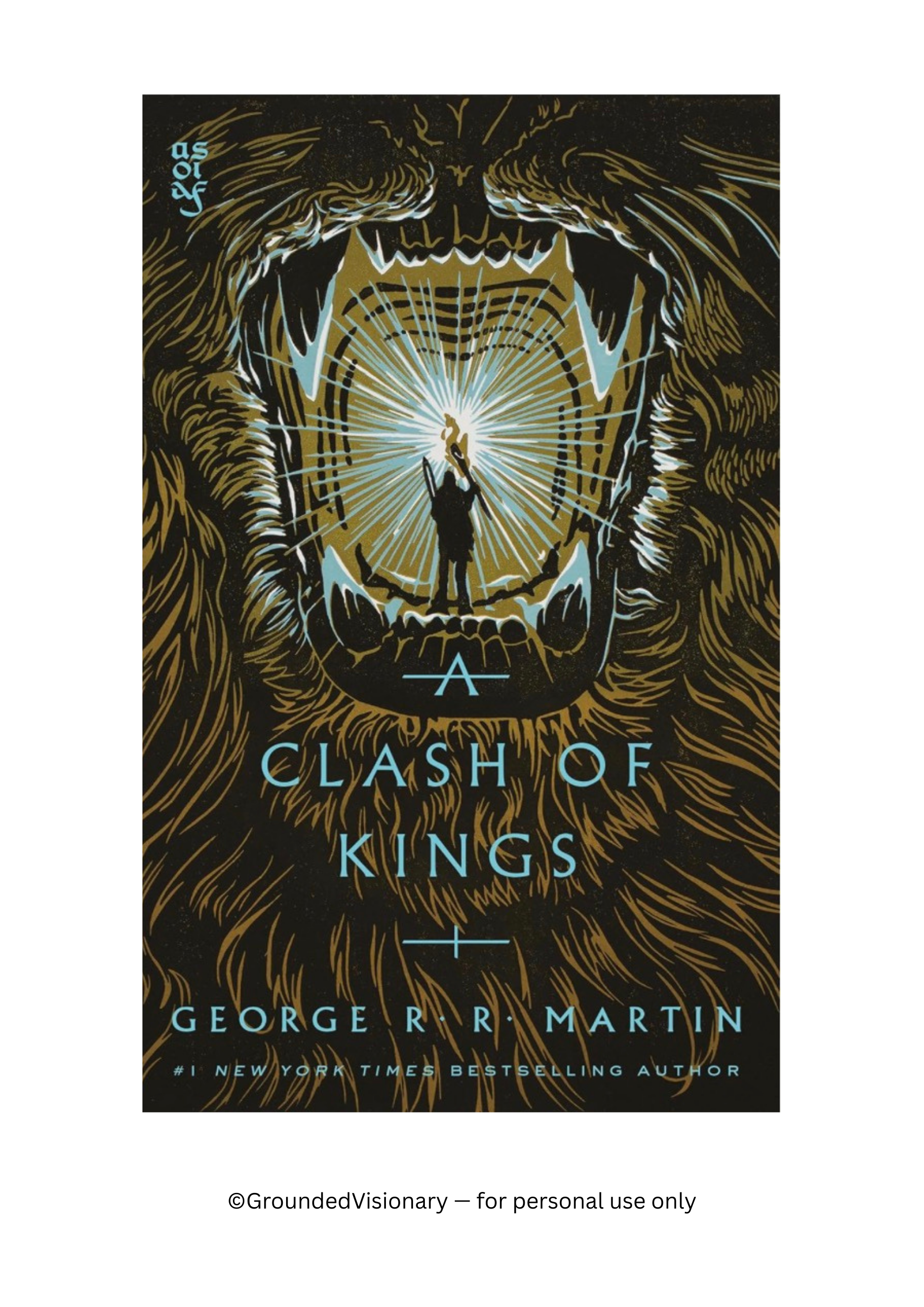
A Game of Thrones established the rules. A Clash of Kings shows you what happens when five different people decide the rules don't apply to them anymore — simultaneously.
This is the book where Martin makes his argument about legitimacy. Not who deserves power, but who can hold it. Renly has more supporters than anyone and the weakest claim. Stannis has the strongest claim and almost no one wants him. Joffrey has the throne and no idea what it's for. Theon has a choice and makes the wrong one for reasons that make complete sense if you understand what the Greyjoys think identity means. And while all five kings exhaust each other, something far worse is building quietly in the north — and the book keeps cutting to Jon Snow to make sure you don't forget it.
The real conversation this book generates is not about who wins the war of five kings. It's about what competence actually earns you in a world that runs on birthright. About what legitimacy means when the person with the best claim is the one nobody wants. About what Theon's arc reveals about the gap between the identity you were given and the one you chose — and what it costs when those two things can't be reconciled.
This kit was built for the room that finished A Clash of Kings and has strong opinions about Stannis. Every room has them. This kit gives those opinions somewhere to go.
✦ What's Inside
✦ About This Book — Five kings, one throne, and the argument about what legitimacy actually means — Why the war of five kings is not the most important thing happening in this book — What Martin is doing with competence and birthright simultaneously
✦ What This Book Is Really About — Legitimacy versus capability — and why the book refuses to let them be the same thing — What Theon's arc reveals about identity, inheritance, and the cost of choosing wrong — The north as the book's real argument hiding underneath the politics
✦ Discussion Questions — Three Tiers — Tier 1: Four warmup questions to get everyone talking — Tier 2: Seven questions requiring a position and a defense — competence vs. birthright, Stannis, Theon's choice, what survival costs — Tier 3: Advanced questions for when the conversation hits its stride plus series progression questions that bridge to what's coming — Closes with: What question did this book refuse to answer?
✦ Character on Trial — Tyrion, Arya, and Stannis — Prosecution/defense structure — pick one, everyone is prosecution or defense — Hard position questions with mandatory reversal — No neutral positions allowed
✦ Activities — The Competence Gap: map who has the skills versus who has the claim — and where those two things never overlap — Arya's Survival School: what Arya learns in this book that no one taught her and whether it makes her stronger or costs her something she can't get back — The Legitimacy Debate: rank all five kings by legitimacy and by competence — defend where they land differently on each list — Verdict Vote: one major decision — Ethical / Unethical / Understandable but wrong
✦ Quote Prompts — Come to your meeting with one moment that stuck with you — Prompts to help you find the passage worth bringing
✦ Spoiler Corner — Host only — use when the conversation needs a jolt — Three escalation questions for groups who finished
✦ For the Host — Meeting flow and timing guide — Notes on which discussions tend to go long — How to handle a room that wants to argue about Stannis for the entire meeting
Details — Instant download PDF — 19 pages, print-ready — Personal and single-group use. No redistribution or resale. — Fan-created guide. Not affiliated with or endorsed by George R.R. Martin, his estate, or any publisher.
Licensing for classrooms, libraries, and educational programs is available. If you plan to use this guide for a class, reading program, or institutional setting, please contact the shop owner to arrange an appropriate license.

This book is not asking who's good. It's asking who's positioned.
A Game of Thrones is not a fantasy novel about good versus evil. It's a novel about leverage — who has it, who thinks they have it, and what happens when someone who genuinely believes in honor walks into a room full of people who understand that honor is just another variable. The dragons and direwolves are real. They're not the point. The point is what people do to each other when power is on the table and the rules are whatever the most dangerous person in the room decides they are.
Martin builds a world where honor is a real thing — people genuinely believe in it, live by it, die for it — and then shows you exactly what that costs in a game that doesn't care. If you came in expecting the hero to win, this book has a specific lesson for you. If you came in already suspicious, it's going to confirm everything.
This kit was built for the room that wants to go past the plot and into what the book is actually doing — with power, honor, family, and consequences. Because if you walk away just talking about who died, you missed the point.
✦ What's Inside
✦ About This Book — Not a fantasy novel about good versus evil — A novel about positioning — who has leverage, who is expendable, who doesn't realize the game is being played — What honor costs in a world that doesn't care about it
✦ What This Book Is Really About — Honor as a variable not a virtue — Information as currency — who controls it, who weaponizes it — Who the story centers versus who it treats as expendable — Why the logic of this world is not as distant from the actual world as it appears
✦ Discussion Questions — Three Tiers — Tier 1: Warmup questions including your gut reaction and the first moment you realized good people don't win here — Tier 2: The real source of power, who is actually safe, moral consistency as strength or liability, strategic versus emotional decisions — Tier 3: Honorable versus useful, what the book thinks justice is, who understands the game and who doesn't even know they're playing — Closes with: What question did this book refuse to answer?
✦ Character on Trial — Ned Stark, Petyr Baelish, Varys — Prosecution/defense structure — Hard position questions with mandatory reversal — No neutral positions allowed
✦ Activities — Leverage Map: four columns — Titles/Status, Money/Resources, Information/Secrets, Fear/Force — place characters, discuss who has the strongest leverage with the least visibility — The Honor Tax: complete the prompts — "Honor cost ___ what?" / "Honor benefited ___ the most." / "In this world, honor is basically ___." — Choose Your Seat at Court: pick a role — Advisor, Commander, Spy, or Heir — name your survival strategy and first alliance — Verdict Vote: one major decision — Ethical / Unethical / Understandable but wrong
✦ Quote Prompts — Five prompts across different emotional entry points — The moment you realized this world rewards the wrong thing — The scene where power shifted and the character holding it didn't notice in time — The passage that felt less like fantasy and more like the actual world
✦ Spoiler Corner — Host only — use when the conversation needs a jolt — Who is playing chess and who thinks they are but isn't — What you thought the central conflict was at the start versus what it actually was by the end — What the final pages changed about how you read the characters who didn't make it
✦ For the Host — Anchor discussion in the logic of the world not plot recap — Built-in spoiler control for groups with mixed progress — Timing flow for a single session — Works for groups of 5–10, generates enough debate for larger rooms too
Details — Instant download PDF — 19 pages, print-ready — Personal and single-group use. No redistribution or resale. — Fan-created guide. Not affiliated with or endorsed by George R.R. Martin, his estate, or any publisher.
Licensing for classrooms, libraries, and educational programs is available. If you plan to use this guide for a class, reading program, or institutional setting, please contact the shop owner to arrange an appropriate license.
George R.R. Martin did not write a fantasy series about who deserves the throne. He wrote a series about what the throne does to everyone who wants it — and what it costs the people who never wanted it at all but got close enough to get consumed anyway. Five books in, the series is unfinished. The argument isn't.
This bundle was built for the book club that made it through all five books and came out the other side with more questions than answers. The individual guides go deep on each book. The connecting material goes somewhere the individual guides couldn't — the long arc of what this series is actually arguing about power, honor, legacy, and the gap between the story people tell themselves and what the story does to them. And there is a direct conversation about the unfinished series — not as a complaint, but as a genuine question about what it means to discuss a story its author has not yet resolved.
This bundle was built for the reader who finished A Dance with Dragons, closed the book, and immediately needed someone else to talk to about it. It was also built for the reader who finished it years ago and is still not over it. Both of those readers are going to find something in here worth arguing about.
✦ What's Inside
✦ Complete Discussion Guide — A Game of Thrones — Three-tier discussion questions — Character on Trial: Ned, Cersei, and Tyrion — Activities including Verdict Vote — Spoiler Corner and For the Host
✦ Complete Discussion Guide — A Clash of Kings — Three-tier discussion questions — Character on Trial — Activities including Verdict Vote — Spoiler Corner and For the Host
✦ Complete Discussion Guide — A Storm of Swords — Three-tier discussion questions — Character on Trial: Jaime, Tyrion, and Catelyn — Activities including Verdict Vote — Spoiler Corner and For the Host
✦ Complete Discussion Guide — A Feast for Crows — Three-tier discussion questions — Character on Trial — Activities including Verdict Vote — Spoiler Corner and For the Host
✦ Complete Discussion Guide — A Dance with Dragons — Three-tier discussion questions — Character on Trial — Activities including Verdict Vote — Spoiler Corner and For the Host
✦ Series Introduction — What Martin is actually arguing across five books — Why the series reads differently after A Dance with Dragons
✦ Six-Session Facilitation Structure — Session closers designed to carry questions between meetings — Guidance for first-time readers and returning groups — Note on the unfinished series and how to discuss it
✦ Four Transition Pages — From Introduction to Escalation — From Escalation to Consequence — From Consequence to Aftermath — From Aftermath to Convergence
✦ Cross-Series Discussion Questions — 15 questions across four sections — The narrative each house told itself — The cost ledger across five books — What Martin is actually arguing about power — The unfinished argument
✦ Where the Series Leaves You — Final closer built around Martin's unresolved questions — Includes the question the remaining books were supposed to answer
Details — Instant download — delivered as two PDF files — File 1: Series introduction, facilitation guide, transition pages, and discussion guides for Books 1–3 — File 2: Completes Book 3 and includes full guides for Books 4–5, plus all cross-series discussion questions and series closer — All content included across both files — Personal and single-group use. No redistribution or resale. — Fan-created guide. Not affiliated with or endorsed by George R.R. Martin, his estate, or any publisher.
Licensing for classrooms, libraries, and educational programs is available. If you plan to use this guide for a class, reading program, or institutional setting, please contact the shop owner to arrange an appropriate license.
The Buffalo Hunter Hunter opens with a diary found inside a wall. Written in 1912 by a Lutheran pastor named Arthur Beaucarne, it contains the confession of a Blackfeet man named Good Stab. What Good Stab has to confess is not what you expect. And what he became — something unkillable, something that hunts the men destroying his world — is not a departure from history. It's a consequence of it.
This is not a vampire story. Or rather — it is, but that's not what it's doing.
The Marias Massacre was real. The near-extinction of the buffalo was real. The erasure of Blackfeet history was real. Stephen Graham Jones, an enrolled member of the Blackfeet Nation, takes that history and builds something on top of it that the horror genre rarely attempts: a story where the monster makes complete sense, where the world that created him is the thing that should frighten you most, and where justice is not a resolution but a question the book keeps asking until the last page.
This kit was written for the book club that wants to talk about all of it. The creature horror and the historical horror. The confession that spans a century. What gets passed down through bloodlines nobody asked to inherit. And what it means to sit with a history that was deliberately buried and is now in your hands.
✦ What's Inside
✦ About This Book — What The Buffalo Hunter Hunter is actually doing underneath the vampire mythology — Why the supernatural and historical horror are not two different things — Built for the room that wants to sit with history that was deliberately buried
✦ What This Book Is Really About — America, erasure, and what it costs to carry a history the culture around you has decided to forget — Why the monster makes complete sense — The world that created him as the thing that should frighten you most
✦ Discussion Questions — Three Tiers — Tier 1: Warmup questions to get everyone talking — Tier 2: Questions that require taking a position and defending it — Tier 3: Questions that go personal and don't resolve cleanly — Closes with: What question did this book refuse to answer?
✦ Character on Trial — Good Stab, Arthur Beaucarne, Etsy Beaucarne — No neutral positions allowed — Prosecution/defense structure
✦ Activities — The History You Weren't Taught — The Confession — The Inheritance — Verdict Vote — Fair warning: most of these get personal
✦ Quote Prompts — Six prompts to help every reader find the passage they want to bring — The moment the horror stopped being supernatural — The passage where the history became undeniable
✦ Spoiler Corner — Host only — use when the conversation needs a jolt
✦ For the Host — Facilitation notes and timing flow — How to handle a room that goes quiet in ways you didn't expect
Details — Instant download PDF — 27 pages, print-ready — Personal and single-group use. No redistribution or resale. — Fan-created guide. Not affiliated with or endorsed by Stephen Graham Jones or any publisher.
Licensing for classrooms, libraries, and educational programs is available. If you plan to use this guide for a class, reading program, or institutional setting, please contact the shop owner to arrange an appropriate license.
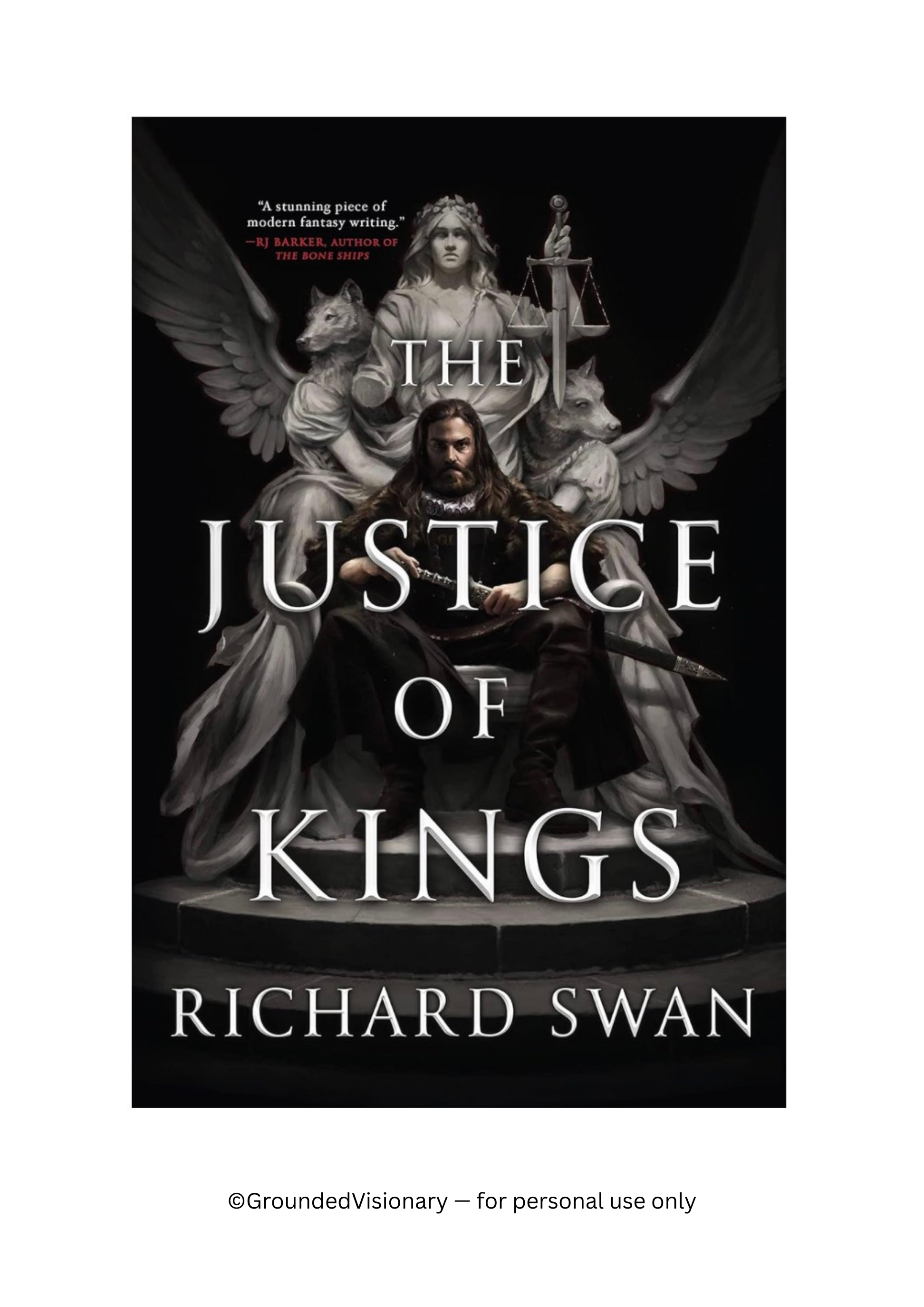
Same situation as The Substitution Order and World War Z — early format. But this kit is actually stronger than those two. The About This Book and What This Book Is Really About pages are solid, the discussion questions are genuinely good, the activities are specific and well designed, and the Spoiler Corner has three real escalation questions. It's not at current template standard but it's closer than the others.
Option A still applies — write the listing honestly for what's there, flag for rebuild later.
REWORKED LISTING — THE JUSTICE OF KINGS
The Justice of Kings starts with a premise that sounds almost procedural: a magistrate travels the countryside administering justice, moving from case to case, making sure the law is applied fairly and without favor. And then you realize that in a world where power is always looking for ways to bend the rules, a man who genuinely won't bend is the most dangerous person in any room he enters.
Sir Konrad Vonvalt is that man. He has legal authority, some unsettling magical abilities, and an absolute commitment to the law that reads less like virtue and more like a force of nature. He doesn't love people. He loves justice. And the book is quietly, carefully asking whether that's enough — or whether it's its own kind of blindness.
The story is told through Helena Sedanka, Vonvalt's clerk, looking back on events she lived through as a young woman. That framing matters. She's not just a narrator — she's a person who loved someone, outgrew them, and is still working out what she thinks about both. This is a fantasy novel about the law, but what it's really about is what happens when the institutions we trust to protect us start being used as weapons instead — and whether a man whose entire identity is built around the law can see that happening until it's too late.
This kit was built for the room that finished this book and wants to argue about Vonvalt — whether he's a hero, a liability, or something the book refuses to resolve cleanly.
✦ What's Inside
✦ About This Book — A magistrate who won't bend in a world built on bending — Why a man who loves justice more than people is the most dangerous kind — Helena's narration and why the framing changes everything
✦ What This Book Is Really About — What Vonvalt's rigidity costs him and the people around him — How Helena's narration changes what we think we're seeing in real time — The Eddard Stark problem: a man of absolute principle in a world of flexible morality — What the factions are actually fighting over — not power, but the definition of what law is for
✦ Discussion Questions — Three Tiers — Tier 1: Warmup questions including what drew you in and whether you trusted Helena — Tier 2: Vonvalt's commitment to law vs. people, Helena's shifting feelings, Bressinger's loyalty, what the supernatural elements say about power outside the law — Tier 3: The Eddard Stark problem, Helena narrating in retrospect, where the gap between what institutions are supposed to do and what they actually do is widest — Closes with: What question did this book refuse to answer?
✦ Activities — The Vonvalt Verdict: one of Vonvalt's decisions — Just / Unjust / Technically correct but wrong — The Factions Table: map what each faction believes the law is for, place each character under their faction, ask who is most honest about what they actually believe — Helena's Retrospective: what does she regret, what is she grateful for, what hasn't she resolved — and does she tell this story fairly? — Verdict Vote: one moment where the law produced an outcome — Ethical / Unethical / Understandable but wrong
✦ Quote Prompts — Five prompts across different emotional entry points — The moment Vonvalt's commitment felt like strength — The moment that same commitment felt like a blindspot — The scene where Helena sees something Vonvalt can't — or won't
✦ Spoiler Corner — Host option — three questions for groups who finished — Whether the ending changed how you read Vonvalt's certainty throughout — Who Helena becomes after this — and whether she's who Vonvalt thought she could be — What the final pages changed about the factions and what they were actually fighting over
✦ For the Host — The cases are not the point — anchor discussion in character and institution — Name Helena's retrospective framing upfront so the group pays attention to how she tells the story — Timing flow for a single session
Details — Instant download PDF — Personal and single-group use. No redistribution or resale. — Fan-created guide. Not affiliated with or endorsed by Richard Swan or any publisher.
Licensing for classrooms, libraries, and educational programs is available. If you plan to use this guide for a class, reading program, or institutional setting, please contact the shop owner to arrange an appropriate license.
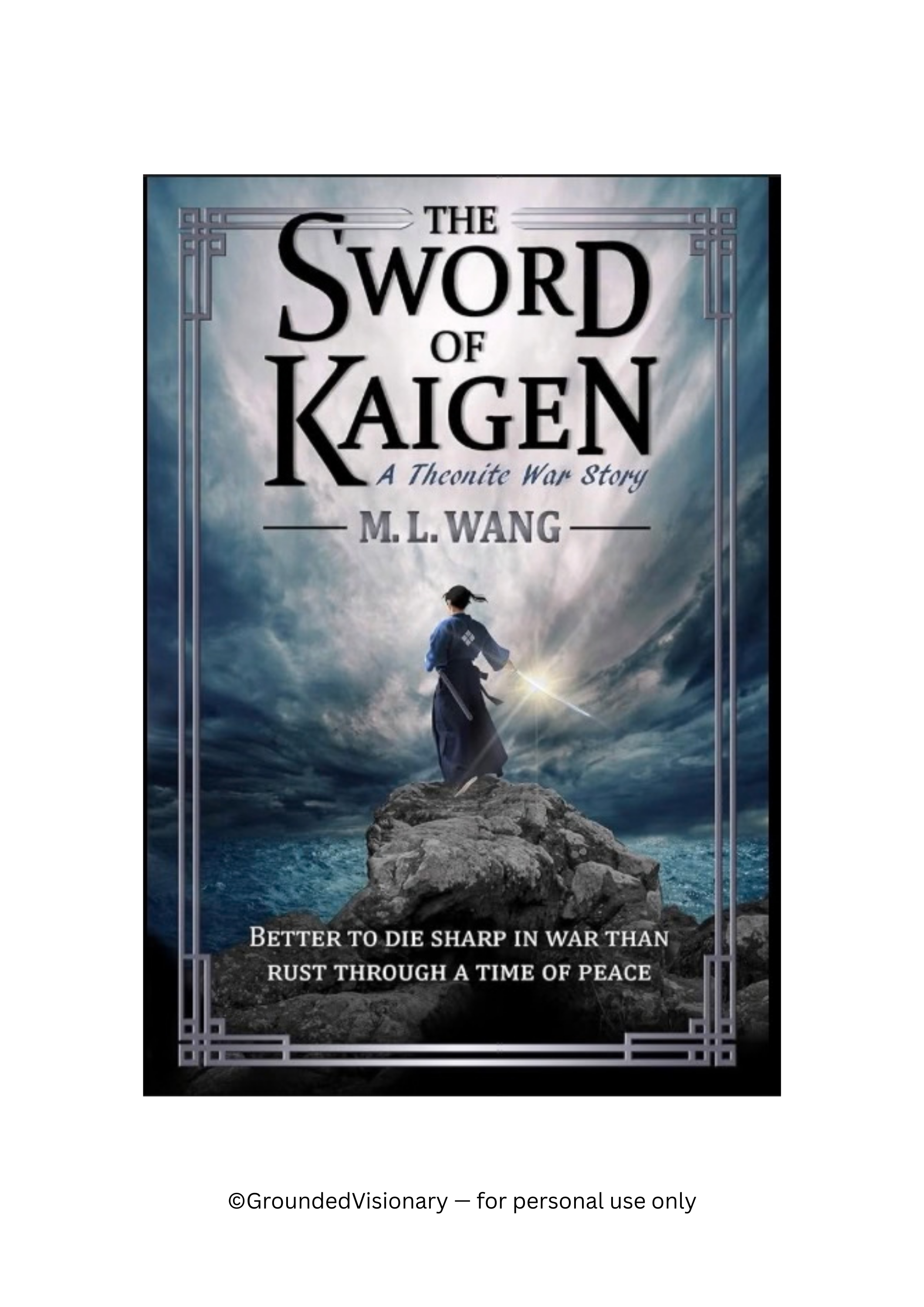
This book looks like a fantasy novel. Elemental powers, warrior clans, and an isolated mountain village with a proud martial tradition. That's the surface. Underneath it is a story about a woman who was exceptional, who buried it completely to become a wife and mother inside a culture that required her silence, and who gets no choice but to become herself again when the world breaks open around her.
Misaki is the book's real argument. Not the invasion. Not the propaganda. Not even the son that the book builds and then breaks your heart with. The real story is fifteen years of silence from a woman who knew the truth — about herself, about the village, about the empire using them all — and chose to keep it anyway. The Sword of Kaigen is a fantasy novel, the way a fire is a light source. Technically accurate. Mostly beside the point.
The conversations this book generates are not generic. They're about what we bury to fit into the roles we're assigned. About whether the explanation is the same as an excuse when it comes to the people who damage us. About what it costs to tell the truth into a system that was built to absorb it. About a marriage that spent fifteen years performing itself and then, in the snow over a son's pyre, finally had the conversation it always needed to have.
✦ What's Inside
✦ About This Book — What the village believes it is and what it actually is — Why Misaki is the real protagonist — The fantasy novel that is mostly beside the point
✦ What This Book Is Really About — Four threads worth following into discussion — Silence as survival strategy and as cost — The central argument the book is making about what we bury to belong
✦ Discussion Questions — Three Tiers — Tier 1: Warmup questions that get everyone talking — Tier 2: Deeper questions requiring a position and a defense — Tier 3: Personal, uncomfortable, unresolvable — Closes with: What question did this book refuse to answer?
✦ Character on Trial — Misaki, Takeru, and Hiroshi — Prosecution/defense structure — Hard position questions with mandatory reversal — No neutral positions allowed
✦ Activities — Verdict Vote: Takeru's duel with his son — The Burial of Self: what you buried to fit the role assigned to you — The Propaganda Inventory: what the village was told and what it cost them to believe it — The Road Not Taken: what Misaki's life looks like if she never came to Kaigen
✦ Quote Prompts — Seven prompts pointing toward specific kinds of passages — The passage where Misaki's silence became legible — The moment the fantasy stopped being the point — The sentence that named what fifteen years of performance costs
✦ Spoiler Corner — Host only — three escalation questions for when the conversation needs a jolt — Mamoru's death and what it unlocks — Takeru's invitation and what it reveals about the marriage — The duel in the snow as the book's real climax
✦ For the Host — Facilitation notes and content sensitivity flags — Full timing flow and guidance for two different kinds of rooms
Details — Instant download PDF — Personal and single-group use. No redistribution or resale. — Fan-created guide. Not affiliated with or endorsed by M.L. Wang or any publisher.
Licensing for classrooms, libraries, and educational programs is available. If you plan to use this guide for a class, reading program, or institutional setting, please contact the shop owner to arrange an appropriate license.
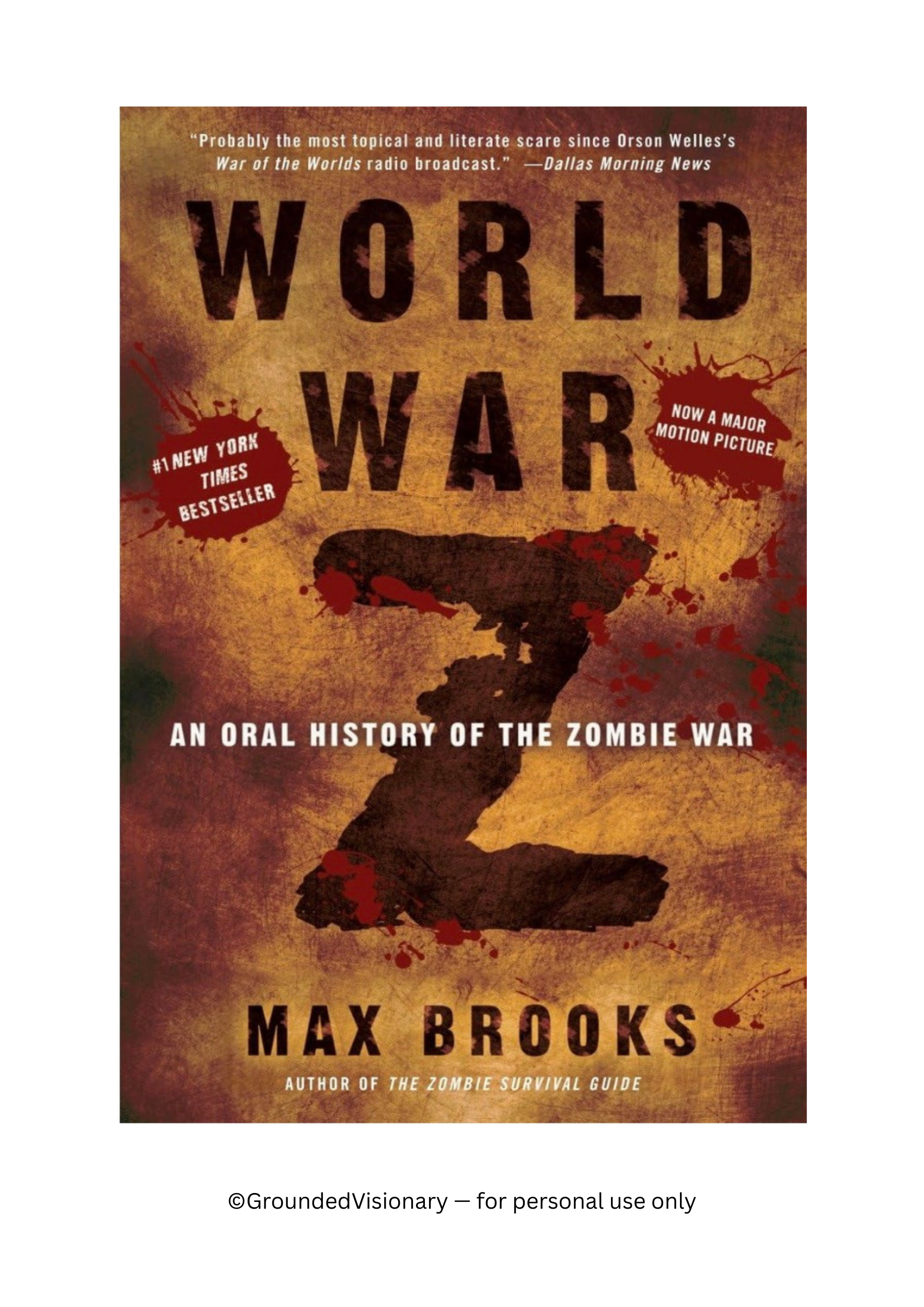
This isn't a zombie novel. The zombies are the least interesting thing about it.
What Max Brooks actually wrote is an oral history of a global catastrophe told through the people who survived it — soldiers, doctors, politicians, civilians, black market operators, regular people who just happened to make it. The format feels like reading a stack of post-war debrief transcripts. That is the point. It gives the whole thing a weight that most disaster fiction never achieves.
Here's what the book is really doing: it's an after-action review of humanity getting completely overwhelmed — and then slowly crawling back to rebuild. The zombies are the disaster. Human behavior is the chaos multiplier. Denial, arrogance, bad planning, political theater, "it won't happen here" — all of it arrives before the zombies even get through the door. Brooks wrote this in 2006. Your book club gets to decide how familiar that pattern feels right now.
Fair warning: this isn't a character-driven novel in the traditional sense. There's no one protagonist you follow emotionally from beginning to end. Humanity is the main character. Groups who go in expecting a traditional story often feel cold toward it. Groups who go in expecting a forensic examination tend to find it riveting. This kit is built for the second kind of room.
✦ What's Inside
✦ About This Book — Not a zombie novel — the zombies are the least interesting thing — An oral history of global catastrophe told by the people who survived it — Why the format is doing as much work as the content
✦ What This Book Is Really About — A forensic examination of how human systems fail, adapt, and rebuild — Who profits from denial — and whether that pattern feels familiar — What survival actually costs the people who achieve it — Whether going back is possible or whether the world just becomes something else
✦ Discussion Questions — Three Tiers — Tier 1: Warmup questions including the format, the voice that stuck, and what you expected vs. what you got — Tier 2: Which institution failed most catastrophically, who profits from denial, where the line is between understandable and unforgivable — Tier 3: Trauma after the danger ends, what humanity lost that it can't get back, what Brooks saw in 2006 that landed this week — Closes with: What question did this book refuse to answer?
✦ Activities — Systems Autopsy: pick one system that failed — healthcare, government, military, media, supply chain — walk through the failure and ask what would have had to be different for it to hold — The Denial Timeline: reconstruct the chain of denial in the early outbreak, map who knew and who profited from silence, ask whether this pattern shows up anywhere in the real world — Survival Cost: name the account that showed you what survival really costs and whether any version of survival in this book costs nothing — Verdict Vote: one decision by a government, military leader, or individual — Necessary / Inexcusable / Understandable but wrong
✦ Quote Prompts — Five prompts across different emotional entry points — The account where the real enemy wasn't the zombies — The passage where denial did more damage than the disaster itself — The voice that felt uncomfortably close to real life
✦ Spoiler Corner — Host option — three questions for groups who finished — Which account changed meaning once you knew how the war ended — Whether the ending felt like hope, exhaustion, or something in between — What the final shape of the world says about what humanity actually learned
✦ For the Host — How to anchor discussion when there's no central protagonist — Go straight to the themes — resist the plot recap — Timing flow for a single session — Good host note: name the format upfront
Details — Instant download PDF — Personal and single-group use. No redistribution or resale. — Fan-created guide. Not affiliated with or endorsed by Max Brooks or any publisher.
Licensing for classrooms, libraries, and educational programs is available. If you plan to use this guide for a class, reading program, or institutional setting, please contact the shop owner to arrange an appropriate license.
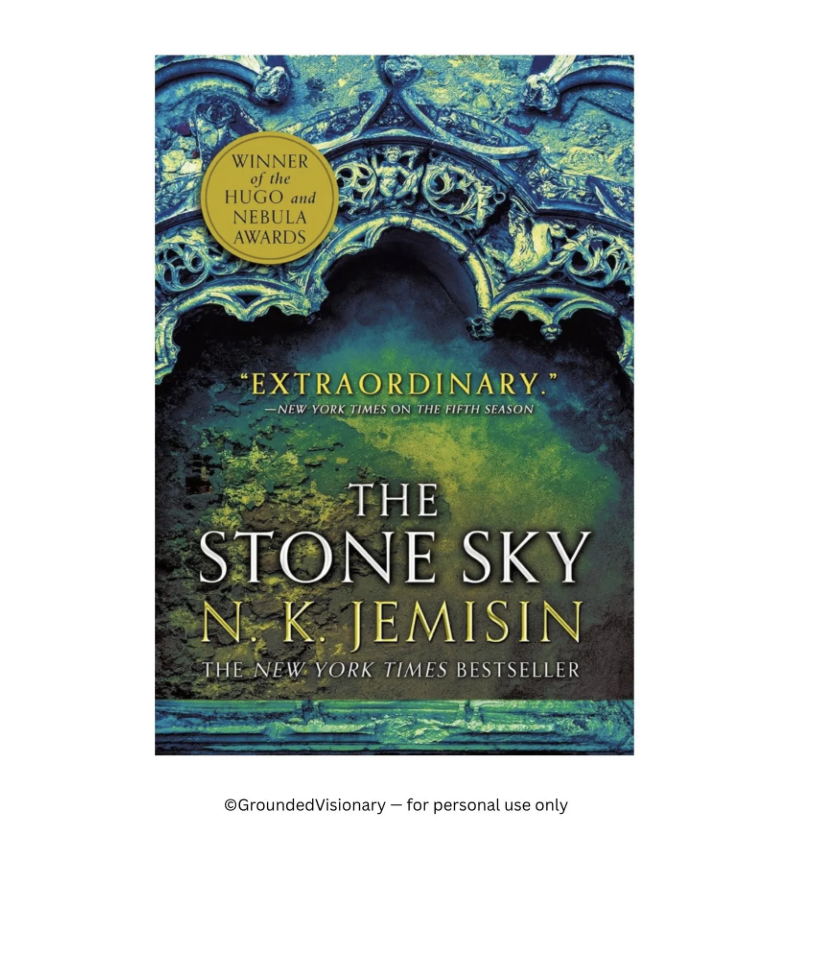
A final reckoning with sacrifice, legacy, and the price of changing the world.
The Stone Sky is the book that has to pay off everything. Three books of fractured timelines, second-person narration, and a world built on deliberate catastrophe — and this is where Jemisin asks you to decide whether any of it can be undone. It is the most ambitious book in the trilogy and in some ways the most demanding. It is also the one where you finally find out what kind of mother Essun was — and why that answer changes everything about Nassun.
This kit was built for the room that finished the Broken Earth trilogy and couldn't stop thinking about it. Not just about the ending — about Nassun's choice, about what Hoa's narration was actually doing across three books, about whether the victory Jemisin delivers is an act of hope or the most honest thing she could have said about what breaking cycles of harm actually costs the people who break them.
The discussion in this room will be divided. Nassun splits every room that reads this trilogy — between readers who understand her completely and readers who think she nearly ended the world because she was in pain and had too much power and not enough wisdom. Both positions are defensible. Both are in this kit. The goal is not to reach a verdict on Nassun. The goal is to hold her accountable and love her at the same time — which is exactly what Jemisin asks of you and exactly what the best book club conversations do.
This kit was built for the room that read all three books and is still sitting with the ending. It was built for the conversation that starts with whether Nassun was right and ends somewhere none of you expected.
✦ What's Inside
✦ About This Book — The most ambitious book in the trilogy — The pacing demands trust — Essun as mother — finally and fully — Nassun as the room's fault line — Built for the reader who finished and couldn't stop thinking
✦ What This Book Is Really About — Forty thousand years of the same cycle — What it costs to end destruction rather than survive it — Whether restoration and destruction are different things or just different names for the same violence
✦ Discussion Questions — Three Tiers — Tier 1: Entry points, no position required yet — Tier 2: Nassun's verdict on humanity, Essun as mother, the origin of the Stillness — Tier 3: Personal, uncomfortable, unresolvable — Closes with: What question did this trilogy refuse to answer?
✦ Where This Book Leaves You — The moon is returning and almost nothing is resolved — What Nassun saw in Essun at the last moment — Hoa's victory and what it cost — What the next generation owes the one that survived
✦ Character on Trial — Nassun, Essun, Hoa — Prosecution/defense structure — Hard position questions with mandatory reversal — No neutral positions allowed — Final synthesis: who gets to decide what was worth it
✦ Activities — The Stone Ledger: what each figure lost that they didn't choose to lose — The Narrator's Chair: one sentence in second person, read aloud — The Verdict on the World: restore it or end it, no neutral answers — Verdict Vote: was Nassun's final choice the right one
✦ Quote Prompts — Six prompts, six emotional entry points — The moment Hoa's narration shifted — The passage that named the argument quietly — The passage about what Essun cost Nassun to read
✦ Spoiler Corner — Host only — full knowledge of all three endings required — The victory that looks like stone and solitude — Nassun's last moment — Hoa's patience and what it cost Essun to be loved that way
✦ For the Host — Two fault lines: Nassun and the ending — Timing flow for a single session — Good host note for Fifth Season devotees and Nassun readers
Details — Instant download PDF — 40+ pages, print-ready — Book 3 of the Broken Earth trilogy — pairs with The Fifth Season and The Obelisk Gate discussion guides — Personal and single-group use. No redistribution or resale. — Fan-created guide. Not affiliated with or endorsed by N.K. Jemisin or any publisher.
Licensing for classrooms, libraries, and educational programs is available. If you plan to use this guide for a class, reading program, or institutional setting, please contact the shop owner to arrange an appropriate license.
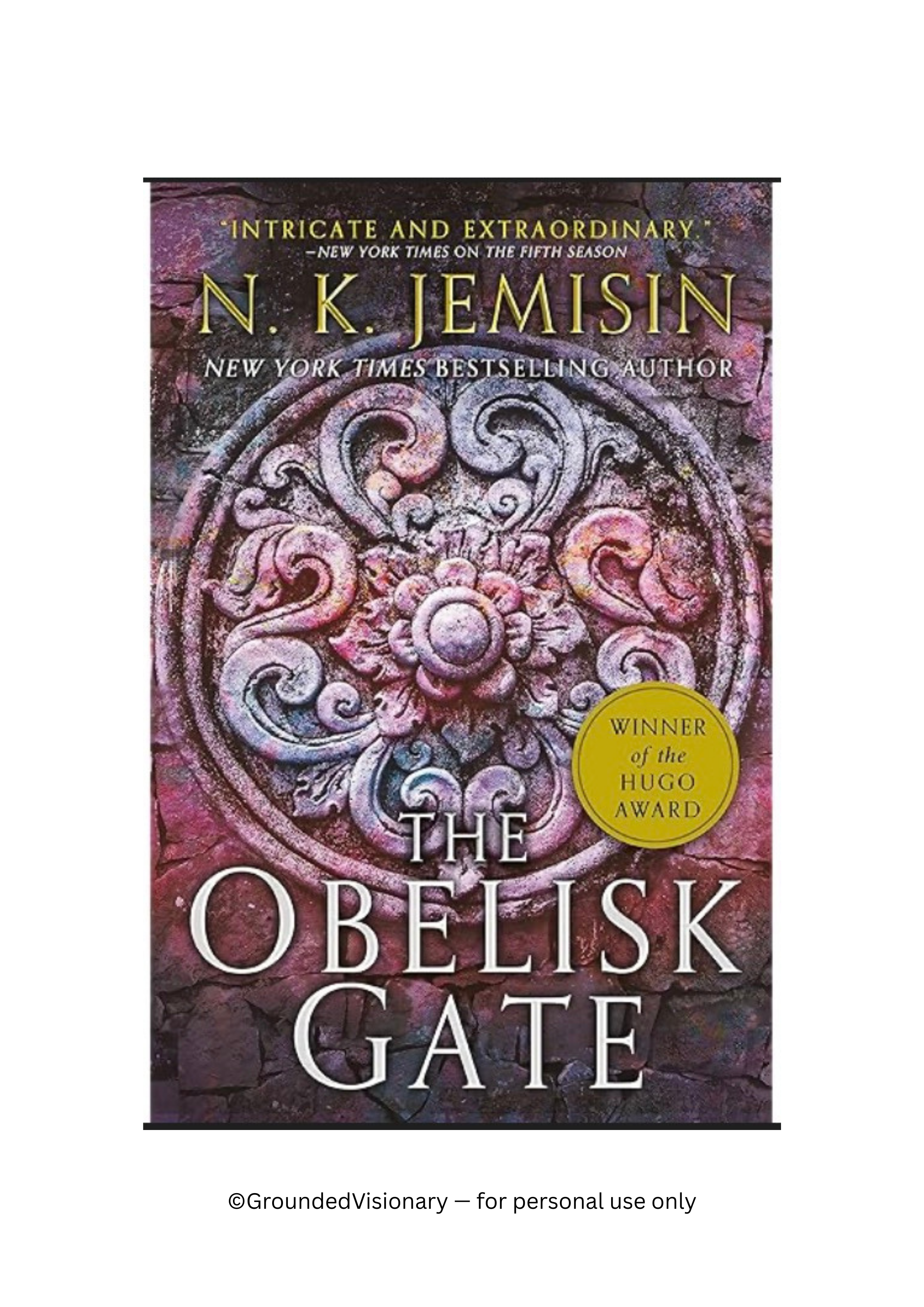
An exploration of control, consequence, and what power really costs.
The Obelisk Gate gives you back the character you loved most from the first book and then shows him to you only in the process of being taken away. Alabaster is dying — his body turning to stone, the cost of what he did to crack the world open — and he spends every session with Essun transferring everything he knows before he finishes the process of becoming what he used to move. His death is this book's central act. It hurts in proportion to how much you cared about him in The Fifth Season. And it is not the most devastating thing Jemisin does in this novel.
The most devastating thing is Nassun. Jemisin splits the narrative between Essun and her daughter moving toward each other and away from each other simultaneously — and what Nassun's chapters reveal is that Essun, in trying to protect her daughter, used the same methods that were used on her. She broke Nassun's hand to teach her control. She trained fear into the person she most wanted to save. The damage the Fulcrum built into Essun did not stay inside Essun. It traveled. That is not a plot twist. It is an argument about what oppression does when it doesn't get named — how it moves through love, how it replicates, how a person can be simultaneously a survivor and a source of the same harm.
This kit was built for the room that finished The Obelisk Gate still feeling the weight of Alabaster's last act — and still not entirely sure what to do with Nassun.
✦ What's Inside
✦ About This Book — What it feels like to get Alabaster back only in the process of losing him — How damage travels through love without announcing itself — Built for the room still holding the weight of what Alabaster left behind
✦ What This Book Is Really About — What oppression builds into people and releases into the next generation — Why Nassun is not a brat — and why that answer is more devastating than the alternative — What Castrima's experiment reveals about coexistence and human fear
✦ Discussion Questions — Three Tiers — Tier 1: Warmup questions that get everyone talking — Tier 2: Essun's hand, Nassun's hand, and what traveled between them — Tier 3: Alabaster's unilateral decision and what it cost everyone who didn't make it — Closes with: What question did this book refuse to answer?
✦ Where This Book Leaves You — What Alabaster's transfer costs Essun going forward — What Nassun has decided and what it means for the collision coming — Whether Castrima's experiment was worth what it cost
✦ Character on Trial — Alabaster, Nassun, and Ykka — Prosecution/defense structure — Hard position questions with mandatory reversal — No neutral positions allowed
✦ Activities — The Inheritance Ledger: what each generation passed to the next and who paid the cost — The Acceptance Inventory: what we do when unconditional acceptance comes from the wrong source — Castrima's Vote: the room becomes the comm — The Transfer: something given that you didn't choose and can't return — Verdict Vote: Alabaster's decision — Justified / Inexcusable / The Only Move Available But Not Justified
✦ Quote Prompts — Six prompts across six distinct kinds of readers — The passage that reframed everything — The one that hurt — The one that refused to resolve
✦ Spoiler Corner — Host only — use when the conversation needs a jolt — Alabaster's death, Essun turning to stone, and Nassun's collision course with her mother
✦ For the Host — Four kinds of readers this book brings into the same room — How to handle Nassun's trial, Alabaster's defense, and the Essun/Nassun damage question — Timing flow and meeting structure — Good host note for two different kinds of rooms
Details — Instant download PDF — Book 2 of the Broken Earth trilogy — pairs with The Fifth Season discussion guide — Personal and single-group use. No redistribution or resale. — Fan-created guide. Not affiliated with or endorsed by N.K. Jemisin or any publisher.
Licensing for classrooms, libraries, and educational programs is available. If you plan to use this guide for a class, reading program, or institutional setting, please contact the shop owner to arrange an appropriate license.
A layered story of power, survival, and oppression in a world that keeps breaking.
The Fifth Season isn't going to ease you in. From the first page, it drops you into a world mid-apocalypse, written in second person, structured in fragments, and building toward a truth that arrives deliberately late and devastating. Most readers figure out what Jemisin is doing somewhere around the moment they can't put it down, despite being completely disoriented. The disorientation is the point.
This is a survival story set inside a fantasy world where oppression isn't background texture — it's infrastructure. A whole civilization built to contain certain people, extract what's useful from them, and punish them for existing at full capacity. The Fulcrum doesn't just control orogenes. It produces them, manages them, and disposes of them on a calculation that has been running for thousands of years. Jemisin doesn't let the reader look away from that calculation. She makes you inhabit it.
The second-person narration isn't a stylistic flex. It's an accusation. You did this. You lost this. You are here now. If your group reads this book and only talks about the plot they'll have missed half of what it's doing. This kit is designed to get the room to the other half.
✦ What's Inside
✦ About This Book — A world built to contain certain people — Oppression as infrastructure not background — Why the form is doing as much work as the content
✦ What This Book Is Really About — Power, compliance, and survival — The second-person narration as accusation not stylistic choice — What the system is actually built to do and who pays for it
✦ Discussion Questions — Three Tiers — Tier 1: Warmup questions that get everyone talking — Tier 2: What resistance looks like when survival depends on compliance — Tier 3: Personal, uncomfortable, unresolvable — Closes with: What question did this book leave sitting in your chest?
✦ Where This Book Leaves You — The fractured timeline as argument about trauma — What it costs to dismantle something holding people down and holding the world together — Who has been telling this story and why
✦ Character on Trial — Essun, Alabaster, and Schaffa — Prosecution/defense structure — Hard position questions with mandatory reversal — No neutral positions allowed
✦ Activities — Power Map: physical, institutional, informational, social — The Humanity Line — Verdict Vote: In this world, morality is a luxury — If You Had Orogeny — Cost Ledger: what the system collected and who paid it
✦ Quote Prompts — Five prompts across different emotional entry points — The passage that built the world — The one that broke the reader — The one that arrived too late
✦ Spoiler Corner — Host only — three escalation questions assuming full knowledge of the ending
✦ For the Host — How this book divides the room and why that's useful — Which activities go most personal and need extra time — Timing flow and meeting structure
Details — Instant download PDF — Personal and single-group use. No redistribution or resale. — Fan-created guide. Not affiliated with or endorsed by N.K. Jemisin or any publisher.
Licensing for classrooms, libraries, and educational programs is available. If you plan to use this guide for a class, reading program, or institutional setting, please contact the shop owner to arrange an appropriate license.
The Broken Earth trilogy begins with a woman who has lost her son and ends with a daughter who saved a world she almost destroyed. In between N.K. Jemisin does something that takes three books to fully understand — she puts you inside a story in second person, tells you that you did this and you lost this and you are here now, and doesn't tell you who is speaking or why until the very end. By the time you know, you have already been inside Essun's life long enough that the revelation doesn't feel like a twist. It feels like something you should have known all along.
This kit is not a summary of three books. It is the conversation that only becomes possible after the last page of The Stone Sky — when you finally have all three books in the room at once and can ask what they mean together that none of them could mean alone.
The Broken Earth trilogy is one argument made in three movements. The Fifth Season asks what a broken system does to the people it decides are useful. The Obelisk Gate asks what those people do to each other when survival requires it. The Stone Sky asks whether any of it can be undone — and what it costs the people who try. This kit was built for the room that finished the trilogy and couldn't stop thinking about it. Not just about the ending — about Alabaster's plan and who paid for it, about what Hoa's narration was actually doing across three books, about whether the victory Jemisin delivers is an act of hope or the most honest thing she could have said about what breaking cycles of harm actually costs the people who break them.
This kit was built for the room that read all three books and is still sitting with the ending. It was built for the conversation that starts with whether Alabaster had the right to crack the world and ends somewhere none of you expected.
Please note: This is a standalone trilogy-level discussion kit built around the conversation all three books make together. It is not a bundle of the individual GroundedVisionary guides for The Fifth Season, The Obelisk Gate, and The Stone Sky. Those guides are available separately in the shop and go deep on each book individually. This kit goes wide — across all three books, across all three names, across the full arc of what Jemisin built.
✦ What's Inside
✦ About This Kit — Not a summary of three books — The conversation that only becomes possible after the last page — One argument made in three movements — Built for the room that finished Stone Sky and needed somewhere to put everything the trilogy left in them
✦ What This Kit Is Really About — The second person narration as structural argument not stylistic choice — Three names, one woman, one question about what survived — The technical victory and the emotional wound — Why the ending is the most honest thing Jemisin could have said
✦ Discussion Questions — Three Tiers — Tier 1: Entry points, no position required yet — Tier 2: Make the case both ways — the system won versus the system failed, Hoa's narration as love versus control, Alabaster's plan and who paid for it — Tier 3: Personal, uncomfortable, unresolvable — Closes with: What question did this trilogy refuse to answer?
✦ Character on Trial — Damaya/Syenite/Essun as one defendant across three names — Alabaster: revolutionary or another powerful figure who decided his vision was worth other people's cost — Hoa at trilogy level: decades of watching, narrating, waiting, and turning to stone — No neutral positions allowed — Final synthesis: whose story was this trilogy actually telling
✦ Activities — The Three Names Ledger: what Damaya lost, what Syenite lost, what Essun lost — The Second Person Exercise: two sentences about your own reading experience in Hoa's voice — The Cycle Map: name the pattern, trace it across three books, argue whether the ending broke it or interrupted it — Verdict Vote: was Alabaster justified in cracking the world and recruiting Essun without full disclosure
✦ Quote Prompts — Six prompts, six emotional entry points — The moment the second person became personal — The passage about what Damaya loved before the system got to her — The passage about Alabaster that reframed everything
✦ Spoiler Corner — Host only — full knowledge of all three endings required — The victory that looks like stone and solitude — Who the trilogy was actually telling the story of — What Jemisin believes about whether the people who break cycles get to choose what breaks them
✦ For the Host — Three fault lines: Alabaster, the ending, and the second person narration — Timing flow for a single session — Good host note for Fifth Season devotees and Nassun readers — The stone eater gap and how to hold it productively
Details — Instant download PDF — 20+ pages, print-ready — Personal and single-group use. No redistribution or resale. — Fan-created guide. Not affiliated with or endorsed by N.K. Jemisin or any publisher.
Licensing for classrooms, libraries, and educational programs is available. If you plan to use this guide for a class, reading program, or institutional setting, please contact the shop owner to arrange an appropriate license.
Octavia Butler set the Parable novels in the 2020s and published the first one in 1993. She wasn't writing science fiction. She was extrapolating from things she could already see — and she put a fifteen-year-old Black girl at the center of the collapse and asked what it takes to build something new when everything around you is actively falling apart. That question still doesn't have a clean answer. This bundle is built for the room that wants to sit with it anyway.
The Parable series is two novels and one unresolved argument. Parable of the Sower follows Lauren Olamina as she survives collapse, forms a philosophy, and arrives at the beginning of something. Parable of the Talents picks up years later, when that beginning has become a movement — and shows you, through the voice of Lauren's daughter, exactly what the movement cost the people who had to live inside it. The two books are not the same kind of story. Reading them together changes what you think you understood about each one separately.
This bundle includes complete discussion guides for both novels plus connecting material designed specifically for readers who have finished the series. Twelve cross-book questions that neither individual guide could ask on its own. A three-session facilitation structure for book clubs moving through both novels in sequence. And a final closer built around the questions Butler left deliberately unresolved — including the third novel she never wrote.
This bundle was built for the room that finished both books and realized the series isn't really about the future. It's about right now — and what we're willing to build inside it.
✦ What's Inside
✦ Complete Discussion Guide — Parable of the Sower — About This Book & What It's Really About — Three-tier discussion questions — Character on Trial: Lauren, Harry, and Zahra — Four activities including Verdict Vote — Quote Prompts, Spoiler Corner, For the Host
✦ Complete Discussion Guide — Parable of the Talents — About This Book & What It's Really About — Three-tier discussion questions — Character on Trial: Lauren, Larkin, Marc, and Bankole — Five activities including Verdict Vote and The Marc Test — Quote Prompts, Spoiler Corner, For the Host
✦ Series Introduction — What the Parable novels are actually arguing — Why the two books need to be read as a sequence
✦ Three-Session Facilitation Structure — Session closers designed to carry questions between meetings — Guidance for single-session and post-read use
✦ Transition Page: From Survival to Legacy — Orients the group between the two novels — Reframes what the second book is doing before discussion begins
✦ Cross-Book Discussion Questions — 12 questions across four sections — The arc of Lauren Olamina across both novels — Earthseed as idea versus institution — Larkin and the question of legacy — What the series leaves unresolved
✦ Where the Parable Series Leaves You — Final closer built around Butler's unresolved questions — Includes the question the third novel was supposed to answer
✦ Bonus Host Guide — A free facilitation toolkit included with every purchase
Details — Instant download PDF — Price reflects both complete individual guides plus all series connecting material — Personal and single-group use. No redistribution or resale. — Fan-created guide. Not affiliated with or endorsed by Octavia Butler's estate or any publisher.
Licensing for classrooms, libraries, and educational programs is available. If you plan to use this guide for a class, reading program, or institutional setting, please contact the shop owner to arrange an appropriate license.

Octavia Butler published this novel in 1998. Her fictional president runs on "Make America Great Again." He uses religious nationalism to justify the enslavement and torture of people he calls heathens. He separates children from their families at the border of his ideology. She was not predicting the future. She was describing a pattern she had already seen — and putting it somewhere people could look at it clearly.
But Parable of the Talents is not primarily a political novel. It is a novel about a woman who was right about everything that mattered and lost almost everyone who mattered in the process of being right. Lauren Olamina builds Earthseed from nothing in a collapsing America, survives enslavement and rape and the violent destruction of her community, spends decades searching for the daughter she lost, and lives to watch humanity leave Earth for the stars exactly as she always said it would. She wins. She is also standing alone at the finish line.
The novel is told through Lauren's journals — assembled, arranged, and framed by Larkin, the daughter Lauren lost as an infant and never fully recovered. Everything the reader receives from Lauren arrives through the hands of a woman who needed her mother to have failed. That is not an accident. Butler built the novel's most uncomfortable question into its structure: whose version of this story are you actually holding?
This kit was built for a room willing to hold Lauren's genuine achievement and her genuine cost simultaneously — without resolving the tension between them into a verdict Butler never delivered.
Note: This guide contains material addressing religious extremism, enslavement, sexual violence, forced separation of children from parents, and political violence consistent with the novel's content. A content warning page is included at the front of the guide with specific facilitation guidance for hosts.
✦ What's Inside
✦ Content Warning — Religious extremism, enslavement, sexual violence — Forced separation of children from parents — Political violence — Facilitation guidance included for hosts
✦ About This Book — Not the religion-building story it appears to be — The narrator problem — whose version are you holding — What Lauren won and what it cost — What kind of conversation this kit was built for
✦ What This Book Is Really About — Five threads worth following into discussion — The inheritance nobody chose — The Marc problem — What Christian America is actually doing in this novel — The book's central argument about vision and cost
✦ Discussion Questions — Three Tiers — Tier 1: Warmup questions that get everyone talking — Tier 2: Deeper questions requiring a position and a defense — Tier 3: Personal, uncomfortable, unresolvable — Closes with: What question did this book refuse to answer?
✦ Character on Trial — Lauren, Larkin, Marc, and Bankole — Prosecution/defense structure — Hard position questions with mandatory reversal — No neutral positions allowed
✦ Activities — Verdict Vote: Lauren's refusal to move Acorn — The Cost Ledger: what the vision cost and who paid it — The Inheritance Question: what Larkin inherited that she didn't choose — The Marc Test: what love looks like when it becomes control — Make America Great Again: what Butler saw and what landed this week
✦ Quote Prompts — Seven prompts pointing toward specific kinds of passages — The passage where Lauren's certainty became its own kind of cost — The moment Larkin's grief reframed everything you thought you understood
✦ Spoiler Corner — Host only — three escalation questions for when the conversation needs a jolt
✦ For the Host — How this book will divide the room — Content sensitivity notes and facilitation guidance — Full timing flow and guidance for two different kinds of rooms
✦ Bonus Host Guide — A free facilitation toolkit included with every purchase
Details — Instant download PDF — 45+ pages, print-ready — Personal and single-group use. No redistribution or resale. — Fan-created guide. Not affiliated with or endorsed by Octavia Butler's estate or any publisher.
Licensing for classrooms, libraries, and educational programs is available. If you plan to use this guide for a class, reading program, or institutional setting, please contact the shop owner to arrange an appropriate license.

Octavia Butler published this book in 1993. She set it in the 2020s.
Lauren Olamina is fifteen years old and already right about everything that matters. The wall is going to fall. The neighborhood is going to burn. The people who stayed are going to die or scatter. She prepares quietly, recruits carefully, and keeps moving north while feeling every death on that road in her own body. The novel gives her the survival she earned and declines to make it feel clean.
This is not a book about the future. It is a book about what Butler saw coming thirty years ago and what it means to be right. The conversation your book club is about to have is not really about Lauren Olamina. It's about leadership as calculation and risk. It's about what community costs, not just what it gives. It's about the line between preparation and paranoia — and who gets to draw it. And it's about what you do when the thing you built your life around won't hold.
This kit goes there. Not a list of comprehension questions. Not a plot summary dressed up as analysis. A room-ready guide built specifically for this book by someone who read it, felt it, and understood that the conversation it generates is not really about the future at all.
Content note: This guide contains discussion of violence, community collapse, sexual violence and threat, drug addiction, and political parallels that are not accidental. Facilitation guidance is included in the For the Host section.
✦ What's Inside
✦ Content Warning — Violence, death, and community collapse — Sexual violence and threat — Drug addiction and its consequences — Political parallels that are not accidental — Facilitation guidance in For the Host
✦ About This Book — What Earthseed is actually doing beyond being a belief system — The line between preparation and paranoia — What it means that Butler wrote this thirty years ago
✦ What This Book Is Really About — Five threads worth following into discussion — Leadership as calculation, risk, and recruitment — What community costs not just what it gives — Butler's argument about what we're living in now
✦ Discussion Questions — Three Tiers — Tier 1: Warmup questions that get everyone talking — Tier 2: Deeper questions requiring a position and a defense — Tier 3: Personal, uncomfortable, unresolvable — Closes with: What question did this book refuse to answer?
✦ Where This Book Leaves You — What Acorn's visibility means for what comes next — The Bankole disagreement that didn't get resolved — What Lauren's survival has not finished accounting for
✦ Character on Trial — Lauren Olamina, Harry Balter, Joanne Garfield — Prosecution/defense structure — Hard position questions with mandatory reversal — No neutral positions allowed
✦ Activities — Verdict Vote: Lauren's choice to prepare privately rather than openly — Survival Roles: what collapse sorts people into and which one you'd be — Then vs. Now: what Butler saw in 1993 and what landed this week — The Cost of the Road: what survival requires you to set down and whether you ever pick it back up
✦ Quote Prompts — Six prompts across six emotional entry points — Entry points for every kind of reader including the one who found Lauren unsettling — The passage where preparation stopped looking like paranoia — The moment the road cost something that couldn't be picked back up
✦ Spoiler Corner — Host only — three escalation questions for when the conversation needs a jolt — Bankole's grief and what Acorn was built on top of — What Butler is saying about ordinary human choices
✦ For the Host — How this book will divide the room and why that's useful — Which activities go most personal and need extra time — What the group will want to skip and why they shouldn't — Full timing flow and guidance for two different kinds of rooms
✦ Bonus Host Guide — A free facilitation toolkit included with every purchase
Details — Instant download PDF — 20+ pages, print-ready — Personal and single-group use. No redistribution or resale. — Fan-created guide. Not affiliated with or endorsed by Octavia Butler's estate or any publisher.
Licensing for classrooms, libraries, and educational programs is available. If you plan to use this guide for a class, reading program, or institutional setting, please contact the shop owner to arrange an appropriate license
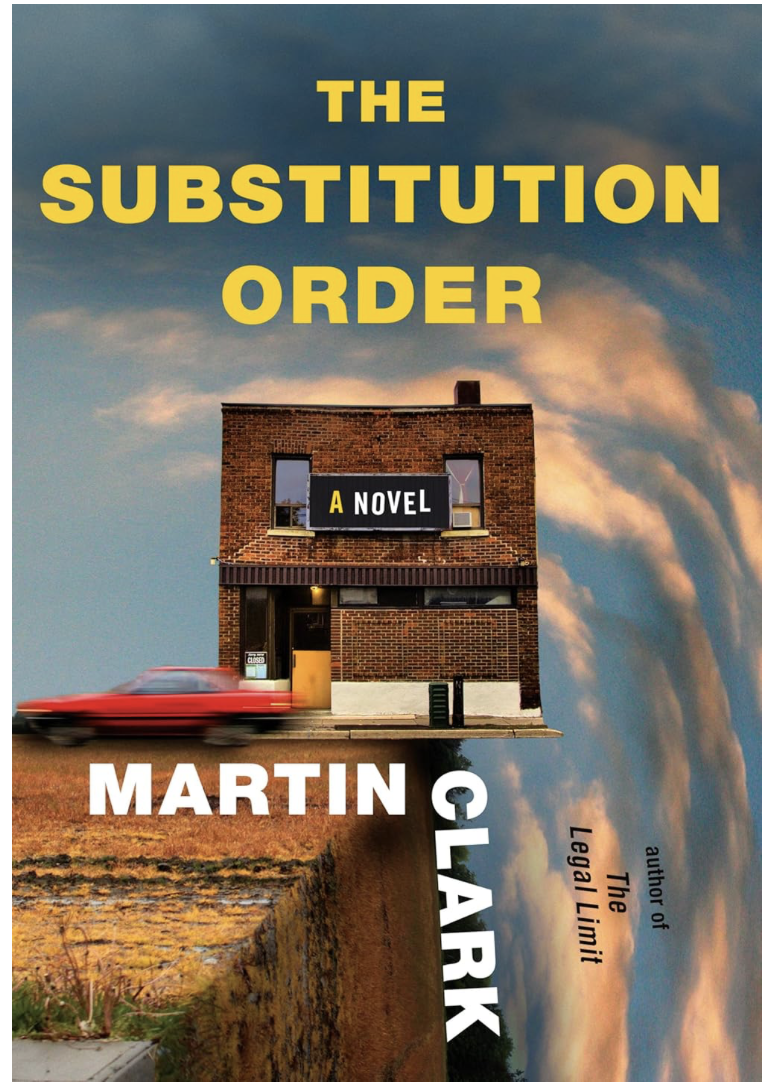
A tense exploration of justice and the systems that decide who matters.
The Substitution Order isn't the legal thriller you think it's going to be. There's no slick courtroom monologue, no dramatic last-minute reveal that fixes everything. What you get instead is a story about a disgraced lawyer named Kevin Moore trying to do right in a system that wasn't built with people like him — or his client — in mind.
This is a book about how power actually works. Not the official version — who holds the gavel, who sits at the bench — but the unofficial version. Who has leverage? Who gets grace? Who gets crushed quietly while everyone looks the other way. The law in this book isn't a clean instrument. It's a system driven by people, and people have agendas, blind spots, and things they're protecting. Martin Clark doesn't pretend otherwise. That's what makes this book worth arguing about.
The discussion this book generates goes after the quiet complicity — the kind where nobody technically did anything wrong, but someone still ended up on the losing end of every decision. It goes after good intentions and the cost they actually entail. It goes after justice as a concept, the book refuses to define cleanly, and asks your room to define it instead.
This kit was built for the room that finished this book with a lot of feelings and nowhere to put them.
✦ What's Inside
✦ About This Book — Not the legal thriller it appears to be — A disgraced lawyer trying to do right in a system not built for him — Built for readers who've watched someone fight hard and still lose ground
✦ What This Book Is Really About — Power — who has it officially and who has it unofficially — Good intentions and what they actually cost — The quiet polite complicity where nobody technically did anything wrong — What justice looks like when it depends entirely on who's driving
✦ Discussion Questions — Three Tiers — Tier 1: Warmup questions that get everyone talking — Tier 2: Who held real power, where tension lived, whether good intentions made things worse — Tier 3: Whether the system is broken, workable, or just dependent on who's driving — Closes with: What question did this book refuse to answer?
✦ Activities — Verdict Vote: one major character decision — ethical, unethical, or understandable but wrong — System Swap: one key scene reimagined in a different context — big city vs. small town, wealthy client vs. broke one — Character on Trial: one character's choices on trial, two argue for, two argue against, everyone else is the jury
✦ Quote Prompts — Six prompts pointing toward specific kinds of passages — The moment power showed up without anyone raising their voice — The scene where the real conflict was happening just under the surface of the official one — The passage that made you think: this is exactly how people actually are
✦ For the Host — Suggested timing flow for a single session — Which questions to prioritize and which to save — How to let the conversation breathe
✦ Bonus Host Guide — A free facilitation toolkit included with every purchase
Details — Instant download PDF — Personal and single-group use. No redistribution or resale. — Fan-created guide. Not affiliated with or endorsed by Martin Clark or any publisher.
Licensing for classrooms, libraries, and educational programs is available. If you plan to use this guide for a class, reading program, or institutional setting, please contact the shop owner to arrange an appropriate license.

A chilling exploration of control, surveillance, and how truth can be rewritten.
1984 has been so thoroughly absorbed into the language of political warning that it can feel more like a reference point than a story — something you cite rather than something you feel. This kit exists for the room that comes in thinking they already know what Orwell was saying, and leaves having a harder time than they expected explaining why it doesn't apply right now.
This book is not primarily about surveillance. It's about what happens when a system gains enough control over language, history, and fear to remake a person from the inside out — not just break them, but rebuild them into something that genuinely loves what it was made to love. The telescreens are almost beside the point. The real mechanism is what happens inside Winston's mind long before the Ministry of Love gets hold of him. A book club that only talks about Big Brother as metaphor will miss the psychological machinery underneath — the paranoia that exhausts you, the trust that destroys you, the love story that turns out to be the most effective lever the Party had all along.
This kit was built to go there. Not just to the politics. To the mechanisms.
This kit was built for the room that comes in thinking 1984 is a warning from the past — and leaves arguing about whether it's a description of the present. That argument is the point.
✦ What's Inside
✦ About This Book — What 1984 looks like from the outside — What it actually does to you from the inside — Why coming back to it hits harder than the first time
✦ What This Book Is Really About — Manufactured reality and the erasure of language — Intimacy turned into a weapon — The hypocrisy of ruling classes across every era — What Winston and Julia's relationship actually was
✦ Discussion Questions — Three Tiers — Tier 1: Warmup questions that establish the range of reader experiences — Tier 2: Winston's trust, the Party's methods, and the logic of total power — Tier 3: Personal, uncomfortable, unresolvable — Closes with: What question did this book refuse to answer?
✦ Character on Trial — Winston Smith, Julia, O'Brien — Prosecution/defense structure — Hard position questions with mandatory reversal — No neutral positions allowed
✦ Activities — Verdict Vote: Winston's decision to trust O'Brien — Room 101: the thing the system could use to own you completely — The Loyalty Test: the performances of belief most people have made without naming them — Rewrite the Resistance: Winston's most avoidable mistake — and whether avoiding it was possible
✦ Quote Prompts — Six prompts across six emotional entry points — The physical texture of paranoia — The seductive coherence of the Party's logic — The quiet devastation of the ending
✦ Spoiler Corner — Host only — three escalation questions for when the conversation needs a jolt — Whether Winston's erasure is the most honest ending or the most defeating one — What it means that the love story was also the trap — How close the Party's logic gets to systems we can actually name
✦ For the Host — How this book divides first-timers from rereaders — How to handle the political thread without letting it swallow everything else — Content sensitivity notes for the torture and Room 101 sequences — Full timing flow and guidance for two different kinds of rooms
✦ Bonus Host Guide — A free facilitation toolkit included with every purchase
Details — Instant download PDF — 20+ pages, print-ready — Personal and single-group use. No redistribution or resale. — Fan-created guide. Not affiliated with or endorsed by the Orwell estate or any publisher.
Licensing for classrooms, libraries, and educational programs is available. If you plan to use this guide for a class, reading program, or institutional setting, please contact the shop owner to arrange an appropriate license.
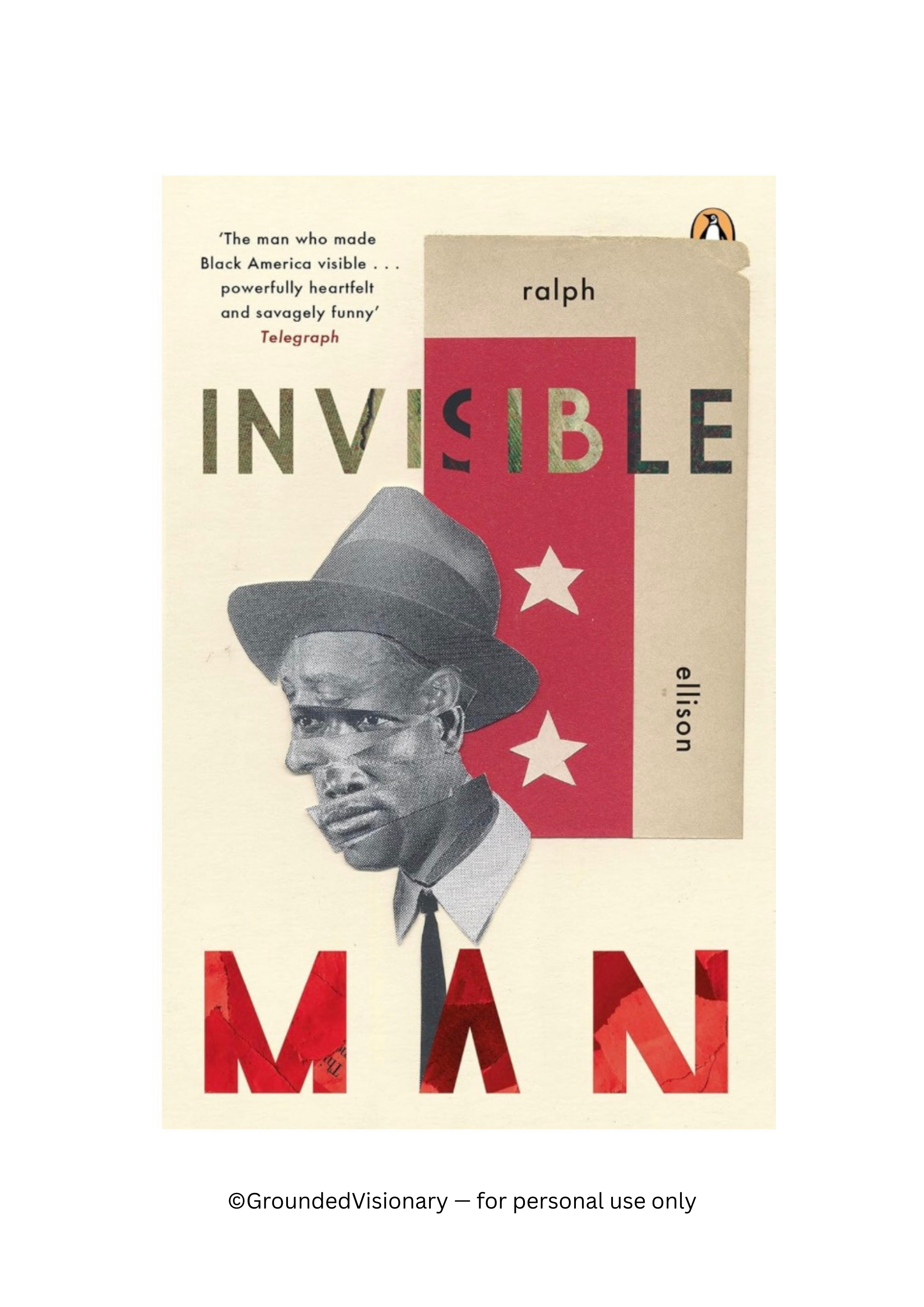

A powerful exploration of identity, invisibility, and what it means to be seen in America
Ralph Ellison published Invisible Man in 1952 and won the National Book Award the following year. That is not why you should read it. You should read it because it is one of the few novels that tells the truth about what it feels like to be a Black person in America who is doing everything right — and discovering that the people on the other side of every door were never actually looking at you. They were looking at what they needed you to be. Those are not the same thing.
The narrator of this novel has no name. He is brilliant, articulate, ambitious, and genuinely talented — and none of it protects him. Not from the white men who use him as entertainment. Not from the Black college president who shakes his hand and passes him letters designed to destroy him. Not from the progressive organization that gives him a platform and calls it liberation while using him as a tool. Every institution the narrator enters promises visibility and delivers a more sophisticated version of the same erasure. Ellison's argument is not that the system is broken. It is that the system is working exactly as designed — and that the most dangerous version of that system is the one that has learned to speak the language of liberation while running the same machinery underneath.
This kit was built to get the room past the plot and into that argument. Past the Battle Royal and into what it reveals about who was watching and why. Past Bledsoe's handshake and into what the letters actually said about who he was willing to sacrifice. Past the Brotherhood's platform and into what it was actually running underneath. The discussion goes personal. The activities go uncomfortable. The Verdict Vote asks the room to decide whether the Brotherhood was more dangerous to Black people in Harlem than the systems it claimed to oppose — and then defend that answer.
This kit was built for the room that needs somewhere to put what this book stirred up.
✦ What's Inside
✦ About This Book — What invisibility looks like when it isn't loud — Why the narrator has no name and what that costs him — Built for the room that needs somewhere to put what this book stirred up
✦ What This Book Is Really About — What ambition costs when the system was never going to reward it — Why progressive institutions cause a specific damage that outright opposition never could — The machinery running underneath the language of liberation
✦ Discussion Questions — Three Tiers — Three tiers: warmup through conversation-enders — The Battle Royal, Bledsoe's letters, and the Brotherhood's glass eye — What the grandfather's dying words actually meant — Closes with: What question did this book refuse to answer?
✦ Where This Book Leaves You — The underground as clarity or defeat — What is left when every institution has failed you — Whether the narrator ever actually sees clearly — and when
✦ Character on Trial — Dr. Bledsoe, Brother Jack, Ras the Exhorter — Prosecution/defense structure — Hard position questions with mandatory reversal — No neutral positions allowed
✦ Activities — The Invisibility Audit: the gap between how you are seen and who you actually are — The Mask Inventory: what each performance cost and what it protected — Cost Ledger: what each institution promised, delivered, and took — The Grandfather's Riddle: what the dying advice actually meant — Verdict Vote: was the Brotherhood more dangerous than the systems it claimed to oppose
✦ Quote Prompts — Six prompts across six distinct kinds of readers — The passage that hurt — The one that felt like last week — The one you couldn't dismiss
✦ Spoiler Corner — Host only — use when the conversation needs a jolt — Tod Clifton's ending, the Brotherhood's final betrayal, and the emergence Ellison wouldn't write
✦ For the Host — Four kinds of readers this book brings into the same room — How to handle the Battle Royal, Ras, and the grandfather's riddle — Timing flow and meeting structure — Good host note for two different kinds of rooms
✦ Bonus Host Guide — A free facilitation toolkit included with every purchase
Details — Instant download PDF — Personal and single-group use. No redistribution or resale. — Fan-created guide. Not affiliated with or endorsed by the Ralph Ellison estate or any publisher.
Licensing for classrooms, libraries, and educational programs is available. If you plan to use this guide for a class, reading program, or institutional setting, please contact the shop owner to arrange an appropriate license.
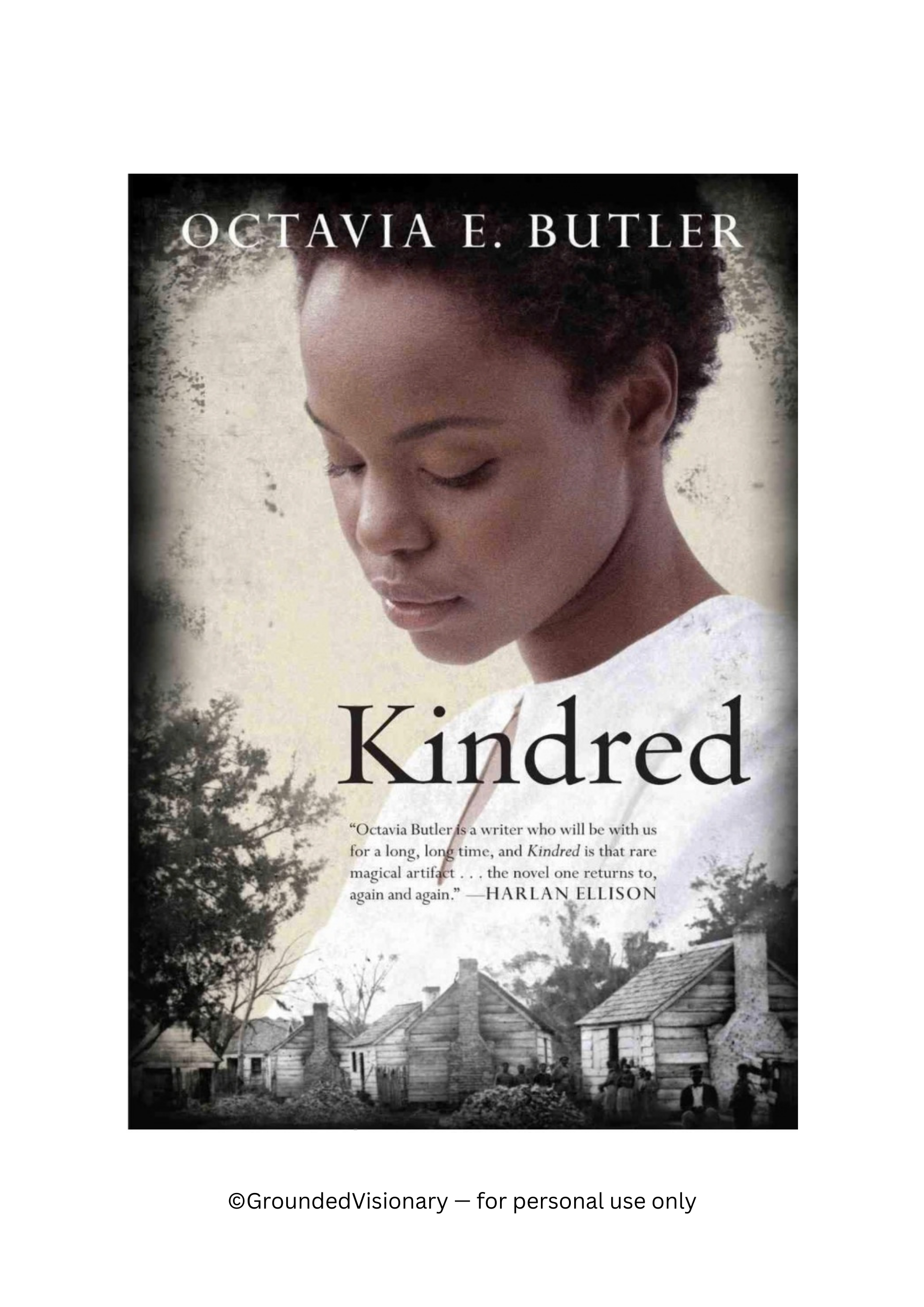

A brutal, time-bending look at slavery, survival, and how the past refuses to stay buried.
Octavia Butler wrote Kindred because young Black Americans in the 1960s and 70s kept saying they never would have tolerated what their enslaved ancestors endured. Dana Franklin is her answer to that argument — and it is not a gentle one.
This is not a time travel story. The time travel is real but it is never explained and never the point. What pulls Dana back, again and again, to a Maryland plantation before the Civil War is something older and more inescapable than physics: she is tethered to a white slaveholder's son because he is her ancestor, and he must survive in order for her to exist. Across six trips she keeps him alive, negotiates with his world, and makes choices she could not have imagined making before she arrived. By the end she has lost an arm and the novel has made its argument: the past does not stay in the past. It comes home with you.
This kit was built for a room willing to sit with what Butler is actually asking. Not whether slavery was evil — it was — but what it does to the people inside it, all of them, and what it means that its damage didn't end when the institution did. The discussion goes to Dana's survival compromises, to Rufus's humanity and his monstrosity, to Alice's uncompromising resistance and what it costs her, to Kevin's good intentions and their limits. It goes personal. It goes uncomfortable. It goes exactly where the book demands.
This kit was built for a room that can hold the full weight of what Butler wrote — the survival, the compromise, the damage that comes home in the body, and the question of what we owe the people history didn't give a way out.
Note: This guide contains material addressing sexual violence, rape, coercion, and racial trauma consistent with the novel's content. A content warning page is included at the front of the guide with specific facilitation guidance for hosts.
✦ What's Inside
✦ Content Warning — Sexual violence, rape, coercion, racial trauma — Facilitation guidance included for hosts — Placed at the front — this book earns it
✦ About This Book — Not the time travel story it appears to be — The difference between knowing history and living inside it — What kind of conversation this kit was built for
✦ What This Book Is Really About — Four threads worth following into discussion — The Dana and Alice parallel — The Kevin problem — The book's argument about what the past leaves in the body
✦ Discussion Questions — Three Tiers — Three tiers built specifically for this book — Tier 1: Warmup questions that get everyone talking — Tier 2: Deeper questions requiring a position and a defense — Tier 3: Questions that go somewhere uncomfortable — Closes with: What question did this book refuse to answer?
✦ Character on Trial — Dana, Rufus, Kevin, and Alice — Prosecution/defense structure — Hard position questions with mandatory reversal — No neutral positions allowed
✦ Activities — Verdict Vote: Rufus's treatment of Alice — The Cost Ledger: what each trip took from Dana — The Survival Question — The Witness Problem — What Alice Deserved
✦ Quote Prompts — Seven prompts pointing toward specific kinds of passages — The moment Dana made a choice you understood and couldn't have made — The passage where the past stopped being history and became present
✦ Spoiler Corner — Host only — three escalation questions for when the conversation needs a jolt
✦ For the Host — How this book will divide the room — Content sensitivity notes and facilitation guidance — Full timing flow for two different kinds of rooms
✦ Bonus Host Guide — A free facilitation toolkit included with every purchase
Details — Instant download PDF — 45+ pages, print-ready — Personal and single-group use. No redistribution or resale. — Fan-created guide. Not affiliated with or endorsed by Octavia Butler's estate or any publisher.
Licensing for classrooms, libraries, and educational programs is available. If you plan to use this guide for a class, reading program, or institutional setting, please contact the shop owner to arrange an appropriate license.
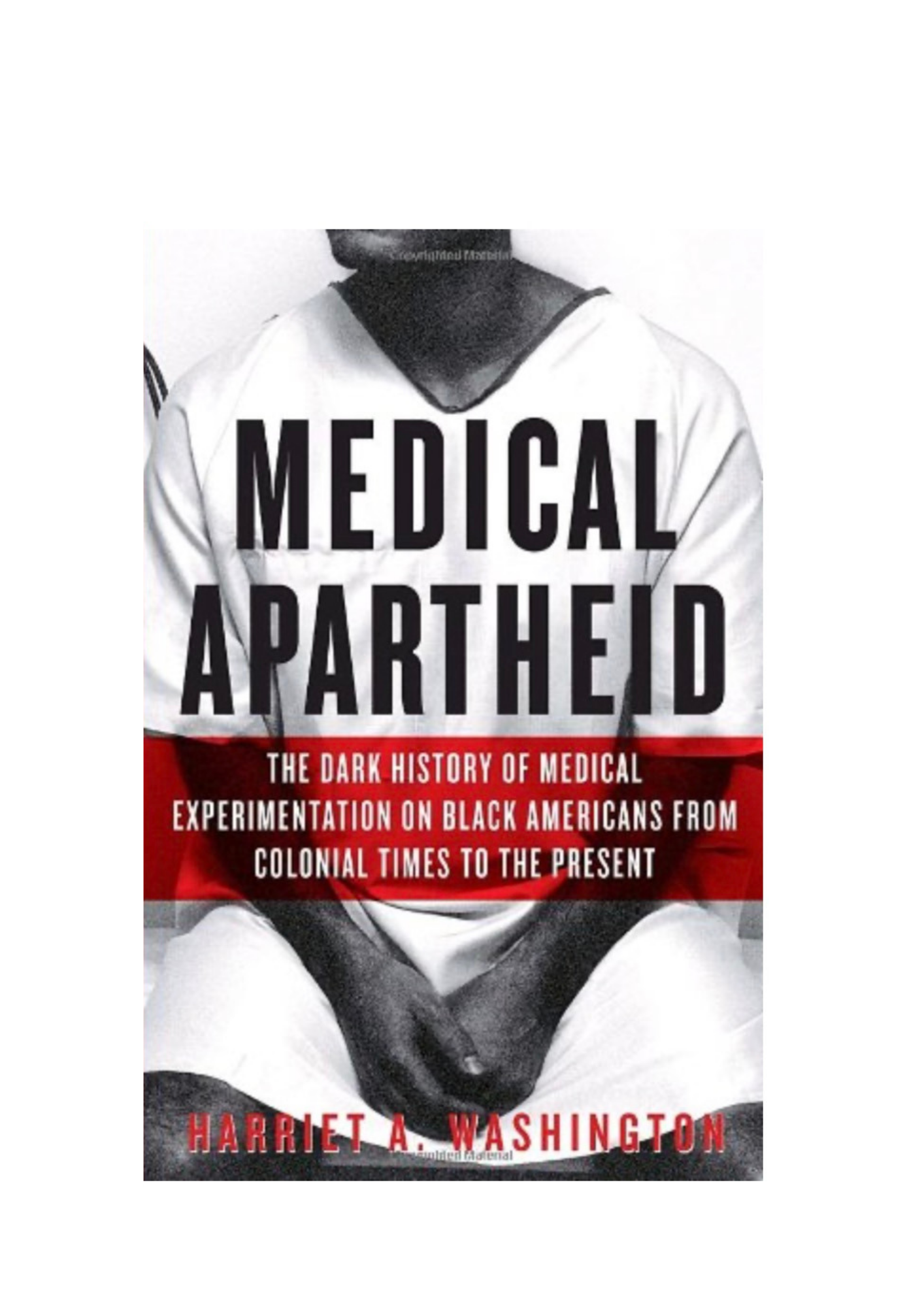


Harriet A. Washington spent years in medical journals and experimental reports that had gone largely undisturbed. What she found was not a collection of isolated incidents. What she found was a system.
J. Marion Sims is considered the father of modern gynecology. The techniques he pioneered were developed by operating repeatedly on enslaved Black women without consent and without anesthesia — because the medical establishment had decided Black people felt less pain. That is not a footnote to the history of American medicine. That is the history of American medicine. Washington traces that history from slavery through Tuskegee through government biological warfare testing on Black communities through contemporary pharmaceutical research. Her argument is not that these are separate horrors. Her argument is that they are the same horror expressed across four centuries by an institution that has never fully reckoned with what it built on.
This kit was built for the room that can handle that argument. Not the room that wants to be reassured that things are better now — Washington addresses that too, and her answer is complicated — but the room willing to sit with what American medicine was built on and ask what that means for what it is now. Washington ends her book not with condemnation but with a complicated ask: she wants Black Americans to participate in medical research despite everything she has just documented. This kit was built to make sure the room argues about whether that ask is reasonable — and what it reveals about where the burden of repair actually lives.
This kit was built for the room that finished Medical Apartheid and needed somewhere to put everything the book left in them.
Content note: This guide discusses medical experimentation on enslaved people, forced sterilization, grave robbing, government biological warfare testing on Black communities, and the ongoing health consequences of four centuries of medical racism. These are not incidental to Washington's argument — they are the argument. Please consider your group's readiness for this material before purchasing.
✦ What's Inside
✦ About This Book — Not a history of isolated incidents — A system documented across four centuries — The body not safe in life and not safe in death — Built for the room that can handle what American medicine was built on
✦ What This Book Is Really About — The myth of Black pain tolerance from Sims to today — Grave robbing as policy not aberration — Tuskegee as the most documented example of a pattern not the exception — The government chose bald eagles over Black Americans and documented it — Eugenics American style and its influence on Nazi Germany — Washington's complicated final ask
✦ Discussion Questions — Three Tiers — Tier 1: Entry points, no position required yet — Tier 2: Make the case both ways — Sims's legacy, Tuskegee as container or reckoning, where the burden of repair lives — Tier 3: Personal, uncomfortable, unresolvable — Closes with: What question did this book refuse to answer?
✦ Character on Trial — J. Marion Sims: the father of modern gynecology and what that title was built on — The Tuskegee Public Health Service: the institution not the individual — The American Medical Establishment: four centuries of documented harm — No neutral positions allowed — Final synthesis: what would genuine accountability actually look like
✦ Activities — The Body Ledger: what was taken that has never been returned or repaired — The Informed Consent Exercise: one sentence of what genuine disclosure would have required — The Pattern Map: trace one thread from slavery to the present without it breaking — The Personal Reckoning: lived experience, family stories, the moment Washington's documentation became personal — Verdict Vote: is Washington's final ask reasonable
✦ Quote Prompts — Six prompts, six emotional entry points — The passage that reframed something you thought you understood — The moment the weight of the pattern required you to stop — The sentence where the through line became undeniable
✦ Spoiler Corner — Host only — full knowledge of the entire book required — The cover-up of the Tuskegee cover-up — The bald eagles decision and where accountability lives — Washington's ending and whether it places the burden of repair on the people who were harmed
✦ For the Host — Three fault lines: Washington's ending, individual versus institutional accountability, and proximity — How to hold space for medical professionals in the room — How to hold space for the room that arrives already angry — Timing flow for a single session
✦ Bonus Host Guide — A free facilitation toolkit included with every purchase
Details — Instant download PDF — 20+ pages, print-ready — Personal and single-group use. No redistribution or resale. — Fan-created guide. Not affiliated with or endorsed by Harriet A. Washington or any publisher.
Licensing for classrooms, libraries, and educational programs is available. If you plan to use this guide for a class, reading program, or institutional setting, please contact the shop owner to arrange an appropriate license.
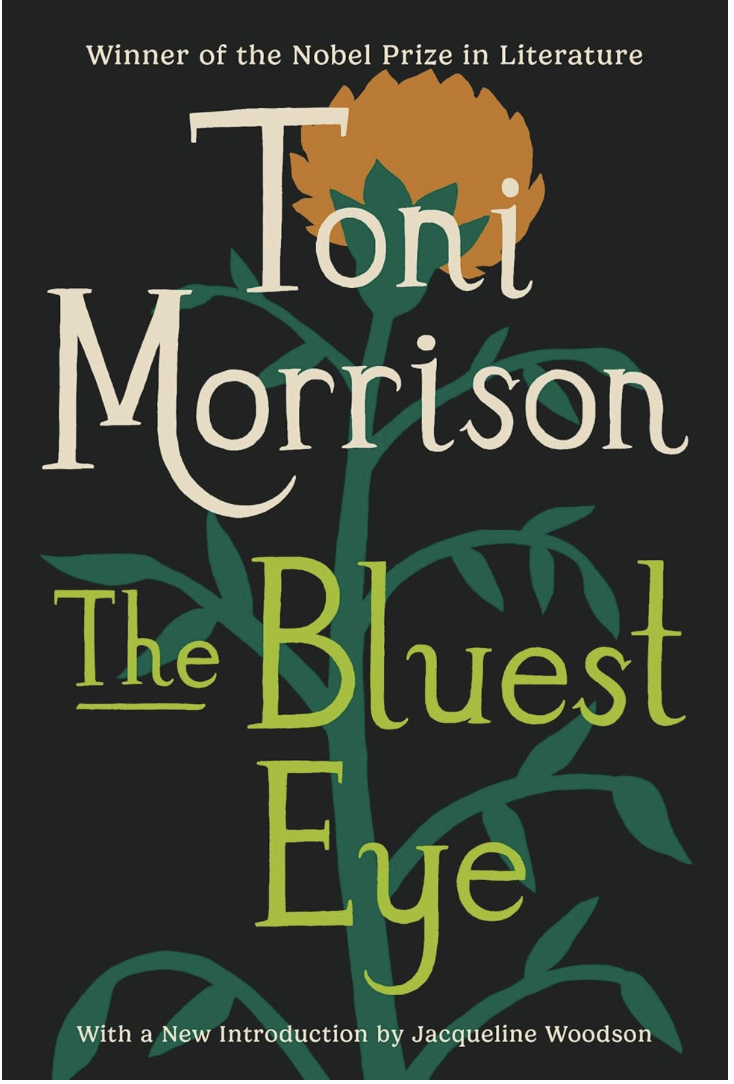
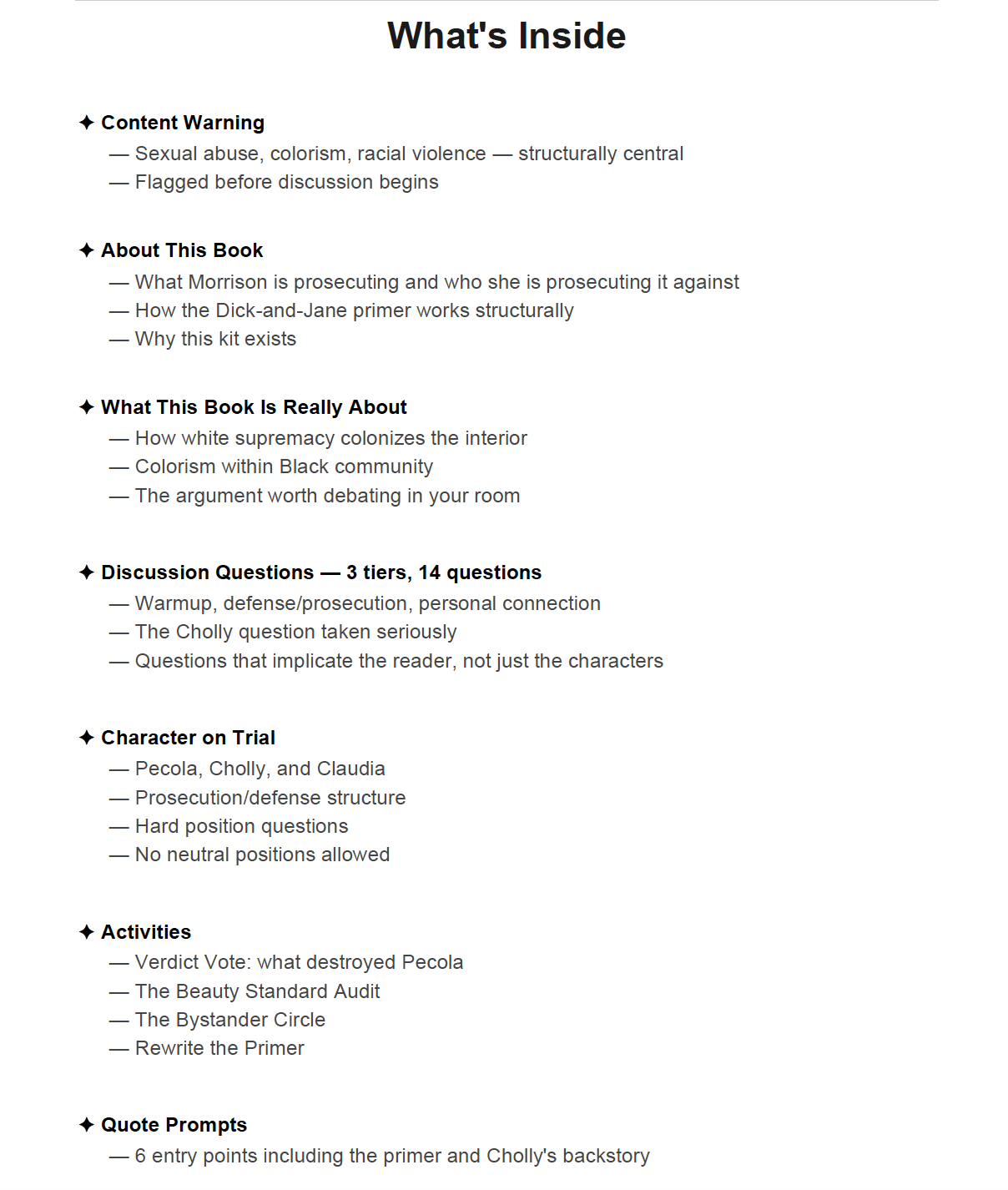
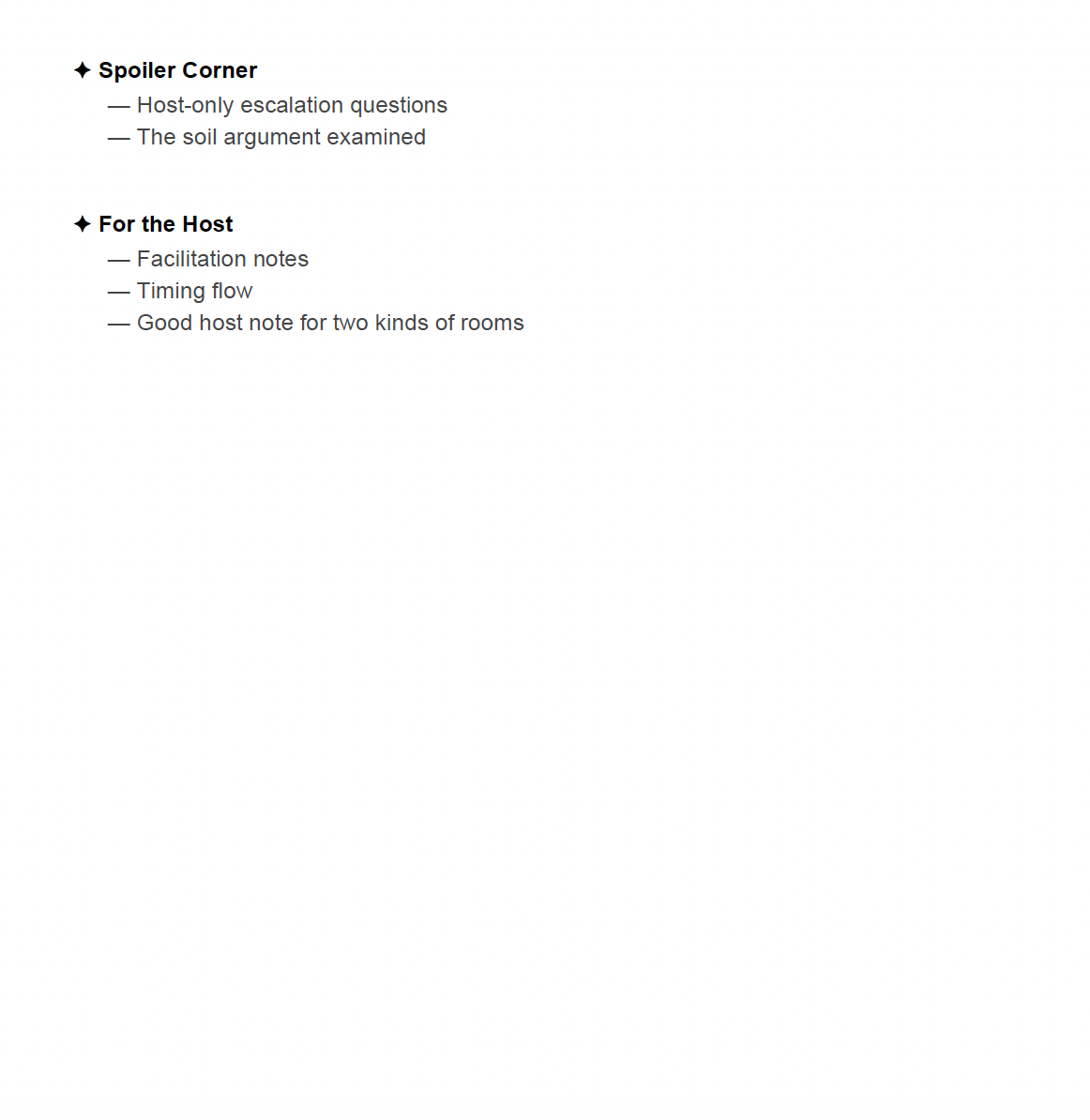
A devastating look at beauty, identity, and how deeply rejection can shape a life.
The Bluest Eye is Morrison's argument that beauty is one of racism's most effective weapons — the standard that decides whose face deserves love — and that when a child internalizes that standard completely, what happens to her cannot be called an accident. This is not a book about a bad father and a broken family. It is a book about a world that built Pecola, looked through her rather than at her, and then called what happened to her tragedy instead of consequence.
This kit follows Morrison's argument all the way through. Into the Dick-and-Jane primer that frames the novel. Into the community that participated in Pecola's erasure without raising a hand. Into the chapter written from Cholly's perspective — the one that asks you to understand how a man becomes capable of what he did, without letting him off the hook for it. That chapter is the hardest thing in this book and this kit does not skip it.
One question in each tier asks readers to bring something from their own lives: a standard they absorbed that wasn't made for them, what they did with it, and whether they still carry it.
This kit was built for a room willing to follow Morrison's argument all the way through — past the obvious villain, past the comfortable verdict, into what she is actually accusing.
Note: This guide contains discussion of child sexual abuse, rape, incest, and colorism as they appear in the novel. The content warning section includes host guidance for facilitating this material responsibly.
✦ What's Inside
✦ Content Warning — Child sexual abuse, rape, incest, colorism — Host guidance for facilitating difficult material — Placed at the front — this book earns it
✦ About This Book & What This Book Is Really About — Beauty as weapon, not standard — The community's role in Pecola's destruction — Why Cholly is not the ending Morrison wrote toward
✦ Discussion Questions — Three Tiers — 14 questions built specifically for this book — Tier 1: Entry points, no position required yet — Tier 2: Make the case both ways — Tier 3: Personal, uncomfortable, unresolvable — One question per tier asks readers to bring something from their own lives
✦ Character on Trial — Cholly Breedlove, Pauline Breedlove, Claudia MacTeer — Prosecution/defense structure — No neutral positions allowed — No comfortable verdicts
✦ Activities — Verdict Vote: Who is most responsible for Pecola — Cholly, the system, or the community? — The Beauty Ledger: standards you absorbed that weren't made for you — The Cholly Chapter: a structured activity for the novel's most difficult section — Verdict Vote: Pauline — moral failure or symptom?
✦ Quote Prompts — Six prompts across different emotional entry points — The passage that named something you absorbed without knowing it — The moment Morrison refused to let the community off the hook
✦ Spoiler Corner — Host only — escalation questions for when the conversation needs a jolt
✦ For the Host — Why Cholly is not the ending Morrison wrote toward — Timing flow and facilitation notes — How to hold the Cholly chapter without letting the room collapse into it
Details — Instant download PDF — 20+ pages, print-ready — Personal and single-group use. No redistribution or resale. — Fan-created guide. Not affiliated with Toni Morrison, her estate, or any publisher.
Licensing for classrooms, libraries, and educational programs is available. Contact GroundedVisionary through the shop.
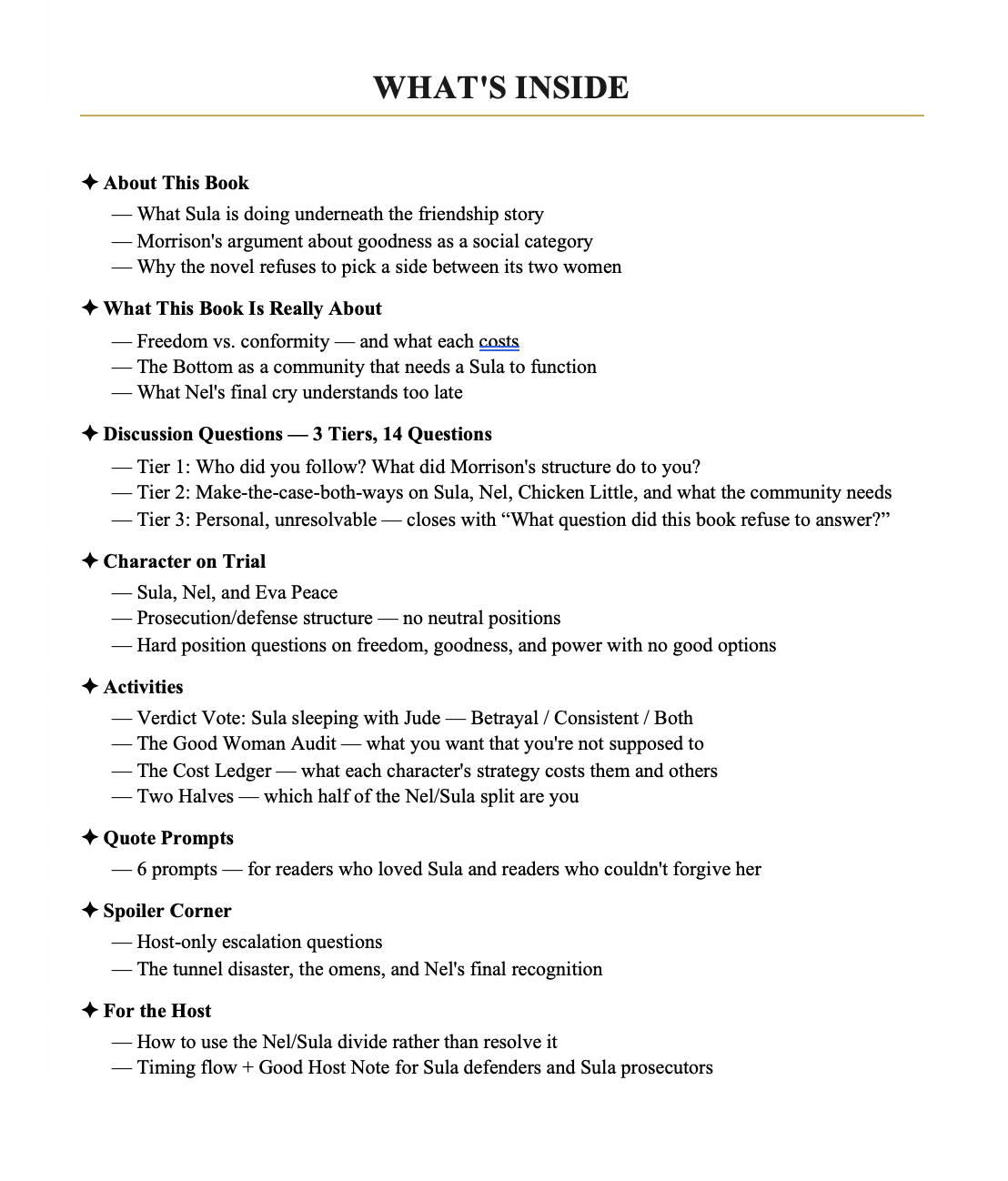
A sharp exploration of friendship, freedom, and the cost of living outside expectations.
Toni Morrison didn't write Sula to be liked. She wrote her to be argued about.
This is a novel about what goodness actually costs — and who pays when a Black woman refuses to perform it. Nel chose the life her community required. Sula chose herself. Morrison doesn't let either of them off the hook. Neither does this kit.
The discussion this book generates isn't really about Sula. It's about what you want that you've been told a good woman shouldn't want. What it costs to claim it. What it costs to suppress it. And what you recognize in Nel and Sula from inside your own friendships and choices — the ones you've never said out loud in a room full of people.
This kit was built for a room that doesn't want to settle the question of whether Sula is good or bad. Because Morrison didn't write a novel that lets you.
✦ What's Inside
✦ About This Book & What This Book Is Really About — Goodness as performance, not morality — What the community requires and what it costs — Why Morrison refuses to let either woman win
✦ Discussion Questions — Three Tiers — 14 questions built specifically for this book — Tier 1: Entry points, no position required yet — Tier 2: Make the case both ways — Tier 3: Personal, uncomfortable, unresolvable
✦ Character on Trial — Sula, Nel, and Eva Peace — Prosecution/defense structure — No neutral positions allowed — Hard position questions with mandatory reversal
✦ Activities — Verdict Vote: Was sleeping with Jude a betrayal, consistent, or both — simultaneously? — The Good Woman Audit: what you want that you're not supposed to — The Cost Ledger: what each character's survival strategy costs them and others — Two Halves: which side of the Nel/Sula split are you — and what would you borrow?
✦ Quote Prompts — Six prompts across different emotional entry points — The passage that named something you'd never said out loud — The moment Morrison refused to let you look away
✦ Spoiler Corner — Host only — escalation questions for when the conversation needs a jolt
✦ For the Host — Timing flow and facilitation notes — Good host note for Sula defenders and Sula prosecutors — What the room will want to skip and why they shouldn't
Details — Instant download PDF — 20+ pages, print-ready — Personal and single-group use. No redistribution or resale. — Fan-created guide. Not affiliated with Toni Morrison, her estate, or any publisher.
Licensing for classrooms, libraries, and educational programs is available. Contact GroundedVisionary through the shop.
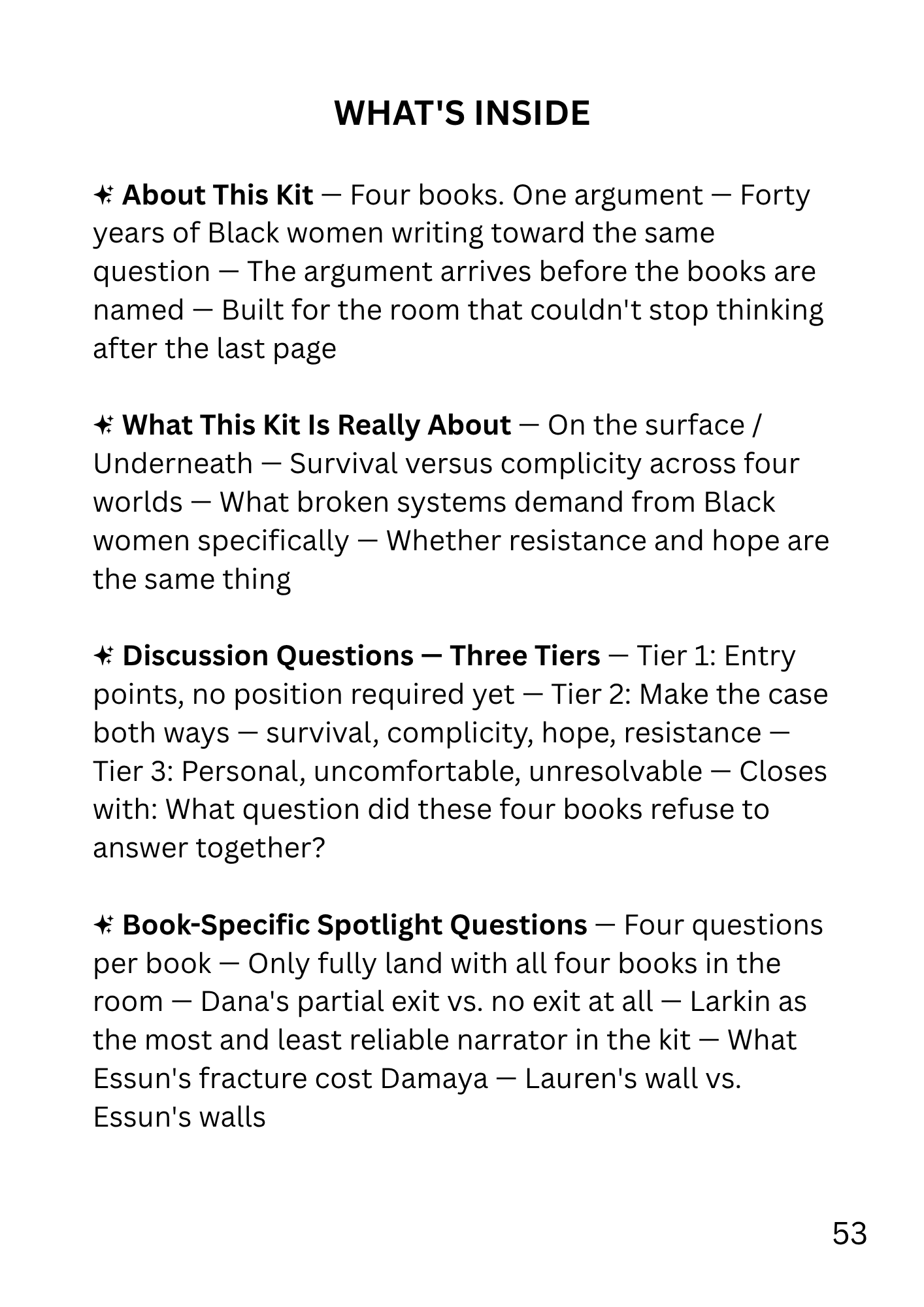
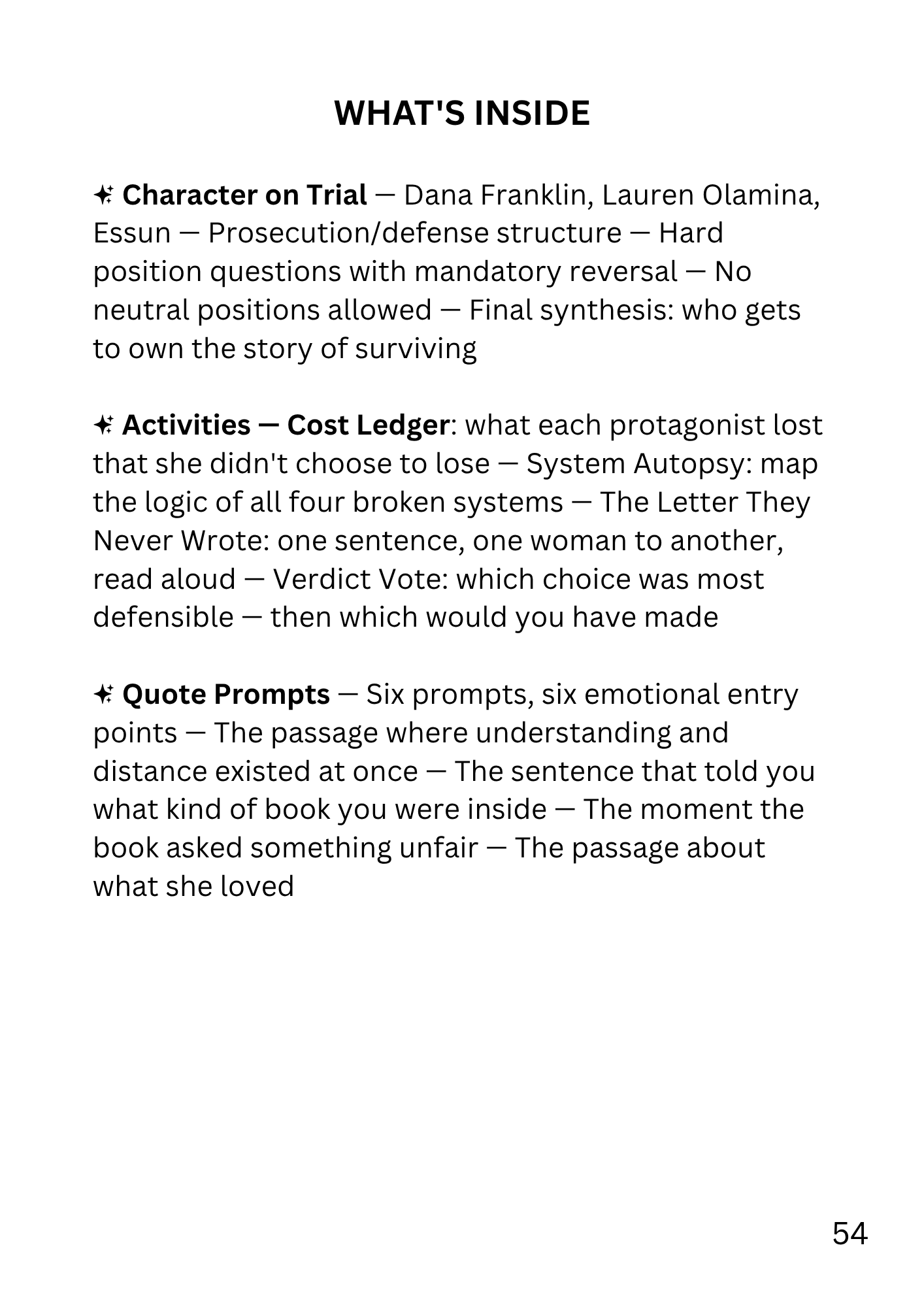
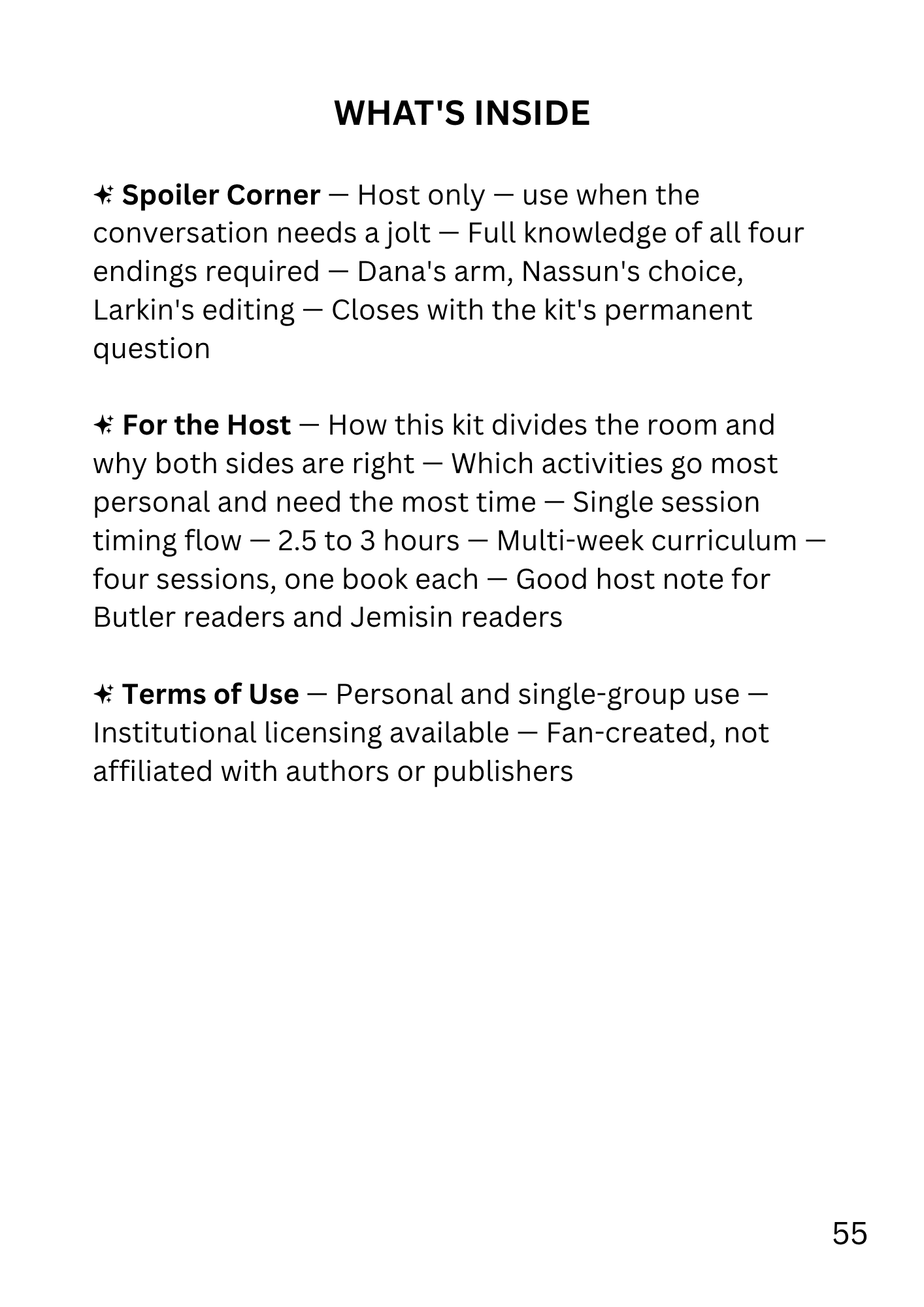
Four books. Two authors. Forty years of the same question asked four different ways: when the system you are inside was built to consume you, what does surviving it actually cost?
Kindred sends a Black woman back into antebellum slavery with a partial exit and no blueprint. Parable of the Sower follows a fifteen-year-old building a philosophy in a journal while the world burns around her. Parable of the Talents asks what happens when that vision becomes real and someone has to live inside the consequences. The Fifth Season fractures its protagonist across time, tells her story out of order, and addresses her directly — as you — before you know who you are. These are not the same story. But they are in conversation across four decades whether your book club knows it or not. This kit makes that conversation explicit, structured, and worth three hours of serious argument.
Octavia Butler and N.K. Jemisin are not making the same argument in the same way. Butler's prose is direct and precise — she names what the system is doing and doesn't look away. Jemisin's is structurally aggressive — second person, fractured timeline, information withheld until the moment it lands hardest. The difference between how these two authors tell stories about Black women surviving broken worlds is itself worth a full discussion. This kit builds that discussion in.
Dana Franklin, Lauren Olamina, Larkin, and Essun are not interchangeable protagonists. They survive differently, lose differently, build differently, and pay different prices for all of it. What they share is a system designed with them specifically in mind — and the question of whether you get to call what you become on the other side survival, or something else. This kit follows that question across all four books and asks your room to answer it. Then it asks whether your answer changes when you stop evaluating these women and start being honest about what you would have done.
This kit was built for the room that finished all four books and realized they had been reading the same argument across decades without knowing it. It was built for the facilitator who wants to go somewhere real. And it was built to be used — in book clubs, in classrooms, in library reading series, in any room where people are willing to argue honestly about what survival costs and who gets to define it.
What's Inside
✦ About This Kit
— Four books. One argument
— Forty years of Black women writing toward the same question
— Built for the room that couldn't stop thinking after the last page
✦ What This Kit Is Really About
— Survival versus complicity across four worlds
— What broken systems demand from Black women specifically
— Whether resistance and hope are the same thing
✦ Discussion Questions — Three Tiers
— Tier 1: Entry points, no position required yet
— Tier 2: Make the case both ways — survival, complicity, hope, resistance
— Tier 3: Personal, uncomfortable, unresolvable
— Closes with: What question did these four books refuse to answer together?
✦ Book-Specific Spotlight Questions
— Four questions per book
— Only fully land with all four books in the room
— Dana's partial exit vs. no exit at all
— Larkin as the most and least reliable narrator in the kit
— What Essun's fracture cost Damaya
— Lauren's wall vs. Essun's walls
✦ Character on Trial
— Dana Franklin, Lauren Olamina, Essun
— Prosecution/defense structure
— Hard position questions with mandatory reversal
— No neutral positions allowed
✦ Activities
— Cost Ledger: what each protagonist lost that she didn't choose to lose
— System Autopsy: map the logic of all four broken systems
— The Letter They Never Wrote: one sentence, one woman to another, read aloud
— Verdict Vote: which choice was most defensible — then which would you have made
✦ Quote Prompts
— Six prompts, six emotional entry points
— The passage where understanding and distance existed at once
— The moment the book asked something unfair
— The passage about what she loved
✦ Spoiler Corner
— Host only — three escalation questions assuming full knowledge of all four endings
✦ For the Host
— Single session timing flow
— Multi-week curriculum — four sessions, one book each
— Good host note for Butler readers and Jemisin readers
Details
— Instant download PDF
— Note: This is not a bundle of the individual book guides. It is a standalone thematic discussion kit built around the cross-book argument these four books make together. Individual kits for Kindred, Parable of the Sower, Parable of the Talents, and The Fifth Season are available separately in the shop.
— Designed for groups that have read all four books
— Personal and single-group use. No redistribution or resale.
— Fan-created guide. Not affiliated with or endorsed by Octavia Butler, N.K. Jemisin, or any publisher.
Licensing for classrooms, libraries, and educational programs is available. If you plan to use this guide for a class, reading program, or institutional setting, please contact the shop owner to arrange an appropriate license.
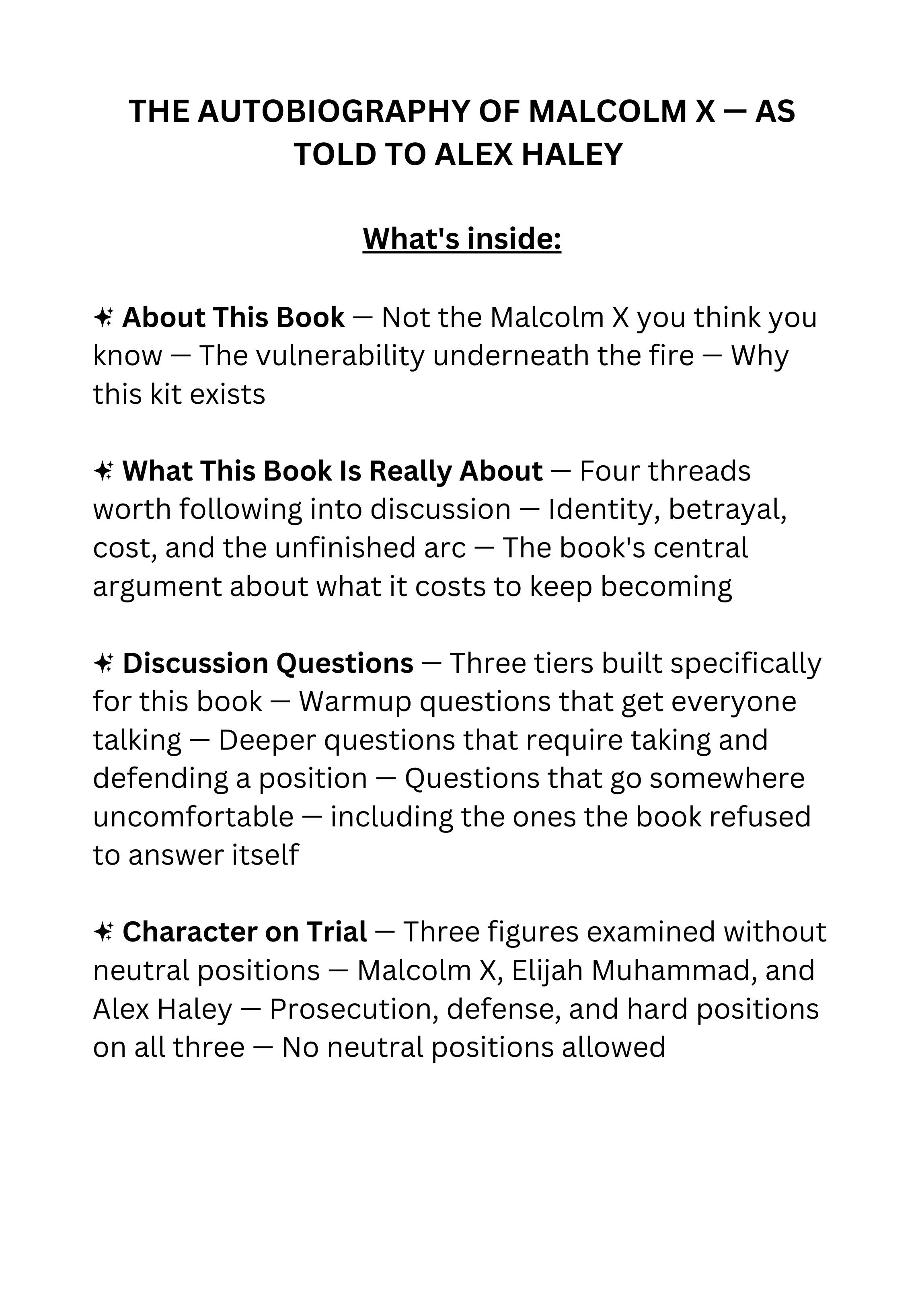
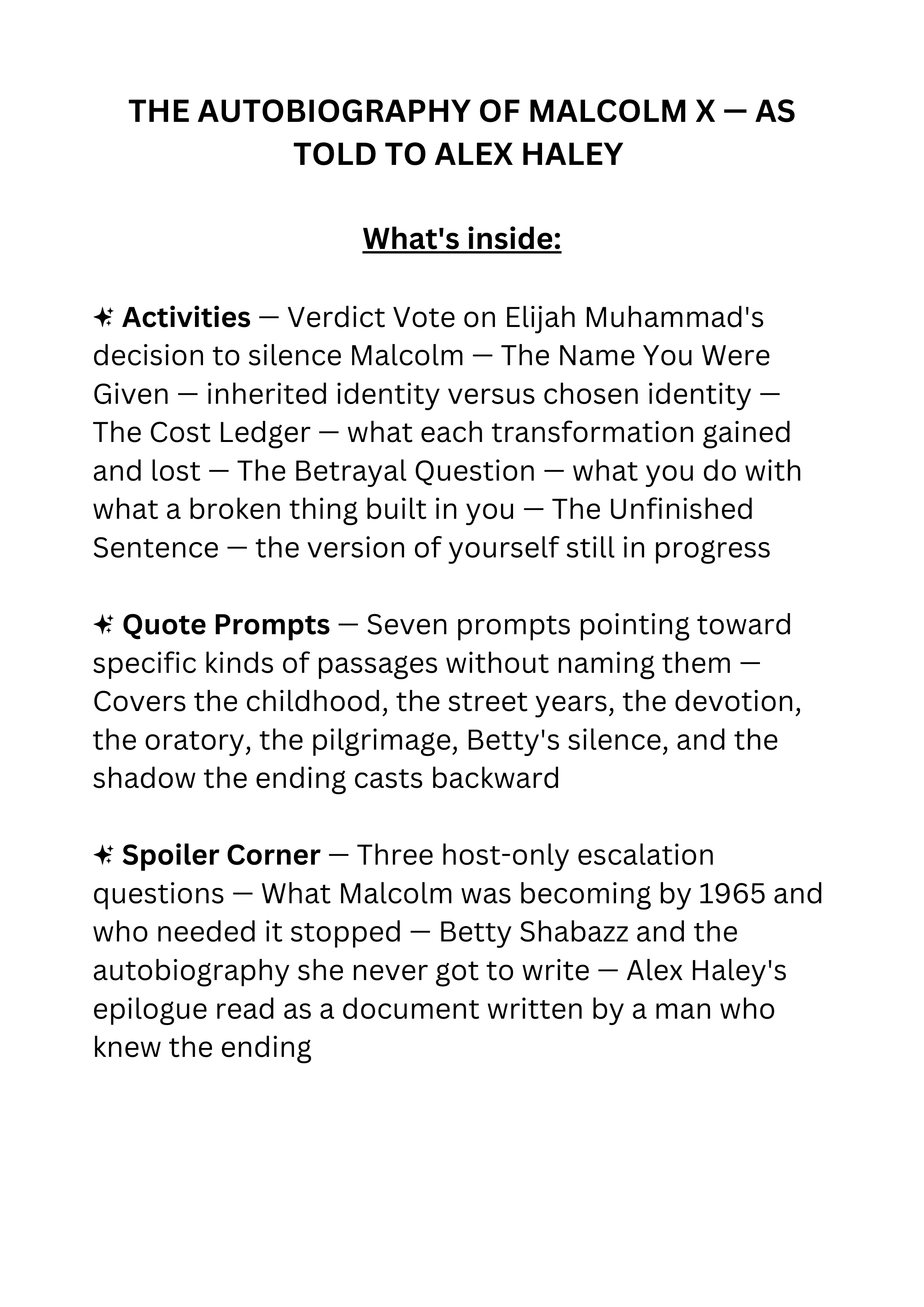
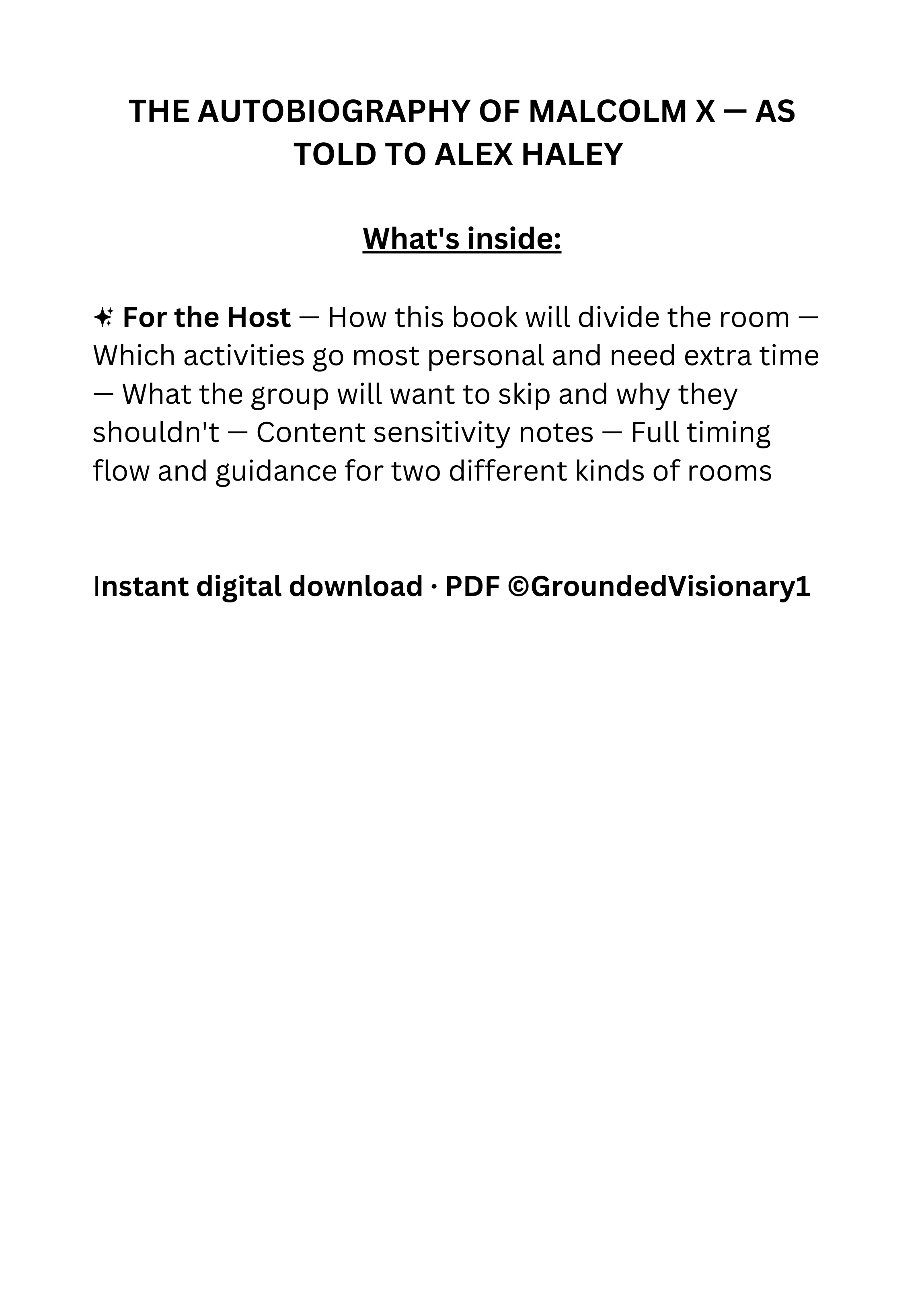
A raw, unfiltered look at transformation, truth, and the cost of seeing the world clearly.
This guide is built for readers who are ready to go beyond the speeches, beyond the image, and sit with the contradictions, the evolution, and the cost of becoming.
This guide is for:
Readers who finished the book and still have questions
Book clubs that aren’t afraid of disagreement
Educators and discussion leaders who want depth—not filler
If your conversations usually stay on the surface… this will change that.
This isn’t just a list of questions.
It helps you:
Break down Malcolm X’s transformation without simplifying it
Navigate difficult conversations without shutting them down
Push past “what happened” into what it meant
Create discussions where people actually take positions
Inside the Guide:
✔ About This Book
Not the Malcolm X you think you know — the vulnerability beneath the fire — and why this guide exists
✔ What This Book Is Really About
Identity, betrayal, transformation, and the cost of becoming — four threads designed to carry real discussion
✔ Discussion Questions (3 Levels)
Warm-up (get people talking)
Position-based (people choose sides)
Uncomfortable (the questions the book leaves unresolved)
✔ Character on Trial
Malcolm X. Elijah Muhammad. Alex Haley.
No neutral positions allowed.
✔ Activities That Go Deeper
Identity vs inheritance, betrayal, transformation, and unfinished self
✔ Quote Prompts
Designed to pull out the most important moments—without spoon-feeding them
✔ Spoiler Section (For Hosts)
Escalation questions + deeper angles most discussions avoid
✔ Host Guide
Timing, flow, sensitive topics, and how to manage a divided room
After using this guide, your discussion won’t sound like:
“Did you like the book?”
It will sound like:
“I don’t agree with that—and here’s why.”
“I never thought about it like that before.”
“That changes how I see him completely.”
⚡ FORMAT
Instant digital download (PDF)
Designed for personal use, book clubs, or classroom discussion
No results found
No results match your search. Try removing a few filters.