 Image 1 of 4
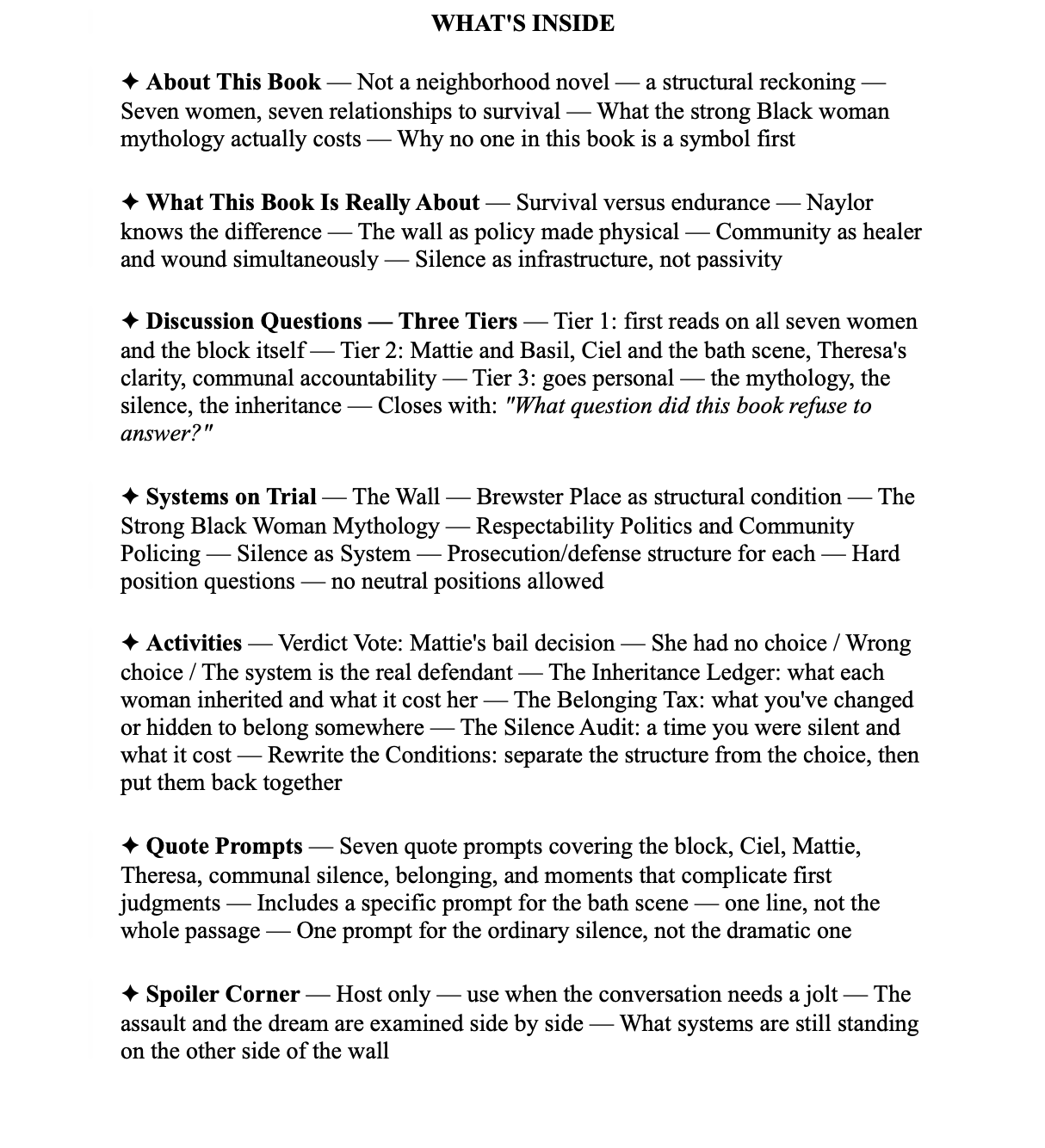 Image 2 of 4
 Image 3 of 4
 Image 4 of 4
Gloria Naylor didn't write a novel about a neighborhood. She wrote a reckoning about what happens to Black women when the world gives them no soft place to land — and then judges how they survive the fall. The Women of Brewster Place gets called a community portrait, a friendship story, a tragedy.
The seven women at the center of this novel arrived at Brewster Place the way people arrive at last resorts: after something else failed, after someone left, after the options narrowed down to this. Mattie Michael, who has lost everything once already and rebuilt it with her hands. Ciel, who disappeared so completely inside her love for Eugene that Mattie had to physically hold her back into her own body. Etta Mae, who understood early that beauty was currency, has been calculating the interest ever since. Kiswana, who chose Brewster Place from a position of privilege and is still learning what it means to inherit a struggle versus select one. Cora Lee, whose relationship to motherhood is more complicated than the judgment the block passes on her. And Lorraine and Theresa — who are not the side plot, not the tragedy, not the lesbian couple in the book, but Naylor's most precise and devastating argument about what communities do to the people they decide don't belong.
This discussion guide puts systems on trial, not characters. The wall goes on trial. The strong Black woman mythology goes on trial. Respectability politics and the silence that makes violence possible go on trial. Because Naylor's argument is structural — these women were failed before they made a single choice — and the guide is built to hold that argument without letting anyone in the room off the hook, including the reader.
✦ About This Book — Not a neighborhood novel — a structural reckoning — Seven women, seven relationships to survival — What the strong Black woman mythology actually costs — Why no one in this book is a symbol first
✦ What This Book Is Really About — Survival versus endurance — Naylor knows the difference — The wall as policy made physical — Community as healer and wound simultaneously — Silence as infrastructure, not passivity
✦ Discussion Questions — Three Tiers — Tier 1: first reads on all seven women and the block itself — Tier 2: Mattie and Basil, Ciel and the bath scene, Theresa's clarity, communal accountability — Tier 3: goes personal — the mythology, the silence, the inheritance — Closes with: "What question did this book refuse to answer?"
✦ Systems on Trial — The Wall — Brewster Place as structural condition — The Strong Black Woman Mythology — Respectability Politics and Community Policing — Silence as System — Prosecution/defense structure for each — Hard position questions — no neutral positions allowed
✦ Activities — Verdict Vote: Mattie's bail decision — She had no choice / Wrong choice / The system is the real defendant — The Inheritance Ledger: what each woman inherited and what it cost her — The Belonging Tax: what you've changed or hidden to belong somewhere — The Silence Audit: a time you were silent and what it cost — Rewrite the Conditions: separate the structure from the choice, then put them back together
✦ Quote Prompts — Seven prompts covering all seven women — Includes a specific prompt for the bath scene — one line, not the whole passage — One prompt for the ordinary silence, not the dramatic one
✦ Spoiler Corner — Host only — use when the conversation needs a jolt — The assault and the dream are examined side by side — What systems are still standing on the other side of the wall
✦ For the Host — Two fault lines: personal responsibility vs. structural accountability, lived experience vs. critical distance — Which activities go personal and need extra time — How to keep Lorraine specific instead of symbolic — Timing flow: 90 minutes, the Wall leads, Silence closes — Two room types: personal readers vs. structural readers
Details: Instant download — PDF delivered immediately at purchase. 20+ pages, print-ready. Licensed for personal and single-group use. Fan-created discussion guide — not affiliated with or endorsed by Gloria Naylor or her publisher.
Licensing for classrooms, libraries, and reading programs is available. If you plan to use this guide in an institutional or educational setting, please contact the shop to arrange an appropriate license.
Gloria Naylor didn't write a novel about a neighborhood. She wrote a reckoning about what happens to Black women when the world gives them no soft place to land — and then judges how they survive the fall. The Women of Brewster Place gets called a community portrait, a friendship story, a tragedy.
The seven women at the center of this novel arrived at Brewster Place the way people arrive at last resorts: after something else failed, after someone left, after the options narrowed down to this. Mattie Michael, who has lost everything once already and rebuilt it with her hands. Ciel, who disappeared so completely inside her love for Eugene that Mattie had to physically hold her back into her own body. Etta Mae, who understood early that beauty was currency, has been calculating the interest ever since. Kiswana, who chose Brewster Place from a position of privilege and is still learning what it means to inherit a struggle versus select one. Cora Lee, whose relationship to motherhood is more complicated than the judgment the block passes on her. And Lorraine and Theresa — who are not the side plot, not the tragedy, not the lesbian couple in the book, but Naylor's most precise and devastating argument about what communities do to the people they decide don't belong.
This discussion guide puts systems on trial, not characters. The wall goes on trial. The strong Black woman mythology goes on trial. Respectability politics and the silence that makes violence possible go on trial. Because Naylor's argument is structural — these women were failed before they made a single choice — and the guide is built to hold that argument without letting anyone in the room off the hook, including the reader.
✦ About This Book — Not a neighborhood novel — a structural reckoning — Seven women, seven relationships to survival — What the strong Black woman mythology actually costs — Why no one in this book is a symbol first
✦ What This Book Is Really About — Survival versus endurance — Naylor knows the difference — The wall as policy made physical — Community as healer and wound simultaneously — Silence as infrastructure, not passivity
✦ Discussion Questions — Three Tiers — Tier 1: first reads on all seven women and the block itself — Tier 2: Mattie and Basil, Ciel and the bath scene, Theresa's clarity, communal accountability — Tier 3: goes personal — the mythology, the silence, the inheritance — Closes with: "What question did this book refuse to answer?"
✦ Systems on Trial — The Wall — Brewster Place as structural condition — The Strong Black Woman Mythology — Respectability Politics and Community Policing — Silence as System — Prosecution/defense structure for each — Hard position questions — no neutral positions allowed
✦ Activities — Verdict Vote: Mattie's bail decision — She had no choice / Wrong choice / The system is the real defendant — The Inheritance Ledger: what each woman inherited and what it cost her — The Belonging Tax: what you've changed or hidden to belong somewhere — The Silence Audit: a time you were silent and what it cost — Rewrite the Conditions: separate the structure from the choice, then put them back together
✦ Quote Prompts — Seven prompts covering all seven women — Includes a specific prompt for the bath scene — one line, not the whole passage — One prompt for the ordinary silence, not the dramatic one
✦ Spoiler Corner — Host only — use when the conversation needs a jolt — The assault and the dream are examined side by side — What systems are still standing on the other side of the wall
✦ For the Host — Two fault lines: personal responsibility vs. structural accountability, lived experience vs. critical distance — Which activities go personal and need extra time — How to keep Lorraine specific instead of symbolic — Timing flow: 90 minutes, the Wall leads, Silence closes — Two room types: personal readers vs. structural readers
Details: Instant download — PDF delivered immediately at purchase. 20+ pages, print-ready. Licensed for personal and single-group use. Fan-created discussion guide — not affiliated with or endorsed by Gloria Naylor or her publisher.
Licensing for classrooms, libraries, and reading programs is available. If you plan to use this guide in an institutional or educational setting, please contact the shop to arrange an appropriate license.