 Image 1 of 3
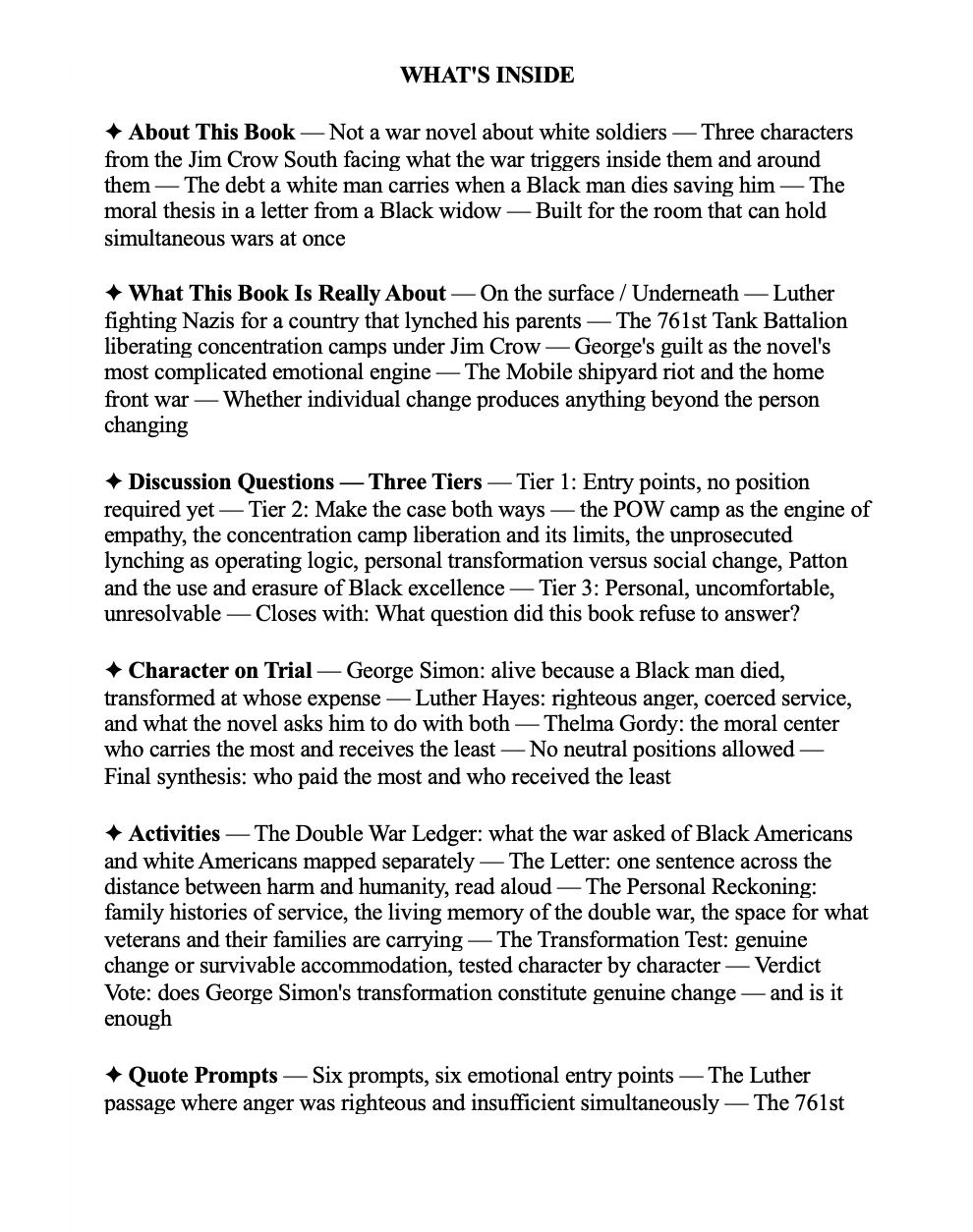 Image 2 of 3
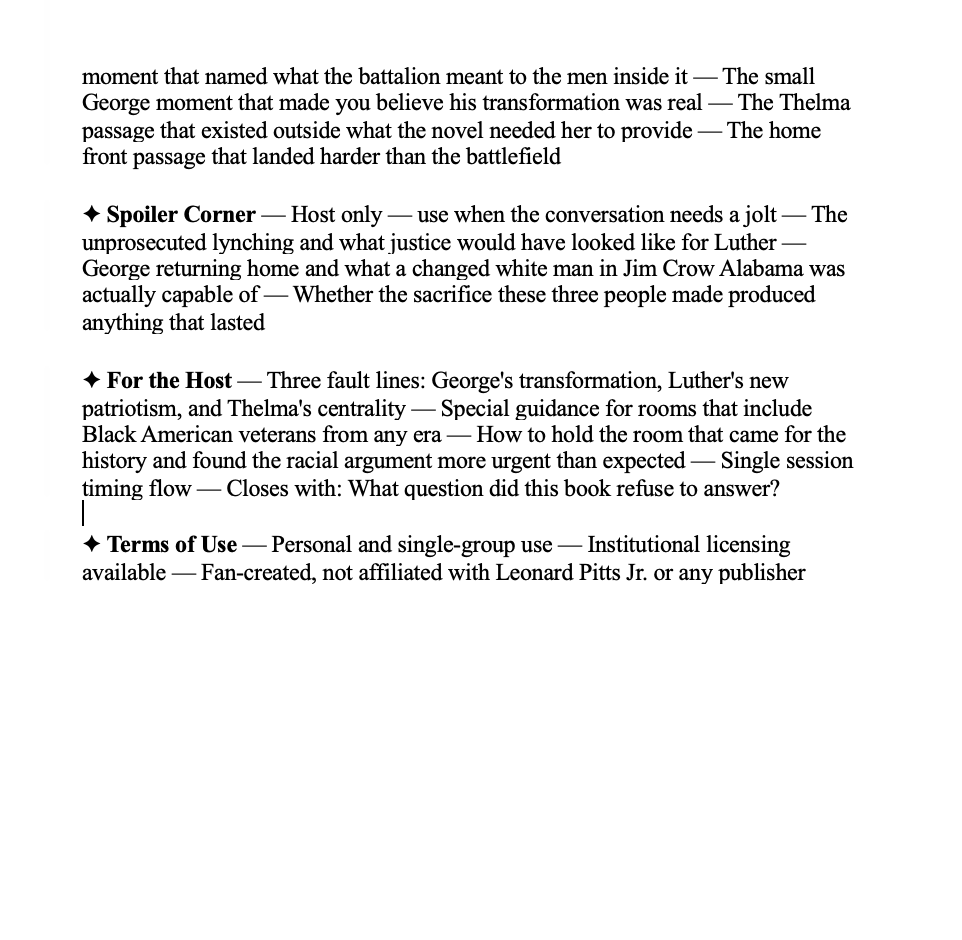 Image 3 of 3
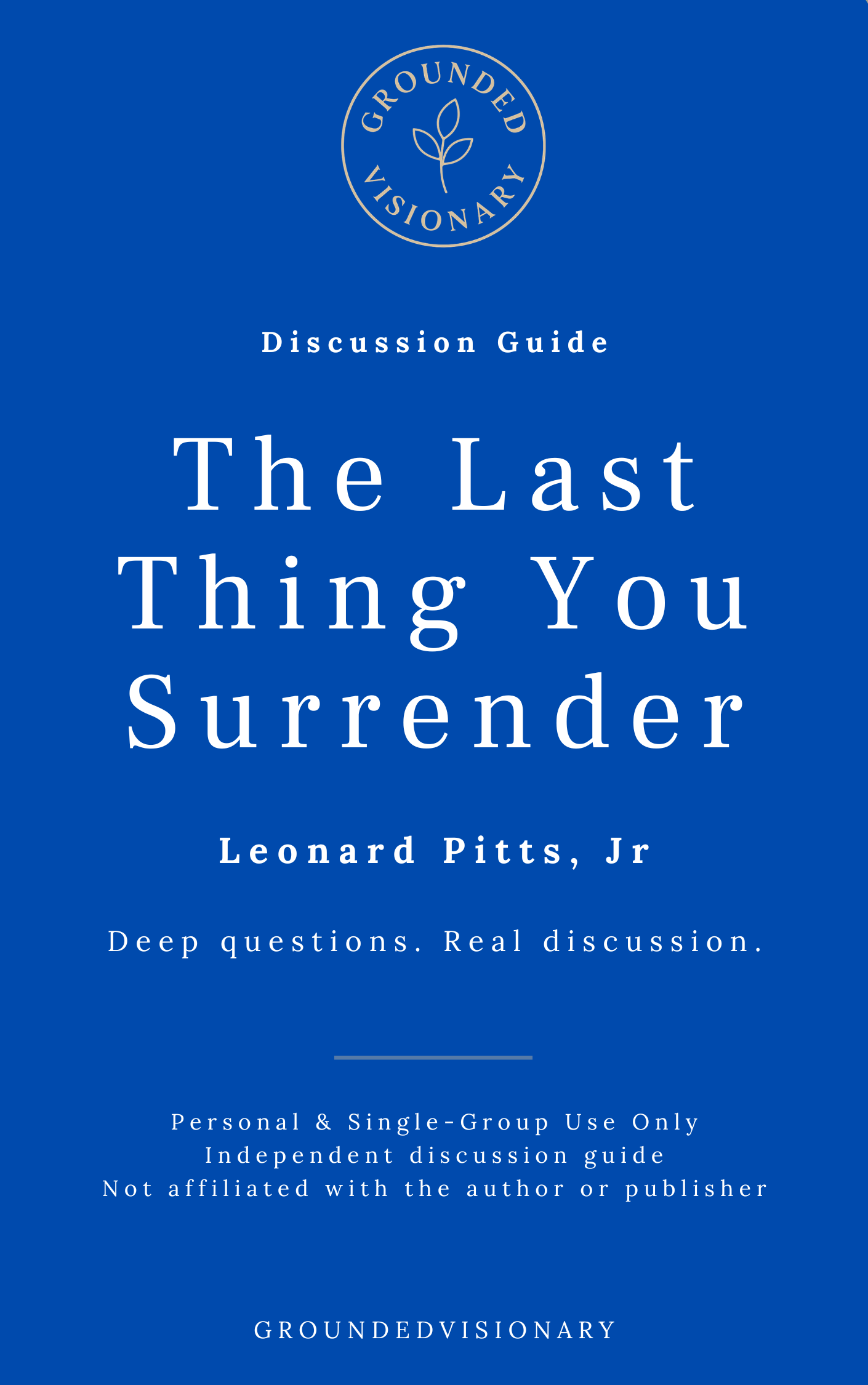
The Last Thing You Surrender — Leonard Pitts Jr. | Discussion Guide
The United States fought two wars during World War II. One was against fascism overseas. The other was the war Black Americans were already fighting at home — against lynching, segregation, economic exclusion, and a legal system that protected white violence and prosecuted Black survival. Leonard Pitts Jr. does not let you forget that both wars were happening simultaneously. This is not a novel about one war. It is a novel about what America asked of three people from the Jim Crow South — and what it cost each of them to answer.
George Simon is an affluent white Marine who survives Pearl Harbor because a Black messman named Gordy pulls him to safety and dies doing it. That debt — a white man alive because a Black man is dead — is what the novel hands George and watches him figure out what to do with. Thelma Gordy is the widow left behind, furious at the Navy for trying to use her husband's death as a recruitment tool for a country that never protected him. Luther Hayes is Thelma's brother who as a child watched his parents be lynched by a mob whose leader was never prosecuted — and who joins the Army not out of patriotism but to avoid prison, and ends up fighting Nazis in Europe with the all-Black 761st Tank Battalion while his own country maintains the racial order the Nazis were trying to export.
Pitts is asking one question across all three of them — what does it take to change someone's mind about race? Not a polite change. Not a theoretical one. The kind of change that costs something. The kind that requires the person changing to reckon with what they were before they changed. This kit was built for the room that finished this novel sitting with the gap between what these three people deserved and what the country delivered — and needed somewhere to put everything the book left in them.
The discussion in this room will divide. Every room that reads this novel eventually has to decide what to think about a white man transformed by a Black man's death and a Black woman's letter who returns home to the same system that produced him — changed inside in ways the novel does not show us challenging outside. Both the prosecution and the defense of his transformation are in this kit. Neither is dismissed. The goal is not to reach a verdict on George Simon. The goal is to ask what change is worth when the system that needed changing is still standing.
What's Inside:
✦ About This Book — Not a war novel about white soldiers — Three characters from the Jim Crow South facing what the war triggers inside them and around them — The debt a white man carries when a Black man dies saving him — The moral thesis in a letter from a Black widow — Built for the room that can hold simultaneous wars at once
✦ What This Book Is Really About — On the surface / Underneath — Luther fighting Nazis for a country that lynched his parents — The 761st Tank Battalion liberating concentration camps under Jim Crow — George's guilt as the novel's most complicated emotional engine — The Mobile shipyard riot and the home front war — Whether individual change produces anything beyond the person changing
✦ Discussion Questions — Three Tiers — Tier 1: Entry points, no position required yet — Tier 2: Make the case both ways — the POW camp as the engine of empathy, the concentration camp liberation and its limits, the unprosecuted lynching as operating logic, personal transformation versus social change, Patton and the use and erasure of Black excellence — Tier 3: Personal, uncomfortable, unresolvable — Closes with: What question did this book refuse to answer?
✦ Character on Trial — George Simon: alive because a Black man died, transformed at whose expense — Luther Hayes: righteous anger, coerced service, and what the novel asks him to do with both — Thelma Gordy: the moral center who carries the most and receives the least — No neutral positions allowed — Final synthesis: who paid the most and who received the least
✦ Activities — The Double War Ledger: what the war asked of Black Americans and white Americans mapped separately — The Letter: one sentence across the distance between harm and humanity, read aloud — The Personal Reckoning: family histories of service, the living memory of the double war, the space for what veterans and their families are carrying — The Transformation Test: genuine change or survivable accommodation, tested character by character — Verdict Vote: does George Simon's transformation constitute genuine change — and is it enough
✦ Quote Prompts — Six prompts, six emotional entry points — The Luther passage where anger was righteous and insufficient simultaneously — The 761st moment that named what the battalion meant to the men inside it — The small George moment that made you believe his transformation was real — The Thelma passage that existed outside what the novel needed her to provide — The home front passage that landed harder than the battlefield
✦ Spoiler Corner — Host only — Full knowledge of the entire novel required — The unprosecuted lynching and what justice would have looked like for Luther — George returning home and what a changed white man in Jim Crow Alabama was actually capable of — Whether the sacrifice these three people made produced anything that lasted
✦ For the Host — Three fault lines: George's transformation, Luther's new patriotism, and Thelma's centrality — Special guidance for rooms that include Black American veterans from any era — Timing flow for a single session — How to hold the room that came for the history and found the racial argument more urgent than expected
Details: Instant download — PDF format — Personal and single-group use — Fan-created discussion guide — Not affiliated with or endorsed by Leonard Pitts Jr. or any publisher — Page count: 20+ pages, print-ready
Content note: This guide discusses lynching, racial violence, Japanese POW camp conditions, the Mobile Alabama shipyard race riot, and the liberation of a Nazi concentration camp. These are not incidental to Pitts's argument — they are the argument. Please consider your group's readiness for this material before purchasing.
Licensing for classrooms, libraries, and educational programs is available. If you plan to use this guide for a class, reading program, or institutional setting, please contact the shop owner to arrange an appropriate license.
The United States fought two wars during World War II. One was against fascism overseas. The other was the war Black Americans were already fighting at home — against lynching, segregation, economic exclusion, and a legal system that protected white violence and prosecuted Black survival. Leonard Pitts Jr. does not let you forget that both wars were happening simultaneously. This is not a novel about one war. It is a novel about what America asked of three people from the Jim Crow South — and what it cost each of them to answer.
George Simon is an affluent white Marine who survives Pearl Harbor because a Black messman named Gordy pulls him to safety and dies doing it. That debt — a white man alive because a Black man is dead — is what the novel hands George and watches him figure out what to do with. Thelma Gordy is the widow left behind, furious at the Navy for trying to use her husband's death as a recruitment tool for a country that never protected him. Luther Hayes is Thelma's brother who as a child watched his parents be lynched by a mob whose leader was never prosecuted — and who joins the Army not out of patriotism but to avoid prison, and ends up fighting Nazis in Europe with the all-Black 761st Tank Battalion while his own country maintains the racial order the Nazis were trying to export.
Pitts is asking one question across all three of them — what does it take to change someone's mind about race? Not a polite change. Not a theoretical one. The kind of change that costs something. The kind that requires the person changing to reckon with what they were before they changed. This kit was built for the room that finished this novel sitting with the gap between what these three people deserved and what the country delivered — and needed somewhere to put everything the book left in them.
The discussion in this room will divide. Every room that reads this novel eventually has to decide what to think about a white man transformed by a Black man's death and a Black woman's letter who returns home to the same system that produced him — changed inside in ways the novel does not show us challenging outside. Both the prosecution and the defense of his transformation are in this kit. Neither is dismissed. The goal is not to reach a verdict on George Simon. The goal is to ask what change is worth when the system that needed changing is still standing.
What's Inside:
✦ About This Book — Not a war novel about white soldiers — Three characters from the Jim Crow South facing what the war triggers inside them and around them — The debt a white man carries when a Black man dies saving him — The moral thesis in a letter from a Black widow — Built for the room that can hold simultaneous wars at once
✦ What This Book Is Really About — On the surface / Underneath — Luther fighting Nazis for a country that lynched his parents — The 761st Tank Battalion liberating concentration camps under Jim Crow — George's guilt as the novel's most complicated emotional engine — The Mobile shipyard riot and the home front war — Whether individual change produces anything beyond the person changing
✦ Discussion Questions — Three Tiers — Tier 1: Entry points, no position required yet — Tier 2: Make the case both ways — the POW camp as the engine of empathy, the concentration camp liberation and its limits, the unprosecuted lynching as operating logic, personal transformation versus social change, Patton and the use and erasure of Black excellence — Tier 3: Personal, uncomfortable, unresolvable — Closes with: What question did this book refuse to answer?
✦ Character on Trial — George Simon: alive because a Black man died, transformed at whose expense — Luther Hayes: righteous anger, coerced service, and what the novel asks him to do with both — Thelma Gordy: the moral center who carries the most and receives the least — No neutral positions allowed — Final synthesis: who paid the most and who received the least
✦ Activities — The Double War Ledger: what the war asked of Black Americans and white Americans mapped separately — The Letter: one sentence across the distance between harm and humanity, read aloud — The Personal Reckoning: family histories of service, the living memory of the double war, the space for what veterans and their families are carrying — The Transformation Test: genuine change or survivable accommodation, tested character by character — Verdict Vote: does George Simon's transformation constitute genuine change — and is it enough
✦ Quote Prompts — Six prompts, six emotional entry points — The Luther passage where anger was righteous and insufficient simultaneously — The 761st moment that named what the battalion meant to the men inside it — The small George moment that made you believe his transformation was real — The Thelma passage that existed outside what the novel needed her to provide — The home front passage that landed harder than the battlefield
✦ Spoiler Corner — Host only — Full knowledge of the entire novel required — The unprosecuted lynching and what justice would have looked like for Luther — George returning home and what a changed white man in Jim Crow Alabama was actually capable of — Whether the sacrifice these three people made produced anything that lasted
✦ For the Host — Three fault lines: George's transformation, Luther's new patriotism, and Thelma's centrality — Special guidance for rooms that include Black American veterans from any era — Timing flow for a single session — How to hold the room that came for the history and found the racial argument more urgent than expected
Details: Instant download — PDF format — Personal and single-group use — Fan-created discussion guide — Not affiliated with or endorsed by Leonard Pitts Jr. or any publisher — Page count: 20+ pages, print-ready
Content note: This guide discusses lynching, racial violence, Japanese POW camp conditions, the Mobile Alabama shipyard race riot, and the liberation of a Nazi concentration camp. These are not incidental to Pitts's argument — they are the argument. Please consider your group's readiness for this material before purchasing.
Licensing for classrooms, libraries, and educational programs is available. If you plan to use this guide for a class, reading program, or institutional setting, please contact the shop owner to arrange an appropriate license.