 Image 1 of 4
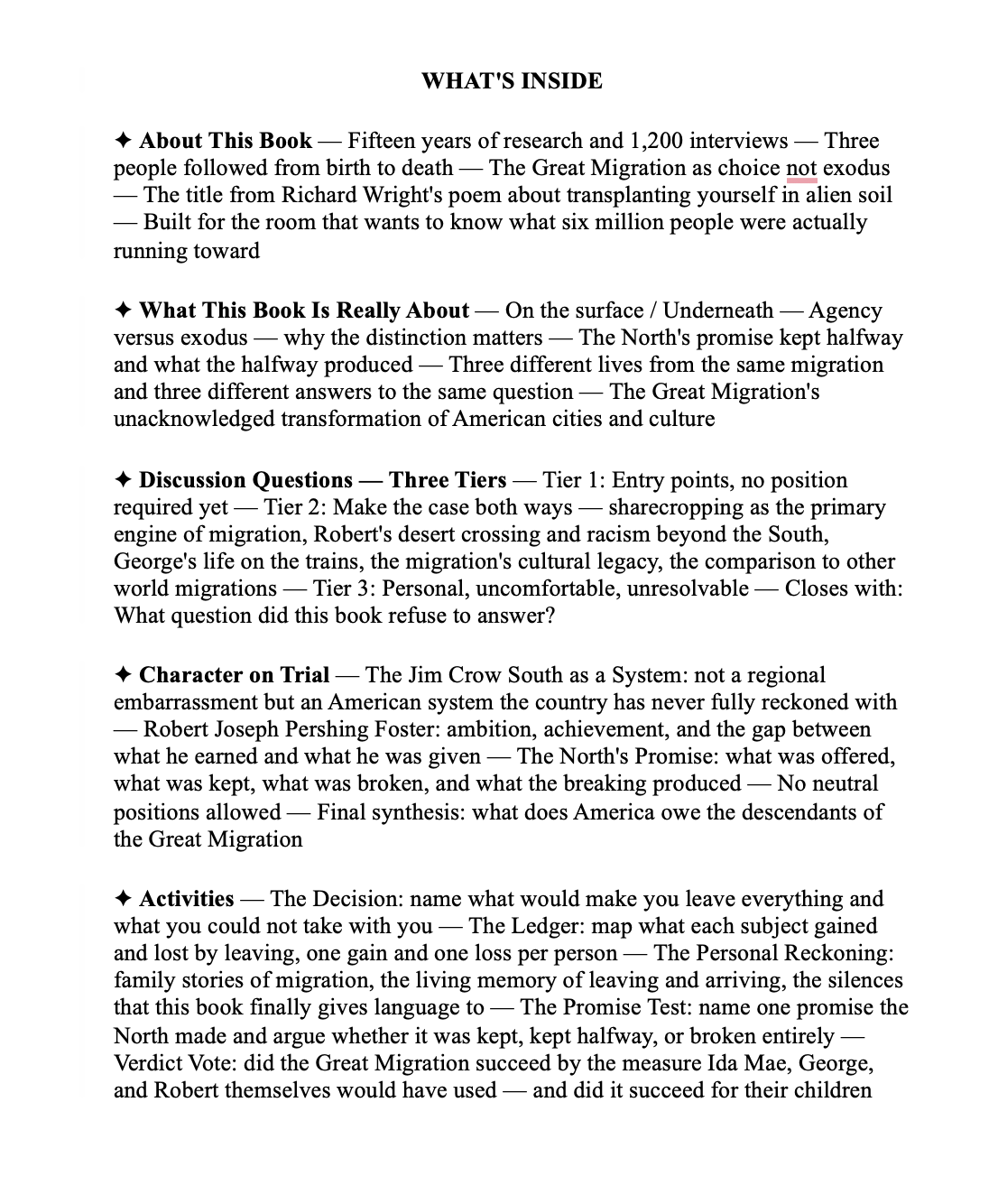 Image 2 of 4
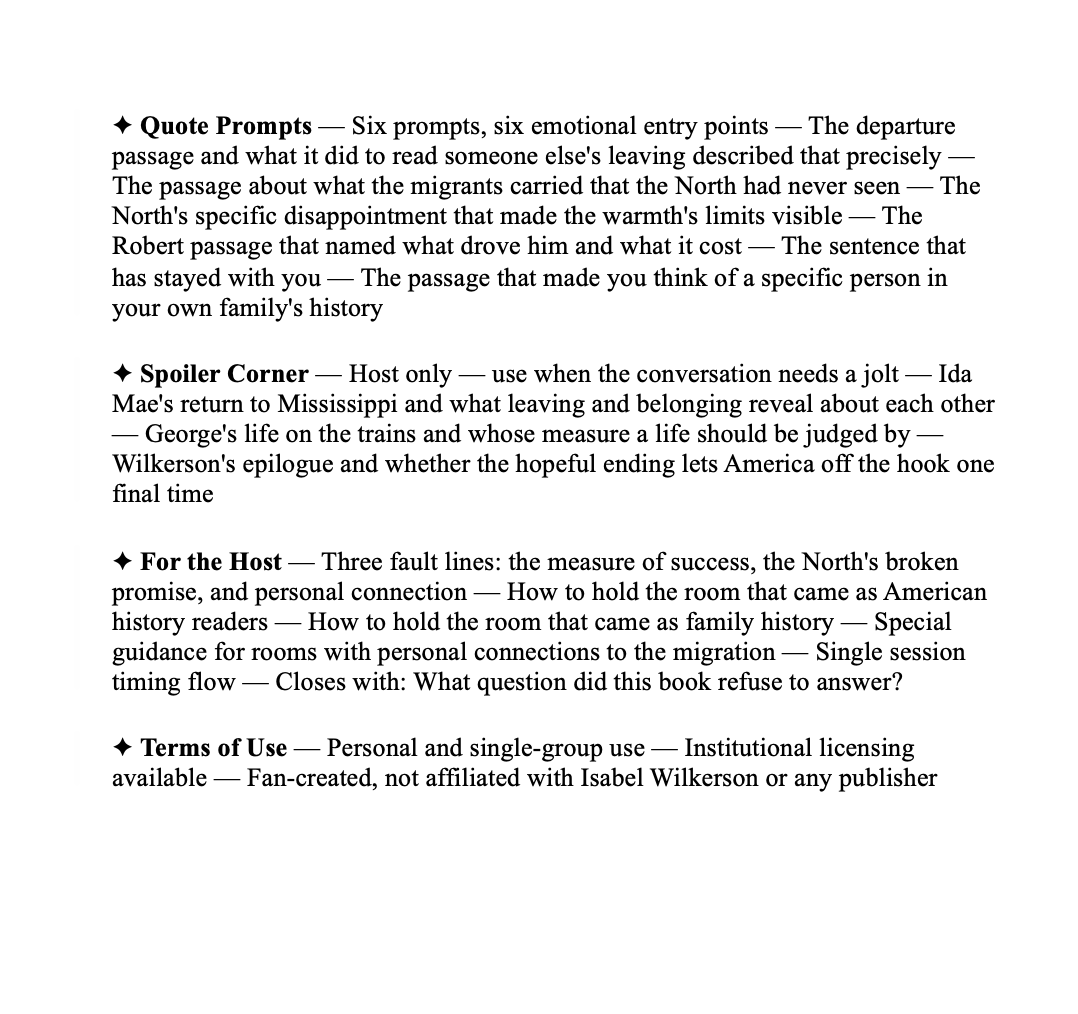 Image 3 of 4
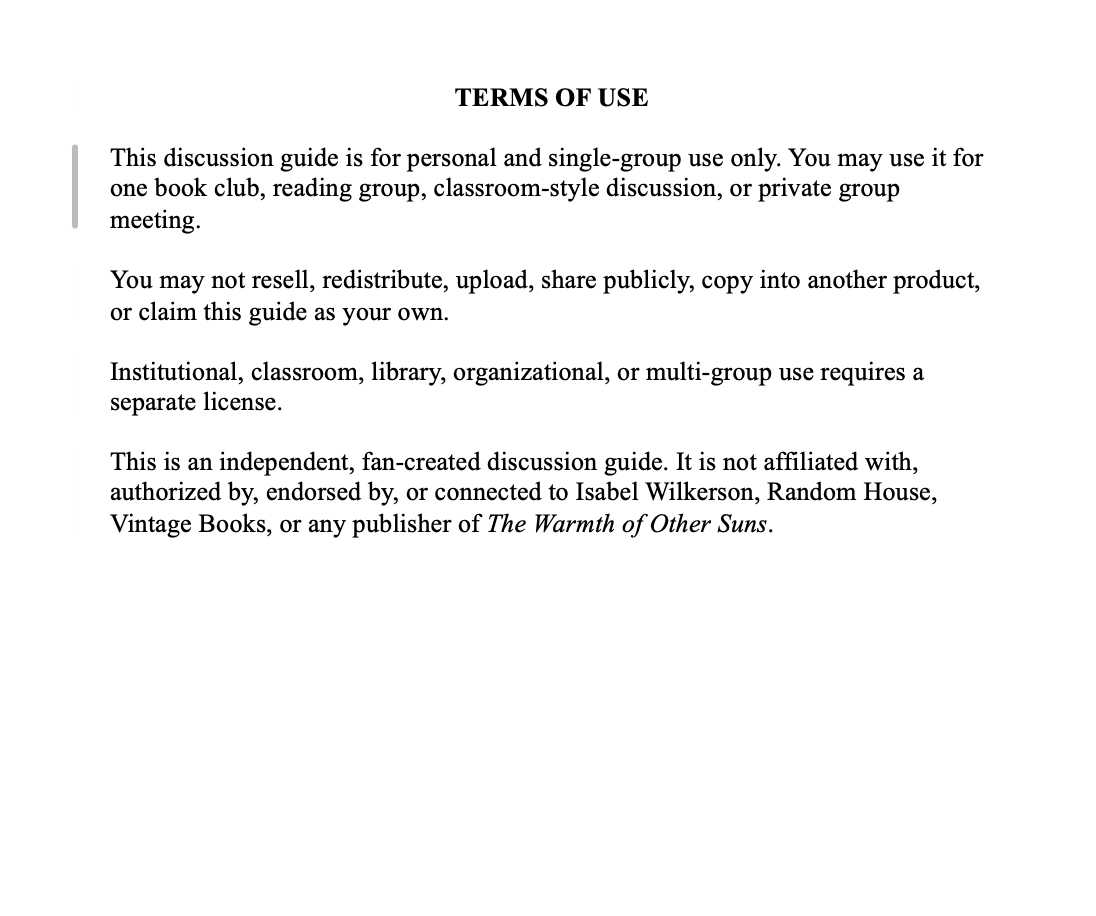 Image 4 of 4
The Warmth of Other Suns — Isabel Wilkerson | Book Club Discussion Guide
Isabel Wilkerson spent fifteen years on this book. She interviewed more than 1,200 people, followed three of them from birth to death, drove one to medical appointments, and sat with another as he was dying in the hospital. None of them lived to see it published. That devotion to three ordinary people is itself an argument — that the Great Migration, one of the largest internal movements of people in American history, belongs to the people who lived it and not just to the historians who cataloged it.
Between 1915 and 1970, six million Black Americans left the South. They left sharecropping, Jim Crow, and the constant threat of racial violence for cities that had never seen them in those numbers and were not always prepared to welcome them. Ida Mae Brandon Gladney left Mississippi in 1937 after watching her husband's cousin be beaten nearly to death over a suspicion that was never proven. George Swanson Starling fled Florida in 1945 in the middle of the night with grove owners threatening to kill him for organizing fruit pickers for better wages. Robert Joseph Pershing Foster drove alone through the desert Southwest in 1953, refused at motel after motel because he was Black, and arrived in Los Angeles with almost nothing and the intention of building everything.
Wilkerson insists these people chose to leave. They were not simply pushed out. They looked at what the South was offering and decided it was not enough. That insistence on agency matters — because it places the responsibility for what made leaving necessary squarely on the system that produced those conditions. And it places the question of what the migrants found when they arrived squarely on the North that promised them something and delivered it halfway
This kit was built for the room where this book was finished, with the specific grief of a story this important being so underreported for so long. It was also built for the room that came to it as family history — one or two generations removed from someone who made this journey and found their own inheritance documented on the page. Both rooms deserve the same conversation. Both rooms are welcome here.
What's Inside:
✦ About This Book — Fifteen years of research and 1,200 interviews — Three people followed from birth to death — The Great Migration as choice not exodus — The title from Richard Wright's poem about transplanting yourself in alien soil — Built for the room that wants to know what six million people were actually running toward
✦ What This Book Is Really About — On the surface / Underneath — Agency versus exodus and why the distinction matters — The North's promise kept halfway and what the halfway produced — Three different lives from the same migration and three different answers to the same question — The Great Migration's unacknowledged transformation of American cities and culture
✦ Discussion Questions — Three Tiers — Tier 1: Entry points, no position required yet — Tier 2: Make the case both ways — sharecropping as the primary engine of migration, Robert's desert crossing and racism beyond the South, George's life on the trains, the migration's cultural legacy, the comparison to other world migrations — Tier 3: Personal, uncomfortable, unresolvable — Closes with: What question did this book refuse to answer?
✦ Character on Trial — The Jim Crow South as a System: not a regional embarrassment but an American system the country has never fully reckoned with — Robert Joseph Pershing Foster: ambition, achievement, and the gap between what he earned and what he was given — The North's Promise: what was offered, what was kept, what was broken, and what the breaking produced — No neutral positions allowed — Final synthesis: what does America owe the descendants of the Great Migration
✦ Activities — The Decision: name what would make you leave everything and what you could not take with you — The Ledger: map what each subject gained and lost by leaving — The Personal Reckoning: family stories of migration, the living memory of leaving and arriving, the silences this book finally gives language to — The Promise Test: name one promise the North made and argue whether it was kept, kept halfway, or broken entirely — Verdict Vote: did the Great Migration succeed by the measure Ida Mae, George, and Robert themselves would have used — and did it succeed for their children
✦ Quote Prompts — Six prompts, six emotional entry points — The departure passage and what it did to read someone else's leaving described that precisely — The passage about what the migrants carried that the North had never seen — The North's specific disappointment that made the warmth's limits visible — The Robert passage that named what drove him and what it cost — The sentence that has stayed with you — The passage that made you think of a specific person in your own family's history
✦ Spoiler Corner — Host only — Full knowledge of the entire book including the epilogue required — Ida Mae's return to Mississippi and what leaving and belonging reveal about each other — George's life on the trains and whose measure a life should be judged by — Wilkerson's epilogue and whether the hopeful ending lets America off the hook one final time
✦ For the Host — Three fault lines: the measure of success, the North's broken promise, and personal connection — How to hold the room that came as American history readers — How to hold the room that came as family history — Special guidance for rooms with personal connections to the migration — Timing flow for a single session
Details: Instant download — PDF format — Personal and single-group use — Fan-created discussion guide — Not affiliated with or endorsed by Isabel Wilkerson or any publisher — Page count: 20+ pages, print-ready
Content note: This guide discusses racial terror and the threat of lynching, the economic exploitation of sharecropping, Jim Crow's specific humiliations, housing discrimination and redlining in the North, and the deliberate concentration of urban poverty. These are not background details — they are Wilkerson's argument. Please consider your group's readiness for this material before purchasing.
Licensing for classrooms, libraries, and educational programs is available. If you plan to use this guide for a class, reading program, or institutional setting, please contact the shop owner to arrange an appropriate license.
This kit was built for the room that finished The Warmth of Other Suns and needed somewhere to put everything the book left in them. It was built for the conversation that starts with what six million people left and ends somewhere none of you expected.
Isabel Wilkerson spent fifteen years on this book. She interviewed more than 1,200 people, followed three of them from birth to death, drove one to medical appointments, and sat with another as he was dying in the hospital. None of them lived to see it published. That devotion to three ordinary people is itself an argument — that the Great Migration, one of the largest internal movements of people in American history, belongs to the people who lived it and not just to the historians who cataloged it.
Between 1915 and 1970, six million Black Americans left the South. They left sharecropping, Jim Crow, and the constant threat of racial violence for cities that had never seen them in those numbers and were not always prepared to welcome them. Ida Mae Brandon Gladney left Mississippi in 1937 after watching her husband's cousin be beaten nearly to death over a suspicion that was never proven. George Swanson Starling fled Florida in 1945 in the middle of the night with grove owners threatening to kill him for organizing fruit pickers for better wages. Robert Joseph Pershing Foster drove alone through the desert Southwest in 1953, refused at motel after motel because he was Black, and arrived in Los Angeles with almost nothing and the intention of building everything.
Wilkerson insists these people chose to leave. They were not simply pushed out. They looked at what the South was offering and decided it was not enough. That insistence on agency matters — because it places the responsibility for what made leaving necessary squarely on the system that produced those conditions. And it places the question of what the migrants found when they arrived squarely on the North that promised them something and delivered it halfway
This kit was built for the room where this book was finished, with the specific grief of a story this important being so underreported for so long. It was also built for the room that came to it as family history — one or two generations removed from someone who made this journey and found their own inheritance documented on the page. Both rooms deserve the same conversation. Both rooms are welcome here.
What's Inside:
✦ About This Book — Fifteen years of research and 1,200 interviews — Three people followed from birth to death — The Great Migration as choice not exodus — The title from Richard Wright's poem about transplanting yourself in alien soil — Built for the room that wants to know what six million people were actually running toward
✦ What This Book Is Really About — On the surface / Underneath — Agency versus exodus and why the distinction matters — The North's promise kept halfway and what the halfway produced — Three different lives from the same migration and three different answers to the same question — The Great Migration's unacknowledged transformation of American cities and culture
✦ Discussion Questions — Three Tiers — Tier 1: Entry points, no position required yet — Tier 2: Make the case both ways — sharecropping as the primary engine of migration, Robert's desert crossing and racism beyond the South, George's life on the trains, the migration's cultural legacy, the comparison to other world migrations — Tier 3: Personal, uncomfortable, unresolvable — Closes with: What question did this book refuse to answer?
✦ Character on Trial — The Jim Crow South as a System: not a regional embarrassment but an American system the country has never fully reckoned with — Robert Joseph Pershing Foster: ambition, achievement, and the gap between what he earned and what he was given — The North's Promise: what was offered, what was kept, what was broken, and what the breaking produced — No neutral positions allowed — Final synthesis: what does America owe the descendants of the Great Migration
✦ Activities — The Decision: name what would make you leave everything and what you could not take with you — The Ledger: map what each subject gained and lost by leaving — The Personal Reckoning: family stories of migration, the living memory of leaving and arriving, the silences this book finally gives language to — The Promise Test: name one promise the North made and argue whether it was kept, kept halfway, or broken entirely — Verdict Vote: did the Great Migration succeed by the measure Ida Mae, George, and Robert themselves would have used — and did it succeed for their children
✦ Quote Prompts — Six prompts, six emotional entry points — The departure passage and what it did to read someone else's leaving described that precisely — The passage about what the migrants carried that the North had never seen — The North's specific disappointment that made the warmth's limits visible — The Robert passage that named what drove him and what it cost — The sentence that has stayed with you — The passage that made you think of a specific person in your own family's history
✦ Spoiler Corner — Host only — Full knowledge of the entire book including the epilogue required — Ida Mae's return to Mississippi and what leaving and belonging reveal about each other — George's life on the trains and whose measure a life should be judged by — Wilkerson's epilogue and whether the hopeful ending lets America off the hook one final time
✦ For the Host — Three fault lines: the measure of success, the North's broken promise, and personal connection — How to hold the room that came as American history readers — How to hold the room that came as family history — Special guidance for rooms with personal connections to the migration — Timing flow for a single session
Details: Instant download — PDF format — Personal and single-group use — Fan-created discussion guide — Not affiliated with or endorsed by Isabel Wilkerson or any publisher — Page count: 20+ pages, print-ready
Content note: This guide discusses racial terror and the threat of lynching, the economic exploitation of sharecropping, Jim Crow's specific humiliations, housing discrimination and redlining in the North, and the deliberate concentration of urban poverty. These are not background details — they are Wilkerson's argument. Please consider your group's readiness for this material before purchasing.
Licensing for classrooms, libraries, and educational programs is available. If you plan to use this guide for a class, reading program, or institutional setting, please contact the shop owner to arrange an appropriate license.
This kit was built for the room that finished The Warmth of Other Suns and needed somewhere to put everything the book left in them. It was built for the conversation that starts with what six million people left and ends somewhere none of you expected.