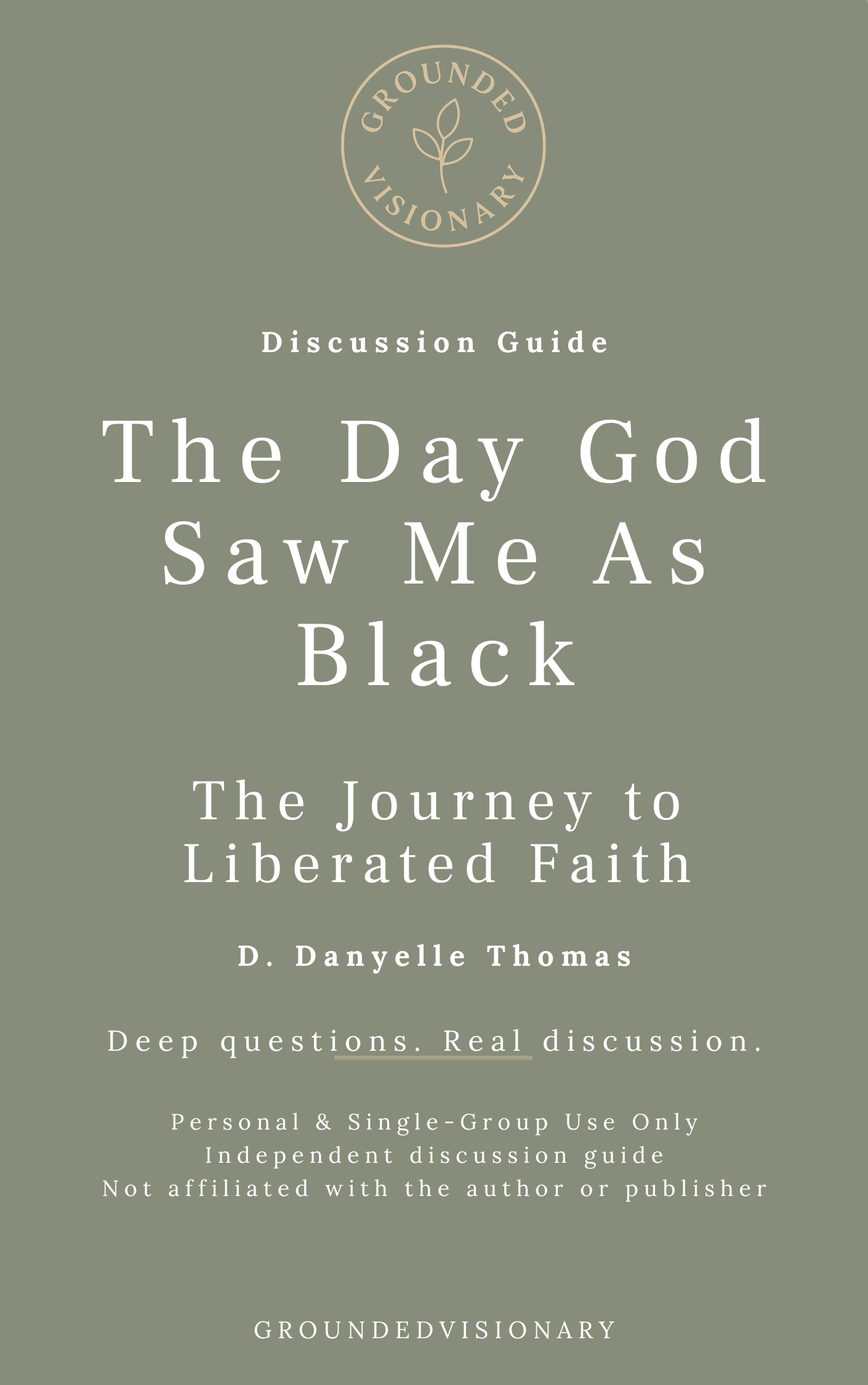
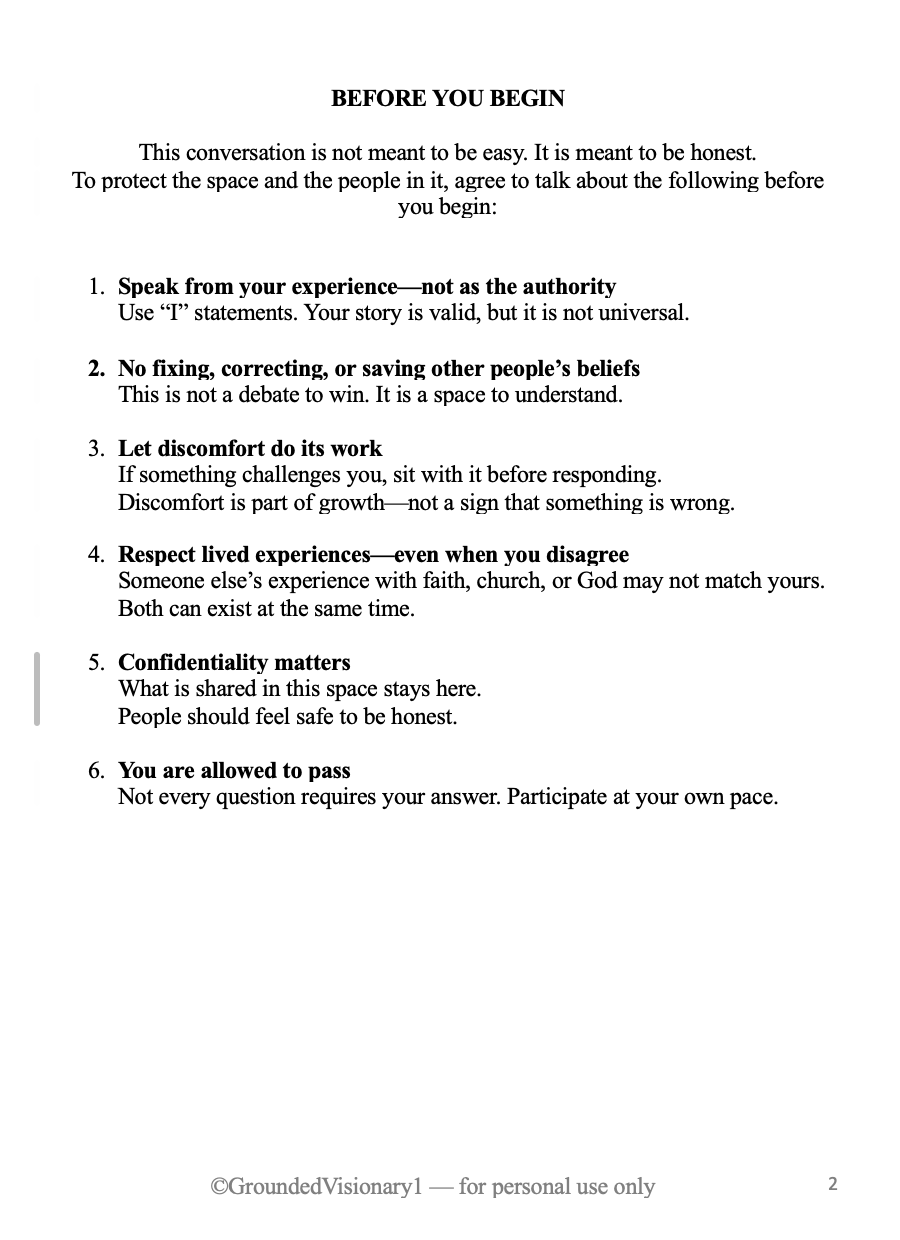
This discussion guide was created for readers of The Day God Saw Me as Black who want to go beyond reflection and into real conversation.
This is not a summary.
This is not a checklist.
This is a structured, thought-provoking experience designed to help individuals and groups wrestle with:
Faith and identity
The role of the Black church
Purity culture and body autonomy
Lived experience vs. traditional theology
What it means to be fully seen by God
Whether you agreed with the book, wrestled with it, or felt challenged by it, this guide gives you the space to process it honestly.
Most discussion guides ask what you think.
This one asks you to examine why you think it.
Inside, you’ll find:
✔ Tiered discussion questions (from accessible → deep → personal)
✔ “Make the case both ways” prompts to encourage real dialogue
✔ “On Trial” sections that challenge systems, not just ideas
✔ Guided activities for reflection, honesty, and group connection
✔ Space for both agreement and disagreement—without shutting either down
This is designed for real conversations—not polite ones.
30+ pages of structured discussion content
3 levels of discussion questions
Character/System “On Trial” debates
Guided group activities (including The Inheritance Audit)
Reflection prompts and quote exploration
Host facilitation notes (for leading meaningful conversations)
This guide is ideal for:
Book clubs ready for deeper conversations
Women’s groups navigating faith and identity
Readers processing church experiences (past or present)
Anyone engaging with deconstruction, theology, or cultural critique
Facilitators who want structure—not guesswork
Use individually for personal reflection
Use in small groups or book clubs
Use in ministry or discussion settings
Use at your own pace—this is not meant to be rushed
This guide engages topics such as:
Church harm and spiritual tension
Purity culture and body autonomy
Identity, race, and theology
It is designed to create space for honest conversation—not to tell you what to believe.
This is more than a printable.
This is a guided conversation experience designed to be revisited, reused, and explored over time.
f you’re ready for a conversation that goes beyond surface-level discussion—
Add this guide to your reading experience.
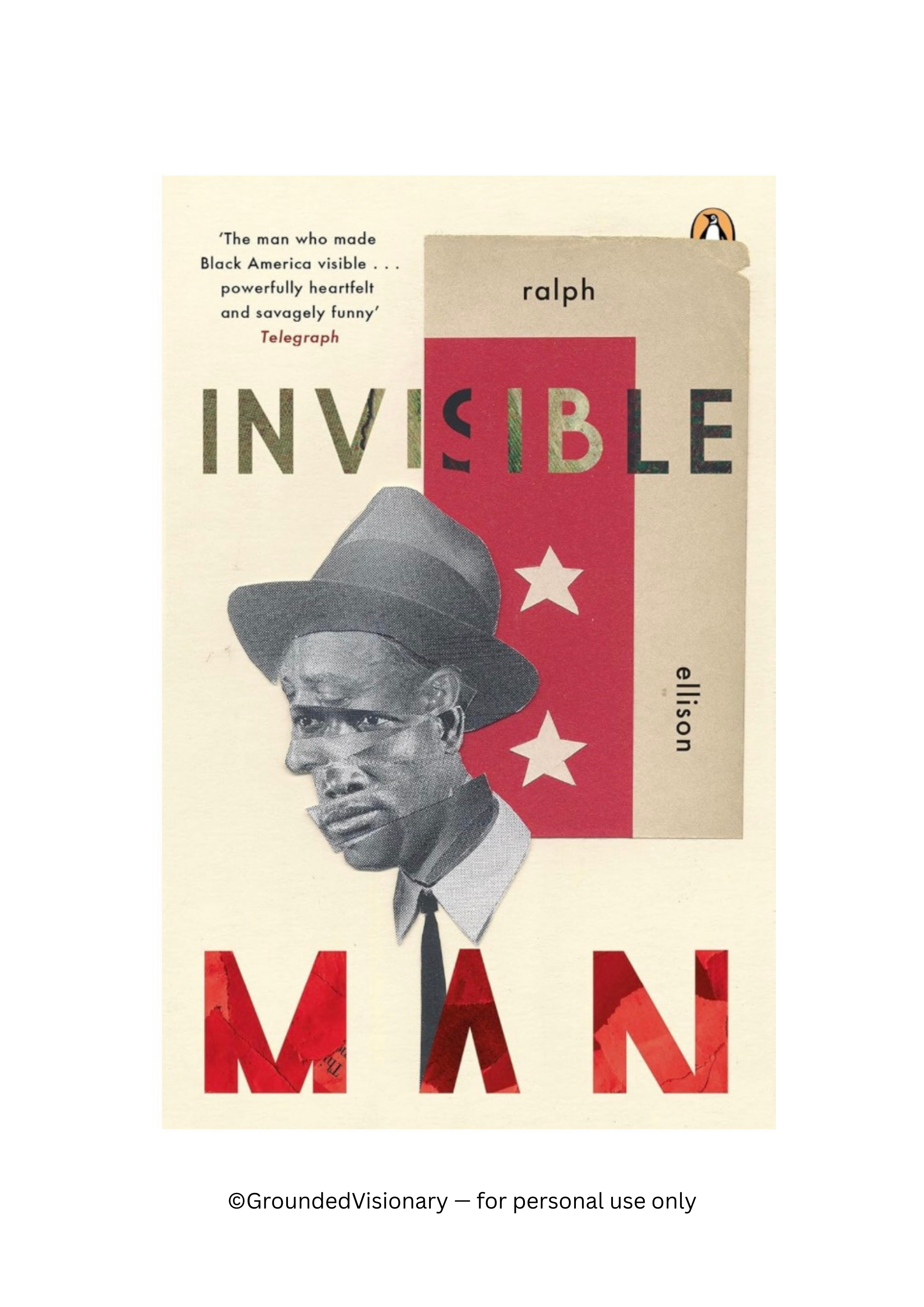
A powerful exploration of identity, invisibility, and what it means to be seen in America
Ralph Ellison published Invisible Man in 1952 and won the National Book Award the following year. That is not why you should read it. You should read it because it is one of the few novels that tells the truth about what it feels like to be a Black person in America who is doing everything right — and discovering that the people on the other side of every door were never actually looking at you. They were looking at what they needed you to be. Those are not the same thing.
The narrator of this novel has no name. He is brilliant, articulate, ambitious, and genuinely talented — and none of it protects him. Not from the white men who use him as entertainment. Not from the Black college president who shakes his hand and passes him letters designed to destroy him. Not from the progressive organization that gives him a platform and calls it liberation while using him as a tool. Every institution the narrator enters promises visibility and delivers a more sophisticated version of the same erasure. Ellison's argument is not that the system is broken. It is that the system is working exactly as designed — and that the most dangerous version of that system is the one that has learned to speak the language of liberation while running the same machinery underneath.
This kit was built to get the room past the plot and into that argument. Past the Battle Royal and into what it reveals about who was watching and why. Past Bledsoe's handshake and into what the letters actually said about who he was willing to sacrifice. Past the Brotherhood's platform and into what it was actually running underneath. The discussion goes personal. The activities go uncomfortable. The Verdict Vote asks the room to decide whether the Brotherhood was more dangerous to Black people in Harlem than the systems it claimed to oppose — and then defend that answer.
This kit was built for the room that needs somewhere to put what this book stirred up.
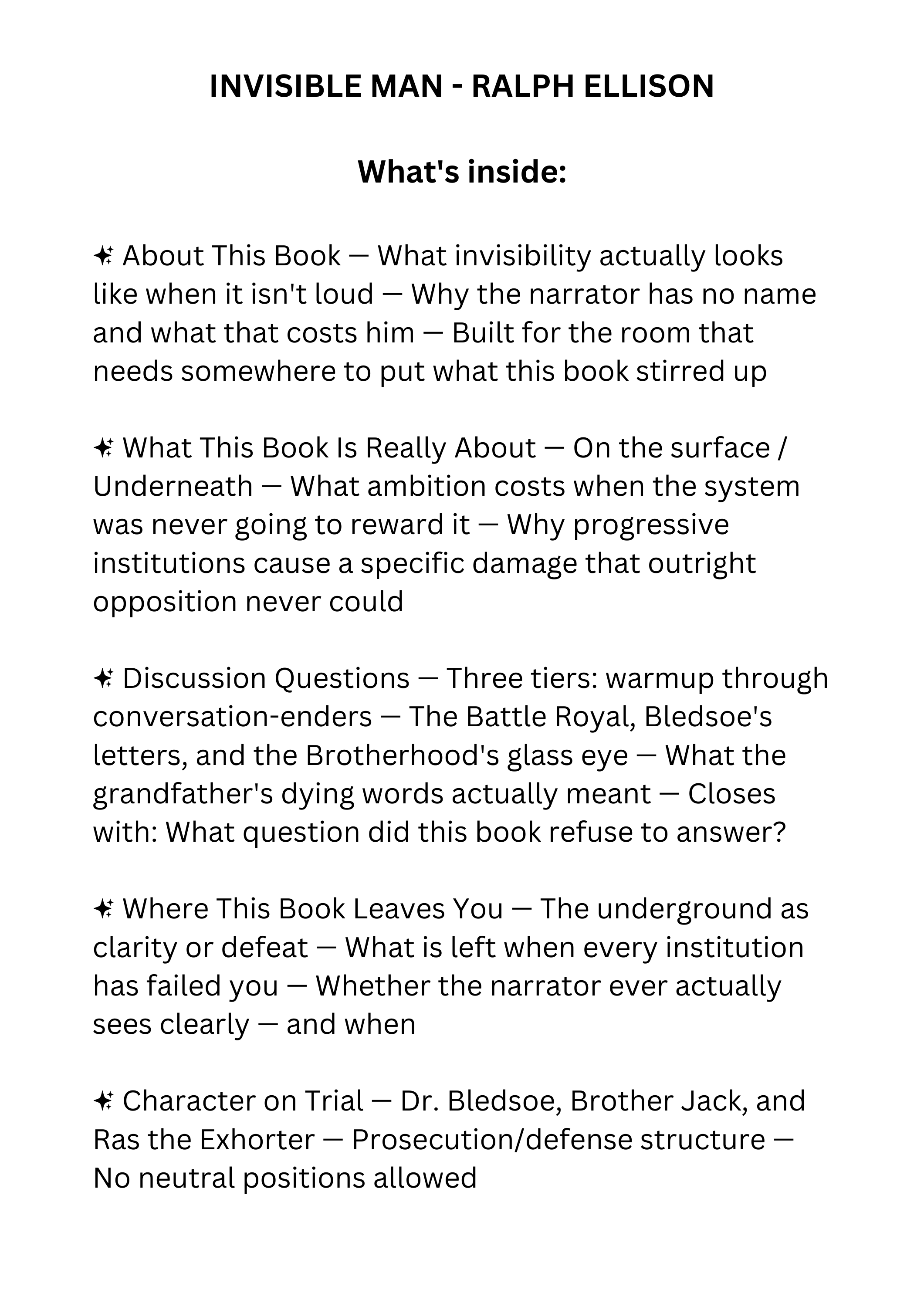
✦ What's Inside
✦ About This Book — What invisibility looks like when it isn't loud — Why the narrator has no name and what that costs him — Built for the room that needs somewhere to put what this book stirred up
✦ What This Book Is Really About — What ambition costs when the system was never going to reward it — Why progressive institutions cause a specific damage that outright opposition never could — The machinery running underneath the language of liberation
✦ Discussion Questions — Three Tiers — Three tiers: warmup through conversation-enders — The Battle Royal, Bledsoe's letters, and the Brotherhood's glass eye — What the grandfather's dying words actually meant — Closes with: What question did this book refuse to answer?
✦ Where This Book Leaves You — The underground as clarity or defeat — What is left when every institution has failed you — Whether the narrator ever actually sees clearly — and when
✦ Character on Trial — Dr. Bledsoe, Brother Jack, Ras the Exhorter — Prosecution/defense structure — Hard position questions with mandatory reversal — No neutral positions allowed
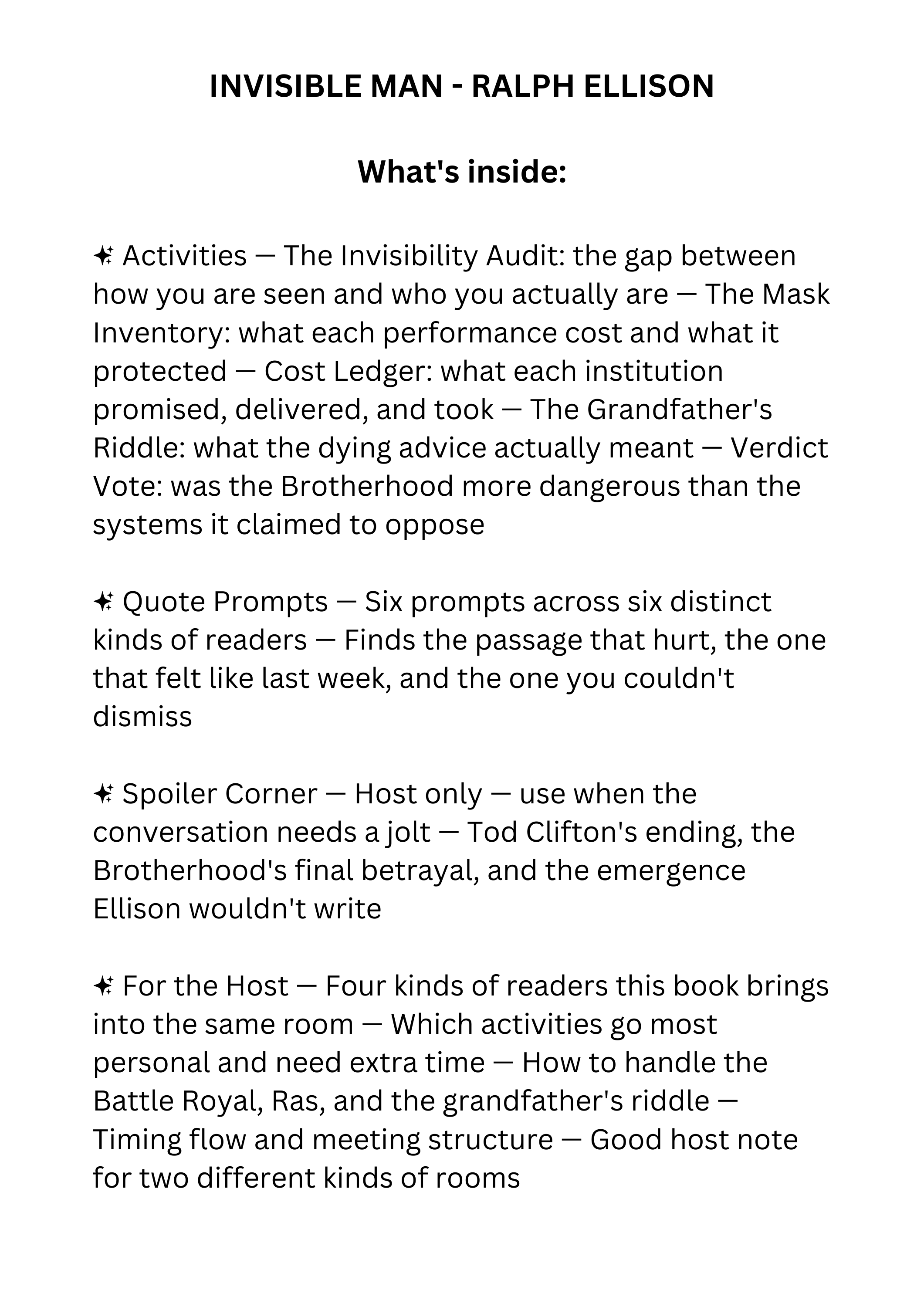
✦ Activities — The Invisibility Audit: the gap between how you are seen and who you actually are — The Mask Inventory: what each performance cost and what it protected — Cost Ledger: what each institution promised, delivered, and took — The Grandfather's Riddle: what the dying advice actually meant — Verdict Vote: was the Brotherhood more dangerous than the systems it claimed to oppose
✦ Quote Prompts — Six prompts across six distinct kinds of readers — The passage that hurt — The one that felt like last week — The one you couldn't dismiss
✦ Spoiler Corner — Host only — use when the conversation needs a jolt — Tod Clifton's ending, the Brotherhood's final betrayal, and the emergence Ellison wouldn't write
✦ For the Host — Four kinds of readers this book brings into the same room — How to handle the Battle Royal, Ras, and the grandfather's riddle — Timing flow and meeting structure — Good host note for two different kinds of rooms
✦ Bonus Host Guide — A free facilitation toolkit included with every purchase
Details — Instant download PDF — Personal and single-group use. No redistribution or resale. — Fan-created guide. Not affiliated with or endorsed by the Ralph Ellison estate or any publisher.
Licensing for classrooms, libraries, and educational programs is available. If you plan to use this guide for a class, reading program, or institutional setting, please contact the shop owner to arrange an appropriate license.
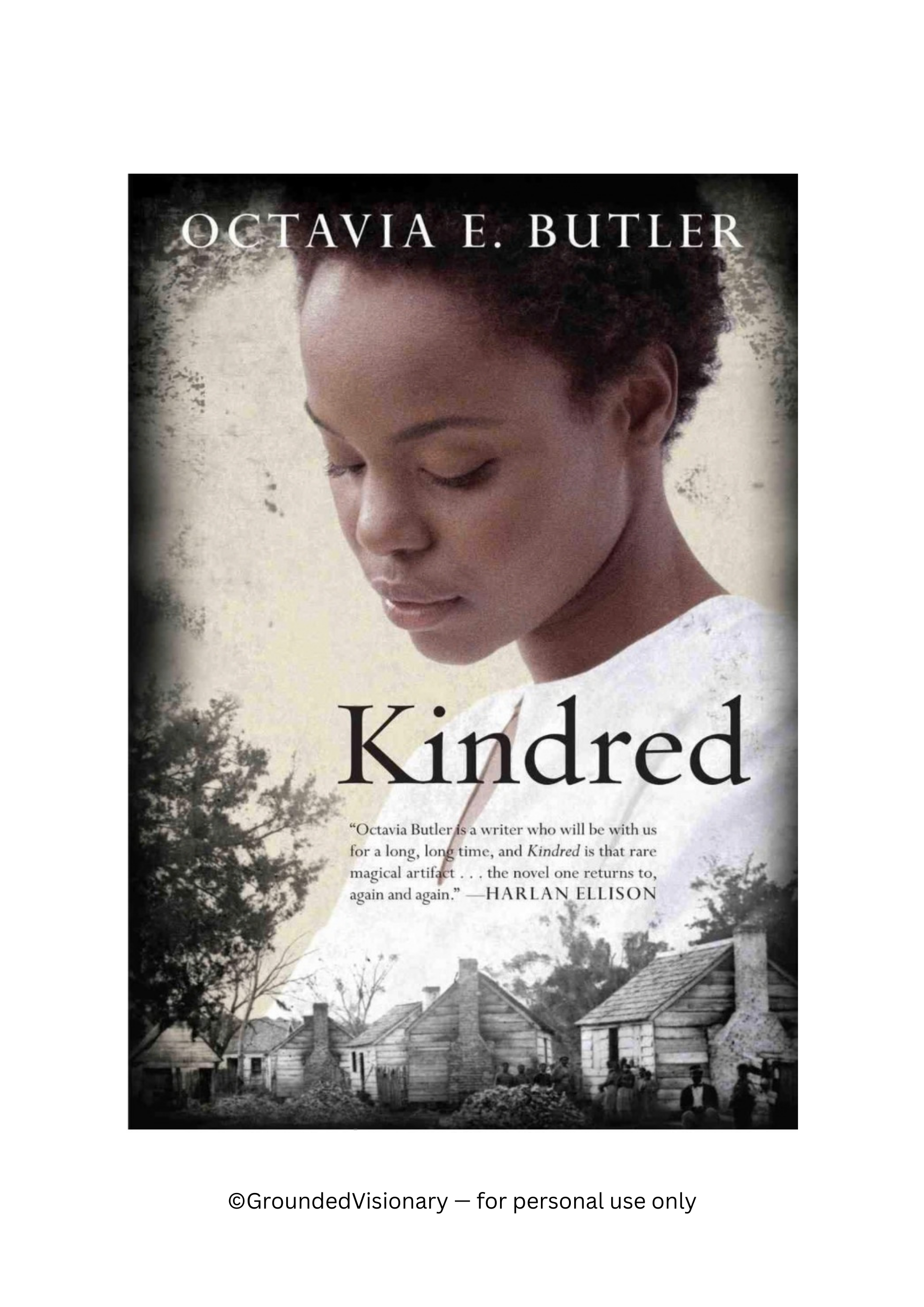
A brutal, time-bending look at slavery, survival, and how the past refuses to stay buried.
Octavia Butler wrote Kindred because young Black Americans in the 1960s and 70s kept saying they never would have tolerated what their enslaved ancestors endured. Dana Franklin is her answer to that argument — and it is not a gentle one.
This is not a time travel story. The time travel is real but it is never explained and never the point. What pulls Dana back, again and again, to a Maryland plantation before the Civil War is something older and more inescapable than physics: she is tethered to a white slaveholder's son because he is her ancestor, and he must survive in order for her to exist. Across six trips she keeps him alive, negotiates with his world, and makes choices she could not have imagined making before she arrived. By the end she has lost an arm and the novel has made its argument: the past does not stay in the past. It comes home with you.
This kit was built for a room willing to sit with what Butler is actually asking. Not whether slavery was evil — it was — but what it does to the people inside it, all of them, and what it means that its damage didn't end when the institution did. The discussion goes to Dana's survival compromises, to Rufus's humanity and his monstrosity, to Alice's uncompromising resistance and what it costs her, to Kevin's good intentions and their limits. It goes personal. It goes uncomfortable. It goes exactly where the book demands.
This kit was built for a room that can hold the full weight of what Butler wrote — the survival, the compromise, the damage that comes home in the body, and the question of what we owe the people history didn't give a way out.
Note: This guide contains material addressing sexual violence, rape, coercion, and racial trauma consistent with the novel's content. A content warning page is included at the front of the guide with specific facilitation guidance for hosts.
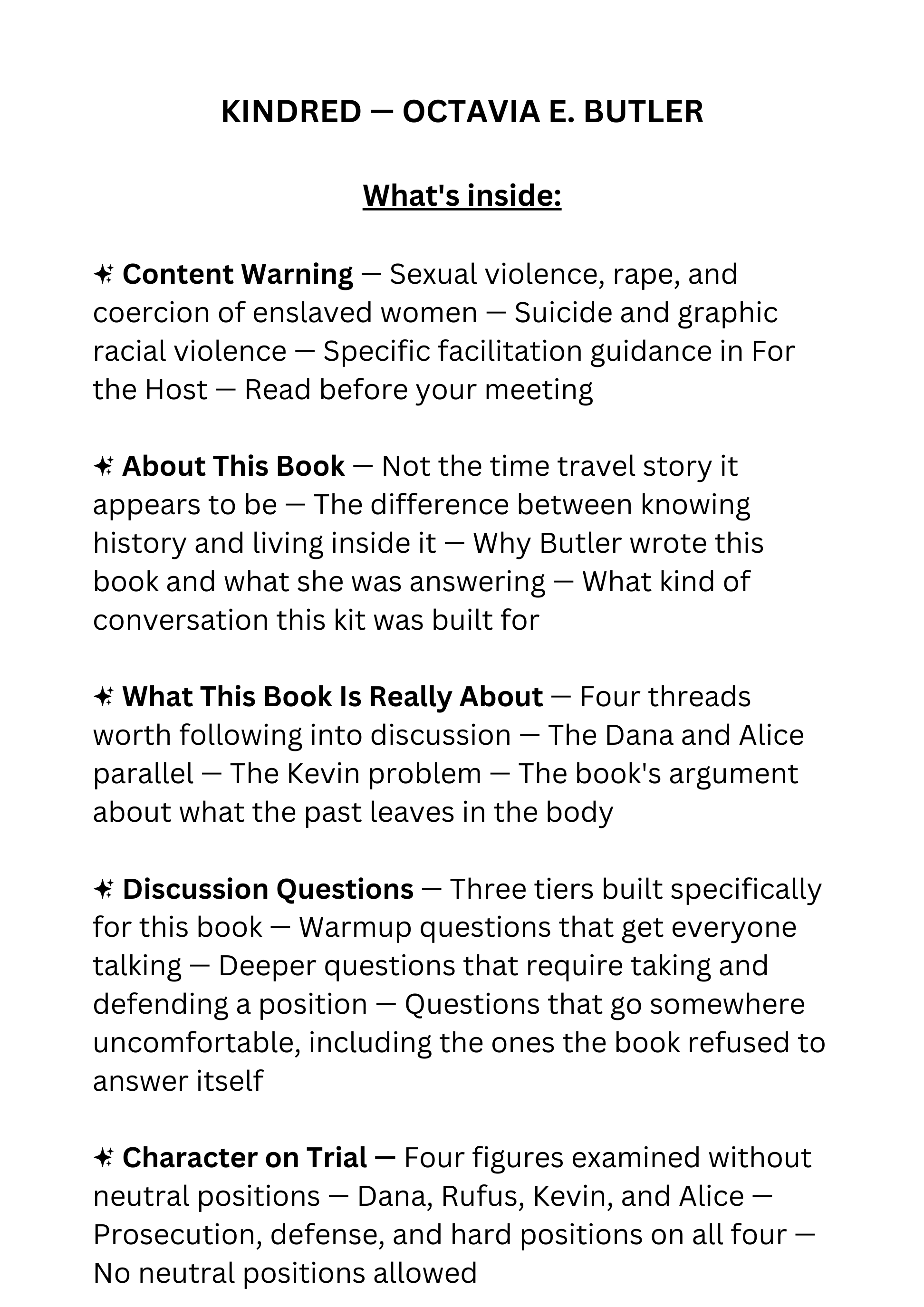
✦ What's Inside
✦ Content Warning — Sexual violence, rape, coercion, racial trauma — Facilitation guidance included for hosts — Placed at the front — this book earns it
✦ About This Book — Not the time travel story it appears to be — The difference between knowing history and living inside it — What kind of conversation this kit was built for
✦ What This Book Is Really About — Four threads worth following into discussion — The Dana and Alice parallel — The Kevin problem — The book's argument about what the past leaves in the body
✦ Discussion Questions — Three Tiers — Three tiers built specifically for this book — Tier 1: Warmup questions that get everyone talking — Tier 2: Deeper questions requiring a position and a defense — Tier 3: Questions that go somewhere uncomfortable — Closes with: What question did this book refuse to answer?
✦ Character on Trial — Dana, Rufus, Kevin, and Alice — Prosecution/defense structure — Hard position questions with mandatory reversal — No neutral positions allowed
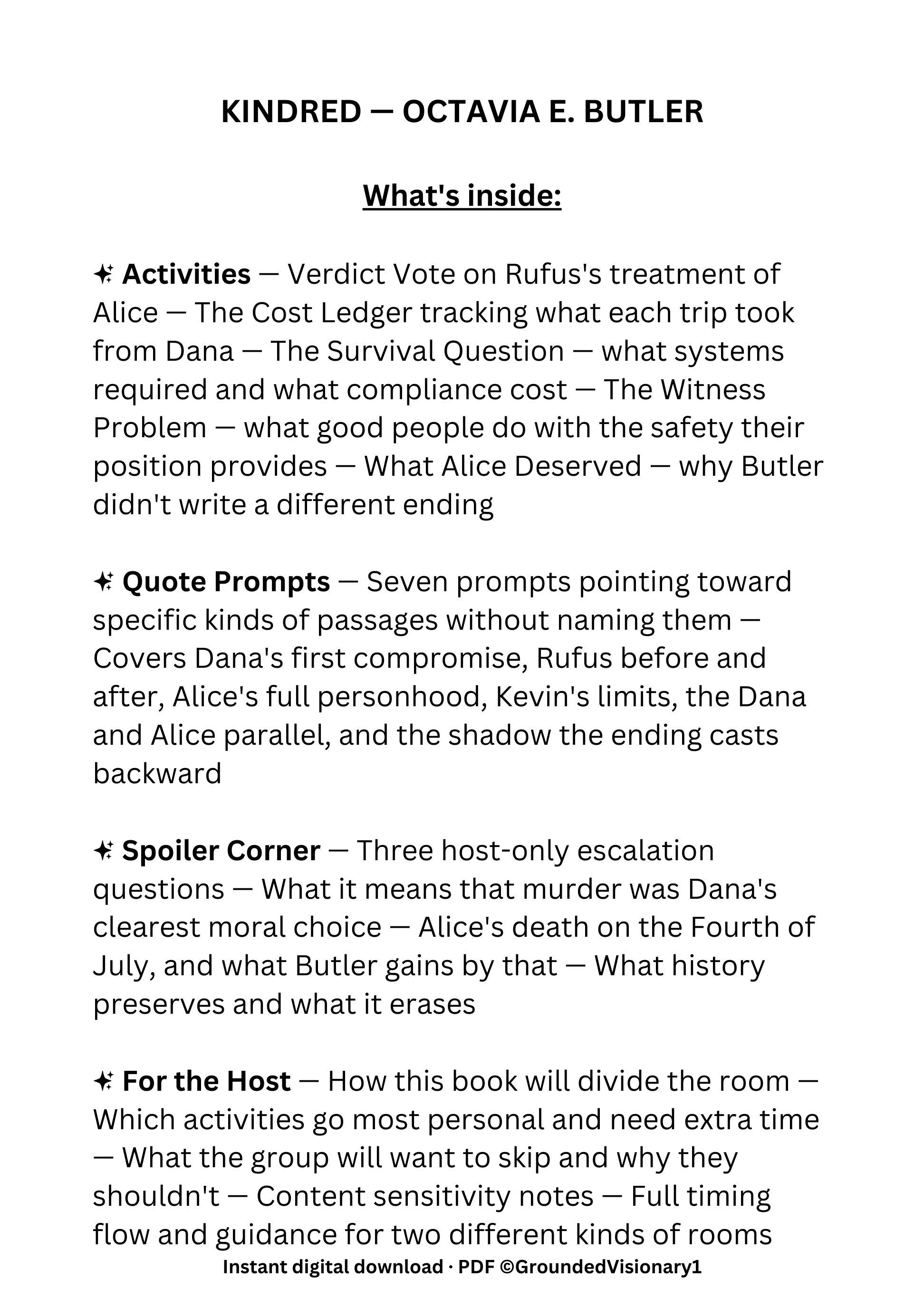
✦ Activities — Verdict Vote: Rufus's treatment of Alice — The Cost Ledger: what each trip took from Dana — The Survival Question — The Witness Problem — What Alice Deserved
✦ Quote Prompts — Seven prompts pointing toward specific kinds of passages — The moment Dana made a choice you understood and couldn't have made — The passage where the past stopped being history and became present
✦ Spoiler Corner — Host only — three escalation questions for when the conversation needs a jolt
✦ For the Host — How this book will divide the room — Content sensitivity notes and facilitation guidance — Full timing flow for two different kinds of rooms
✦ Bonus Host Guide — A free facilitation toolkit included with every purchase
Details — Instant download PDF — 45+ pages, print-ready — Personal and single-group use. No redistribution or resale. — Fan-created guide. Not affiliated with or endorsed by Octavia Butler's estate or any publisher.
Licensing for classrooms, libraries, and educational programs is available. If you plan to use this guide for a class, reading program, or institutional setting, please contact the shop owner to arrange an appropriate license.
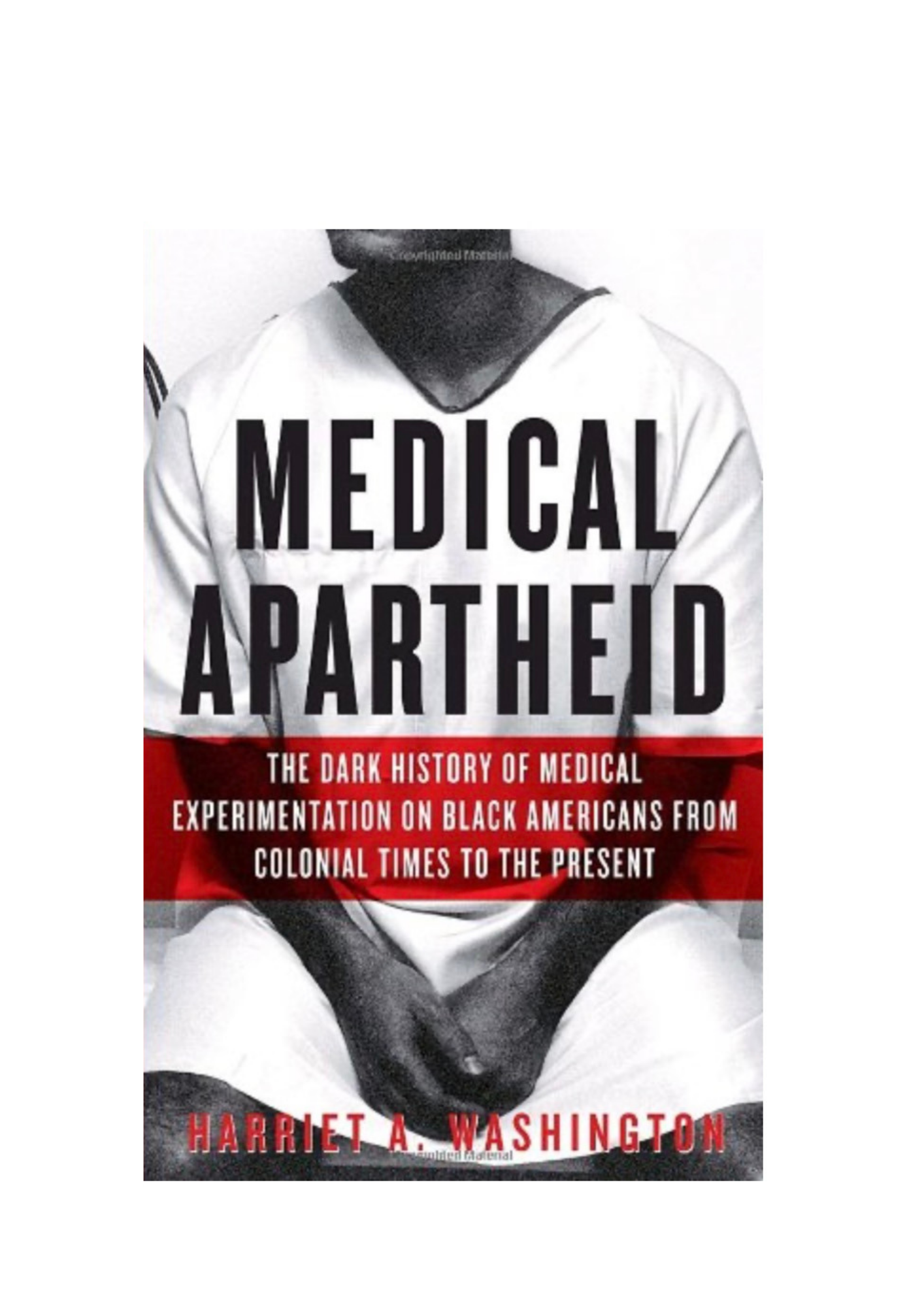
Harriet A. Washington spent years in medical journals and experimental reports that had gone largely undisturbed. What she found was not a collection of isolated incidents. What she found was a system.
J. Marion Sims is considered the father of modern gynecology. The techniques he pioneered were developed by operating repeatedly on enslaved Black women without consent and without anesthesia — because the medical establishment had decided Black people felt less pain. That is not a footnote to the history of American medicine. That is the history of American medicine. Washington traces that history from slavery through Tuskegee through government biological warfare testing on Black communities through contemporary pharmaceutical research. Her argument is not that these are separate horrors. Her argument is that they are the same horror expressed across four centuries by an institution that has never fully reckoned with what it built on.
This kit was built for the room that can handle that argument. Not the room that wants to be reassured that things are better now — Washington addresses that too, and her answer is complicated — but the room willing to sit with what American medicine was built on and ask what that means for what it is now. Washington ends her book not with condemnation but with a complicated ask: she wants Black Americans to participate in medical research despite everything she has just documented. This kit was built to make sure the room argues about whether that ask is reasonable — and what it reveals about where the burden of repair actually lives.
This kit was built for the room that finished Medical Apartheid and needed somewhere to put everything the book left in them.
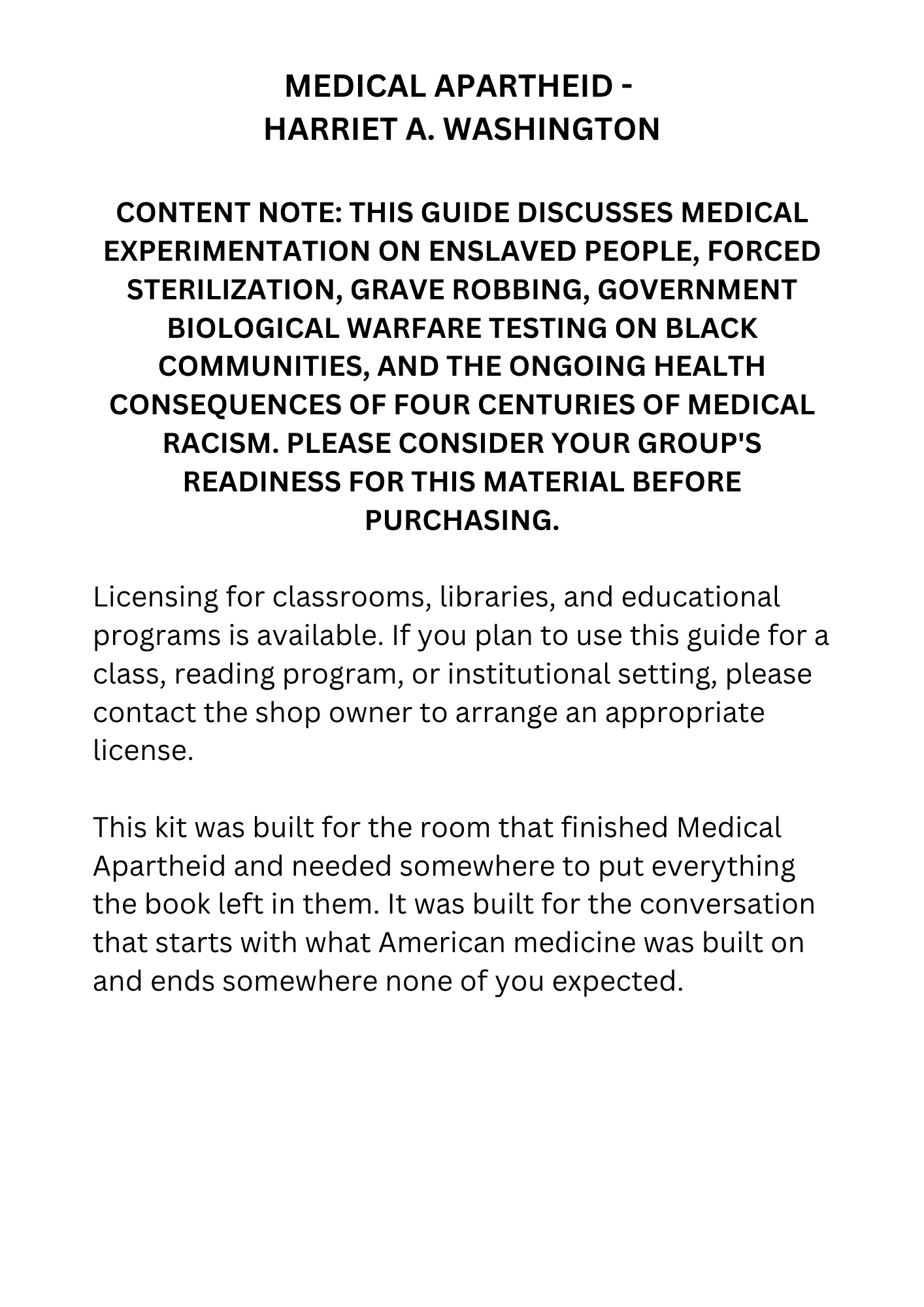
Content note: This guide discusses medical experimentation on enslaved people, forced sterilization, grave robbing, government biological warfare testing on Black communities, and the ongoing health consequences of four centuries of medical racism. These are not incidental to Washington's argument — they are the argument. Please consider your group's readiness for this material before purchasing.
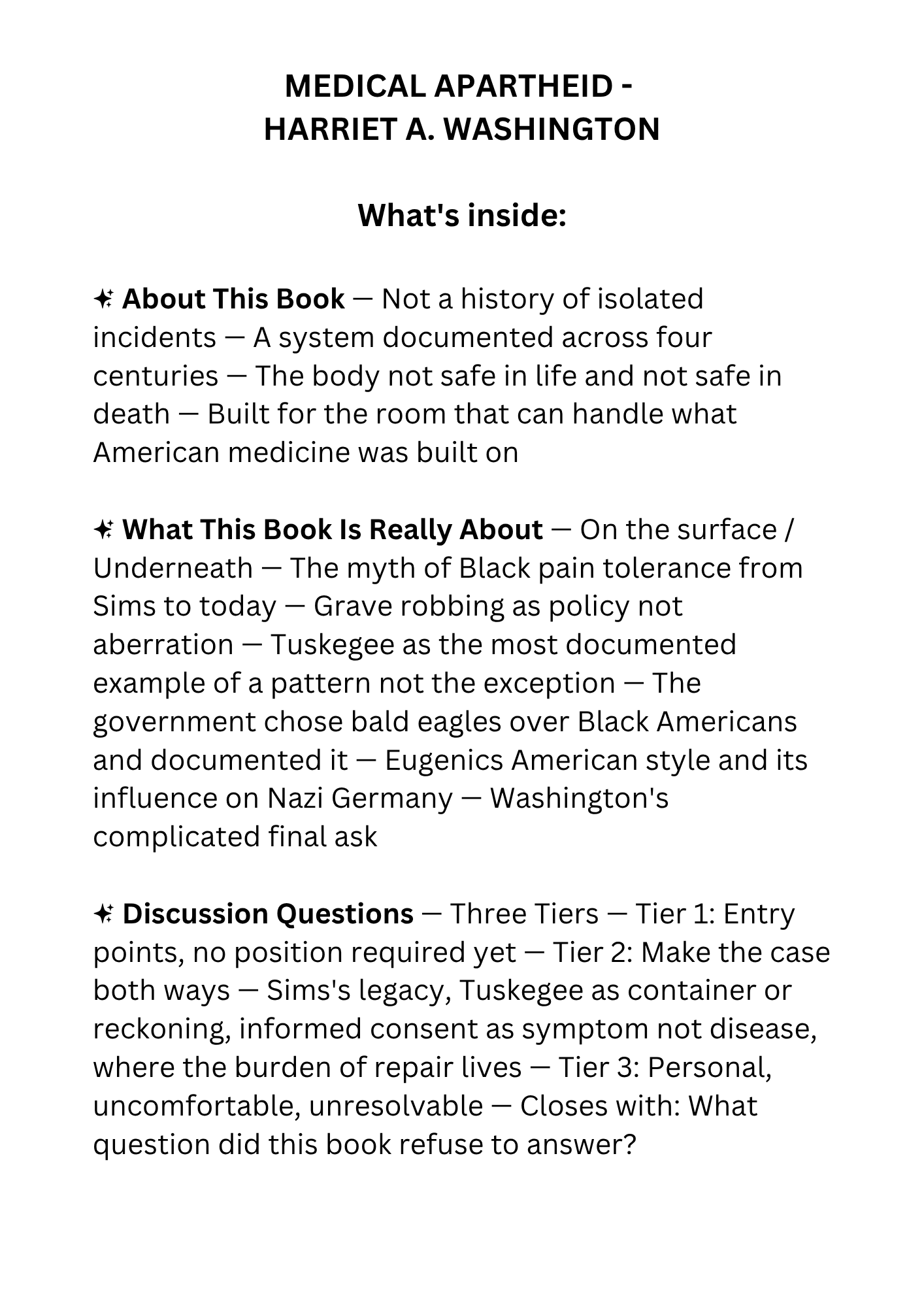
✦ What's Inside
✦ About This Book — Not a history of isolated incidents — A system documented across four centuries — The body not safe in life and not safe in death — Built for the room that can handle what American medicine was built on
✦ What This Book Is Really About — The myth of Black pain tolerance from Sims to today — Grave robbing as policy not aberration — Tuskegee as the most documented example of a pattern not the exception — The government chose bald eagles over Black Americans and documented it — Eugenics American style and its influence on Nazi Germany — Washington's complicated final ask
✦ Discussion Questions — Three Tiers — Tier 1: Entry points, no position required yet — Tier 2: Make the case both ways — Sims's legacy, Tuskegee as container or reckoning, where the burden of repair lives — Tier 3: Personal, uncomfortable, unresolvable — Closes with: What question did this book refuse to answer?
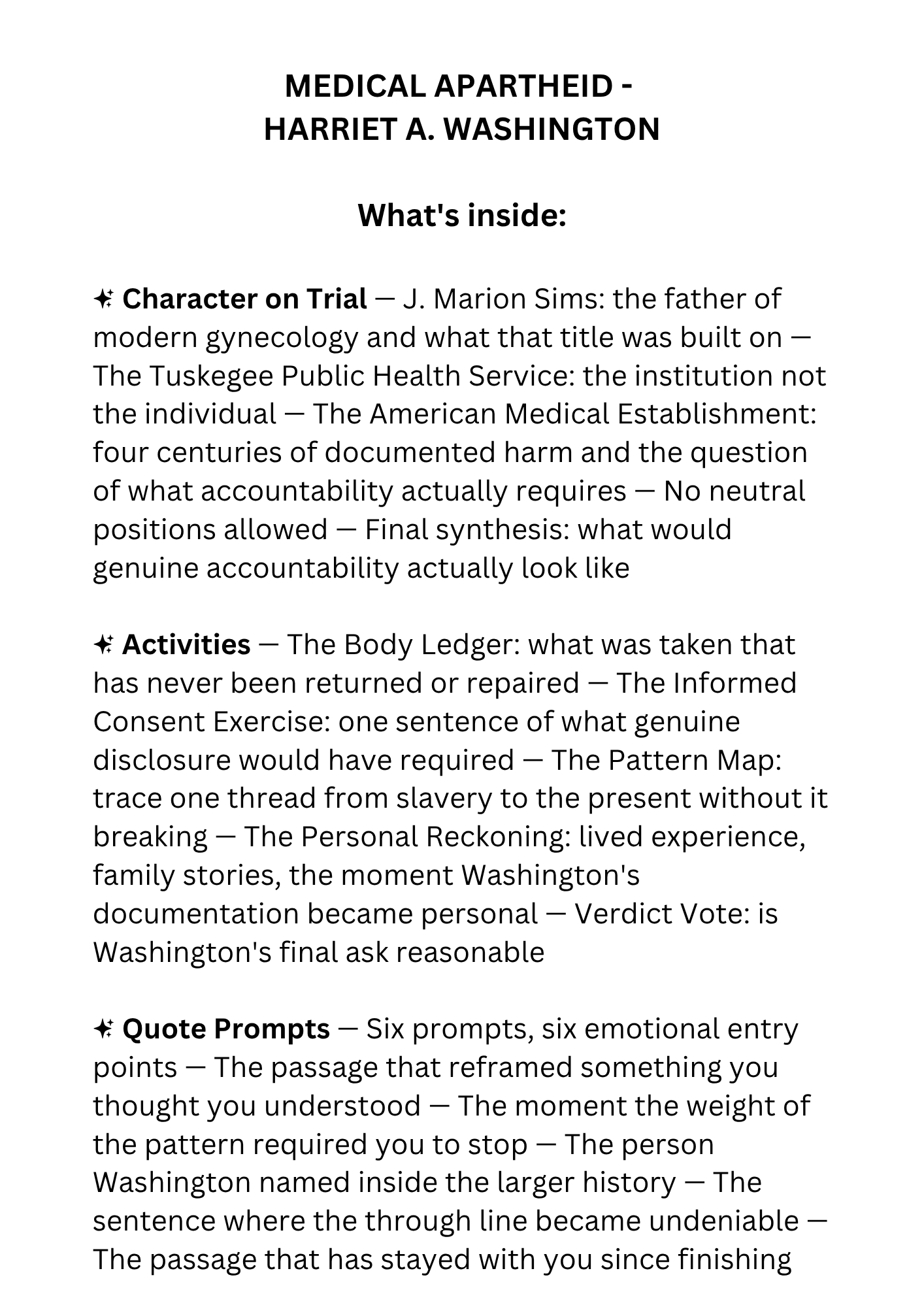
✦ Character on Trial — J. Marion Sims: the father of modern gynecology and what that title was built on — The Tuskegee Public Health Service: the institution not the individual — The American Medical Establishment: four centuries of documented harm — No neutral positions allowed — Final synthesis: what would genuine accountability actually look like
✦ Activities — The Body Ledger: what was taken that has never been returned or repaired — The Informed Consent Exercise: one sentence of what genuine disclosure would have required — The Pattern Map: trace one thread from slavery to the present without it breaking — The Personal Reckoning: lived experience, family stories, the moment Washington's documentation became personal — Verdict Vote: is Washington's final ask reasonable
✦ Quote Prompts — Six prompts, six emotional entry points — The passage that reframed something you thought you understood — The moment the weight of the pattern required you to stop — The sentence where the through line became undeniable
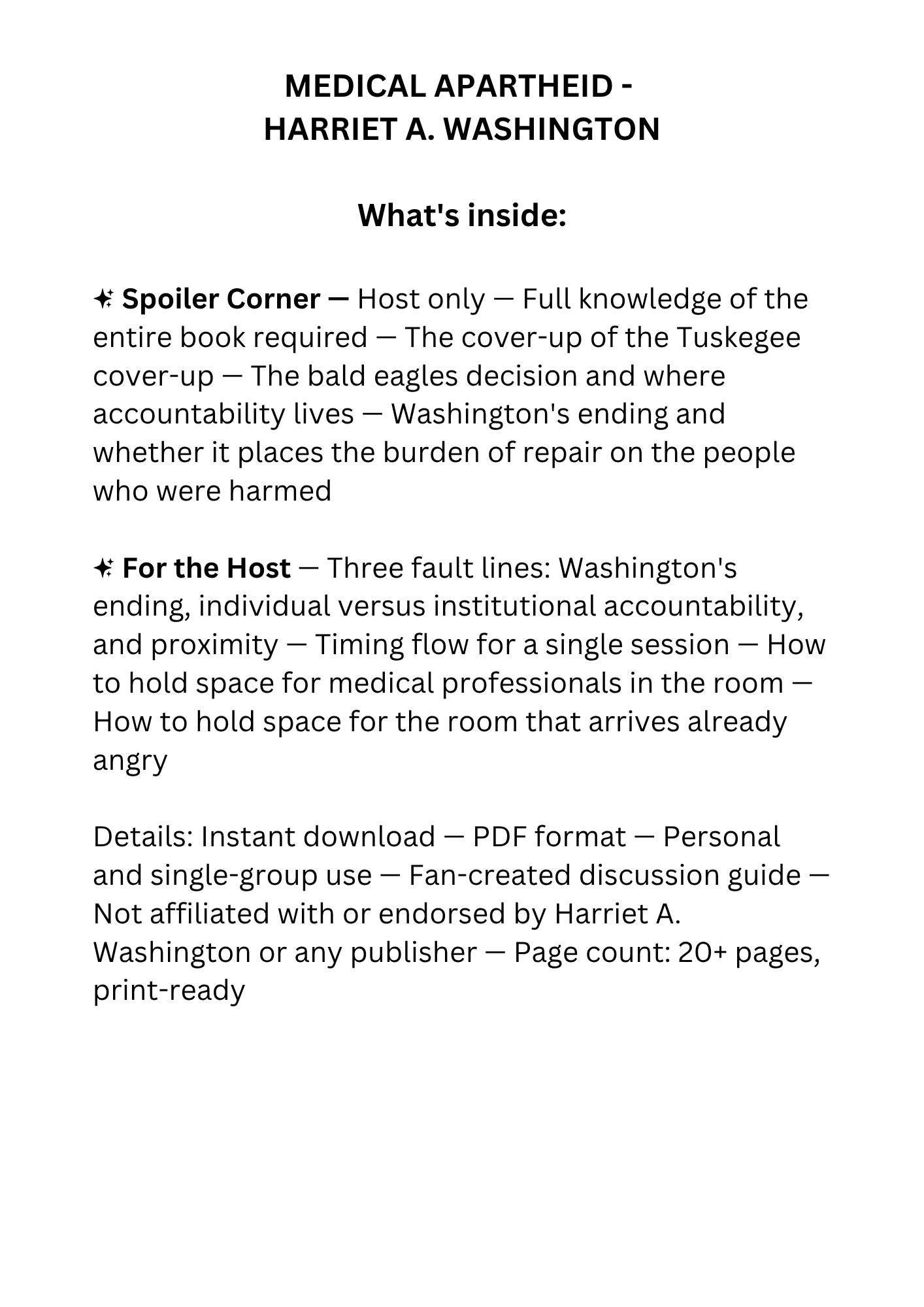
✦ Spoiler Corner — Host only — full knowledge of the entire book required — The cover-up of the Tuskegee cover-up — The bald eagles decision and where accountability lives — Washington's ending and whether it places the burden of repair on the people who were harmed
✦ For the Host — Three fault lines: Washington's ending, individual versus institutional accountability, and proximity — How to hold space for medical professionals in the room — How to hold space for the room that arrives already angry — Timing flow for a single session
✦ Bonus Host Guide — A free facilitation toolkit included with every purchase
Details — Instant download PDF — 20+ pages, print-ready — Personal and single-group use. No redistribution or resale. — Fan-created guide. Not affiliated with or endorsed by Harriet A. Washington or any publisher.
Licensing for classrooms, libraries, and educational programs is available. If you plan to use this guide for a class, reading program, or institutional setting, please contact the shop owner to arrange an appropriate license.
A devastating look at beauty, identity, and how deeply rejection can shape a life.
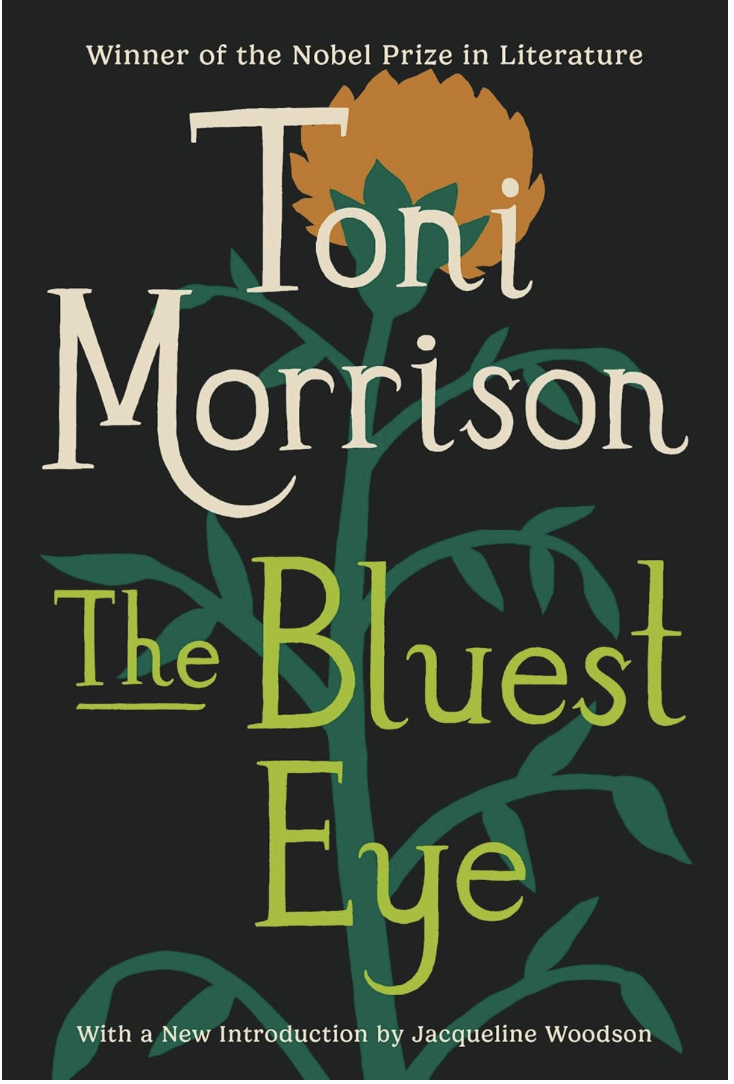
The Bluest Eye is Morrison's argument that beauty is one of racism's most effective weapons — the standard that decides whose face deserves love — and that when a child internalizes that standard completely, what happens to her cannot be called an accident. This is not a book about a bad father and a broken family. It is a book about a world that built Pecola, looked through her rather than at her, and then called what happened to her tragedy instead of consequence.
This kit follows Morrison's argument all the way through. Into the Dick-and-Jane primer that frames the novel. Into the community that participated in Pecola's erasure without raising a hand. Into the chapter written from Cholly's perspective — the one that asks you to understand how a man becomes capable of what he did, without letting him off the hook for it. That chapter is the hardest thing in this book and this kit does not skip it.
One question in each tier asks readers to bring something from their own lives: a standard they absorbed that wasn't made for them, what they did with it, and whether they still carry it.
This kit was built for a room willing to follow Morrison's argument all the way through — past the obvious villain, past the comfortable verdict, into what she is actually accusing.
Note: This guide contains discussion of child sexual abuse, rape, incest, and colorism as they appear in the novel. The content warning section includes host guidance for facilitating this material responsibly.
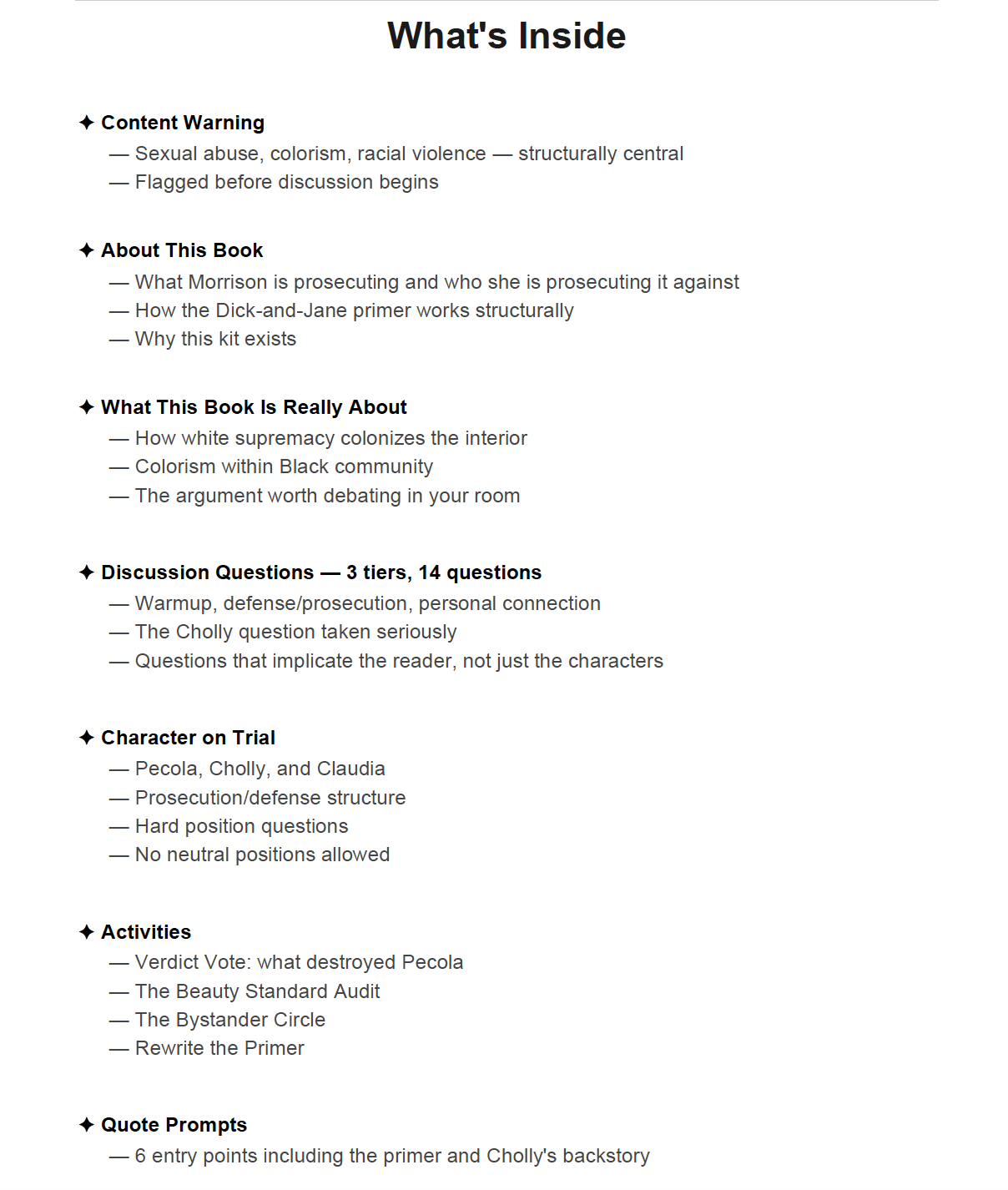
✦ What's Inside
✦ Content Warning — Child sexual abuse, rape, incest, colorism — Host guidance for facilitating difficult material — Placed at the front — this book earns it
✦ About This Book & What This Book Is Really About — Beauty as weapon, not standard — The community's role in Pecola's destruction — Why Cholly is not the ending Morrison wrote toward
✦ Discussion Questions — Three Tiers — 14 questions built specifically for this book — Tier 1: Entry points, no position required yet — Tier 2: Make the case both ways — Tier 3: Personal, uncomfortable, unresolvable — One question per tier asks readers to bring something from their own lives
✦ Character on Trial — Cholly Breedlove, Pauline Breedlove, Claudia MacTeer — Prosecution/defense structure — No neutral positions allowed — No comfortable verdicts
✦ Activities — Verdict Vote: Who is most responsible for Pecola — Cholly, the system, or the community? — The Beauty Ledger: standards you absorbed that weren't made for you — The Cholly Chapter: a structured activity for the novel's most difficult section — Verdict Vote: Pauline — moral failure or symptom?
✦ Quote Prompts — Six prompts across different emotional entry points — The passage that named something you absorbed without knowing it — The moment Morrison refused to let the community off the hook
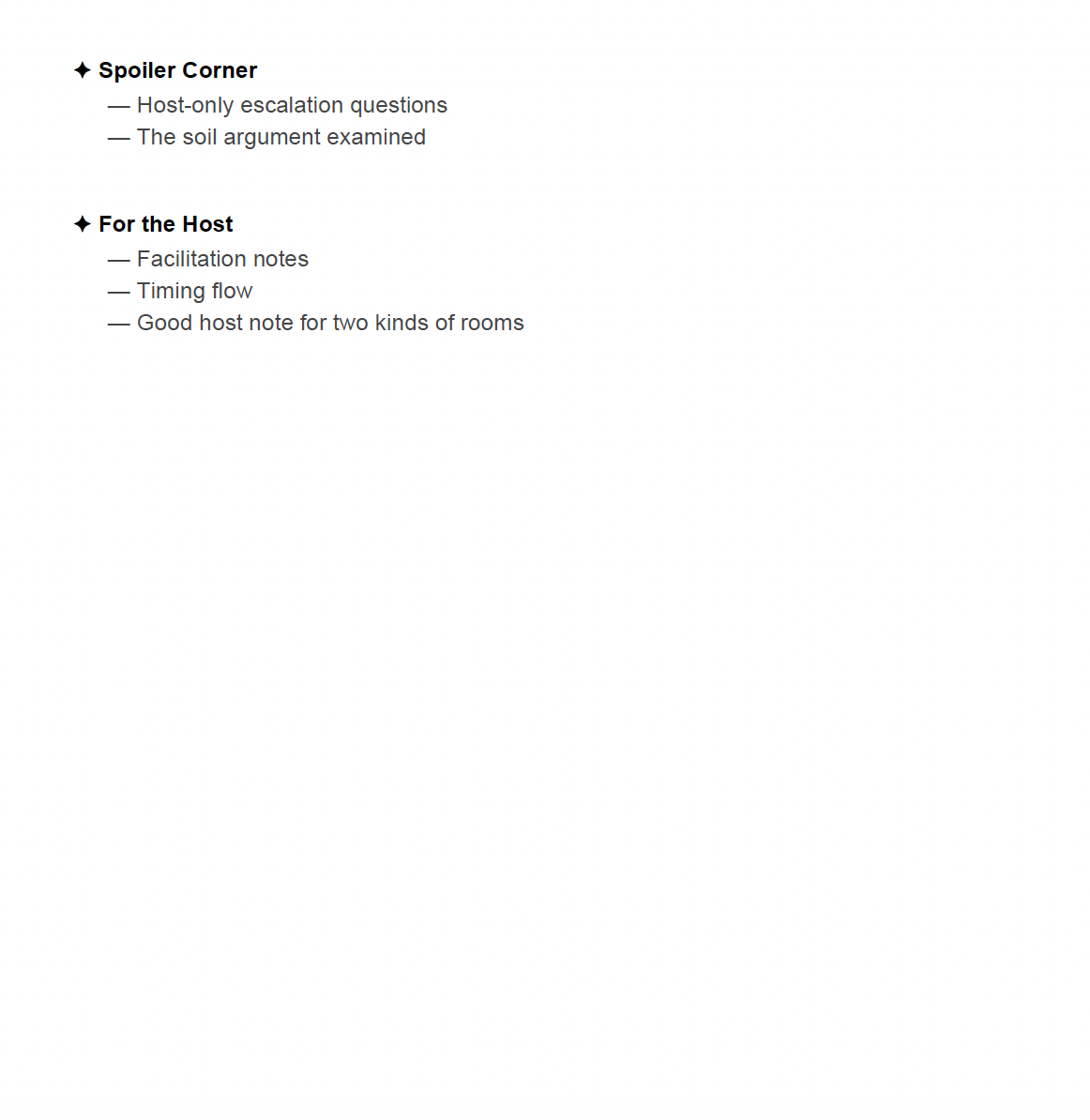
✦ Spoiler Corner — Host only — escalation questions for when the conversation needs a jolt
✦ For the Host — Why Cholly is not the ending Morrison wrote toward — Timing flow and facilitation notes — How to hold the Cholly chapter without letting the room collapse into it
Details — Instant download PDF — 20+ pages, print-ready — Personal and single-group use. No redistribution or resale. — Fan-created guide. Not affiliated with Toni Morrison, her estate, or any publisher.
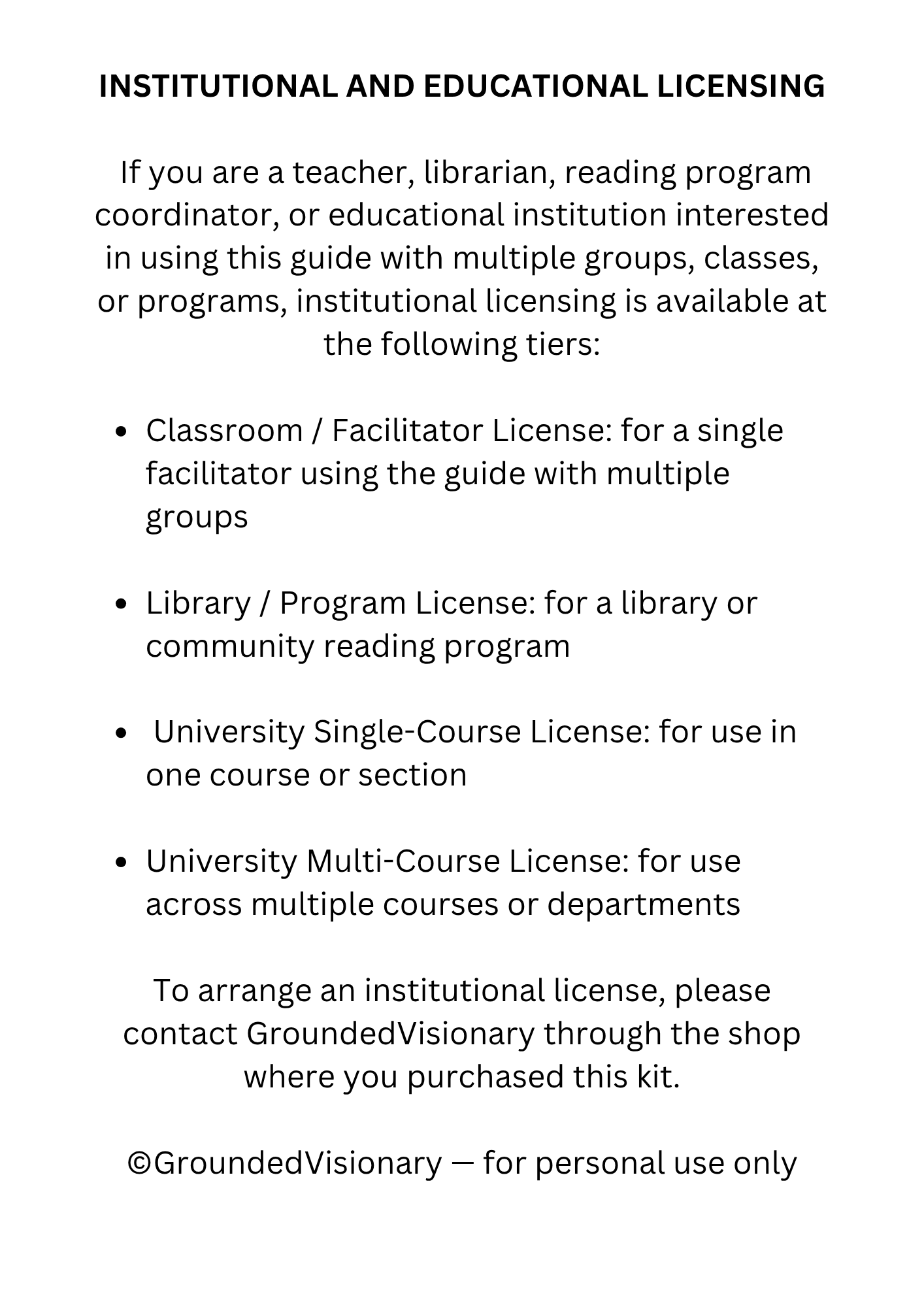
Licensing for classrooms, libraries, and educational programs is available. Contact GroundedVisionary through the shop.
A sharp exploration of friendship, freedom, and the cost of living outside expectations.
Toni Morrison didn't write Sula to be liked. She wrote her to be argued about.
This is a novel about what goodness actually costs — and who pays when a Black woman refuses to perform it. Nel chose the life her community required. Sula chose herself. Morrison doesn't let either of them off the hook. Neither does this kit.
The discussion this book generates isn't really about Sula. It's about what you want that you've been told a good woman shouldn't want. What it costs to claim it. What it costs to suppress it. And what you recognize in Nel and Sula from inside your own friendships and choices — the ones you've never said out loud in a room full of people.
This kit was built for a room that doesn't want to settle the question of whether Sula is good or bad. Because Morrison didn't write a novel that lets you.
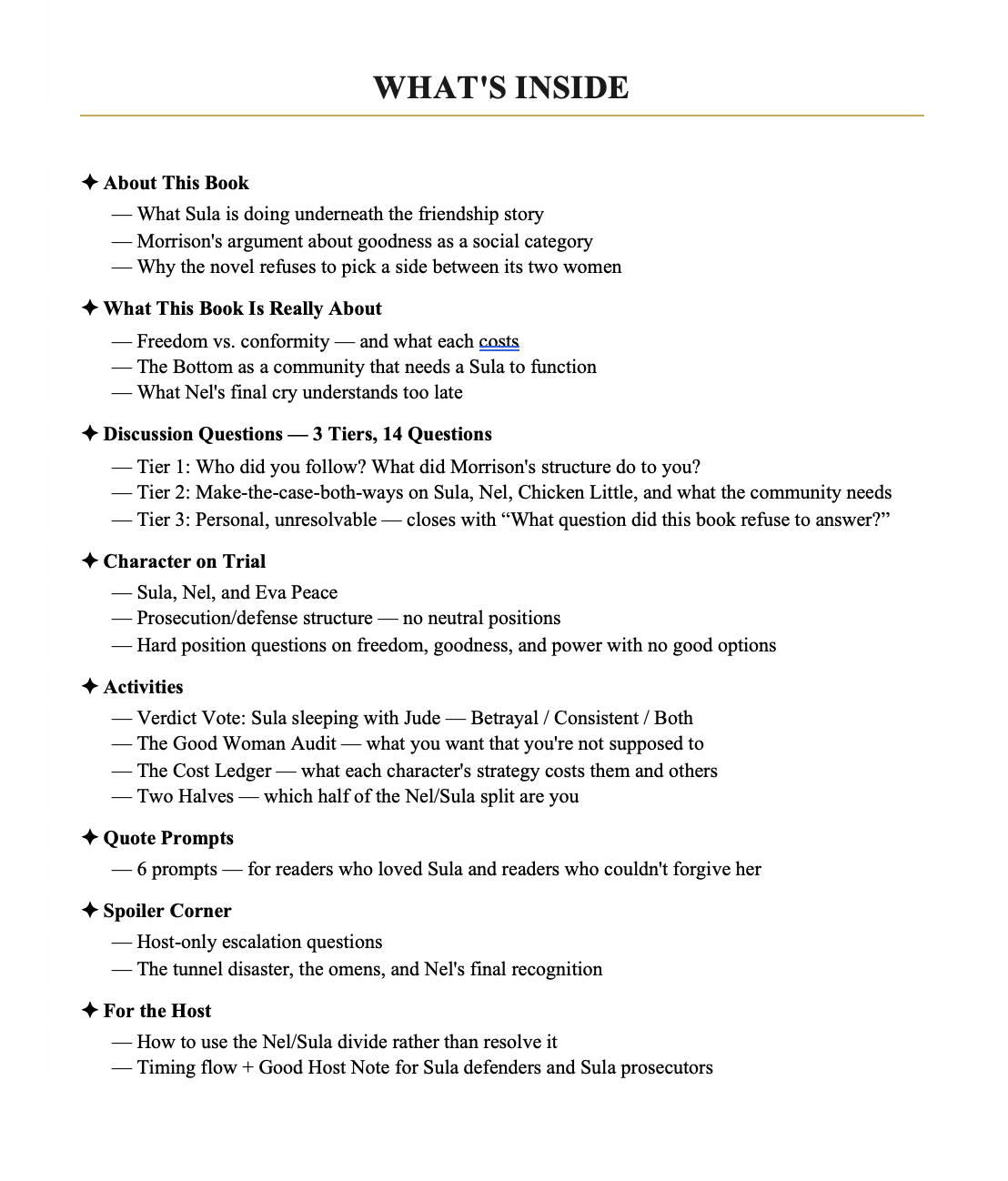
✦ What's Inside
✦ About This Book & What This Book Is Really About — Goodness as performance, not morality — What the community requires and what it costs — Why Morrison refuses to let either woman win
✦ Discussion Questions — Three Tiers — 14 questions built specifically for this book — Tier 1: Entry points, no position required yet — Tier 2: Make the case both ways — Tier 3: Personal, uncomfortable, unresolvable
✦ Character on Trial — Sula, Nel, and Eva Peace — Prosecution/defense structure — No neutral positions allowed — Hard position questions with mandatory reversal
✦ Activities — Verdict Vote: Was sleeping with Jude a betrayal, consistent, or both — simultaneously? — The Good Woman Audit: what you want that you're not supposed to — The Cost Ledger: what each character's survival strategy costs them and others — Two Halves: which side of the Nel/Sula split are you — and what would you borrow?
✦ Quote Prompts — Six prompts across different emotional entry points — The passage that named something you'd never said out loud — The moment Morrison refused to let you look away
✦ Spoiler Corner — Host only — escalation questions for when the conversation needs a jolt
✦ For the Host — Timing flow and facilitation notes — Good host note for Sula defenders and Sula prosecutors — What the room will want to skip and why they shouldn't
Details — Instant download PDF — 20+ pages, print-ready — Personal and single-group use. No redistribution or resale. — Fan-created guide. Not affiliated with Toni Morrison, her estate, or any publisher.
Licensing for classrooms, libraries, and educational programs is available. Contact GroundedVisionary through the shop.
No results match your search. Try removing a few filters.