 Image 1 of 3
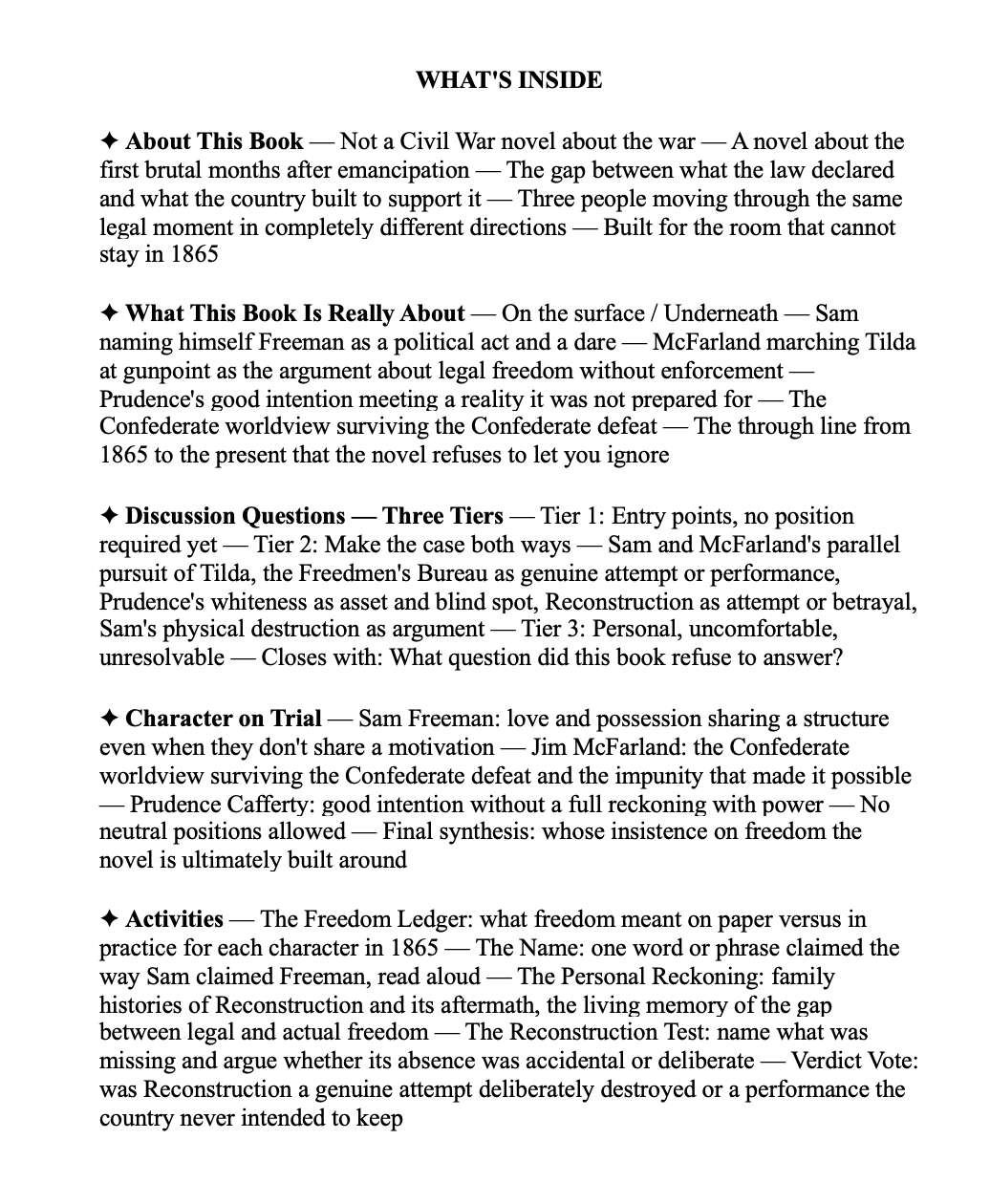 Image 2 of 3
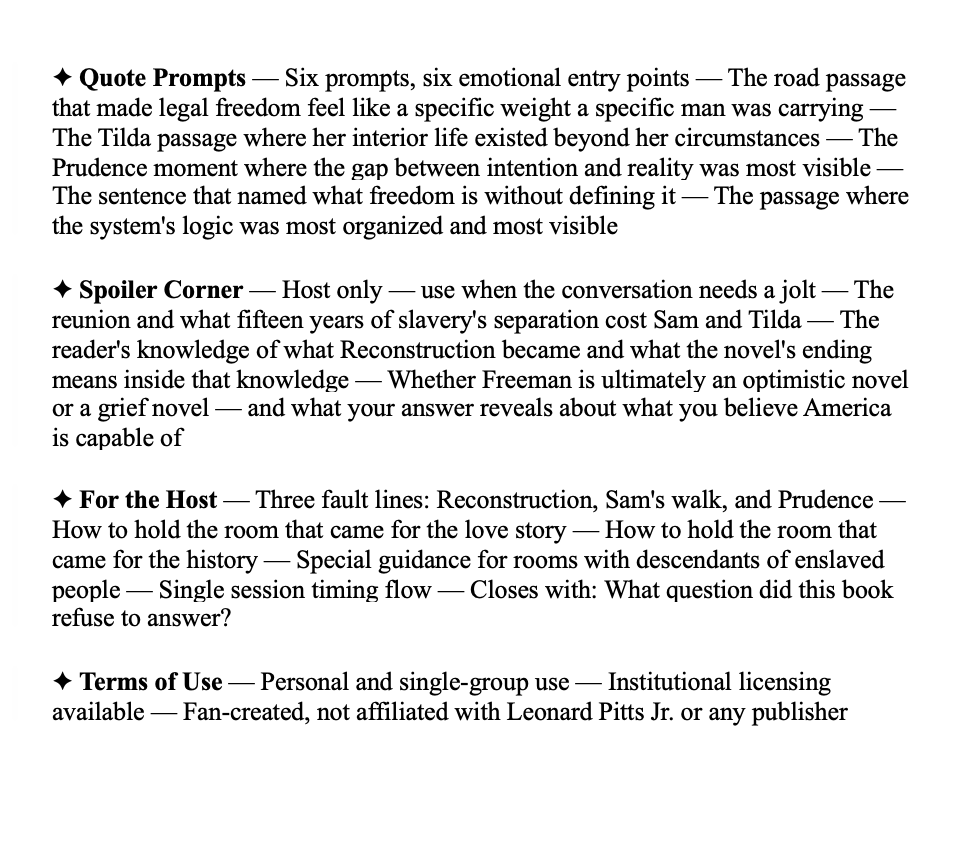 Image 3 of 3
Freeman — Leonard Pitts Jr. | Book Club Discussion Guide
The Emancipation Proclamation declared four million people free. What it did not build was anything to hold that freedom up. No land. No legal protection that was actually enforced. No safety from the men who had owned people and refused to accept that they no longer did. Leonard Pitts Jr. sets his novel in this specific and brutal gap — the first months after Lee's surrender, after Lincoln's assassination, after the law changed and almost nothing else did. Freeman is not a novel about the Civil War. It is a novel about what happened the morning after.
Three people move through this moment in completely different directions. Sam — a formerly enslaved man who took the last name Freeman the day he decided to walk south — leaves his safe haven in Philadelphia and walks a thousand miles through a lawless devastated country to find the wife slavery separated him from fifteen years earlier. Tilda — Sam's wife — is being marched at gunpoint by her former owner toward Arkansas where he believes the old order can still be maintained. Prudence — a wealthy white war widow from Boston — is heading south to honor her abolitionist father's dying wish and open a school for emancipated slaves in a place that has decided it does not want what she is offering.
Pitts is asking one question across all three of them — what does freedom actually mean when it exists on paper but not in practice? When the law has changed and the violence has not. When the men who lost the war are still operating with enough impunity to act as though they won. When a man can name himself Freeman and walk toward that name and lose an arm doing it and keep walking anyway because the alternative is letting slavery have the final word.
This kit was built for the room that finished Freeman sitting with the grief of a novel set at the moment of maximum possibility — before Reconstruction's abandonment, before Jim Crow, before the country made the specific choices it made about what emancipation was actually going to mean. It was built for the conversation that starts in 1865 and cannot stay there.
What's Inside:
✦ About This Book — Not a Civil War novel about the war — A novel about the first brutal months after emancipation — The gap between what the law declared and what the country built to support it — Three people moving through the same legal moment in completely different directions — Built for the room that cannot stay in 1865
✦ What This Book Is Really About — On the surface / Underneath — Sam naming himself Freeman as a political act and a dare — McFarland marching Tilda at gunpoint as the argument about legal freedom without enforcement — Prudence's good intention meeting a reality it was not prepared for — The Confederate worldview surviving the Confederate defeat — The through line from 1865 to the present that the novel refuses to let you ignore
✦ Discussion Questions — Three Tiers — Tier 1: Entry points, no position required yet — Tier 2: Make the case both ways — Sam and McFarland's parallel pursuit of Tilda, the Freedmen's Bureau as genuine attempt or performance, Prudence's whiteness as asset and blind spot, Reconstruction as attempt or betrayal, Sam's physical destruction as argument — Tier 3: Personal, uncomfortable, unresolvable — Closes with: What question did this book refuse to answer?
✦ Character on Trial — Sam Freeman: love and possession sharing a structure even when they don't share a motivation — Jim McFarland: the Confederate worldview surviving the Confederate defeat and the impunity that made it possible — Prudence Cafferty: good intention without a full reckoning with power — No neutral positions allowed — Final synthesis: whose insistence on freedom the novel is ultimately built around
✦ Activities — The Freedom Ledger: what freedom meant on paper versus in practice for each character in 1865 — The Name: one word or phrase claimed the way Sam claimed Freeman, read aloud — The Personal Reckoning: family histories of Reconstruction and its aftermath, the living memory of the gap between legal and actual freedom — The Reconstruction Test: name what was missing and argue whether its absence was accidental or deliberate — Verdict Vote: was Reconstruction a genuine attempt deliberately destroyed or a performance the country never intended to keep
✦ Quote Prompts — Six prompts, six emotional entry points — The road passage that made legal freedom feel like a specific weight a specific man was carrying — The Tilda passage where her interior life existed beyond her circumstances — The Prudence moment where the gap between intention and reality was most visible — The sentence that named what freedom is without defining it — The passage where the system's logic was most organized and most visible
✦ Spoiler Corner — Host only — Full knowledge of the entire novel required — The reunion and what fifteen years of slavery's separation cost Sam and Tilda — The reader's knowledge of what Reconstruction became and what the novel's ending means inside that knowledge — Whether Freeman is ultimately an optimistic novel or a grief novel
✦ For the Host — Three fault lines: Reconstruction, Sam's walk, and Prudence — How to hold the room that came for the love story — How to hold the room that came for the history — Special guidance for rooms with descendants of enslaved people — Timing flow for a single session
Details: Instant download — PDF format — Personal and single-group use — Fan-created discussion guide — Not affiliated with or endorsed by Leonard Pitts Jr. or any publisher — Page count: 20+ pages, print-ready
Content note: This guide discusses slavery and its violence, lynching, re-enslavement through coercion, racial violence in the post-war South, and the systematic destruction of Reconstruction-era Black progress. These are not background details — they are the argument. Please consider your group's readiness for this material before purchasing.
Licensing for classrooms, libraries, and educational programs is available. If you plan to use this guide for a class, reading program, or institutional setting, please contact the shop owner to arrange an appropriate license
The Emancipation Proclamation declared four million people free. What it did not build was anything to hold that freedom up. No land. No legal protection that was actually enforced. No safety from the men who had owned people and refused to accept that they no longer did. Leonard Pitts Jr. sets his novel in this specific and brutal gap — the first months after Lee's surrender, after Lincoln's assassination, after the law changed and almost nothing else did. Freeman is not a novel about the Civil War. It is a novel about what happened the morning after.
Three people move through this moment in completely different directions. Sam — a formerly enslaved man who took the last name Freeman the day he decided to walk south — leaves his safe haven in Philadelphia and walks a thousand miles through a lawless devastated country to find the wife slavery separated him from fifteen years earlier. Tilda — Sam's wife — is being marched at gunpoint by her former owner toward Arkansas where he believes the old order can still be maintained. Prudence — a wealthy white war widow from Boston — is heading south to honor her abolitionist father's dying wish and open a school for emancipated slaves in a place that has decided it does not want what she is offering.
Pitts is asking one question across all three of them — what does freedom actually mean when it exists on paper but not in practice? When the law has changed and the violence has not. When the men who lost the war are still operating with enough impunity to act as though they won. When a man can name himself Freeman and walk toward that name and lose an arm doing it and keep walking anyway because the alternative is letting slavery have the final word.
This kit was built for the room that finished Freeman sitting with the grief of a novel set at the moment of maximum possibility — before Reconstruction's abandonment, before Jim Crow, before the country made the specific choices it made about what emancipation was actually going to mean. It was built for the conversation that starts in 1865 and cannot stay there.
What's Inside:
✦ About This Book — Not a Civil War novel about the war — A novel about the first brutal months after emancipation — The gap between what the law declared and what the country built to support it — Three people moving through the same legal moment in completely different directions — Built for the room that cannot stay in 1865
✦ What This Book Is Really About — On the surface / Underneath — Sam naming himself Freeman as a political act and a dare — McFarland marching Tilda at gunpoint as the argument about legal freedom without enforcement — Prudence's good intention meeting a reality it was not prepared for — The Confederate worldview surviving the Confederate defeat — The through line from 1865 to the present that the novel refuses to let you ignore
✦ Discussion Questions — Three Tiers — Tier 1: Entry points, no position required yet — Tier 2: Make the case both ways — Sam and McFarland's parallel pursuit of Tilda, the Freedmen's Bureau as genuine attempt or performance, Prudence's whiteness as asset and blind spot, Reconstruction as attempt or betrayal, Sam's physical destruction as argument — Tier 3: Personal, uncomfortable, unresolvable — Closes with: What question did this book refuse to answer?
✦ Character on Trial — Sam Freeman: love and possession sharing a structure even when they don't share a motivation — Jim McFarland: the Confederate worldview surviving the Confederate defeat and the impunity that made it possible — Prudence Cafferty: good intention without a full reckoning with power — No neutral positions allowed — Final synthesis: whose insistence on freedom the novel is ultimately built around
✦ Activities — The Freedom Ledger: what freedom meant on paper versus in practice for each character in 1865 — The Name: one word or phrase claimed the way Sam claimed Freeman, read aloud — The Personal Reckoning: family histories of Reconstruction and its aftermath, the living memory of the gap between legal and actual freedom — The Reconstruction Test: name what was missing and argue whether its absence was accidental or deliberate — Verdict Vote: was Reconstruction a genuine attempt deliberately destroyed or a performance the country never intended to keep
✦ Quote Prompts — Six prompts, six emotional entry points — The road passage that made legal freedom feel like a specific weight a specific man was carrying — The Tilda passage where her interior life existed beyond her circumstances — The Prudence moment where the gap between intention and reality was most visible — The sentence that named what freedom is without defining it — The passage where the system's logic was most organized and most visible
✦ Spoiler Corner — Host only — Full knowledge of the entire novel required — The reunion and what fifteen years of slavery's separation cost Sam and Tilda — The reader's knowledge of what Reconstruction became and what the novel's ending means inside that knowledge — Whether Freeman is ultimately an optimistic novel or a grief novel
✦ For the Host — Three fault lines: Reconstruction, Sam's walk, and Prudence — How to hold the room that came for the love story — How to hold the room that came for the history — Special guidance for rooms with descendants of enslaved people — Timing flow for a single session
Details: Instant download — PDF format — Personal and single-group use — Fan-created discussion guide — Not affiliated with or endorsed by Leonard Pitts Jr. or any publisher — Page count: 20+ pages, print-ready
Content note: This guide discusses slavery and its violence, lynching, re-enslavement through coercion, racial violence in the post-war South, and the systematic destruction of Reconstruction-era Black progress. These are not background details — they are the argument. Please consider your group's readiness for this material before purchasing.
Licensing for classrooms, libraries, and educational programs is available. If you plan to use this guide for a class, reading program, or institutional setting, please contact the shop owner to arrange an appropriate license