 Image 1 of 2
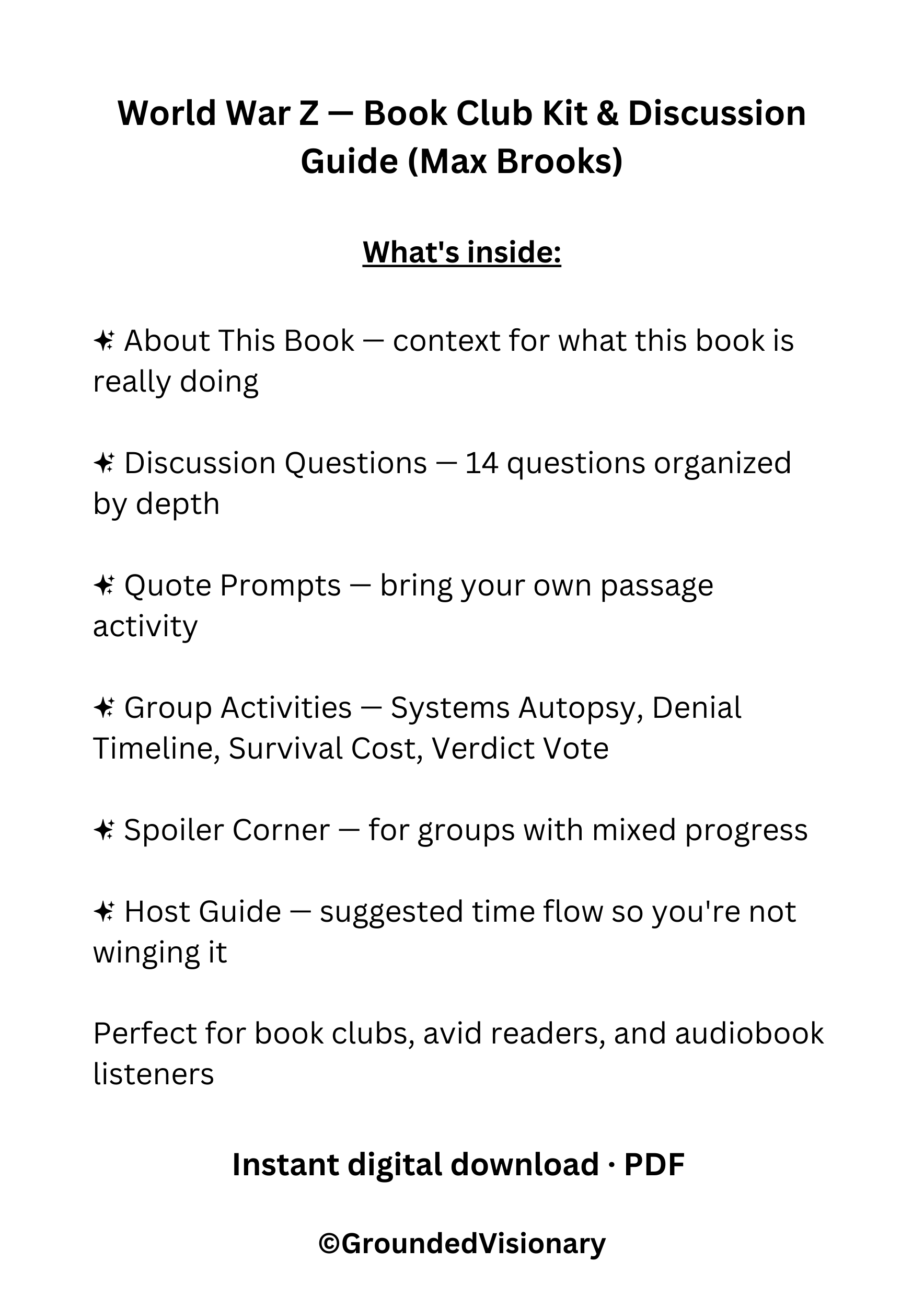 Image 2 of 2
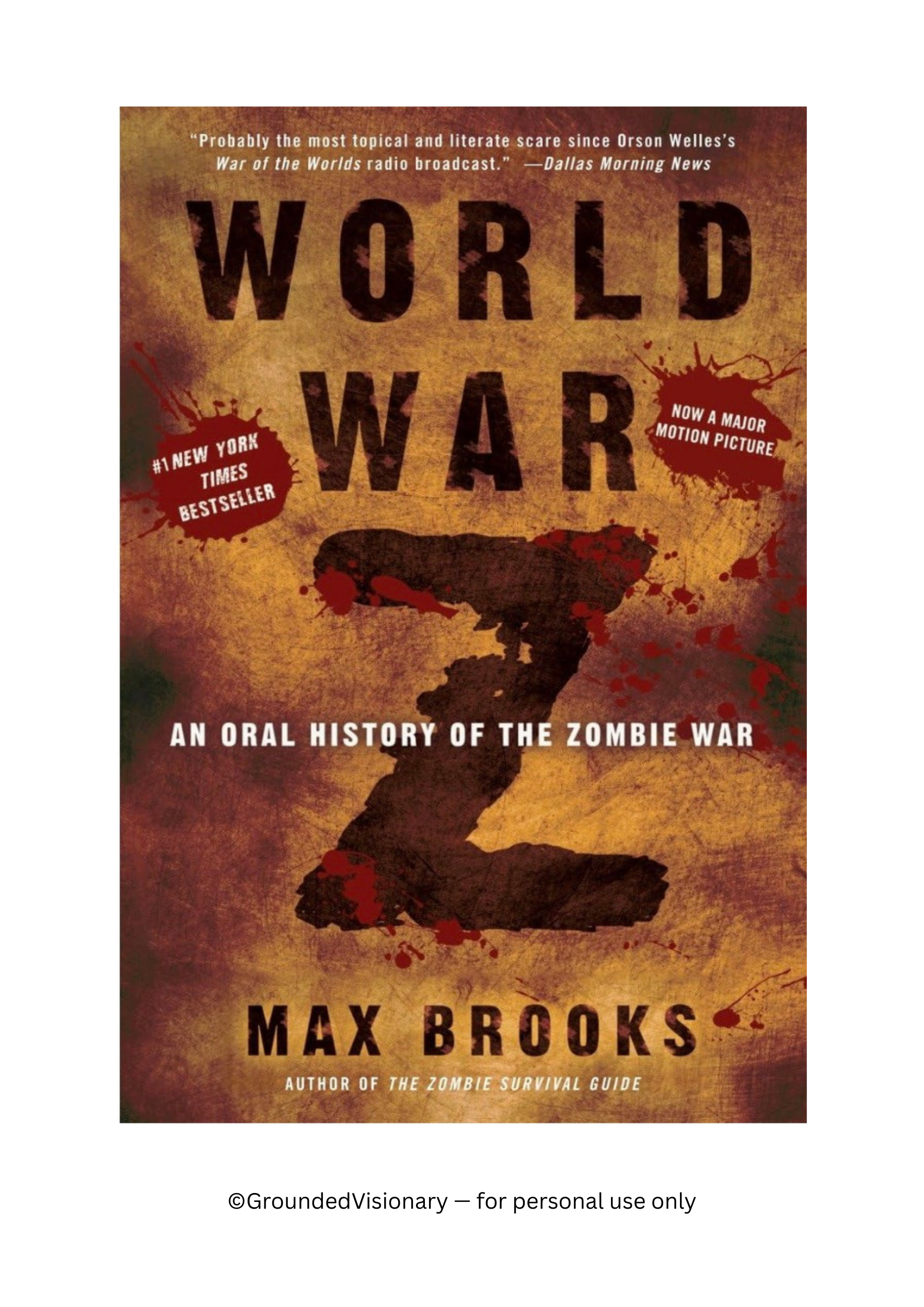
WORLD WAR Z
This isn't a zombie novel. The zombies are the least interesting thing about it.
What Max Brooks actually wrote is an oral history of a global catastrophe told through the people who survived it — soldiers, doctors, politicians, civilians, black market operators, regular people who just happened to make it. The format feels like reading a stack of post-war debrief transcripts. That is the point. It gives the whole thing a weight that most disaster fiction never achieves.
Here's what the book is really doing: it's an after-action review of humanity getting completely overwhelmed — and then slowly crawling back to rebuild. The zombies are the disaster. Human behavior is the chaos multiplier. Denial, arrogance, bad planning, political theater, "it won't happen here" — all of it arrives before the zombies even get through the door. Brooks wrote this in 2006. Your book club gets to decide how familiar that pattern feels right now.
Fair warning: this isn't a character-driven novel in the traditional sense. There's no one protagonist you follow emotionally from beginning to end. Humanity is the main character. Groups who go in expecting a traditional story often feel cold toward it. Groups who go in expecting a forensic examination tend to find it riveting. This kit is built for the second kind of room.
✦ What's Inside
✦ About This Book — Not a zombie novel — the zombies are the least interesting thing — An oral history of global catastrophe told by the people who survived it — Why the format is doing as much work as the content
✦ What This Book Is Really About — A forensic examination of how human systems fail, adapt, and rebuild — Who profits from denial — and whether that pattern feels familiar — What survival actually costs the people who achieve it — Whether going back is possible or whether the world just becomes something else
✦ Discussion Questions — Three Tiers — Tier 1: Warmup questions including the format, the voice that stuck, and what you expected vs. what you got — Tier 2: Which institution failed most catastrophically, who profits from denial, where the line is between understandable and unforgivable — Tier 3: Trauma after the danger ends, what humanity lost that it can't get back, what Brooks saw in 2006 that landed this week — Closes with: What question did this book refuse to answer?
✦ Activities — Systems Autopsy: pick one system that failed — healthcare, government, military, media, supply chain — walk through the failure and ask what would have had to be different for it to hold — The Denial Timeline: reconstruct the chain of denial in the early outbreak, map who knew and who profited from silence, ask whether this pattern shows up anywhere in the real world — Survival Cost: name the account that showed you what survival really costs and whether any version of survival in this book costs nothing — Verdict Vote: one decision by a government, military leader, or individual — Necessary / Inexcusable / Understandable but wrong
✦ Quote Prompts — Five prompts across different emotional entry points — The account where the real enemy wasn't the zombies — The passage where denial did more damage than the disaster itself — The voice that felt uncomfortably close to real life
✦ Spoiler Corner — Host option — three questions for groups who finished — Which account changed meaning once you knew how the war ended — Whether the ending felt like hope, exhaustion, or something in between — What the final shape of the world says about what humanity actually learned
✦ For the Host — How to anchor discussion when there's no central protagonist — Go straight to the themes — resist the plot recap — Timing flow for a single session — Good host note: name the format upfront
Details — Instant download PDF — Personal and single-group use. No redistribution or resale. — Fan-created guide. Not affiliated with or endorsed by Max Brooks or any publisher.
Licensing for classrooms, libraries, and educational programs is available. If you plan to use this guide for a class, reading program, or institutional setting, please contact the shop owner to arrange an appropriate license.
This isn't a zombie novel. The zombies are the least interesting thing about it.
What Max Brooks actually wrote is an oral history of a global catastrophe told through the people who survived it — soldiers, doctors, politicians, civilians, black market operators, regular people who just happened to make it. The format feels like reading a stack of post-war debrief transcripts. That is the point. It gives the whole thing a weight that most disaster fiction never achieves.
Here's what the book is really doing: it's an after-action review of humanity getting completely overwhelmed — and then slowly crawling back to rebuild. The zombies are the disaster. Human behavior is the chaos multiplier. Denial, arrogance, bad planning, political theater, "it won't happen here" — all of it arrives before the zombies even get through the door. Brooks wrote this in 2006. Your book club gets to decide how familiar that pattern feels right now.
Fair warning: this isn't a character-driven novel in the traditional sense. There's no one protagonist you follow emotionally from beginning to end. Humanity is the main character. Groups who go in expecting a traditional story often feel cold toward it. Groups who go in expecting a forensic examination tend to find it riveting. This kit is built for the second kind of room.
✦ What's Inside
✦ About This Book — Not a zombie novel — the zombies are the least interesting thing — An oral history of global catastrophe told by the people who survived it — Why the format is doing as much work as the content
✦ What This Book Is Really About — A forensic examination of how human systems fail, adapt, and rebuild — Who profits from denial — and whether that pattern feels familiar — What survival actually costs the people who achieve it — Whether going back is possible or whether the world just becomes something else
✦ Discussion Questions — Three Tiers — Tier 1: Warmup questions including the format, the voice that stuck, and what you expected vs. what you got — Tier 2: Which institution failed most catastrophically, who profits from denial, where the line is between understandable and unforgivable — Tier 3: Trauma after the danger ends, what humanity lost that it can't get back, what Brooks saw in 2006 that landed this week — Closes with: What question did this book refuse to answer?
✦ Activities — Systems Autopsy: pick one system that failed — healthcare, government, military, media, supply chain — walk through the failure and ask what would have had to be different for it to hold — The Denial Timeline: reconstruct the chain of denial in the early outbreak, map who knew and who profited from silence, ask whether this pattern shows up anywhere in the real world — Survival Cost: name the account that showed you what survival really costs and whether any version of survival in this book costs nothing — Verdict Vote: one decision by a government, military leader, or individual — Necessary / Inexcusable / Understandable but wrong
✦ Quote Prompts — Five prompts across different emotional entry points — The account where the real enemy wasn't the zombies — The passage where denial did more damage than the disaster itself — The voice that felt uncomfortably close to real life
✦ Spoiler Corner — Host option — three questions for groups who finished — Which account changed meaning once you knew how the war ended — Whether the ending felt like hope, exhaustion, or something in between — What the final shape of the world says about what humanity actually learned
✦ For the Host — How to anchor discussion when there's no central protagonist — Go straight to the themes — resist the plot recap — Timing flow for a single session — Good host note: name the format upfront
Details — Instant download PDF — Personal and single-group use. No redistribution or resale. — Fan-created guide. Not affiliated with or endorsed by Max Brooks or any publisher.
Licensing for classrooms, libraries, and educational programs is available. If you plan to use this guide for a class, reading program, or institutional setting, please contact the shop owner to arrange an appropriate license.