 Image 1 of 2
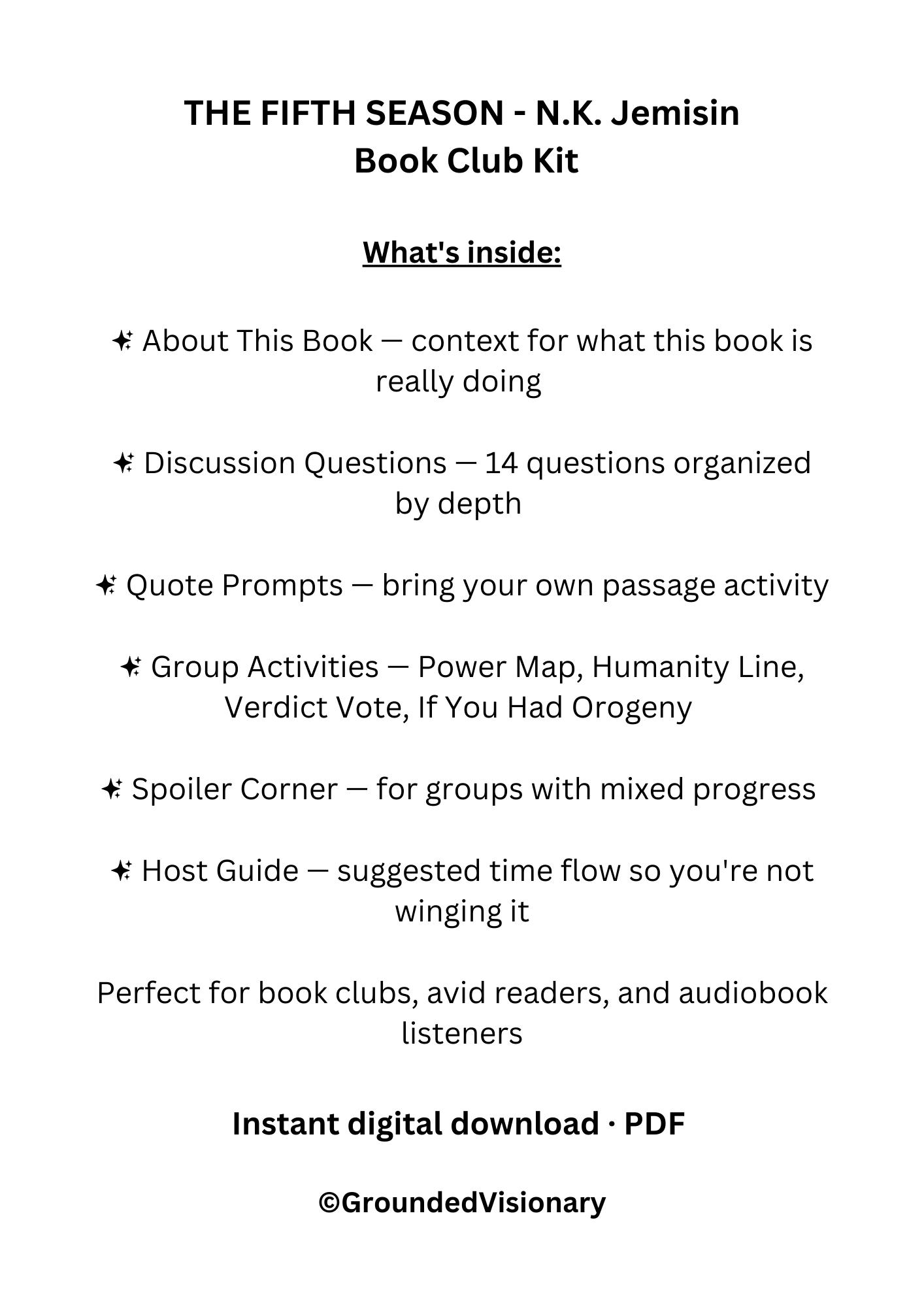 Image 2 of 2
A layered story of power, survival, and oppression in a world that keeps breaking.
The Fifth Season isn't going to ease you in. From the first page, it drops you into a world mid-apocalypse, written in second person, structured in fragments, and building toward a truth that arrives deliberately late and devastating. Most readers figure out what Jemisin is doing somewhere around the moment they can't put it down, despite being completely disoriented. The disorientation is the point.
This is a survival story set inside a fantasy world where oppression isn't background texture — it's infrastructure. A whole civilization built to contain certain people, extract what's useful from them, and punish them for existing at full capacity. The Fulcrum doesn't just control orogenes. It produces them, manages them, and disposes of them on a calculation that has been running for thousands of years. Jemisin doesn't let the reader look away from that calculation. She makes you inhabit it.
The second-person narration isn't a stylistic flex. It's an accusation. You did this. You lost this. You are here now. If your group reads this book and only talks about the plot they'll have missed half of what it's doing. This kit is designed to get the room to the other half.
✦ What's Inside
✦ About This Book — A world built to contain certain people — Oppression as infrastructure not background — Why the form is doing as much work as the content
✦ What This Book Is Really About — Power, compliance, and survival — The second-person narration as accusation not stylistic choice — What the system is actually built to do and who pays for it
✦ Discussion Questions — Three Tiers — Tier 1: Warmup questions that get everyone talking — Tier 2: What resistance looks like when survival depends on compliance — Tier 3: Personal, uncomfortable, unresolvable — Closes with: What question did this book leave sitting in your chest?
✦ Where This Book Leaves You — The fractured timeline as argument about trauma — What it costs to dismantle something holding people down and holding the world together — Who has been telling this story and why
✦ Character on Trial — Essun, Alabaster, and Schaffa — Prosecution/defense structure — Hard position questions with mandatory reversal — No neutral positions allowed
✦ Activities — Power Map: physical, institutional, informational, social — The Humanity Line — Verdict Vote: In this world, morality is a luxury — If You Had Orogeny — Cost Ledger: what the system collected and who paid it
✦ Quote Prompts — Five prompts across different emotional entry points — The passage that built the world — The one that broke the reader — The one that arrived too late
✦ Spoiler Corner — Host only — three escalation questions assuming full knowledge of the ending
✦ For the Host — How this book divides the room and why that's useful — Which activities go most personal and need extra time — Timing flow and meeting structure
Details — Instant download PDF — Personal and single-group use. No redistribution or resale. — Fan-created guide. Not affiliated with or endorsed by N.K. Jemisin or any publisher.
Licensing for classrooms, libraries, and educational programs is available. If you plan to use this guide for a class, reading program, or institutional setting, please contact the shop owner to arrange an appropriate license.
A layered story of power, survival, and oppression in a world that keeps breaking.
The Fifth Season isn't going to ease you in. From the first page, it drops you into a world mid-apocalypse, written in second person, structured in fragments, and building toward a truth that arrives deliberately late and devastating. Most readers figure out what Jemisin is doing somewhere around the moment they can't put it down, despite being completely disoriented. The disorientation is the point.
This is a survival story set inside a fantasy world where oppression isn't background texture — it's infrastructure. A whole civilization built to contain certain people, extract what's useful from them, and punish them for existing at full capacity. The Fulcrum doesn't just control orogenes. It produces them, manages them, and disposes of them on a calculation that has been running for thousands of years. Jemisin doesn't let the reader look away from that calculation. She makes you inhabit it.
The second-person narration isn't a stylistic flex. It's an accusation. You did this. You lost this. You are here now. If your group reads this book and only talks about the plot they'll have missed half of what it's doing. This kit is designed to get the room to the other half.
✦ What's Inside
✦ About This Book — A world built to contain certain people — Oppression as infrastructure not background — Why the form is doing as much work as the content
✦ What This Book Is Really About — Power, compliance, and survival — The second-person narration as accusation not stylistic choice — What the system is actually built to do and who pays for it
✦ Discussion Questions — Three Tiers — Tier 1: Warmup questions that get everyone talking — Tier 2: What resistance looks like when survival depends on compliance — Tier 3: Personal, uncomfortable, unresolvable — Closes with: What question did this book leave sitting in your chest?
✦ Where This Book Leaves You — The fractured timeline as argument about trauma — What it costs to dismantle something holding people down and holding the world together — Who has been telling this story and why
✦ Character on Trial — Essun, Alabaster, and Schaffa — Prosecution/defense structure — Hard position questions with mandatory reversal — No neutral positions allowed
✦ Activities — Power Map: physical, institutional, informational, social — The Humanity Line — Verdict Vote: In this world, morality is a luxury — If You Had Orogeny — Cost Ledger: what the system collected and who paid it
✦ Quote Prompts — Five prompts across different emotional entry points — The passage that built the world — The one that broke the reader — The one that arrived too late
✦ Spoiler Corner — Host only — three escalation questions assuming full knowledge of the ending
✦ For the Host — How this book divides the room and why that's useful — Which activities go most personal and need extra time — Timing flow and meeting structure
Details — Instant download PDF — Personal and single-group use. No redistribution or resale. — Fan-created guide. Not affiliated with or endorsed by N.K. Jemisin or any publisher.
Licensing for classrooms, libraries, and educational programs is available. If you plan to use this guide for a class, reading program, or institutional setting, please contact the shop owner to arrange an appropriate license.