 Image 1 of 2
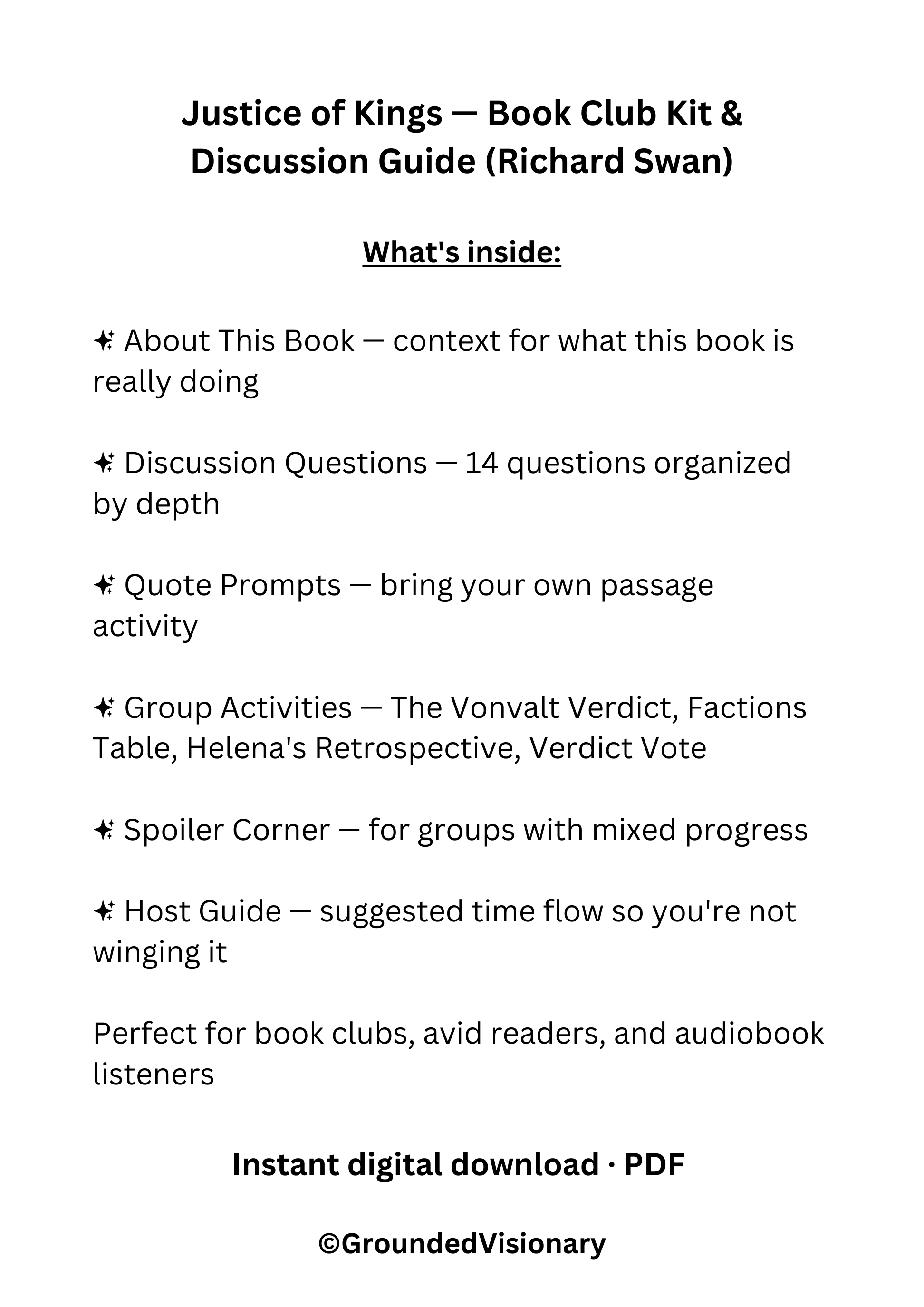 Image 2 of 2
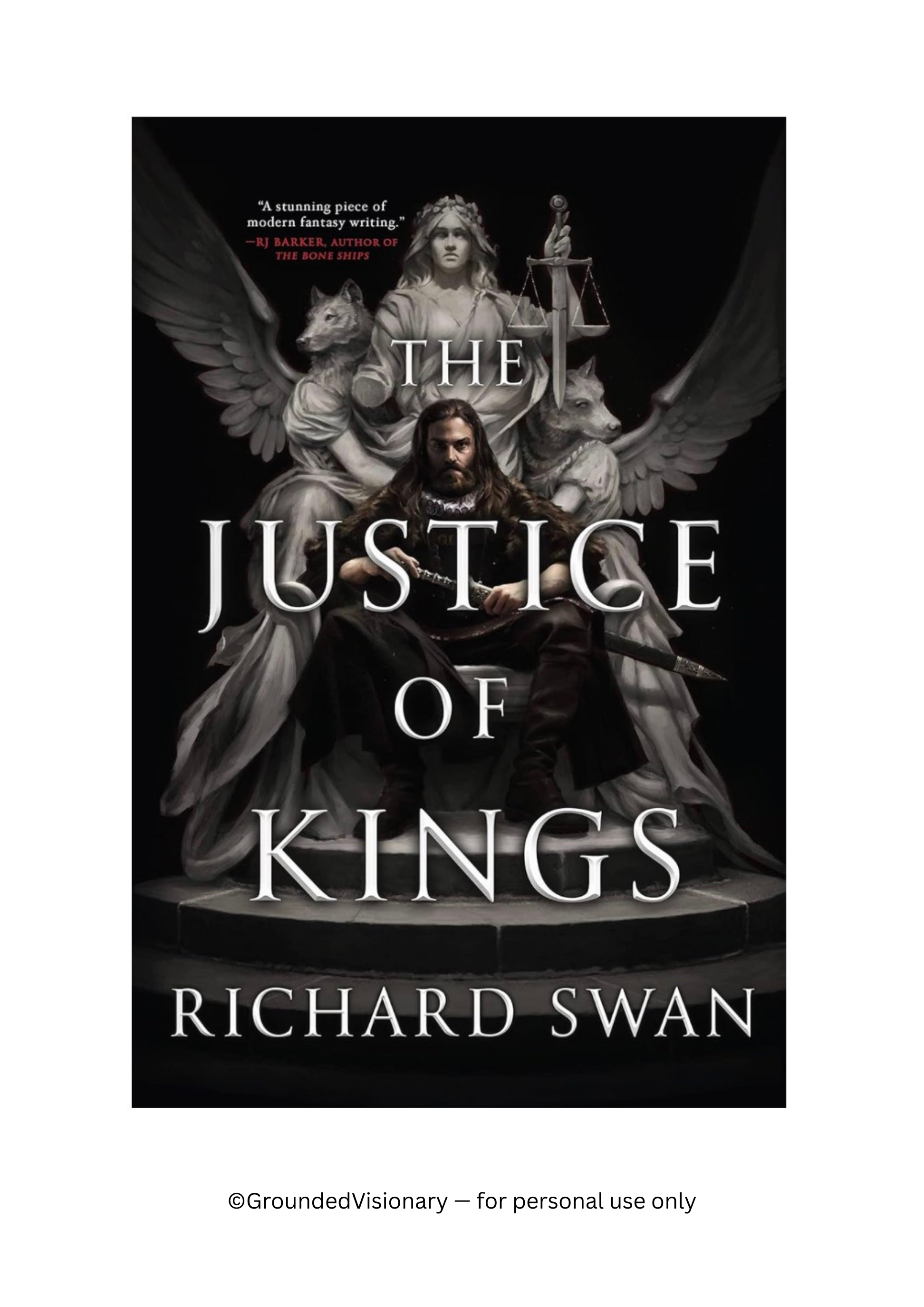
THE JUSTICE OF KINGS
Same situation as The Substitution Order and World War Z — early format. But this kit is actually stronger than those two. The About This Book and What This Book Is Really About pages are solid, the discussion questions are genuinely good, the activities are specific and well designed, and the Spoiler Corner has three real escalation questions. It's not at current template standard but it's closer than the others.
Option A still applies — write the listing honestly for what's there, flag for rebuild later.
REWORKED LISTING — THE JUSTICE OF KINGS
The Justice of Kings starts with a premise that sounds almost procedural: a magistrate travels the countryside administering justice, moving from case to case, making sure the law is applied fairly and without favor. And then you realize that in a world where power is always looking for ways to bend the rules, a man who genuinely won't bend is the most dangerous person in any room he enters.
Sir Konrad Vonvalt is that man. He has legal authority, some unsettling magical abilities, and an absolute commitment to the law that reads less like virtue and more like a force of nature. He doesn't love people. He loves justice. And the book is quietly, carefully asking whether that's enough — or whether it's its own kind of blindness.
The story is told through Helena Sedanka, Vonvalt's clerk, looking back on events she lived through as a young woman. That framing matters. She's not just a narrator — she's a person who loved someone, outgrew them, and is still working out what she thinks about both. This is a fantasy novel about the law, but what it's really about is what happens when the institutions we trust to protect us start being used as weapons instead — and whether a man whose entire identity is built around the law can see that happening until it's too late.
This kit was built for the room that finished this book and wants to argue about Vonvalt — whether he's a hero, a liability, or something the book refuses to resolve cleanly.
✦ What's Inside
✦ About This Book — A magistrate who won't bend in a world built on bending — Why a man who loves justice more than people is the most dangerous kind — Helena's narration and why the framing changes everything
✦ What This Book Is Really About — What Vonvalt's rigidity costs him and the people around him — How Helena's narration changes what we think we're seeing in real time — The Eddard Stark problem: a man of absolute principle in a world of flexible morality — What the factions are actually fighting over — not power, but the definition of what law is for
✦ Discussion Questions — Three Tiers — Tier 1: Warmup questions including what drew you in and whether you trusted Helena — Tier 2: Vonvalt's commitment to law vs. people, Helena's shifting feelings, Bressinger's loyalty, what the supernatural elements say about power outside the law — Tier 3: The Eddard Stark problem, Helena narrating in retrospect, where the gap between what institutions are supposed to do and what they actually do is widest — Closes with: What question did this book refuse to answer?
✦ Activities — The Vonvalt Verdict: one of Vonvalt's decisions — Just / Unjust / Technically correct but wrong — The Factions Table: map what each faction believes the law is for, place each character under their faction, ask who is most honest about what they actually believe — Helena's Retrospective: what does she regret, what is she grateful for, what hasn't she resolved — and does she tell this story fairly? — Verdict Vote: one moment where the law produced an outcome — Ethical / Unethical / Understandable but wrong
✦ Quote Prompts — Five prompts across different emotional entry points — The moment Vonvalt's commitment felt like strength — The moment that same commitment felt like a blindspot — The scene where Helena sees something Vonvalt can't — or won't
✦ Spoiler Corner — Host option — three questions for groups who finished — Whether the ending changed how you read Vonvalt's certainty throughout — Who Helena becomes after this — and whether she's who Vonvalt thought she could be — What the final pages changed about the factions and what they were actually fighting over
✦ For the Host — The cases are not the point — anchor discussion in character and institution — Name Helena's retrospective framing upfront so the group pays attention to how she tells the story — Timing flow for a single session
Details — Instant download PDF — Personal and single-group use. No redistribution or resale. — Fan-created guide. Not affiliated with or endorsed by Richard Swan or any publisher.
Licensing for classrooms, libraries, and educational programs is available. If you plan to use this guide for a class, reading program, or institutional setting, please contact the shop owner to arrange an appropriate license.
Same situation as The Substitution Order and World War Z — early format. But this kit is actually stronger than those two. The About This Book and What This Book Is Really About pages are solid, the discussion questions are genuinely good, the activities are specific and well designed, and the Spoiler Corner has three real escalation questions. It's not at current template standard but it's closer than the others.
Option A still applies — write the listing honestly for what's there, flag for rebuild later.
REWORKED LISTING — THE JUSTICE OF KINGS
The Justice of Kings starts with a premise that sounds almost procedural: a magistrate travels the countryside administering justice, moving from case to case, making sure the law is applied fairly and without favor. And then you realize that in a world where power is always looking for ways to bend the rules, a man who genuinely won't bend is the most dangerous person in any room he enters.
Sir Konrad Vonvalt is that man. He has legal authority, some unsettling magical abilities, and an absolute commitment to the law that reads less like virtue and more like a force of nature. He doesn't love people. He loves justice. And the book is quietly, carefully asking whether that's enough — or whether it's its own kind of blindness.
The story is told through Helena Sedanka, Vonvalt's clerk, looking back on events she lived through as a young woman. That framing matters. She's not just a narrator — she's a person who loved someone, outgrew them, and is still working out what she thinks about both. This is a fantasy novel about the law, but what it's really about is what happens when the institutions we trust to protect us start being used as weapons instead — and whether a man whose entire identity is built around the law can see that happening until it's too late.
This kit was built for the room that finished this book and wants to argue about Vonvalt — whether he's a hero, a liability, or something the book refuses to resolve cleanly.
✦ What's Inside
✦ About This Book — A magistrate who won't bend in a world built on bending — Why a man who loves justice more than people is the most dangerous kind — Helena's narration and why the framing changes everything
✦ What This Book Is Really About — What Vonvalt's rigidity costs him and the people around him — How Helena's narration changes what we think we're seeing in real time — The Eddard Stark problem: a man of absolute principle in a world of flexible morality — What the factions are actually fighting over — not power, but the definition of what law is for
✦ Discussion Questions — Three Tiers — Tier 1: Warmup questions including what drew you in and whether you trusted Helena — Tier 2: Vonvalt's commitment to law vs. people, Helena's shifting feelings, Bressinger's loyalty, what the supernatural elements say about power outside the law — Tier 3: The Eddard Stark problem, Helena narrating in retrospect, where the gap between what institutions are supposed to do and what they actually do is widest — Closes with: What question did this book refuse to answer?
✦ Activities — The Vonvalt Verdict: one of Vonvalt's decisions — Just / Unjust / Technically correct but wrong — The Factions Table: map what each faction believes the law is for, place each character under their faction, ask who is most honest about what they actually believe — Helena's Retrospective: what does she regret, what is she grateful for, what hasn't she resolved — and does she tell this story fairly? — Verdict Vote: one moment where the law produced an outcome — Ethical / Unethical / Understandable but wrong
✦ Quote Prompts — Five prompts across different emotional entry points — The moment Vonvalt's commitment felt like strength — The moment that same commitment felt like a blindspot — The scene where Helena sees something Vonvalt can't — or won't
✦ Spoiler Corner — Host option — three questions for groups who finished — Whether the ending changed how you read Vonvalt's certainty throughout — Who Helena becomes after this — and whether she's who Vonvalt thought she could be — What the final pages changed about the factions and what they were actually fighting over
✦ For the Host — The cases are not the point — anchor discussion in character and institution — Name Helena's retrospective framing upfront so the group pays attention to how she tells the story — Timing flow for a single session
Details — Instant download PDF — Personal and single-group use. No redistribution or resale. — Fan-created guide. Not affiliated with or endorsed by Richard Swan or any publisher.
Licensing for classrooms, libraries, and educational programs is available. If you plan to use this guide for a class, reading program, or institutional setting, please contact the shop owner to arrange an appropriate license.