 Image 1 of 4
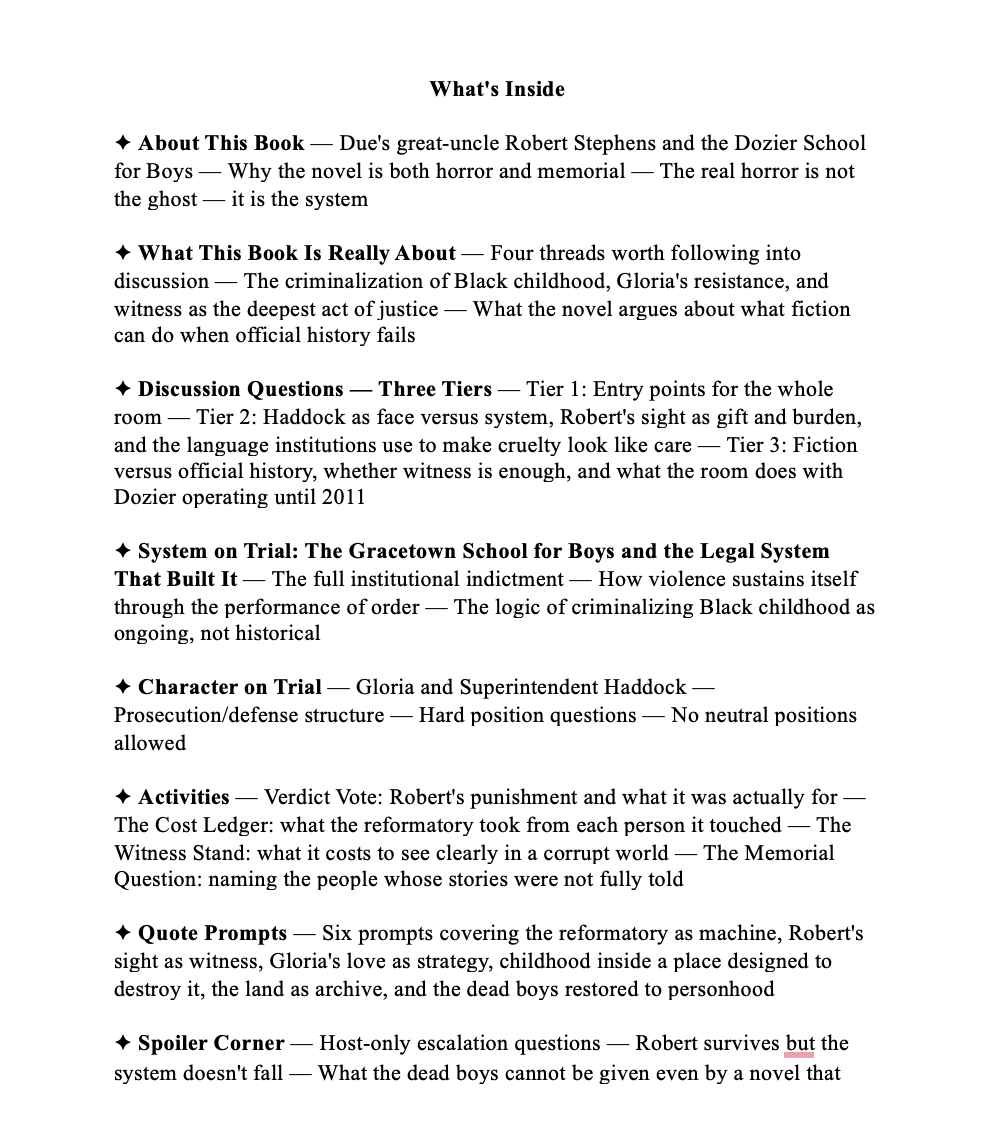 Image 2 of 4
 Image 3 of 4
 Image 4 of 4
Tananarive Due did not begin with a story idea. She began with a name — her great-uncle Robert Stephens, who died at the Dozier School for Boys in Marianna, Florida, and was largely forgotten in family memory. The Dozier School operated from 1900 to 2011. Over more than a century, boys — disproportionately Black boys — were beaten, abused, disappeared, and buried in unmarked graves while the institution kept running behind the language of reform, discipline, and correction. Due wrote The Reformatory to pull one forgotten child back from that erasure. What she built in his name is a ghost story that is really a reckoning.
The real horror in this novel is not the haints. It is the system. The Gracetown School for Boys is not an accident — it is a machine, and Due is precise about how machines like it operate: through law, procedure, authority, religion, and the cooperation of ordinary people who know what is happening and keep the institution running anyway. Robert Stephens Jr. is twelve years old when he is sent there for defending his sister from a white boy. The horror begins before he ever reaches the gates, because the world has already decided he is punishable. His sister Gloria fights from the outside with everything she has. The dead boys who never made it out fight from wherever the dead go when institutions refuse to mourn them. This is a novel about what Black childhood costs when the legal system becomes the monster — and about what fiction can do when official history has failed the people it was supposed to record.
This guide was built for the room that is ready to sit with all of it — the horror, the history, the haints, and the harder question underneath: is witness enough when accountability was never available? It names the Dozier School directly. It puts the institution on trial. It gives Gloria the space the novel gives her. And in the Spoiler Corner, it asks the question Due's novel earns the right to ask: what are the dead owed by the living who finally remember them?
✦ About This Book — Due's great-uncle Robert Stephens and the Dozier School for Boys — Why the novel is both horror and memorial — The real horror is not the ghost — it is the system
✦ What This Book Is Really About — Four threads worth following into discussion — The criminalization of Black childhood, Gloria's resistance, and witness as the deepest act of justice — What the novel argues about what fiction can do when official history fails
✦ Discussion Questions — Three Tiers — Tier 1: Entry points for the whole room — Tier 2: Haddock as face versus system, Robert's sight as gift and burden, and the language institutions use to make cruelty look like care — Tier 3: Fiction versus official history, whether witness is enough, and what the room does with Dozier operating until 2011
✦ System on Trial: The Gracetown School for Boys and the Legal System That Built It — The full institutional indictment — How violence sustains itself through the performance of order — The logic of criminalizing Black childhood as ongoing, not historical
✦ Character on Trial — Gloria and Superintendent Haddock — Prosecution/defense structure — Hard position questions — No neutral positions allowed
✦ Activities — Verdict Vote: Robert's punishment and what it was actually for — The Cost Ledger: what the reformatory took from each person it touched — The Witness Stand: what it costs to see clearly in a corrupt world — The Memorial Question: naming the people whose stories were not fully told
✦ Quote Prompts — Six prompts covering the reformatory as machine, Robert's sight as witness, Gloria's love as strategy, childhood inside a place designed to destroy it, the land as archive, and the dead boys restored to personhood
✦ Spoiler Corner — Host-only escalation questions — Robert survives but the system doesn't fall — What the dead boys cannot be given even by a novel that sees them — Whether fiction is justice — and what the dead are owed by the living who remember them
✦ For the Host — How this book divides the room across two fault lines — Which activities go most personal and need extra time — Timing flow for a 90-minute meeting — Good host note for horror readers versus historical fiction readers
Tananarive Due did not begin with a story idea. She began with a name — her great-uncle Robert Stephens, who died at the Dozier School for Boys in Marianna, Florida, and was largely forgotten in family memory. The Dozier School operated from 1900 to 2011. Over more than a century, boys — disproportionately Black boys — were beaten, abused, disappeared, and buried in unmarked graves while the institution kept running behind the language of reform, discipline, and correction. Due wrote The Reformatory to pull one forgotten child back from that erasure. What she built in his name is a ghost story that is really a reckoning.
The real horror in this novel is not the haints. It is the system. The Gracetown School for Boys is not an accident — it is a machine, and Due is precise about how machines like it operate: through law, procedure, authority, religion, and the cooperation of ordinary people who know what is happening and keep the institution running anyway. Robert Stephens Jr. is twelve years old when he is sent there for defending his sister from a white boy. The horror begins before he ever reaches the gates, because the world has already decided he is punishable. His sister Gloria fights from the outside with everything she has. The dead boys who never made it out fight from wherever the dead go when institutions refuse to mourn them. This is a novel about what Black childhood costs when the legal system becomes the monster — and about what fiction can do when official history has failed the people it was supposed to record.
This guide was built for the room that is ready to sit with all of it — the horror, the history, the haints, and the harder question underneath: is witness enough when accountability was never available? It names the Dozier School directly. It puts the institution on trial. It gives Gloria the space the novel gives her. And in the Spoiler Corner, it asks the question Due's novel earns the right to ask: what are the dead owed by the living who finally remember them?
✦ About This Book — Due's great-uncle Robert Stephens and the Dozier School for Boys — Why the novel is both horror and memorial — The real horror is not the ghost — it is the system
✦ What This Book Is Really About — Four threads worth following into discussion — The criminalization of Black childhood, Gloria's resistance, and witness as the deepest act of justice — What the novel argues about what fiction can do when official history fails
✦ Discussion Questions — Three Tiers — Tier 1: Entry points for the whole room — Tier 2: Haddock as face versus system, Robert's sight as gift and burden, and the language institutions use to make cruelty look like care — Tier 3: Fiction versus official history, whether witness is enough, and what the room does with Dozier operating until 2011
✦ System on Trial: The Gracetown School for Boys and the Legal System That Built It — The full institutional indictment — How violence sustains itself through the performance of order — The logic of criminalizing Black childhood as ongoing, not historical
✦ Character on Trial — Gloria and Superintendent Haddock — Prosecution/defense structure — Hard position questions — No neutral positions allowed
✦ Activities — Verdict Vote: Robert's punishment and what it was actually for — The Cost Ledger: what the reformatory took from each person it touched — The Witness Stand: what it costs to see clearly in a corrupt world — The Memorial Question: naming the people whose stories were not fully told
✦ Quote Prompts — Six prompts covering the reformatory as machine, Robert's sight as witness, Gloria's love as strategy, childhood inside a place designed to destroy it, the land as archive, and the dead boys restored to personhood
✦ Spoiler Corner — Host-only escalation questions — Robert survives but the system doesn't fall — What the dead boys cannot be given even by a novel that sees them — Whether fiction is justice — and what the dead are owed by the living who remember them
✦ For the Host — How this book divides the room across two fault lines — Which activities go most personal and need extra time — Timing flow for a 90-minute meeting — Good host note for horror readers versus historical fiction readers