Juneteenth marks a legal announcement. On June 19, 1865, enslaved people in Texas learned — two and a half years after the Emancipation Proclamation — that they were legally free. The country treats that announcement as a finish line. These three books treat it as a starting gun.
This thematic discussion kit pairs Octavia Butler's Kindred, Toni Morrison's Beloved, and Isabel Wilkerson's The Warmth of Other Suns around a single argument none of them makes alone: that legal freedom is a threshold, not a destination. That the harm, the memory, and the economic architecture of exploitation did not stop when the law said stop. That the people who lived on the other side of that legal threshold had to reckon with something the law could not touch. This kit was built for the room that wants to ask the harder question — not whether emancipation mattered, but what it left unfinished, and what that unfinished thing has cost the generations who inherited it.
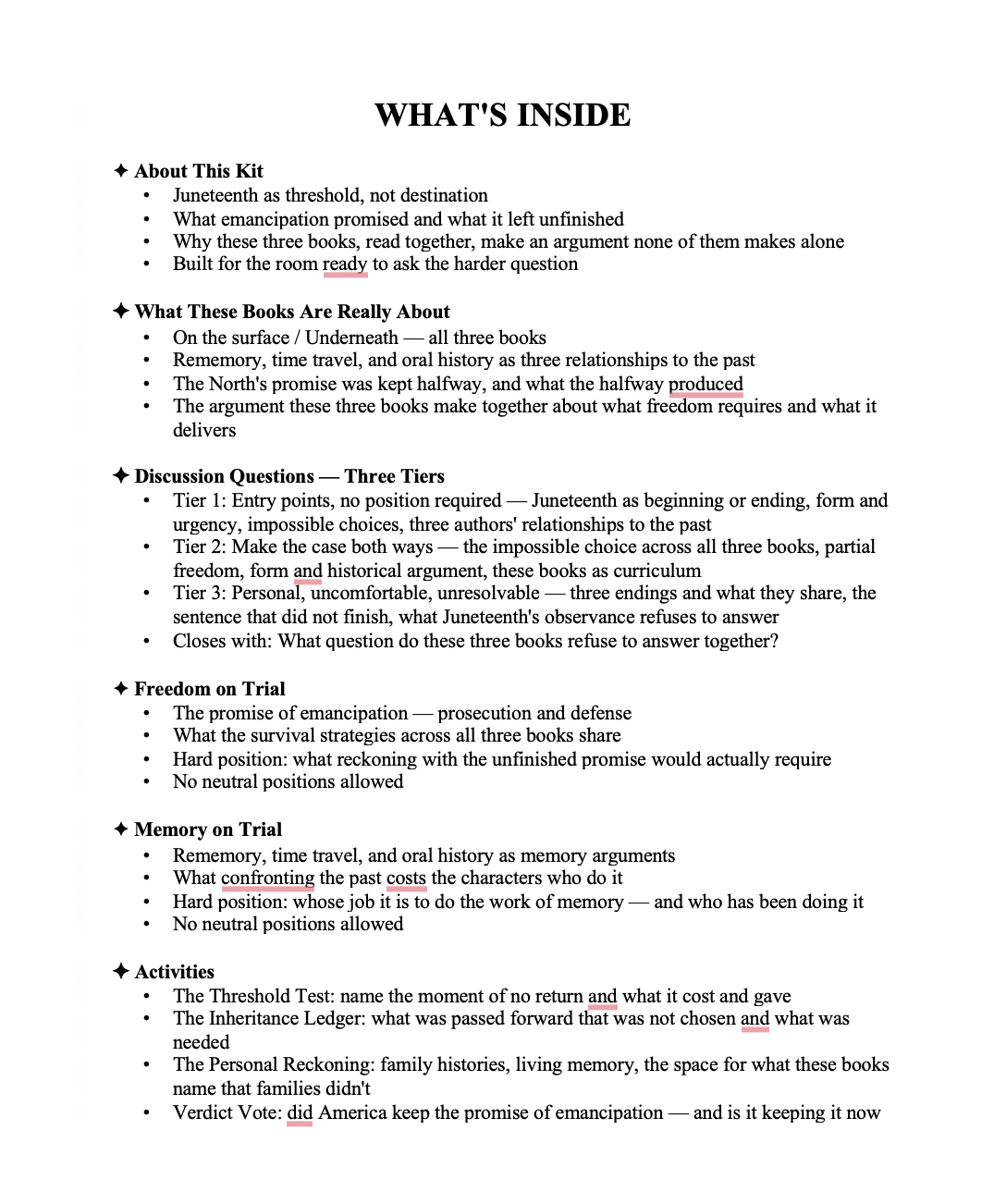
✦ What's Inside
Discussion questions across three tiers — from entry points about Juneteenth as beginning or ending, into prosecution/defense questions on impossible choices, partial freedom, and whether these books should be read as a unified argument — closing with the question all three books refuse to answer together.
Freedom on Trial: the promise of emancipation, what the survival strategies across all three books share, and what reckoning with that unfinished promise would actually require. Memory on Trial: rememory, time travel, and oral history as three versions of the same argument about what the past does to the present — and whose job it is to do the work of memory.
Four activities: The Threshold Test (the moment of no return, and what it cost and gave); The Inheritance Ledger (what was passed forward that was not chosen); The Personal Reckoning (family histories, living memory, and the space for what these books name that families didn't); and a Verdict Vote with two ballots — whether America kept the promise of emancipation, and whether it is keeping it now.
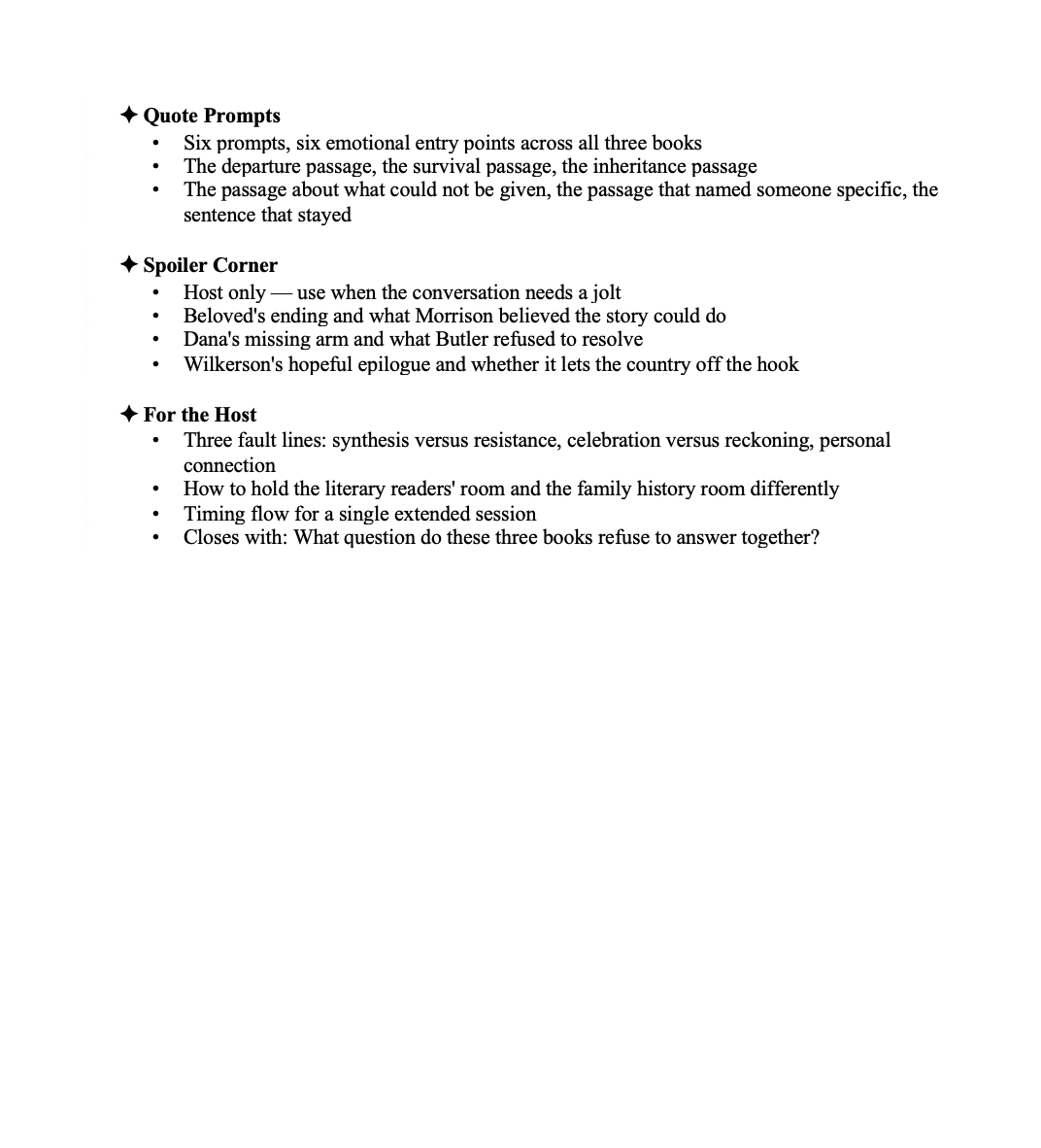
Six Quote Prompts, a Spoiler Corner with host-only escalation questions on Morrison's triple repetition, Dana's missing arm, and whether Wilkerson's hopeful ending lets the country off the hook. Full facilitation notes, timing flow for an extended session, and a host note for literary readers versus rooms where the Great Migration is family history.
Instant download PDF. Fan-created guide, not affiliated with the authors or publishers. Personal and single-group use.
This is the guide for the room that can hold celebration and reckoning in the same discussion— and is ready to ask what the holiday refuses to answer.
Every system in these four books has a story that explains why it works the way it does. Slavery protected the social order. Gilead protected the species. The Black Panther Party protected the revolution. The village of Nakara protected its legacy. The stories are different. The mechanism is the same: women's bodies, labor, silence, and selfhood were the price, and the system made sure the women closest to the cost were the ones explaining why it was necessary.
This kit pairs four books across four genres, four eras, and four very different kinds of rooms. Toni Morrison's Beloved is a ghost story about what slavery did to the interior life of a woman who survived it. Margaret Atwood's The Handmaid's Tale is a dystopian novel about a theocracy that turned women's reproductive capacity into a state resource. Elaine Brown's A Taste of Power is a memoir about leading a revolutionary organization that believed in Black liberation and drew the line at women having authority over men. M.L. Wang's The Sword of Kaigen is a fantasy novel about a woman who buried everything she was to become what a village needed her to be — and what happens when the world breaks open, and the burial becomes impossible to maintain.
None of these women are fighting strangers. Sethe's captor knew her name. Offred's enforcer lived in the same house. Elaine Brown's betrayers called her Comrade. Misaki's silence was maintained by the man she married and the children she raised. That is the specific horror this kit was built around — not oppression from a distance, but the kind that gets into the closest relationships you have and uses them as the delivery mechanism.
The question this kit was built to hold is not whether these women suffered. That is not in dispute. The question is what survival looked like from inside systems that had already occupied the territory closest to them — and whether what each woman chose to do constitutes resistance, accommodation, complicity, or something the English language does not have a clean word for yet. Your book club gets to decide.
What's Inside
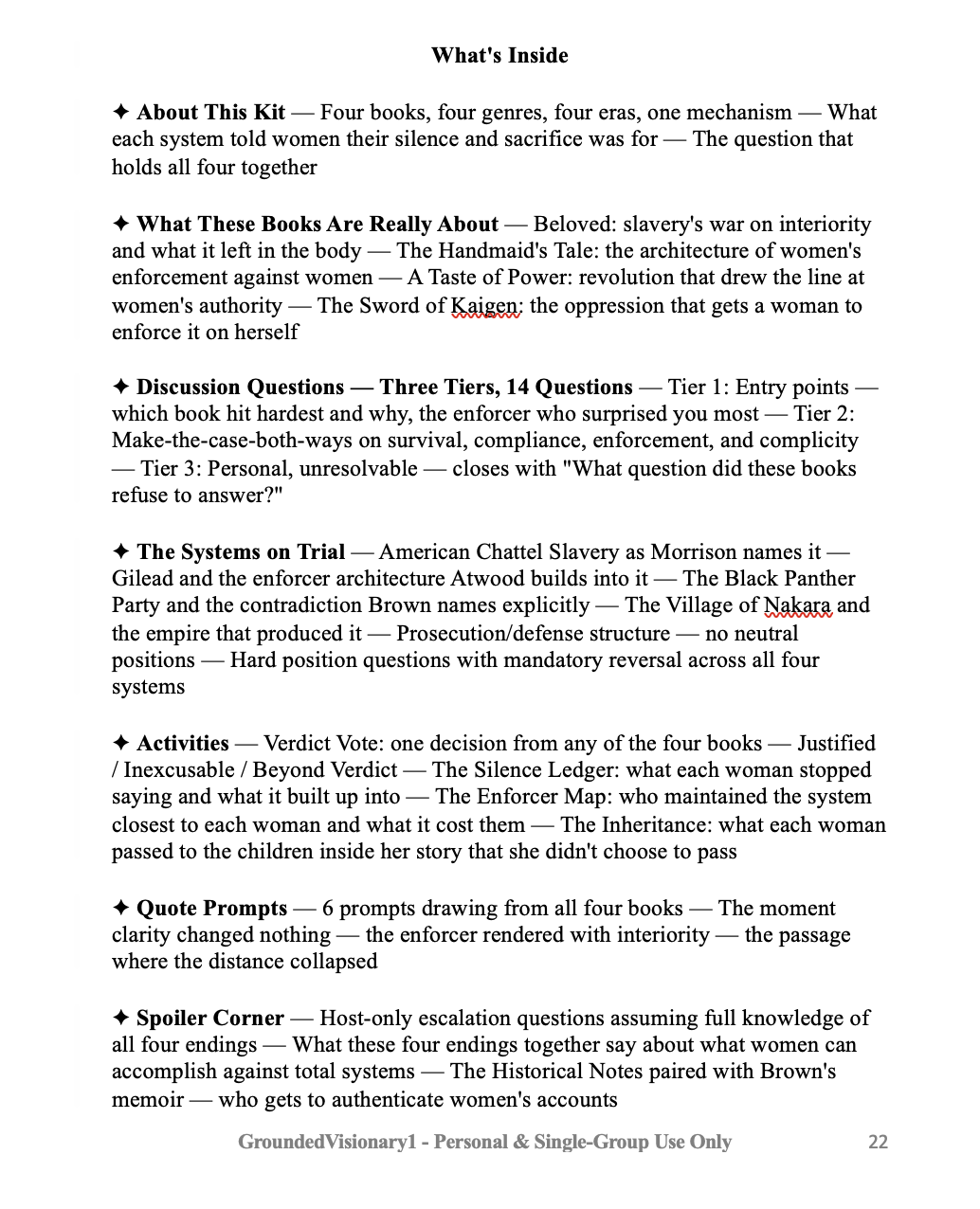
✦ About This Kit — Four books, four genres, four eras, one mechanism — What each system told women their silence and sacrifice was for — The question that holds all four together
✦ What These Books Are Really About — Beloved: slavery's war on interiority and what it left in the body — The Handmaid's Tale: the architecture of women's enforcement against women — A Taste of Power: revolution that drew the line at women's authority — The Sword of Kaigen: the oppression that gets a woman to enforce it on herself
✦ Discussion Questions — Three Tiers, 14 Questions — Tier 1: Entry points — which book hit hardest, the enforcer who surprised you most — Tier 2: Make-the-case-both-ways on survival, compliance, enforcement, and complicity — Tier 3: Personal, unresolvable — closes with "What question did these books refuse to answer?"
✦ The Systems on Trial — American Chattel Slavery, Gilead, the Black Panther Party, and the Village of Nakara — Prosecution/defense structure — no neutral positions allowed — Hard position questions with mandatory reversal across all four systems
✦ Activities — Verdict Vote: one decision from any of the four books — Justified / Inexcusable / Beyond Verdict — The Silence Ledger: what each woman stopped saying and what it built up into — The Enforcer Map: who maintained the system closest to each woman and what it cost them — The Inheritance: what each woman passed to the children inside her story that she didn't choose to pass
✦ Quote Prompts — 6 prompts drawing from all four books — The moment clarity changed nothing — the enforcer rendered with interiority — the passage where the distance collapsed
✦ Spoiler Corner — Host-only escalation questions assuming full knowledge of all four endings — What these four endings say about what women can accomplish against total systems — Who gets to authenticate women's accounts of what was done to them
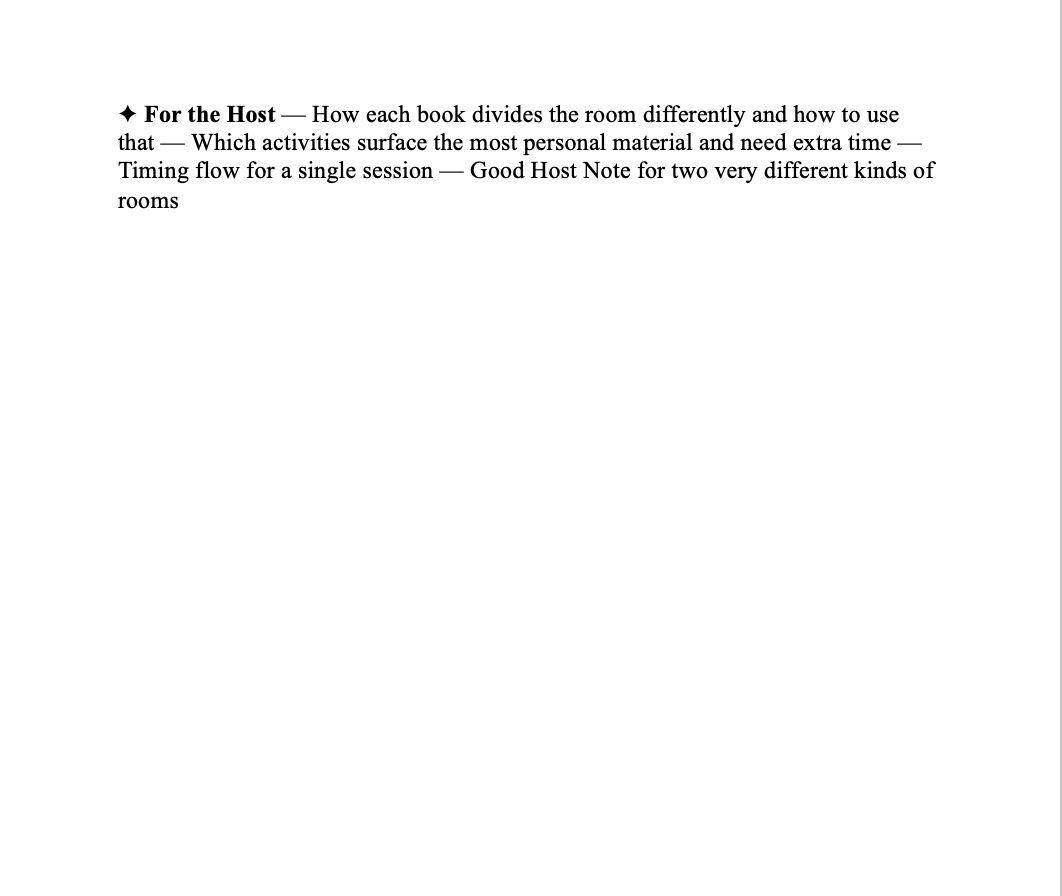
✦ For the Host — How each book divides the room differently and how to use that — Timing flow for a single session — Good Host Note for two very different kinds of rooms
Details — Instant download PDF — Print-ready — Personal and single-group use — Fan-created guide — Not affiliated with or endorsed by any of the authors or their publishers — Individual discussion guides for all four books are available separately in the shop
Licensing for classrooms, libraries, and educational programs is available. If you plan to use this guide for a class, reading program, or institutional setting, please contact the shop owner to arrange an appropriate license.
This kit was built for the room that finished all four books and needed somewhere to put everything they left behind. It was built for the conversation that starts with what these women survived and ends somewhere none of you expected.

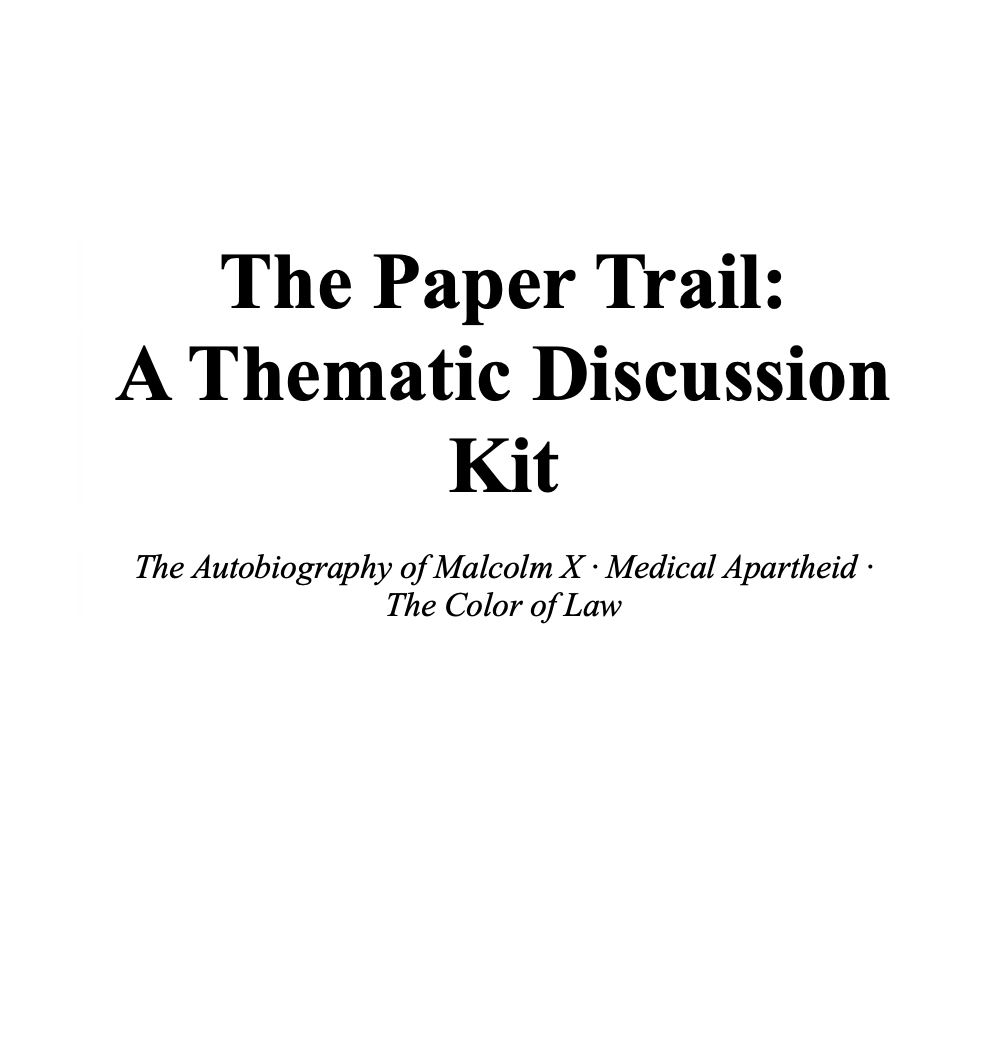
Three books. Three different genres. One continuous argument: the American government — its law enforcement apparatus, its medical institutions, its housing agencies — enacted deliberate, documented harm against Black Americans. Not in a distant past requiring reconciliation. In living memory. With files still in the archives.
The Autobiography of Malcolm X gives you a sense of the surveillance state through one man's extraordinary life. Medical Apartheid gives you four centuries of medical exploitation, documented case by case, institution by institution. The Color of Law gives you the federal paper trail that engineered residential segregation and called it private choice. Read individually, each book makes a complete argument. Read together, they become something none of them is alone: a full prosecution of the American state's deliberate, coordinated, ongoing project of harm — and the question of what we are supposed to do with the fact that it happened.
This kit was built for readers who finished all three books and felt the argument accumulating into something larger than any single volume could contain. It treats these books as a curriculum — cross-book discussion questions that move between all three institutions put on trial, and activities designed to bring the argument out of the archive and into the room.
What's Inside:
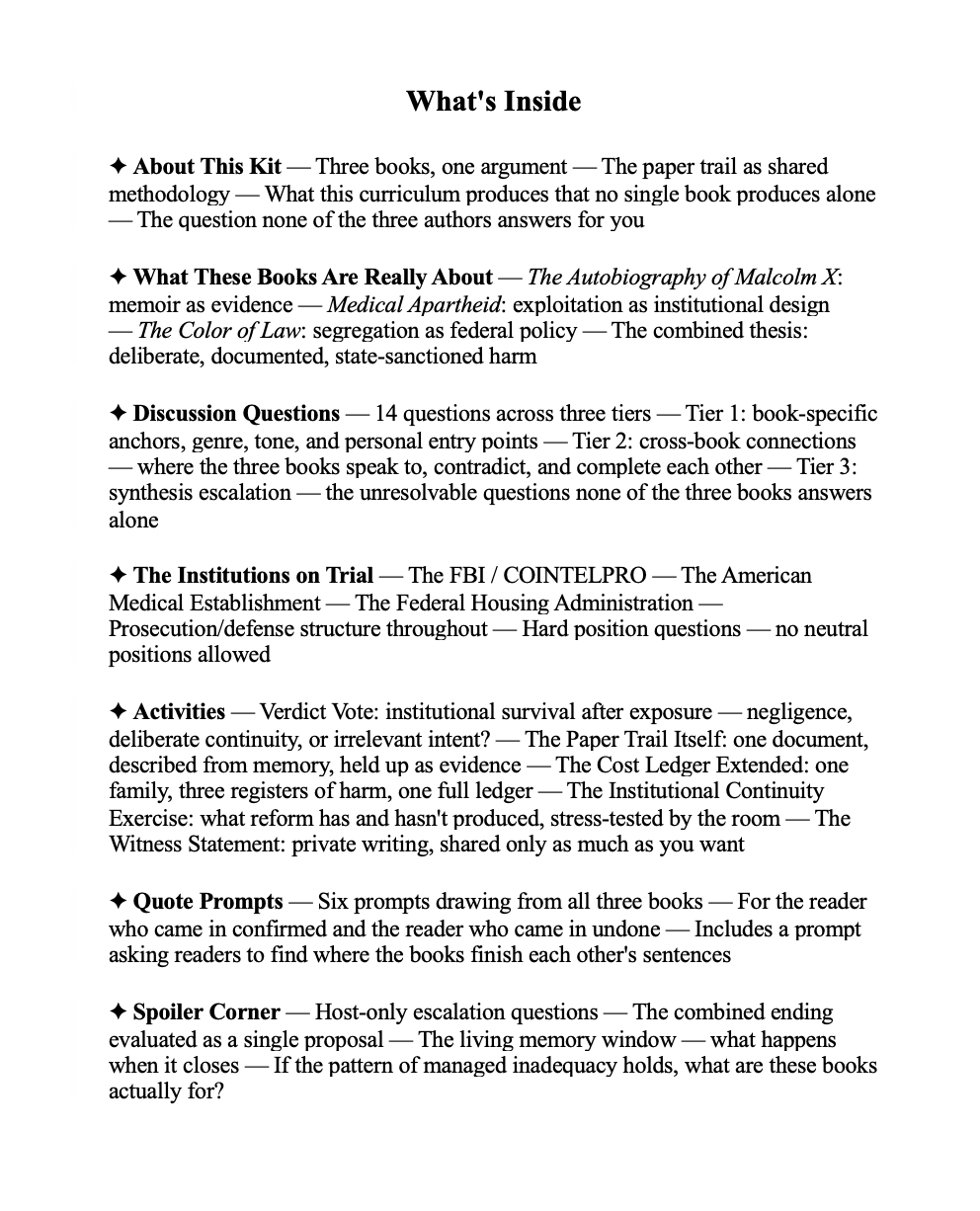
✦ About This Kit — The paper trail as shared methodology, and what this curriculum produces that no single book can produce alone
✦ What These Books Are Really About — Book-specific anchors for all three, plus the combined thesis that emerges when they're read together
✦ Discussion Questions — 14 questions across three tiers, from book-specific entry points to the cross-book connections to the unresolvable questions none of the three authors answers alone
✦ The Institutions on Trial — The FBI/COINTELPRO, the American Medical Establishment, and the Federal Housing Administration — prosecution/defense structure, hard positions required, no neutral stances allowed
✦ Activities — Verdict Vote, The Paper Trail Itself, The Cost Ledger Extended, The Institutional Continuity Exercise, and The Witness Statement (private writing, shared only as much as you want)
✦ Quote Prompts — Six prompts drawing from all three books, including one that asks readers to find where the books finish each other's sentences
✦ Spoiler Corner — Host-only escalation questions, including: if the pattern of managed inadequacy holds, what are these books actually for?
✦ For the Host — Facilitation notes for a three-book curriculum, timing flow, and a good host note for two very different kinds of rooms
Details: — Instant download PDF, print-ready — 20+ pages — Personal and single-group use — Fan-created guide, not affiliated with or endorsed by any of the authors or their publishers — Individual discussion guides for The Autobiography of Malcolm X, Medical Apartheid, and The Color of Law are also available separately in the shop
Licensing for classrooms, libraries, and educational programs is available. If you plan to use this guide for a class, reading program, or institutional setting, please contact the shop owner to arrange an appropriate license.
This kit was built for the room that finishes all three books and doesn't know what to do with what they now know — together. That's not a comfortable place to be. It's exactly the right place to start.
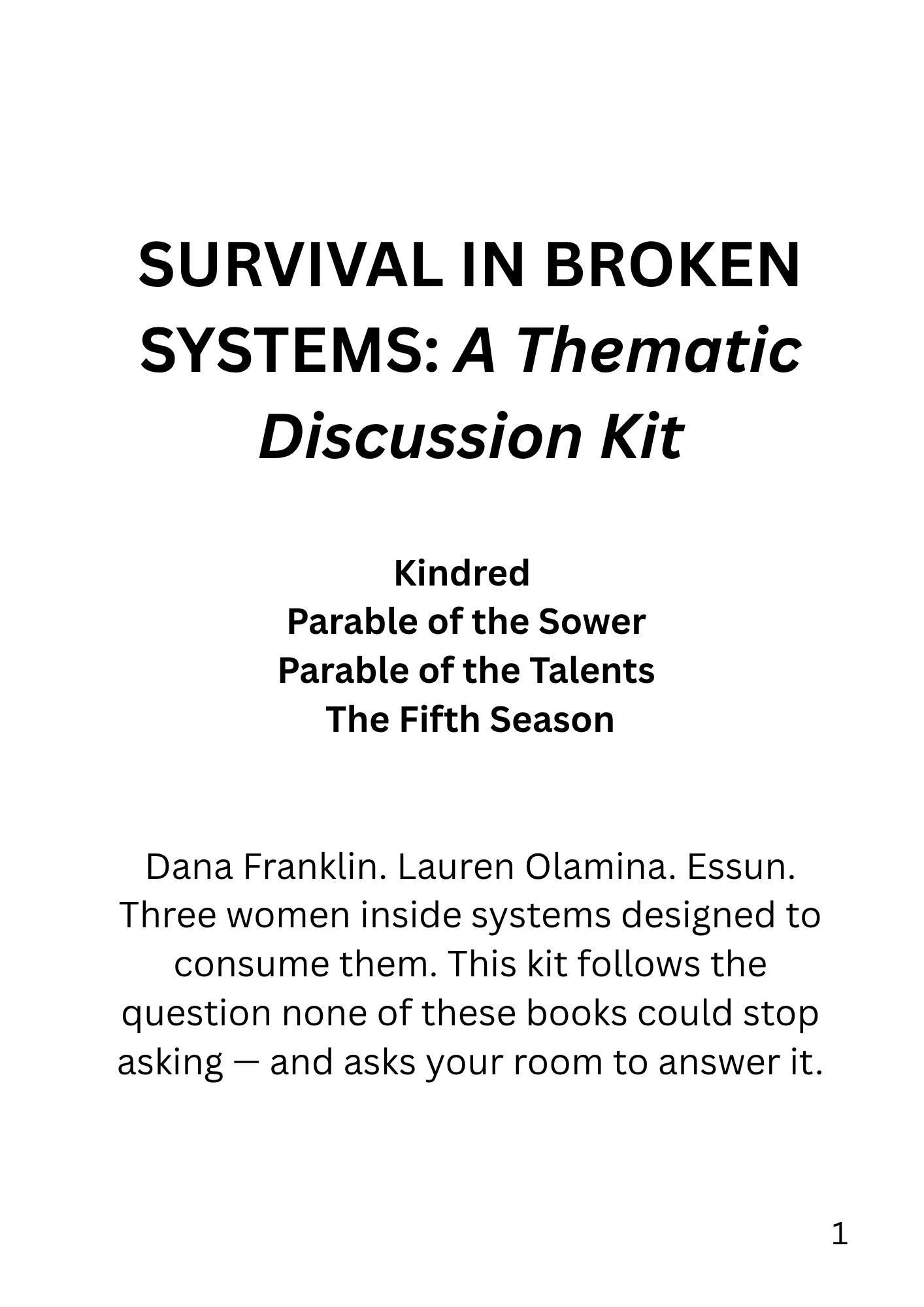
Four books. Two authors. Forty years of the same question asked four different ways: when the system you are inside was built to consume you, what does surviving it actually cost?
Kindred sends a Black woman back into antebellum slavery with a partial exit and no blueprint. Parable of the Sower follows a fifteen-year-old building a philosophy in a journal while the world burns around her. Parable of the Talents asks what happens when that vision becomes real and someone has to live inside the consequences. The Fifth Season fractures its protagonist across time, tells her story out of order, and addresses her directly — as you — before you know who you are. These are not the same story. But they are in conversation across four decades whether your book club knows it or not. This kit makes that conversation explicit, structured, and worth three hours of serious argument.
Octavia Butler and N.K. Jemisin are not making the same argument in the same way. Butler's prose is direct and precise — she names what the system is doing and doesn't look away. Jemisin's is structurally aggressive — second person, fractured timeline, information withheld until the moment it lands hardest. The difference between how these two authors tell stories about Black women surviving broken worlds is itself worth a full discussion. This kit builds that discussion in.
Dana Franklin, Lauren Olamina, Larkin, and Essun are not interchangeable protagonists. They survive differently, lose differently, build differently, and pay different prices for all of it. What they share is a system designed with them specifically in mind — and the question of whether you get to call what you become on the other side survival, or something else. This kit follows that question across all four books and asks your room to answer it. Then it asks whether your answer changes when you stop evaluating these women and start being honest about what you would have done.
This kit was built for the room that finished all four books and realized they had been reading the same argument across decades without knowing it. It was built for the facilitator who wants to go somewhere real. And it was built to be used — in book clubs, in classrooms, in library reading series, in any room where people are willing to argue honestly about what survival costs and who gets to define it.
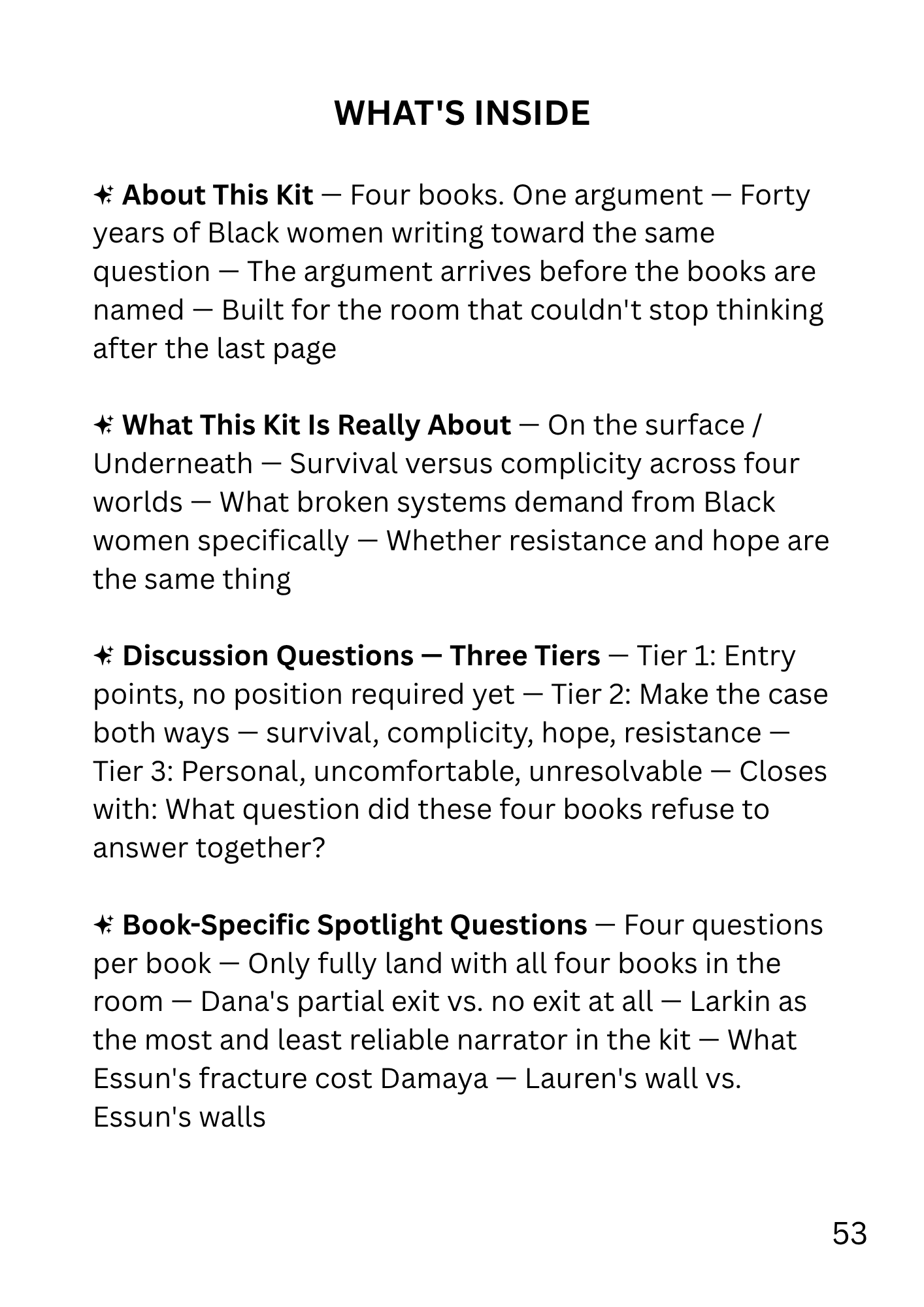
What's Inside
✦ About This Kit
— Four books. One argument
— Forty years of Black women writing toward the same question
— Built for the room that couldn't stop thinking after the last page
✦ What This Kit Is Really About
— Survival versus complicity across four worlds
— What broken systems demand from Black women specifically
— Whether resistance and hope are the same thing
✦ Discussion Questions — Three Tiers
— Tier 1: Entry points, no position required yet
— Tier 2: Make the case both ways — survival, complicity, hope, resistance
— Tier 3: Personal, uncomfortable, unresolvable
— Closes with: What question did these four books refuse to answer together?
✦ Book-Specific Spotlight Questions
— Four questions per book
— Only fully land with all four books in the room
— Dana's partial exit vs. no exit at all
— Larkin as the most and least reliable narrator in the kit
— What Essun's fracture cost Damaya
— Lauren's wall vs. Essun's walls
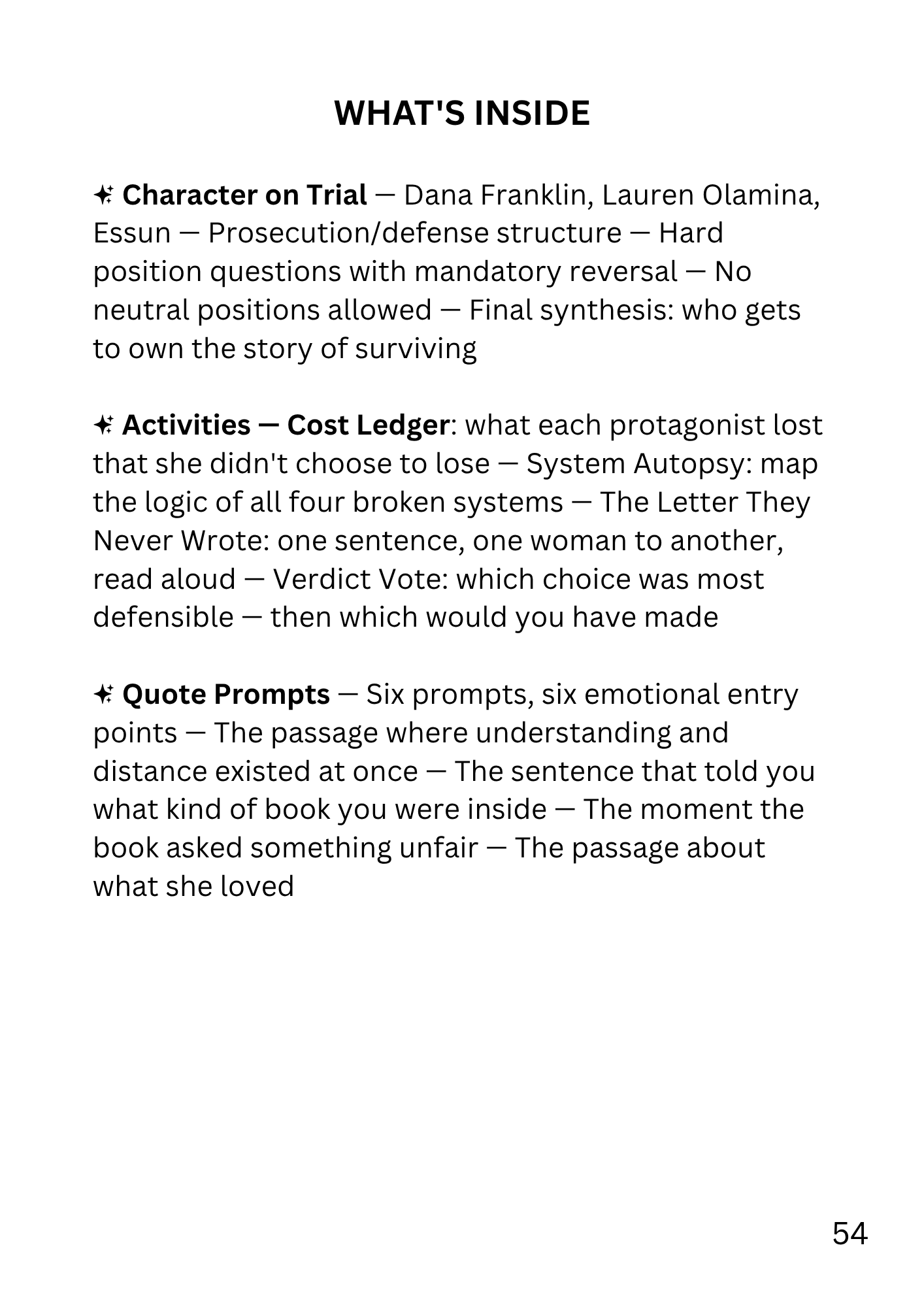
✦ Character on Trial
— Dana Franklin, Lauren Olamina, Essun
— Prosecution/defense structure
— Hard position questions with mandatory reversal
— No neutral positions allowed
✦ Activities
— Cost Ledger: what each protagonist lost that she didn't choose to lose
— System Autopsy: map the logic of all four broken systems
— The Letter They Never Wrote: one sentence, one woman to another, read aloud
— Verdict Vote: which choice was most defensible — then which would you have made
✦ Quote Prompts
— Six prompts, six emotional entry points
— The passage where understanding and distance existed at once
— The moment the book asked something unfair
— The passage about what she loved
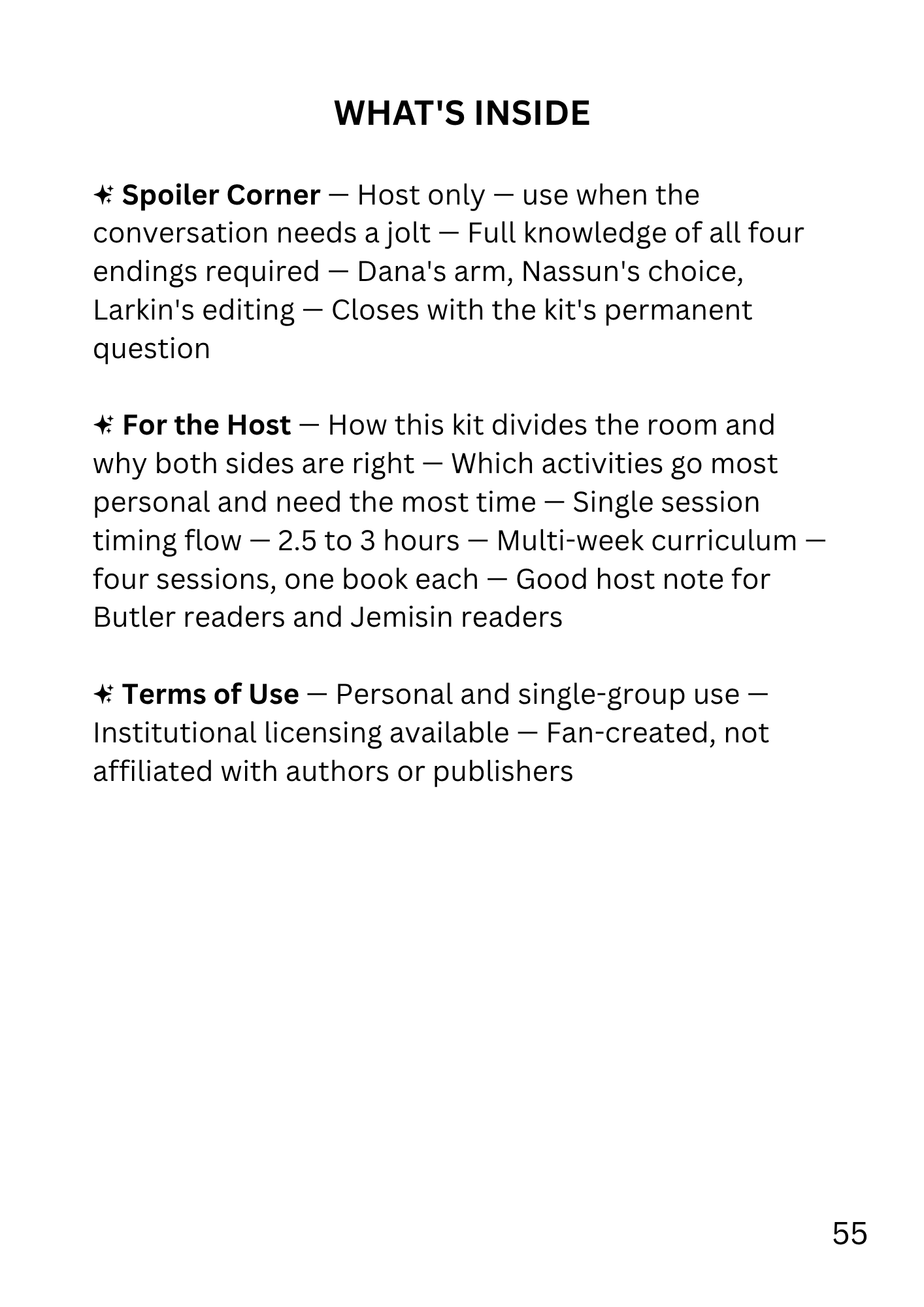
✦ Spoiler Corner
— Host only — three escalation questions assuming full knowledge of all four endings
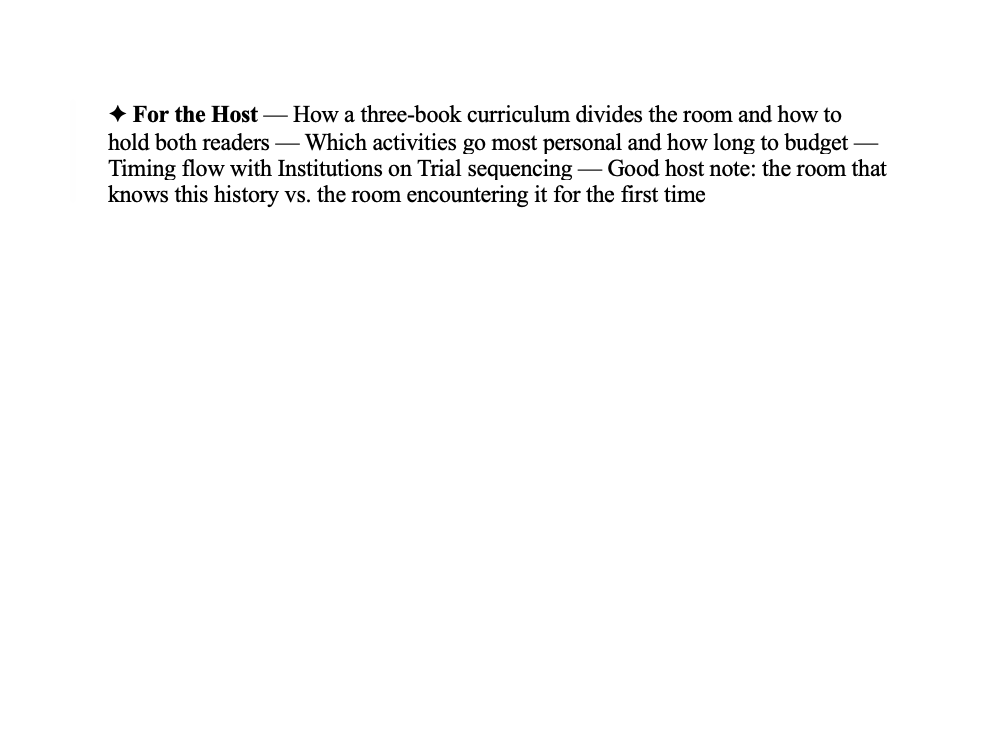
✦ For the Host
— Single session timing flow
— Multi-week curriculum — four sessions, one book each
— Good host note for Butler readers and Jemisin readers
Details
— Instant download PDF
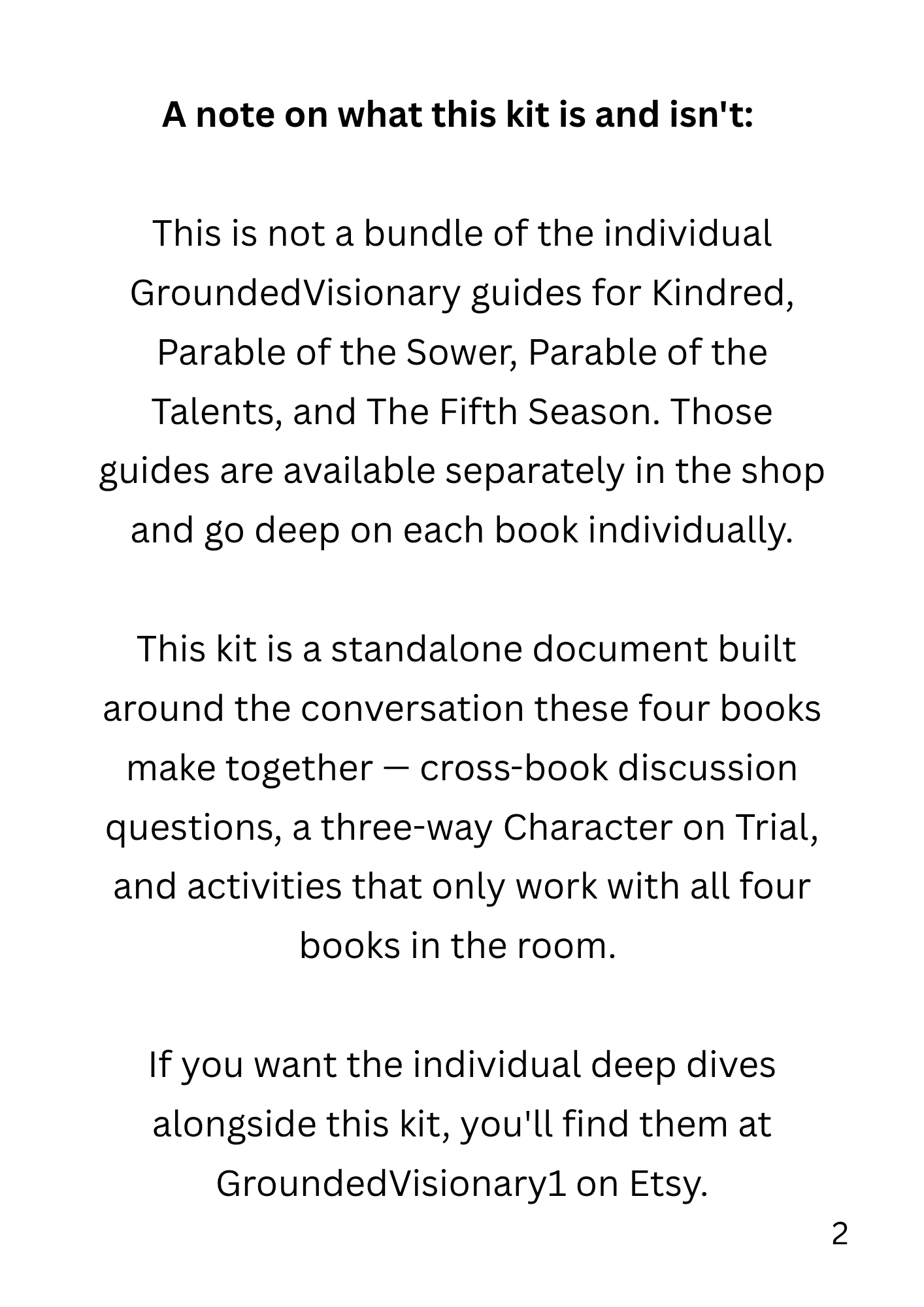
— Note: This is not a bundle of the individual book guides. It is a standalone thematic discussion kit built around the cross-book argument these four books make together. Individual kits for Kindred, Parable of the Sower, Parable of the Talents, and The Fifth Season are available separately in the shop.
— Designed for groups that have read all four books
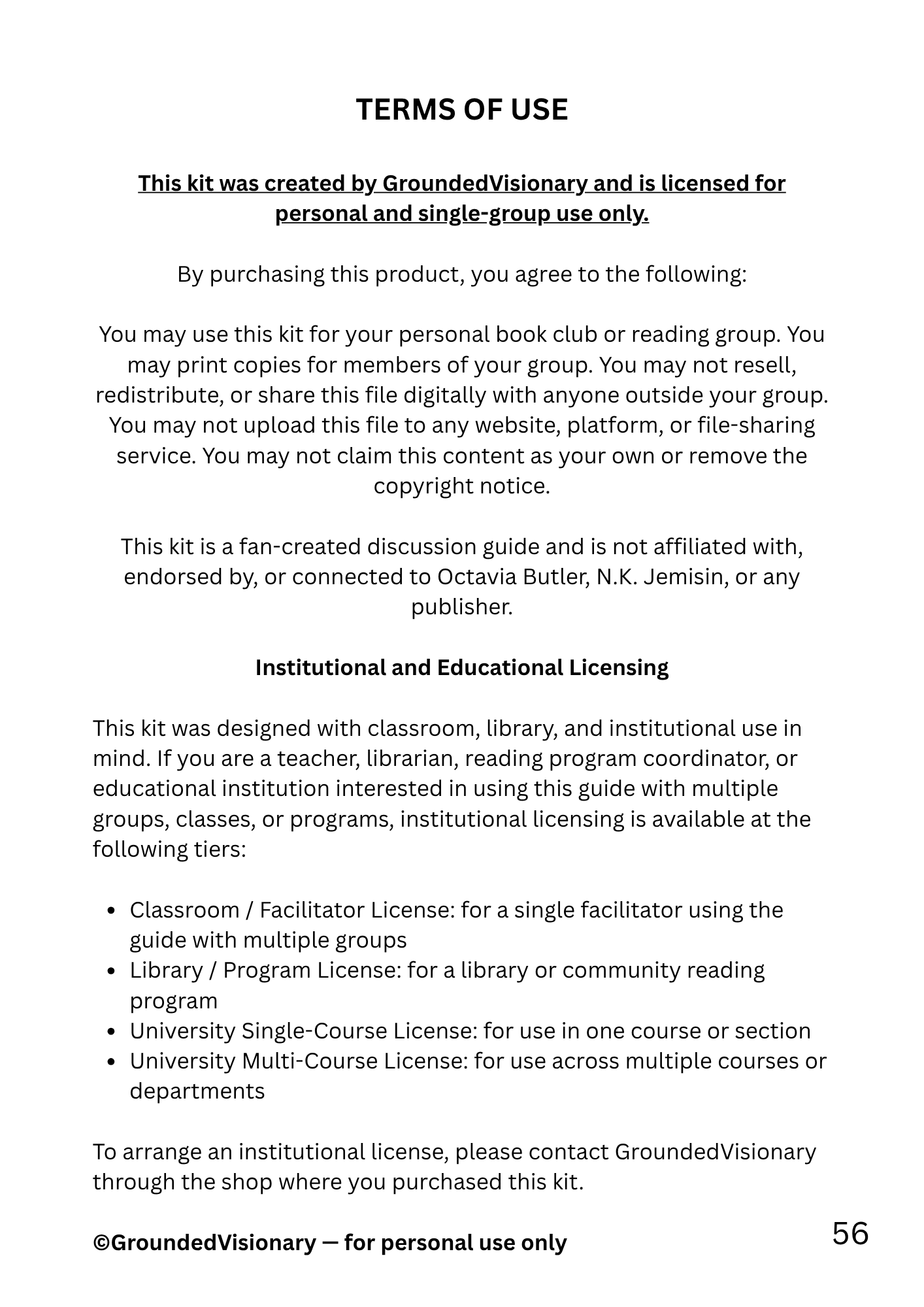
— Personal and single-group use. No redistribution or resale.
— Fan-created guide. Not affiliated with or endorsed by Octavia Butler, N.K. Jemisin, or any publisher.
Licensing for classrooms, libraries, and educational programs is available. If you plan to use this guide for a class, reading program, or institutional setting, please contact the shop owner to arrange an appropriate license.
No results match your search. Try removing a few filters.