 Image 1 of 4
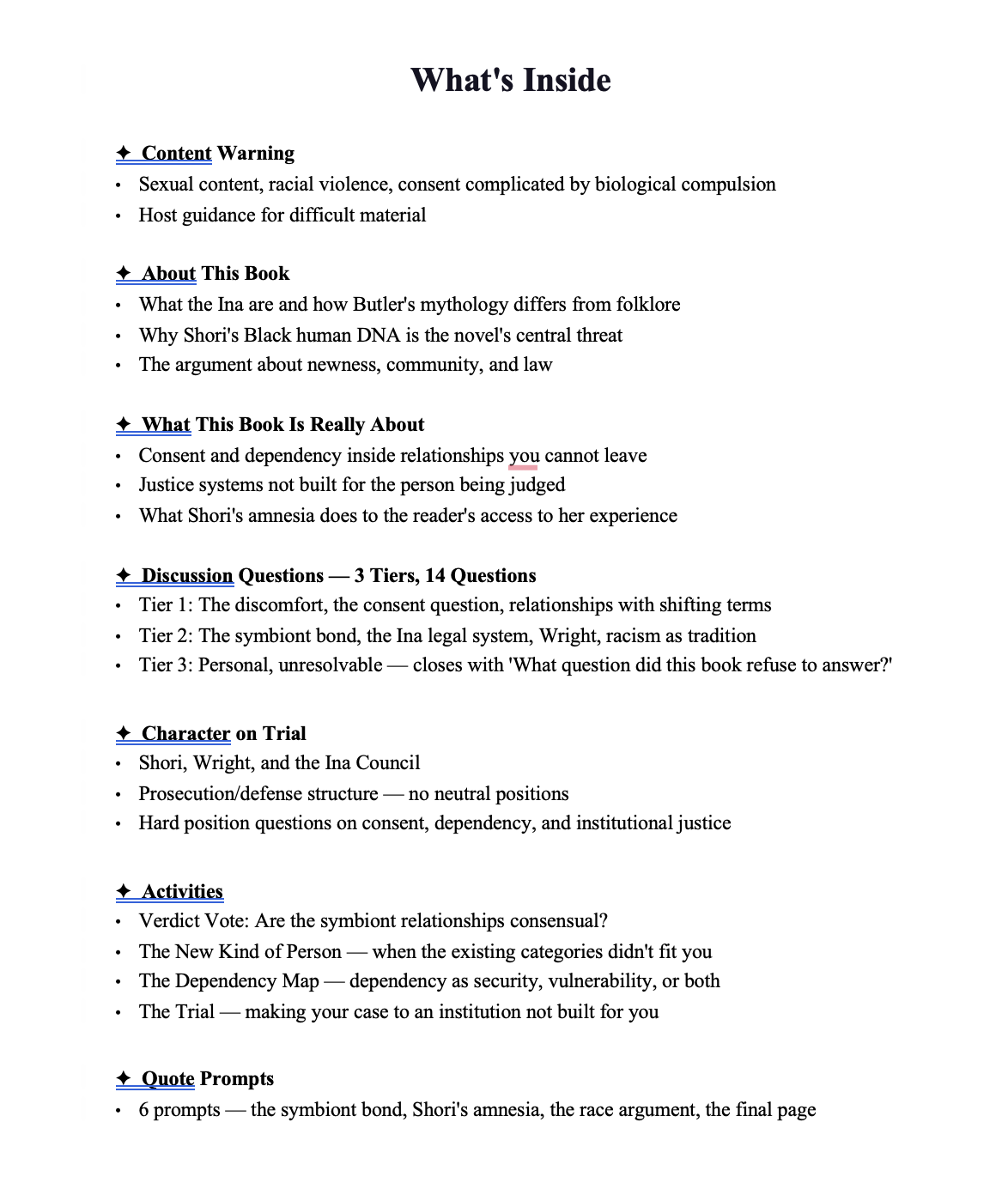 Image 2 of 4
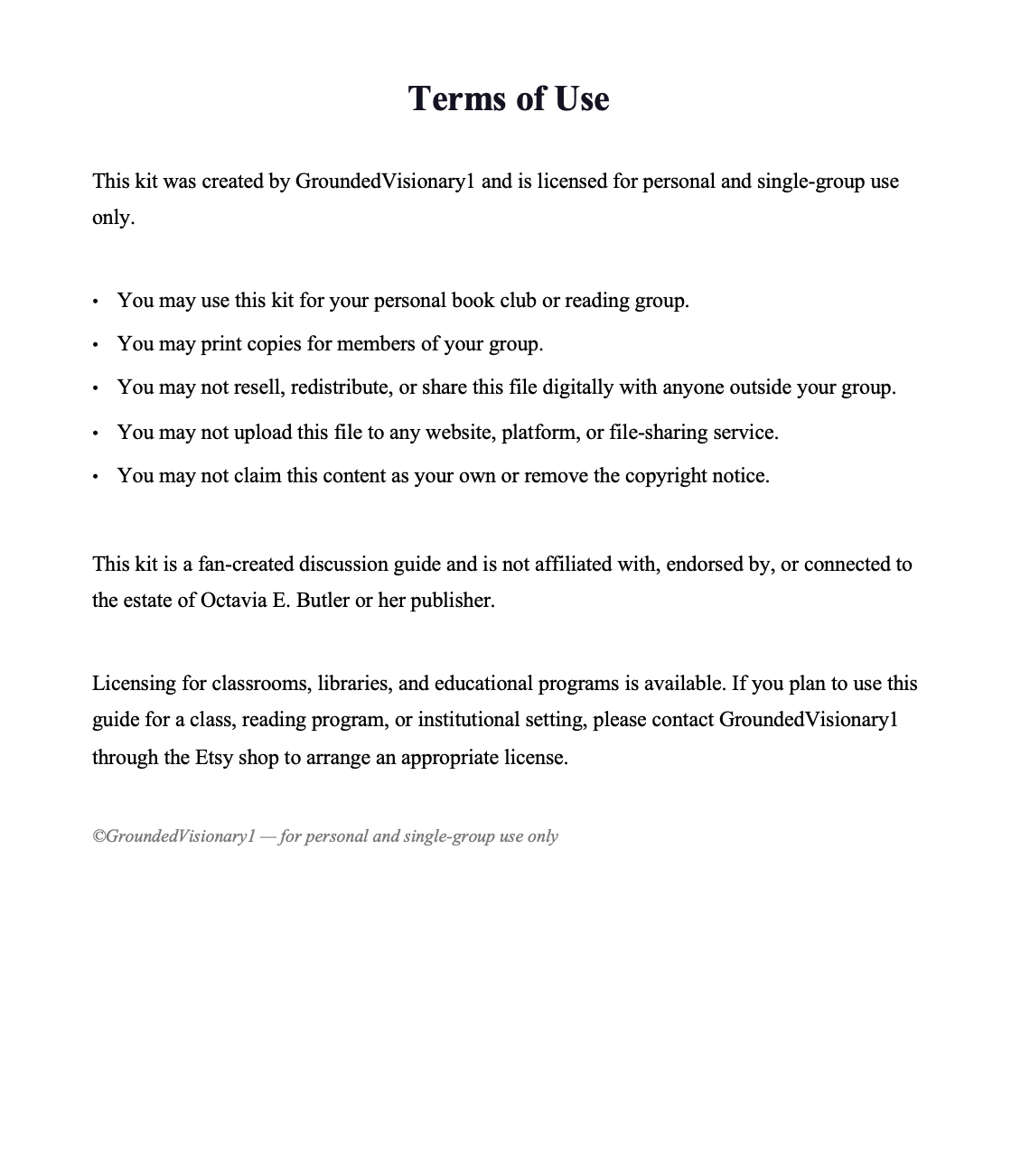 Image 3 of 4
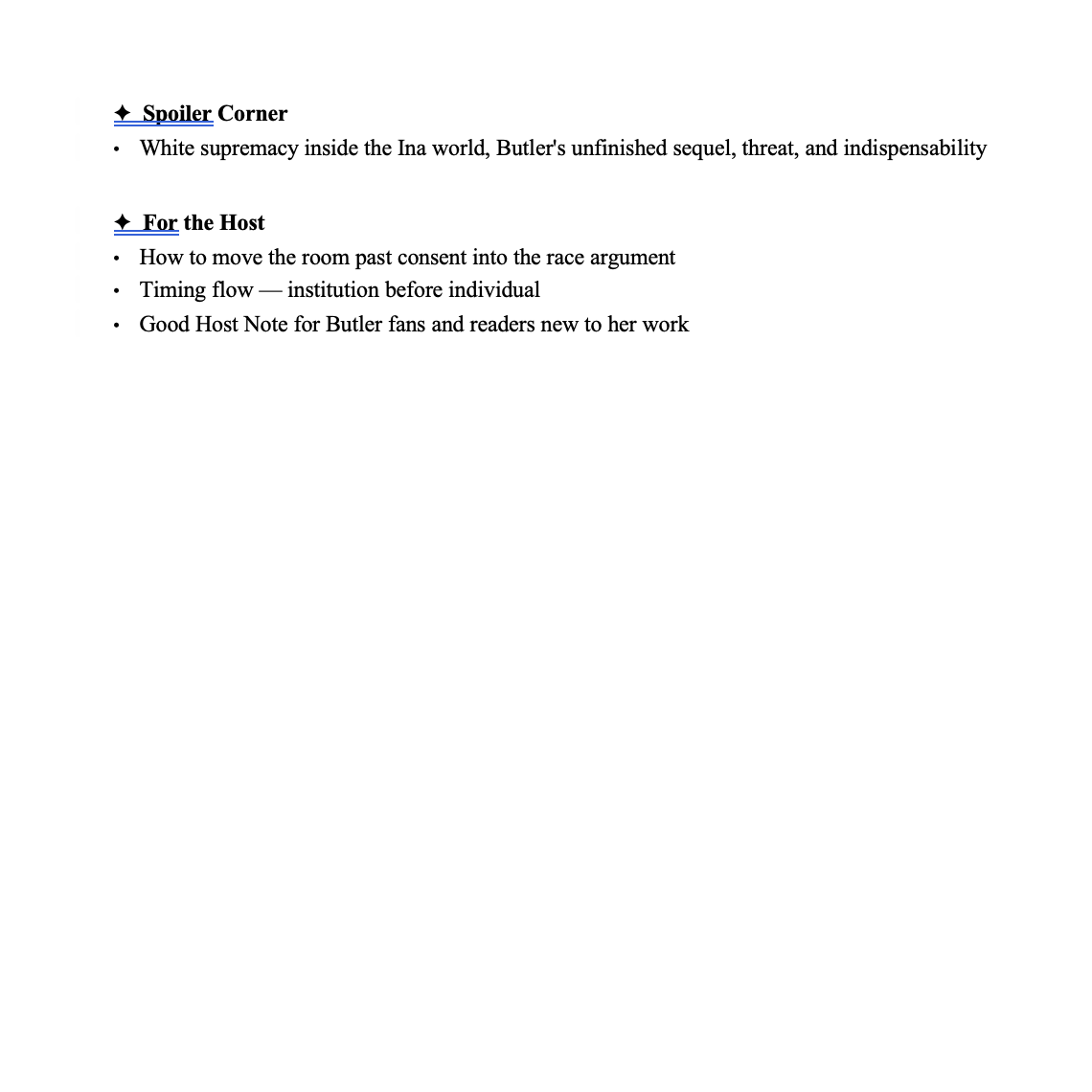 Image 4 of 4
Shori wakes up with no memory, a body that appears to be a ten-year-old girl's, and a hunger she doesn't understand. She is actually 53 years old — a member of an ancient species that bonds with humans for survival. Those bonds are biological, addictive, and for the human, fatal to break. Butler does not frame this as horror. She frames it as a question: what is consent when you cannot survive refusing?
Fledgling is one of Butler's most argued-over novels — not because of the violence, but because she builds a world where the relationship you cannot escape is also the one both parties say they want. Running underneath it is a second argument: Shori's Black human DNA gives her an ability the ancient Ina community wants to destroy, and the institution delivering judgment on her case was never built to protect someone like her. Butler's deepest argument is not about vampires. It's about who a community's laws were written to hold — and who they leave out by design.
This guide puts all of it on the floor. The consent question, the race argument, the Ina legal system itself. It does not resolve what Butler refused to resolve. It gives your group the structure to argue it properly.
✦ Content Warning — sexual content, racial violence, consent complicated by biological compulsion; host guidance included
✦ About This Book & What This Book Is Really About — the Ina mythology, Shori's Black human DNA as the novel's central threat, and Butler's argument about institutions and newness
✦ Discussion Questions — 14 questions across 3 tiers; one question per tier draws from readers' own experience
✦ Character on Trial — Shori, Wright, and the Ina Council; no neutral positions, prosecution/defense structure, hard position questions on consent and institutional justice
✦ Activities — Verdict Vote on the symbiont relationships, The New Kind of Person, The Dependency Map, and The Trial
✦ Quote Prompts — 6 prompts covering the symbiont bond, Shori's amnesia, the race argument, and the final page
✦ Spoiler Corner — host-only escalation questions on white supremacy inside the Ina world and Butler's unfinished sequel
✦ For the Host — how to move the room past consent into Butler's deeper argument; timing flow; guidance for Butler fans and readers new to her work
Details: Instant download. PDF delivered immediately after purchase. 20+ pages, print-ready. Personal and single-group use. Fan-created — not affiliated with the estate of Octavia E. Butler or her publisher.
For classrooms, libraries, and educational programs — contact the shop for institutional licensing.
Built for the room that wants to argue about what Butler was actually doing — not just what happened in the book, but what she was saying about who institutions are built to protect.
Shori wakes up with no memory, a body that appears to be a ten-year-old girl's, and a hunger she doesn't understand. She is actually 53 years old — a member of an ancient species that bonds with humans for survival. Those bonds are biological, addictive, and for the human, fatal to break. Butler does not frame this as horror. She frames it as a question: what is consent when you cannot survive refusing?
Fledgling is one of Butler's most argued-over novels — not because of the violence, but because she builds a world where the relationship you cannot escape is also the one both parties say they want. Running underneath it is a second argument: Shori's Black human DNA gives her an ability the ancient Ina community wants to destroy, and the institution delivering judgment on her case was never built to protect someone like her. Butler's deepest argument is not about vampires. It's about who a community's laws were written to hold — and who they leave out by design.
This guide puts all of it on the floor. The consent question, the race argument, the Ina legal system itself. It does not resolve what Butler refused to resolve. It gives your group the structure to argue it properly.
✦ Content Warning — sexual content, racial violence, consent complicated by biological compulsion; host guidance included
✦ About This Book & What This Book Is Really About — the Ina mythology, Shori's Black human DNA as the novel's central threat, and Butler's argument about institutions and newness
✦ Discussion Questions — 14 questions across 3 tiers; one question per tier draws from readers' own experience
✦ Character on Trial — Shori, Wright, and the Ina Council; no neutral positions, prosecution/defense structure, hard position questions on consent and institutional justice
✦ Activities — Verdict Vote on the symbiont relationships, The New Kind of Person, The Dependency Map, and The Trial
✦ Quote Prompts — 6 prompts covering the symbiont bond, Shori's amnesia, the race argument, and the final page
✦ Spoiler Corner — host-only escalation questions on white supremacy inside the Ina world and Butler's unfinished sequel
✦ For the Host — how to move the room past consent into Butler's deeper argument; timing flow; guidance for Butler fans and readers new to her work
Details: Instant download. PDF delivered immediately after purchase. 20+ pages, print-ready. Personal and single-group use. Fan-created — not affiliated with the estate of Octavia E. Butler or her publisher.
For classrooms, libraries, and educational programs — contact the shop for institutional licensing.
Built for the room that wants to argue about what Butler was actually doing — not just what happened in the book, but what she was saying about who institutions are built to protect.