Survival in Broken Worlds
Survival in Broken Worlds
Filters
Mary was supposed to be manageable. She was one of thousands in Doro's centuries-long breeding program — monitored, arranged, and expected to be useful. Then she transitioned. Then she built the Pattern. Then she killed him. The satisfaction of that ending is real, and this kit does not shortchange it — but Octavia Butler does not let victory stay simple, and neither does this guide.
This guide is for readers who loved watching Doro finally meet something he couldn't consume, and who are ready to sit with the harder question underneath: If the people inside the Pattern are still ranked, absorbed, and made dependent on a structure they didn't choose, what exactly did the victory change? Butler's argument in Mind of My Mind is sharper than almost anything else in her catalog — rebellion does not automatically produce freedom — and this guide was built to put that argument in front of a room and let them fight about it.
✦ What's Inside
Discussion questions across three tiers — from entry points for the whole room into prosecution/defense questions on Mary's inheritance, transition as capture, Emma's suggestion, Karl and consent, and what Doro's exclusion from the Pattern actually reveals — closing with the questions Butler refuses to answer for you.
Character on Trial: Mary, Doro, and Emma/Anyanwu — hard position questions, prosecution/defense structure, no neutral positions allowed.
System on Trial: The Pattern — rescue versus acquisition, intimate control versus distant control, and what a genuinely free version of the Pattern would require.
Five activities: Verdict Vote on what Mary's victory actually changed; The Transition Question (what it costs to be rescued at your most vulnerable); Mary's Leadership Audit (safety, consent, accountability, necessity, long-term danger); What Doro Misunderstood; and The Pattern Map (family, government, nervous system, church, prison, or empire in embryo — you commit to a frame and defend it).
Six Quote Prompts, a Spoiler Corner with three host-only escalation questions, full facilitation notes, timing flow, and a host note for Wild Seed readers versus first-time Butler readers.
Instant download PDF. Fan-created guide, not affiliated with the author or publisher. Personal and single-group use.
The Emancipation Proclamation declared four million people free. What it did not build was anything to hold that freedom up. No land. No legal protection that was actually enforced. No safety from the men who had owned people and refused to accept that they no longer did. Leonard Pitts Jr. sets his novel in this specific and brutal gap — the first months after Lee's surrender, after Lincoln's assassination, after the law changed and almost nothing else did. Freeman is not a novel about the Civil War. It is a novel about what happened the morning after.
Three people move through this moment in completely different directions. Sam — a formerly enslaved man who took the last name Freeman the day he decided to walk south — leaves his safe haven in Philadelphia and walks a thousand miles through a lawless devastated country to find the wife slavery separated him from fifteen years earlier. Tilda — Sam's wife — is being marched at gunpoint by her former owner toward Arkansas where he believes the old order can still be maintained. Prudence — a wealthy white war widow from Boston — is heading south to honor her abolitionist father's dying wish and open a school for emancipated slaves in a place that has decided it does not want what she is offering.
Pitts is asking one question across all three of them — what does freedom actually mean when it exists on paper but not in practice? When the law has changed and the violence has not. When the men who lost the war are still operating with enough impunity to act as though they won. When a man can name himself Freeman and walk toward that name and lose an arm doing it and keep walking anyway because the alternative is letting slavery have the final word.
This kit was built for the room that finished Freeman sitting with the grief of a novel set at the moment of maximum possibility — before Reconstruction's abandonment, before Jim Crow, before the country made the specific choices it made about what emancipation was actually going to mean. It was built for the conversation that starts in 1865 and cannot stay there.
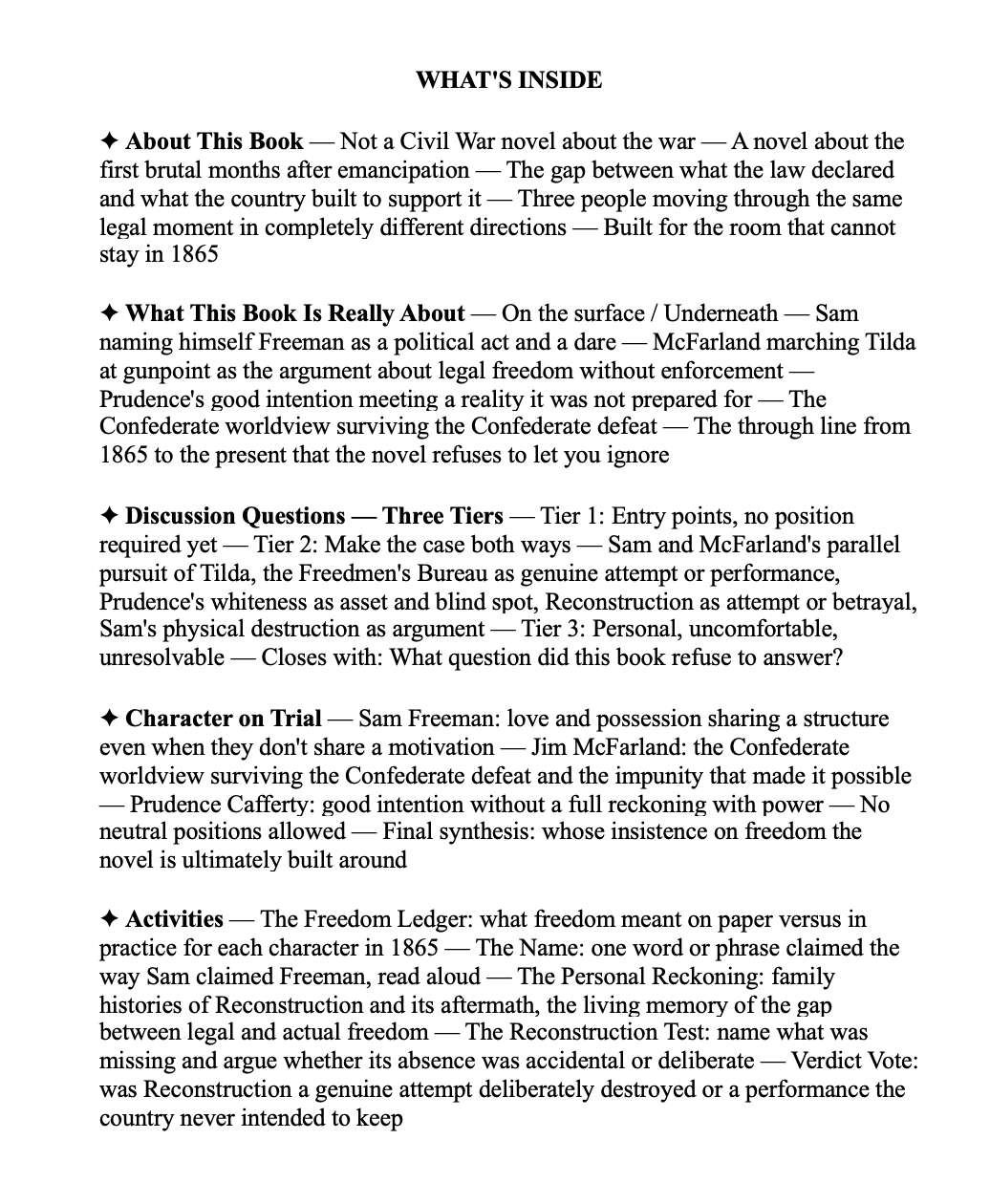
What's Inside:
✦ About This Book — Not a Civil War novel about the war — A novel about the first brutal months after emancipation — The gap between what the law declared and what the country built to support it — Three people moving through the same legal moment in completely different directions — Built for the room that cannot stay in 1865
✦ What This Book Is Really About — On the surface / Underneath — Sam naming himself Freeman as a political act and a dare — McFarland marching Tilda at gunpoint as the argument about legal freedom without enforcement — Prudence's good intention meeting a reality it was not prepared for — The Confederate worldview surviving the Confederate defeat — The through line from 1865 to the present that the novel refuses to let you ignore
✦ Discussion Questions — Three Tiers — Tier 1: Entry points, no position required yet — Tier 2: Make the case both ways — Sam and McFarland's parallel pursuit of Tilda, the Freedmen's Bureau as genuine attempt or performance, Prudence's whiteness as asset and blind spot, Reconstruction as attempt or betrayal, Sam's physical destruction as argument — Tier 3: Personal, uncomfortable, unresolvable — Closes with: What question did this book refuse to answer?
✦ Character on Trial — Sam Freeman: love and possession sharing a structure even when they don't share a motivation — Jim McFarland: the Confederate worldview surviving the Confederate defeat and the impunity that made it possible — Prudence Cafferty: good intention without a full reckoning with power — No neutral positions allowed — Final synthesis: whose insistence on freedom the novel is ultimately built around
✦ Activities — The Freedom Ledger: what freedom meant on paper versus in practice for each character in 1865 — The Name: one word or phrase claimed the way Sam claimed Freeman, read aloud — The Personal Reckoning: family histories of Reconstruction and its aftermath, the living memory of the gap between legal and actual freedom — The Reconstruction Test: name what was missing and argue whether its absence was accidental or deliberate — Verdict Vote: was Reconstruction a genuine attempt deliberately destroyed or a performance the country never intended to keep
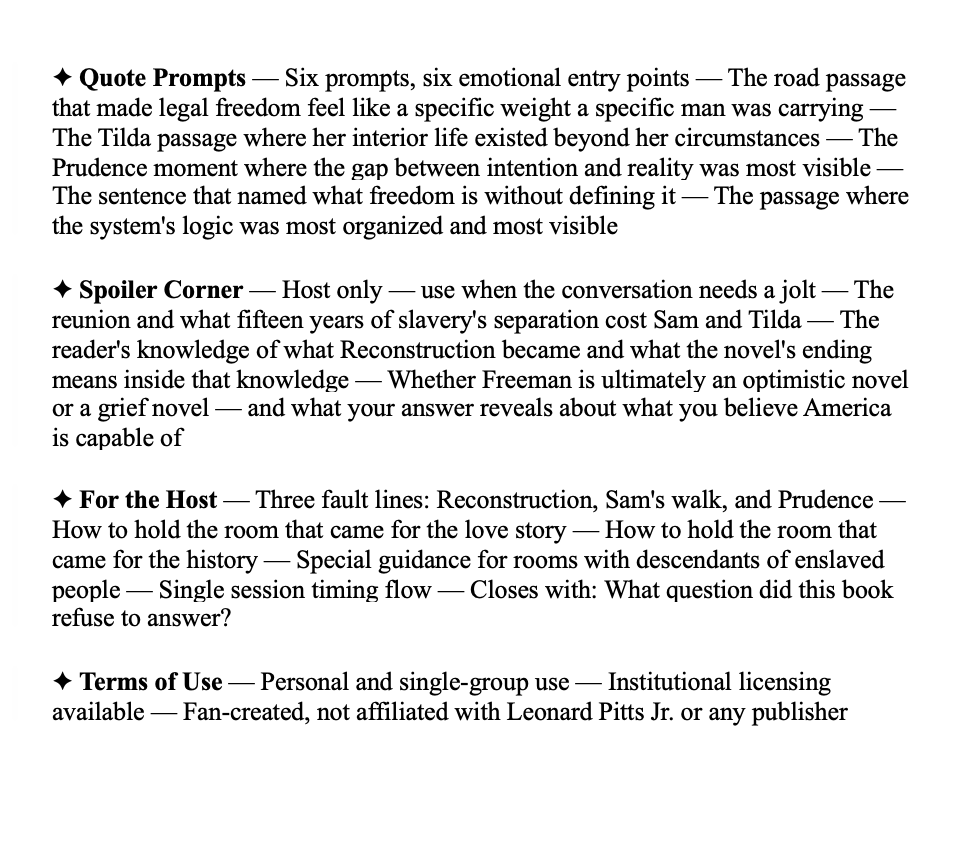
✦ Quote Prompts — Six prompts, six emotional entry points — The road passage that made legal freedom feel like a specific weight a specific man was carrying — The Tilda passage where her interior life existed beyond her circumstances — The Prudence moment where the gap between intention and reality was most visible — The sentence that named what freedom is without defining it — The passage where the system's logic was most organized and most visible
✦ Spoiler Corner — Host only — Full knowledge of the entire novel required — The reunion and what fifteen years of slavery's separation cost Sam and Tilda — The reader's knowledge of what Reconstruction became and what the novel's ending means inside that knowledge — Whether Freeman is ultimately an optimistic novel or a grief novel
✦ For the Host — Three fault lines: Reconstruction, Sam's walk, and Prudence — How to hold the room that came for the love story — How to hold the room that came for the history — Special guidance for rooms with descendants of enslaved people — Timing flow for a single session
Details: Instant download — PDF format — Personal and single-group use — Fan-created discussion guide — Not affiliated with or endorsed by Leonard Pitts Jr. or any publisher — Page count: 20+ pages, print-ready
Content note: This guide discusses slavery and its violence, lynching, re-enslavement through coercion, racial violence in the post-war South, and the systematic destruction of Reconstruction-era Black progress. These are not background details — they are the argument. Please consider your group's readiness for this material before purchasing.
Licensing for classrooms, libraries, and educational programs is available. If you plan to use this guide for a class, reading program, or institutional setting, please contact the shop owner to arrange an appropriate license
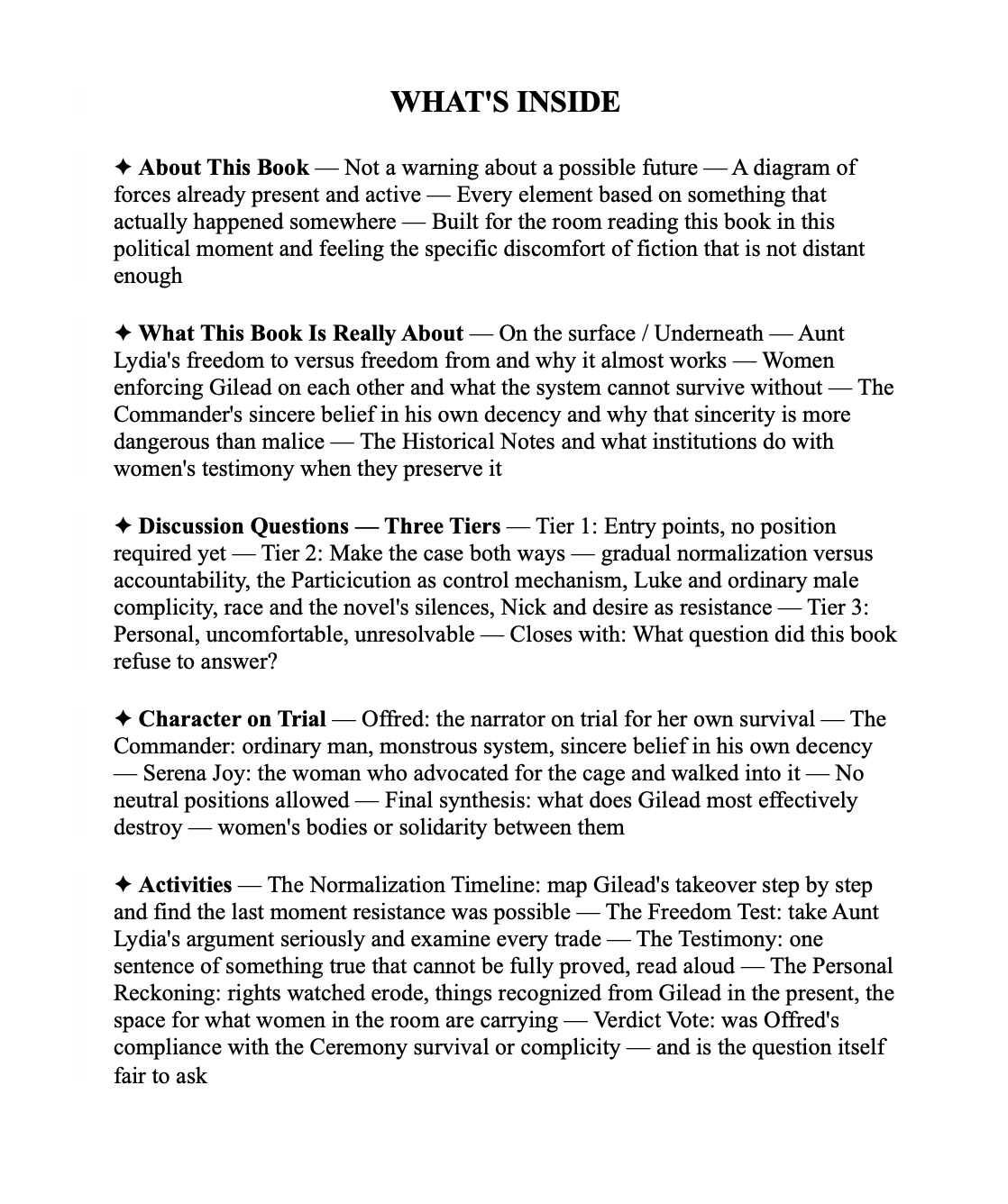
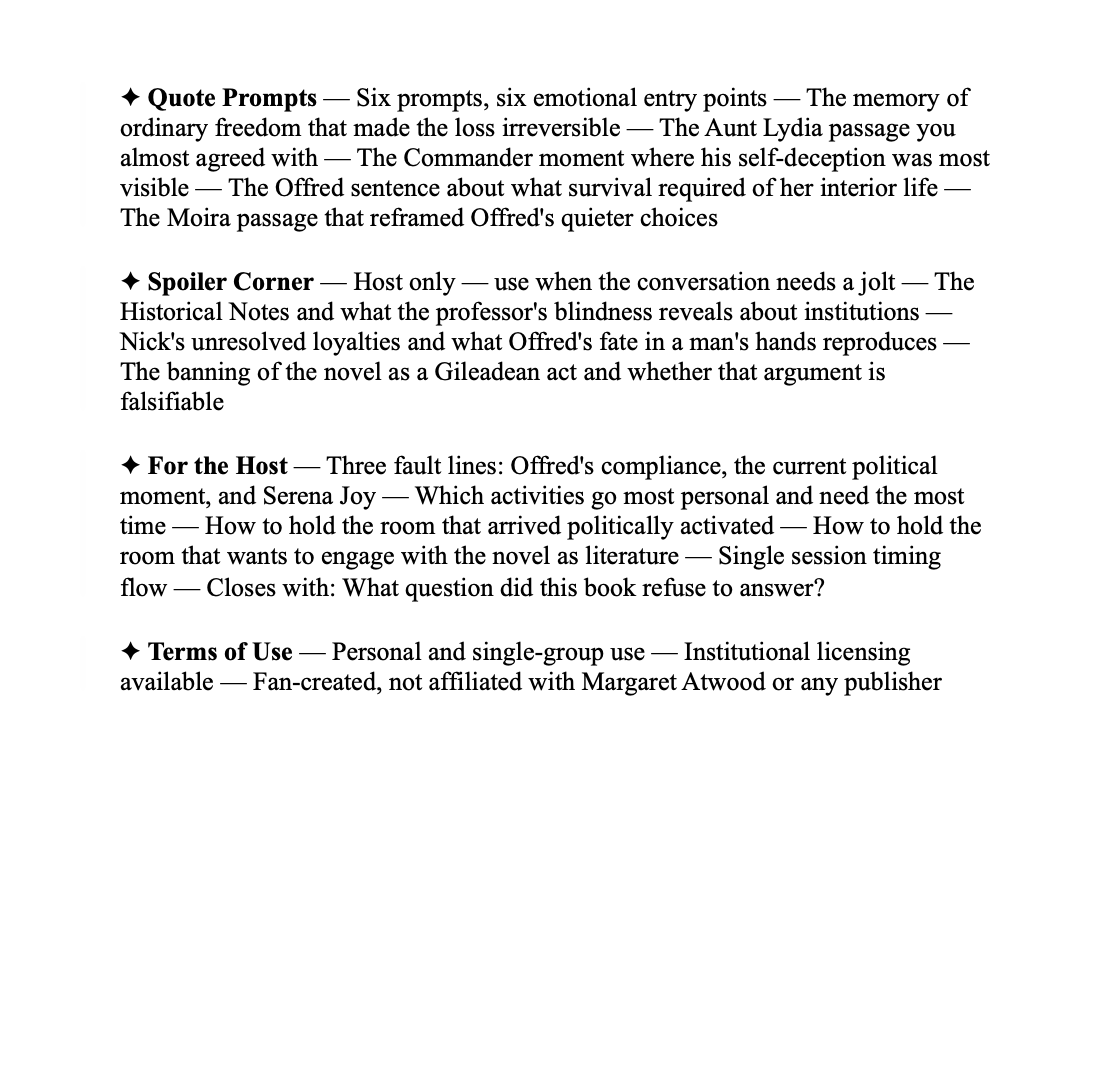
Margaret Atwood wrote this novel in 1985 and carried newspaper clippings to every interview about it. Not because she was proud of the research. Because she needed people to understand that she had not invented anything. Romania's Ceausescu forced women to undergo monthly pregnancy tests. Iran's Islamic revolution reduced women's rights overnight. American slavery's apparatus — the auctions, the assignments, the breeding, the complete legal erasure of personhood — is directly present in Gilead's structure. Atwood's point was not that a society like Gilead could happen. Her point was that it already had — in pieces, in different places, across different centuries — and that the pieces were all still available.
This kit was built for the room reading this book right now in this political moment and feeling the specific discomfort of fiction that is not distant enough. Not the room that wants to be reassured that Gilead is safely fictional. The room that is sitting with the specific unease of a novel that keeps finding new urgency because the forces it diagrams are present and active — the gradual erosion of rights described as protection, the use of religion as a vehicle for power, the women who enforce systems that harm them in exchange for relative safety, and the men who build monstrous things while maintaining a sincere and unshakeable belief in their own decency.
The discussion in this room will divide. Every room that reads this novel eventually has to decide what to think about Offred — a narrator who survives by compliance, who takes small pleasures from the man who rapes her monthly, who has an affair with a man she cannot fully trust, and who tells you she may be constructing her own story. Both the prosecution and the defense of her choices are in this kit. Neither is dismissed. The goal is not to reach a verdict on Offred. The goal is to ask what survival looks like from the inside of a totalitarian system — and whether the question itself is fair to ask of her.
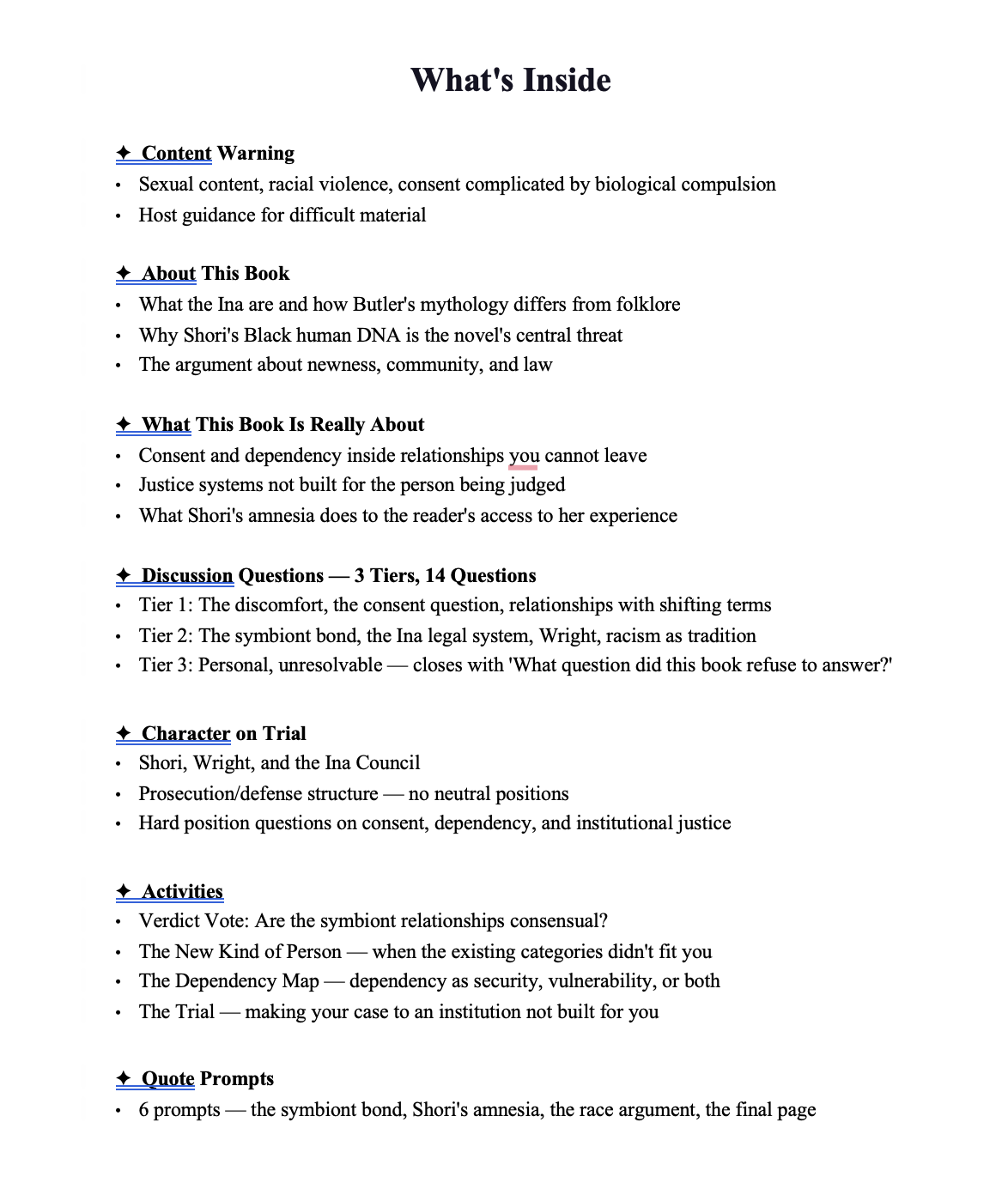
Shori wakes up with no memory, a body that appears to be a ten-year-old girl's, and a hunger she doesn't understand. She is actually 53 years old — a member of an ancient species that bonds with humans for survival. Those bonds are biological, addictive, and for the human, fatal to break. Butler does not frame this as horror. She frames it as a question: what is consent when you cannot survive refusing?
Fledgling is one of Butler's most argued-over novels — not because of the violence, but because she builds a world where the relationship you cannot escape is also the one both parties say they want. Running underneath it is a second argument: Shori's Black human DNA gives her an ability the ancient Ina community wants to destroy, and the institution delivering judgment on her case was never built to protect someone like her. Butler's deepest argument is not about vampires. It's about who a community's laws were written to hold — and who they leave out by design.
This guide puts all of it on the floor. The consent question, the race argument, the Ina legal system itself. It does not resolve what Butler refused to resolve. It gives your group the structure to argue it properly.
✦ Content Warning — sexual content, racial violence, consent complicated by biological compulsion; host guidance included
✦ About This Book & What This Book Is Really About — the Ina mythology, Shori's Black human DNA as the novel's central threat, and Butler's argument about institutions and newness
✦ Discussion Questions — 14 questions across 3 tiers; one question per tier draws from readers' own experience
✦ Character on Trial — Shori, Wright, and the Ina Council; no neutral positions, prosecution/defense structure, hard position questions on consent and institutional justice
✦ Activities — Verdict Vote on the symbiont relationships, The New Kind of Person, The Dependency Map, and The Trial
✦ Quote Prompts — 6 prompts covering the symbiont bond, Shori's amnesia, the race argument, and the final page
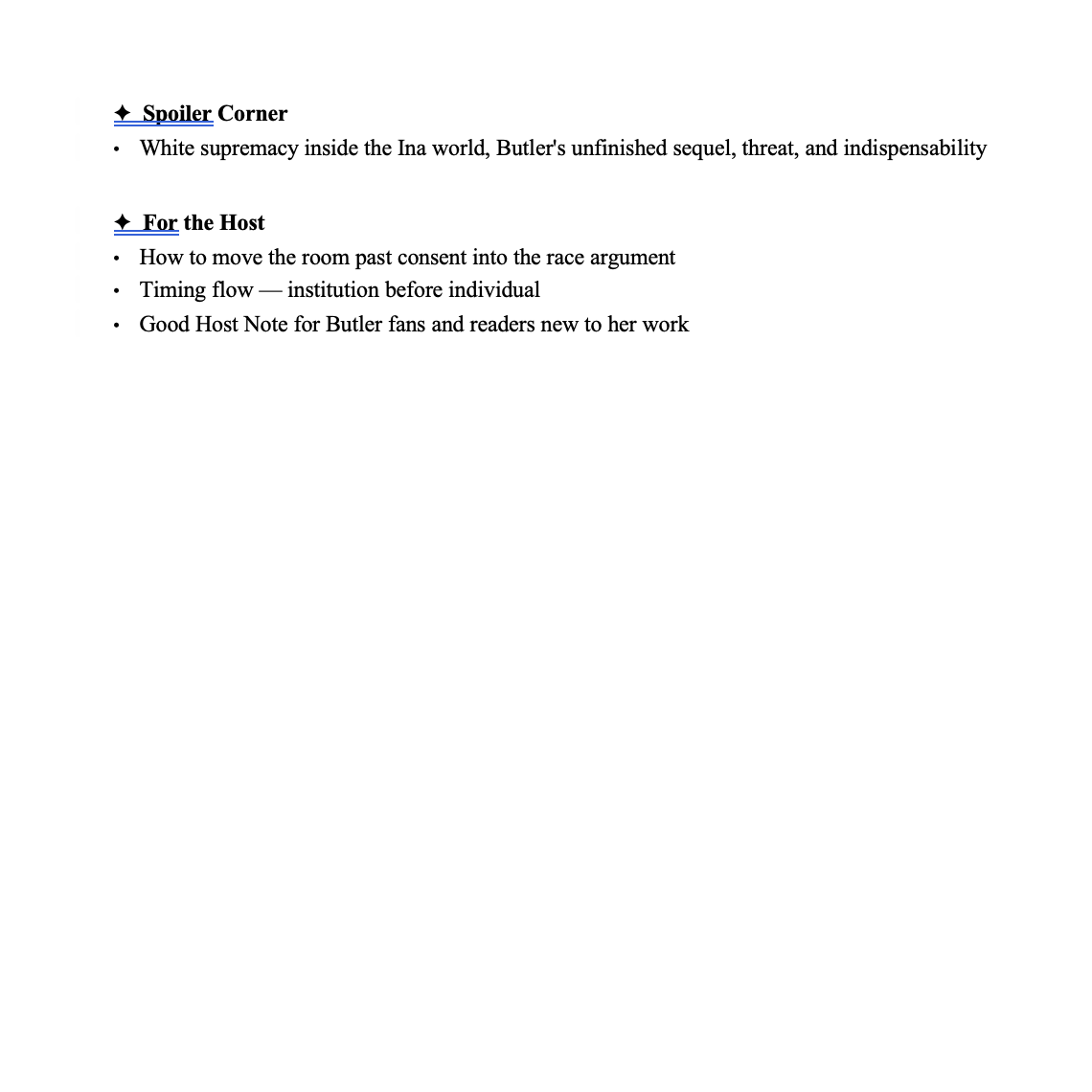
✦ Spoiler Corner — host-only escalation questions on white supremacy inside the Ina world and Butler's unfinished sequel
✦ For the Host — how to move the room past consent into Butler's deeper argument; timing flow; guidance for Butler fans and readers new to her work
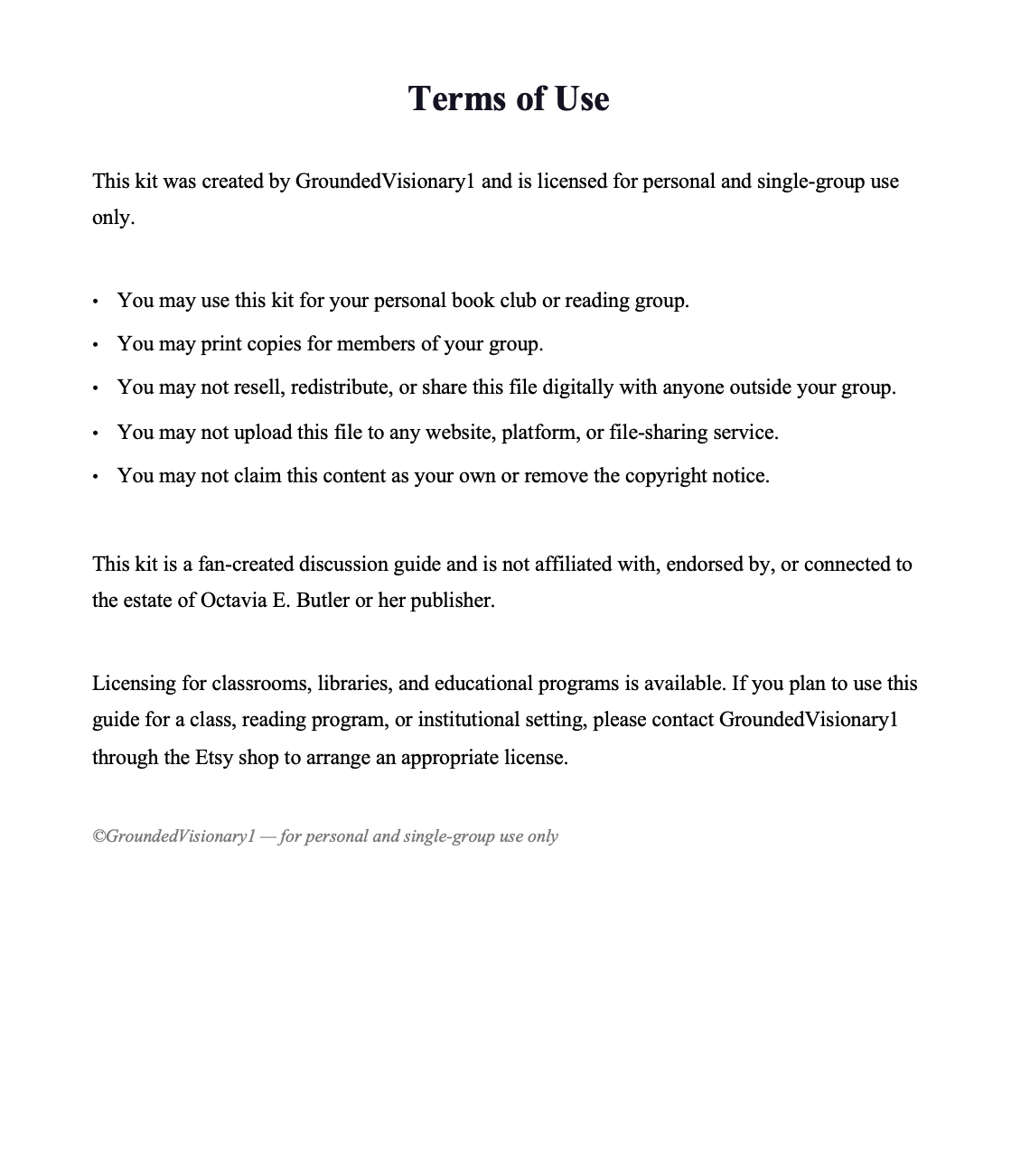
Details: Instant download. PDF delivered immediately after purchase. 20+ pages, print-ready. Personal and single-group use. Fan-created — not affiliated with the estate of Octavia E. Butler or her publisher.
For classrooms, libraries, and educational programs — contact the shop for institutional licensing.
Built for the room that wants to argue about what Butler was actually doing — not just what happened in the book, but what she was saying about who institutions are built to protect.
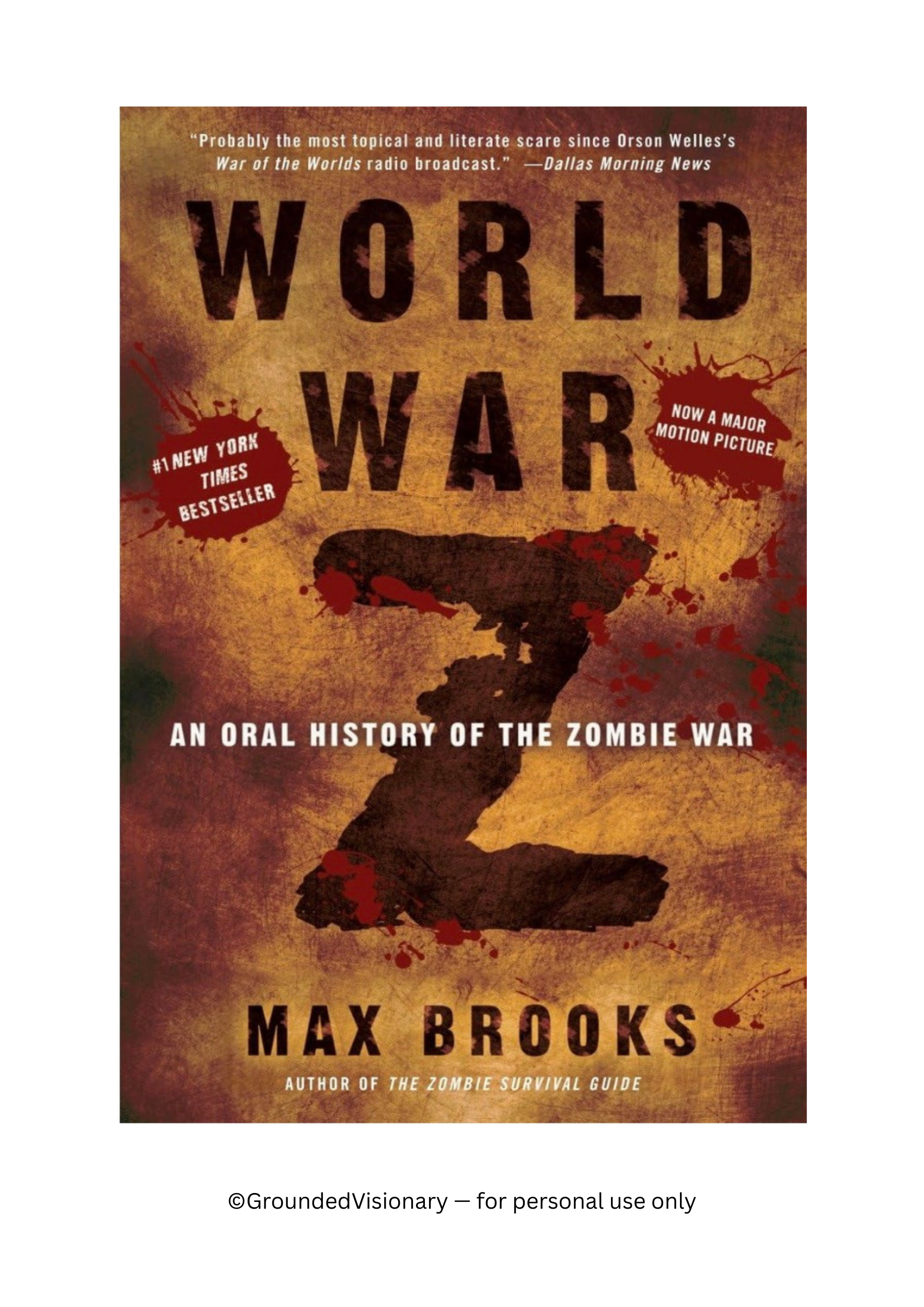
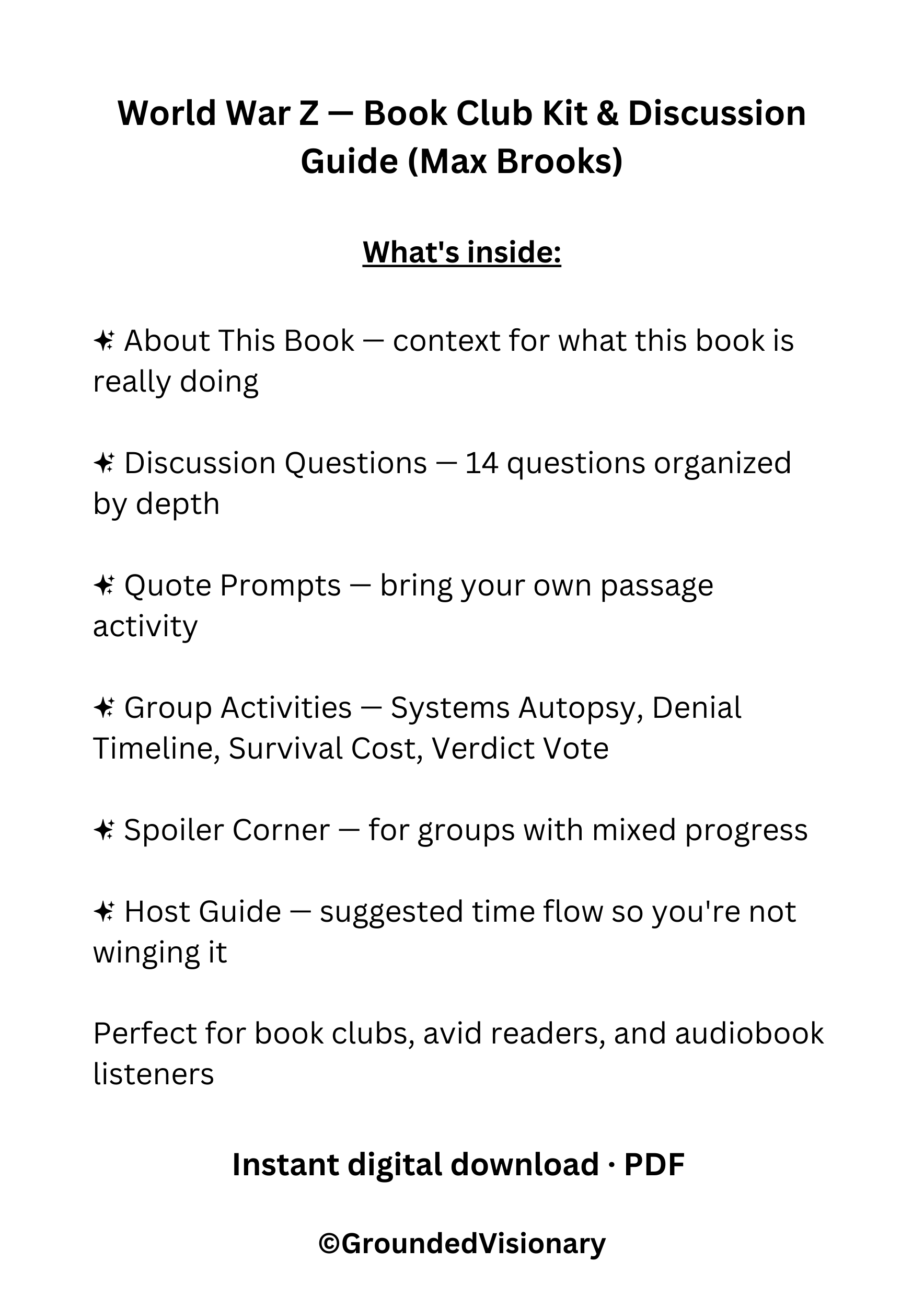
This isn't a zombie novel. The zombies are the least interesting thing about it.
What Max Brooks actually wrote is an oral history of a global catastrophe told through the people who survived it — soldiers, doctors, politicians, civilians, black market operators, regular people who just happened to make it. The format feels like reading a stack of post-war debrief transcripts. That is the point. It gives the whole thing a weight that most disaster fiction never achieves.
Here's what the book is really doing: it's an after-action review of humanity getting completely overwhelmed — and then slowly crawling back to rebuild. The zombies are the disaster. Human behavior is the chaos multiplier. Denial, arrogance, bad planning, political theater, "it won't happen here" — all of it arrives before the zombies even get through the door. Brooks wrote this in 2006. Your book club gets to decide how familiar that pattern feels right now.
Fair warning: this isn't a character-driven novel in the traditional sense. There's no one protagonist you follow emotionally from beginning to end. Humanity is the main character. Groups who go in expecting a traditional story often feel cold toward it. Groups who go in expecting a forensic examination tend to find it riveting. This kit is built for the second kind of room.
✦ What's Inside
✦ About This Book — Not a zombie novel — the zombies are the least interesting thing — An oral history of global catastrophe told by the people who survived it — Why the format is doing as much work as the content
✦ What This Book Is Really About — A forensic examination of how human systems fail, adapt, and rebuild — Who profits from denial — and whether that pattern feels familiar — What survival actually costs the people who achieve it — Whether going back is possible or whether the world just becomes something else
✦ Discussion Questions — Three Tiers — Tier 1: Warmup questions including the format, the voice that stuck, and what you expected vs. what you got — Tier 2: Which institution failed most catastrophically, who profits from denial, where the line is between understandable and unforgivable — Tier 3: Trauma after the danger ends, what humanity lost that it can't get back, what Brooks saw in 2006 that landed this week — Closes with: What question did this book refuse to answer?
✦ Activities — Systems Autopsy: pick one system that failed — healthcare, government, military, media, supply chain — walk through the failure and ask what would have had to be different for it to hold — The Denial Timeline: reconstruct the chain of denial in the early outbreak, map who knew and who profited from silence, ask whether this pattern shows up anywhere in the real world — Survival Cost: name the account that showed you what survival really costs and whether any version of survival in this book costs nothing — Verdict Vote: one decision by a government, military leader, or individual — Necessary / Inexcusable / Understandable but wrong
✦ Quote Prompts — Five prompts across different emotional entry points — The account where the real enemy wasn't the zombies — The passage where denial did more damage than the disaster itself — The voice that felt uncomfortably close to real life
✦ Spoiler Corner — Host option — three questions for groups who finished — Which account changed meaning once you knew how the war ended — Whether the ending felt like hope, exhaustion, or something in between — What the final shape of the world says about what humanity actually learned
✦ For the Host — How to anchor discussion when there's no central protagonist — Go straight to the themes — resist the plot recap — Timing flow for a single session — Good host note: name the format upfront
Details — Instant download PDF — Personal and single-group use. No redistribution or resale. — Fan-created guide. Not affiliated with or endorsed by Max Brooks or any publisher.
Licensing for classrooms, libraries, and educational programs is available. If you plan to use this guide for a class, reading program, or institutional setting, please contact the shop owner to arrange an appropriate license.
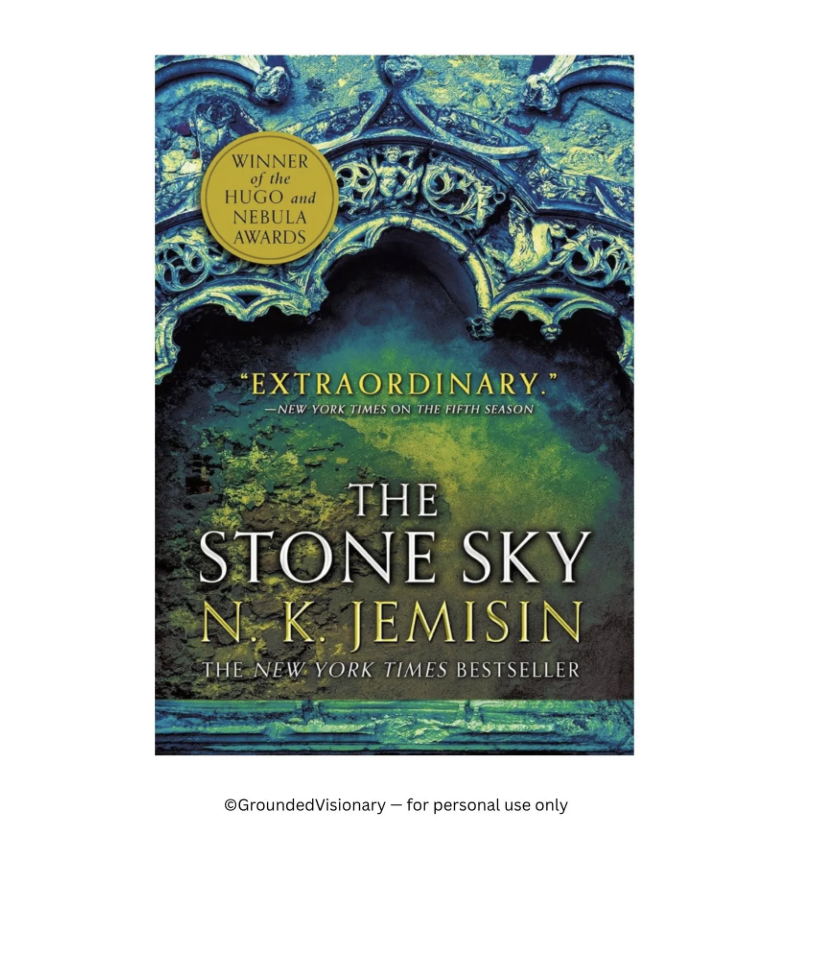
A final reckoning with sacrifice, legacy, and the price of changing the world.
The Stone Sky is the book that has to pay off everything. Three books of fractured timelines, second-person narration, and a world built on deliberate catastrophe — and this is where Jemisin asks you to decide whether any of it can be undone. It is the most ambitious book in the trilogy and in some ways the most demanding. It is also the one where you finally find out what kind of mother Essun was — and why that answer changes everything about Nassun.
This kit was built for the room that finished the Broken Earth trilogy and couldn't stop thinking about it. Not just about the ending — about Nassun's choice, about what Hoa's narration was actually doing across three books, about whether the victory Jemisin delivers is an act of hope or the most honest thing she could have said about what breaking cycles of harm actually costs the people who break them.
The discussion in this room will be divided. Nassun splits every room that reads this trilogy — between readers who understand her completely and readers who think she nearly ended the world because she was in pain and had too much power and not enough wisdom. Both positions are defensible. Both are in this kit. The goal is not to reach a verdict on Nassun. The goal is to hold her accountable and love her at the same time — which is exactly what Jemisin asks of you and exactly what the best book club conversations do.
This kit was built for the room that read all three books and is still sitting with the ending. It was built for the conversation that starts with whether Nassun was right and ends somewhere none of you expected.
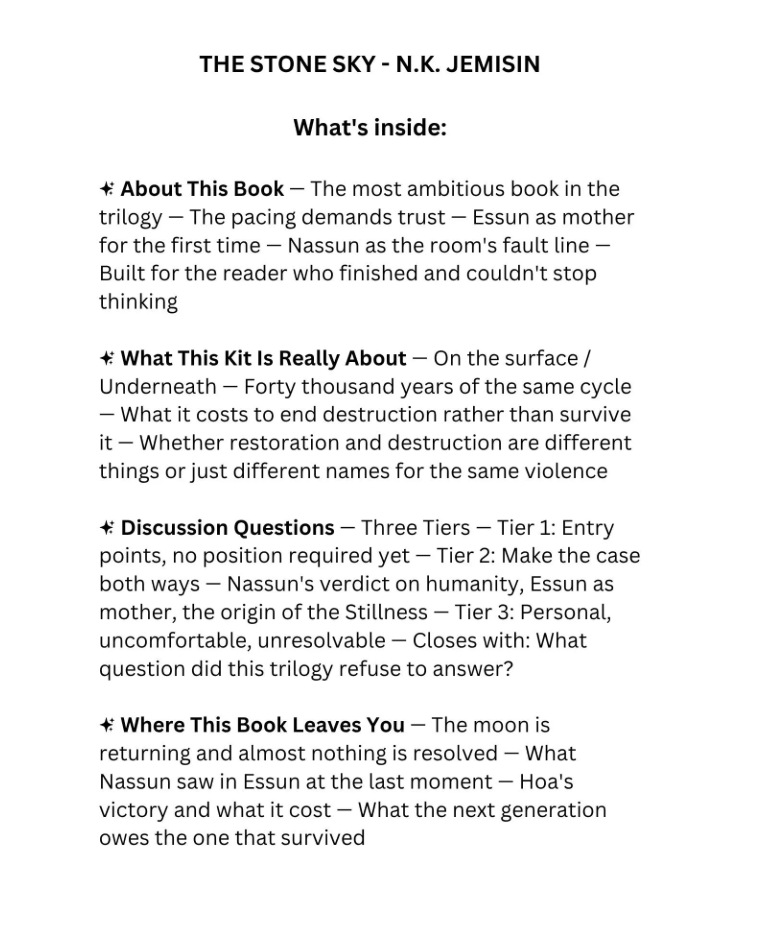
✦ What's Inside
✦ About This Book — The most ambitious book in the trilogy — The pacing demands trust — Essun as mother — finally and fully — Nassun as the room's fault line — Built for the reader who finished and couldn't stop thinking
✦ What This Book Is Really About — Forty thousand years of the same cycle — What it costs to end destruction rather than survive it — Whether restoration and destruction are different things or just different names for the same violence
✦ Discussion Questions — Three Tiers — Tier 1: Entry points, no position required yet — Tier 2: Nassun's verdict on humanity, Essun as mother, the origin of the Stillness — Tier 3: Personal, uncomfortable, unresolvable — Closes with: What question did this trilogy refuse to answer?
✦ Where This Book Leaves You — The moon is returning and almost nothing is resolved — What Nassun saw in Essun at the last moment — Hoa's victory and what it cost — What the next generation owes the one that survived
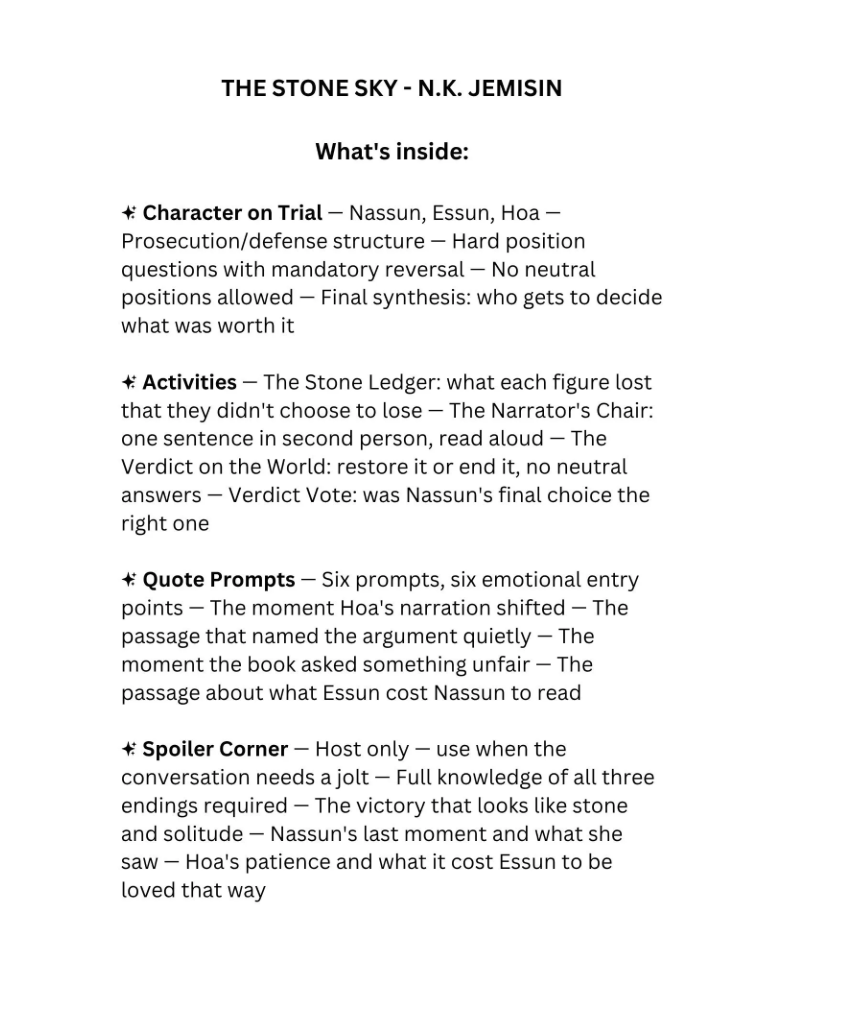
✦ Character on Trial — Nassun, Essun, Hoa — Prosecution/defense structure — Hard position questions with mandatory reversal — No neutral positions allowed — Final synthesis: who gets to decide what was worth it
✦ Activities — The Stone Ledger: what each figure lost that they didn't choose to lose — The Narrator's Chair: one sentence in second person, read aloud — The Verdict on the World: restore it or end it, no neutral answers — Verdict Vote: was Nassun's final choice the right one
✦ Quote Prompts — Six prompts, six emotional entry points — The moment Hoa's narration shifted — The passage that named the argument quietly — The passage about what Essun cost Nassun to read
✦ Spoiler Corner — Host only — full knowledge of all three endings required — The victory that looks like stone and solitude — Nassun's last moment — Hoa's patience and what it cost Essun to be loved that way
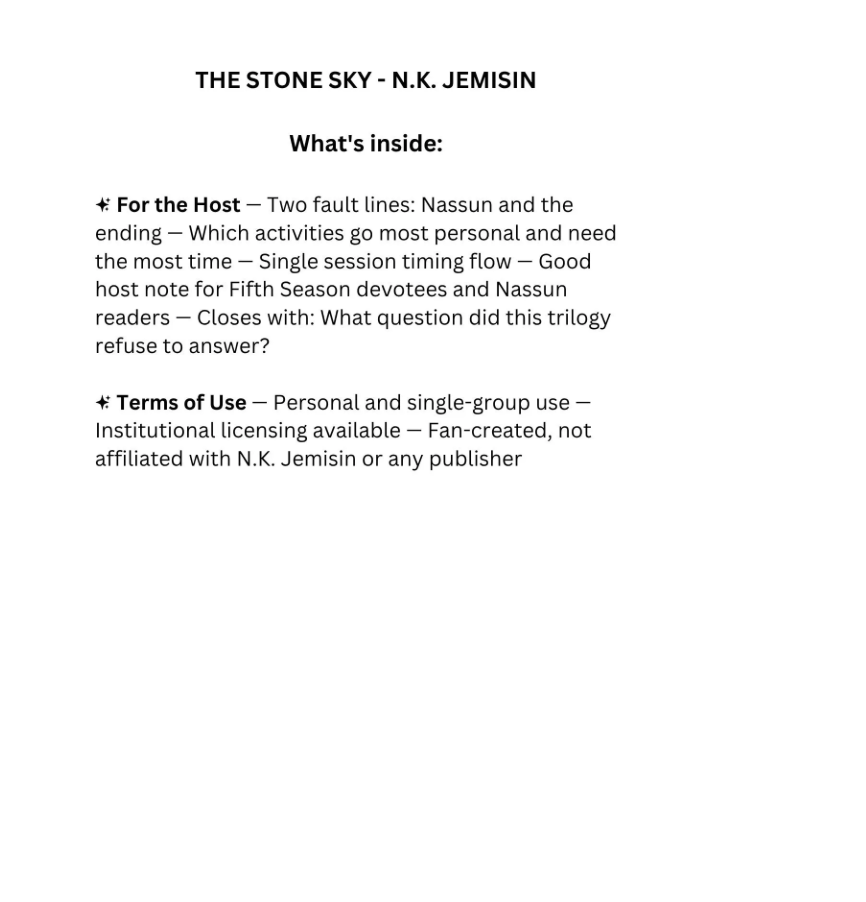
✦ For the Host — Two fault lines: Nassun and the ending — Timing flow for a single session — Good host note for Fifth Season devotees and Nassun readers
Details — Instant download PDF — 40+ pages, print-ready — Book 3 of the Broken Earth trilogy — pairs with The Fifth Season and The Obelisk Gate discussion guides — Personal and single-group use. No redistribution or resale. — Fan-created guide. Not affiliated with or endorsed by N.K. Jemisin or any publisher.
Licensing for classrooms, libraries, and educational programs is available. If you plan to use this guide for a class, reading program, or institutional setting, please contact the shop owner to arrange an appropriate license.
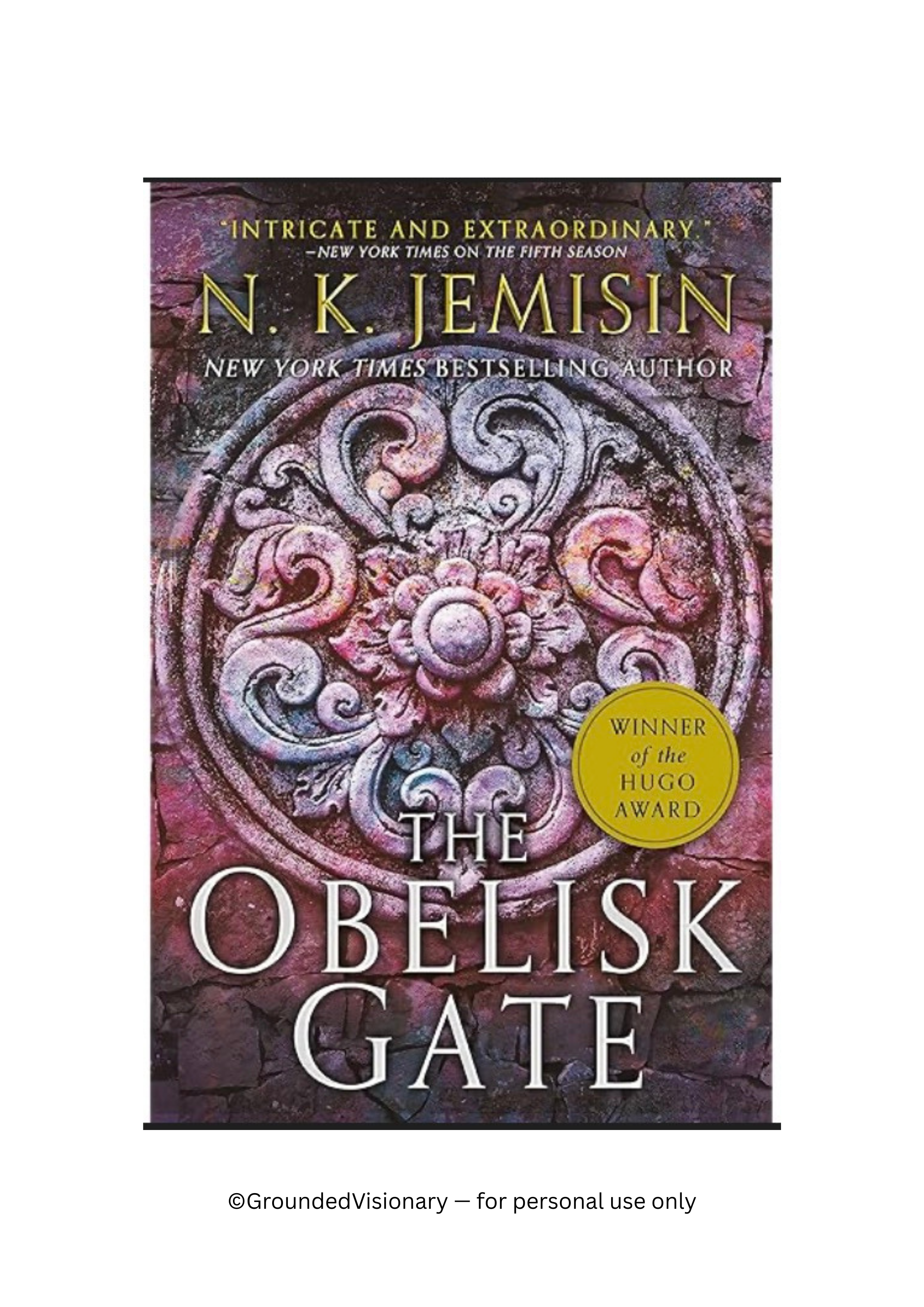
An exploration of control, consequence, and what power really costs.
The Obelisk Gate gives you back the character you loved most from the first book and then shows him to you only in the process of being taken away. Alabaster is dying — his body turning to stone, the cost of what he did to crack the world open — and he spends every session with Essun transferring everything he knows before he finishes the process of becoming what he used to move. His death is this book's central act. It hurts in proportion to how much you cared about him in The Fifth Season. And it is not the most devastating thing Jemisin does in this novel.
The most devastating thing is Nassun. Jemisin splits the narrative between Essun and her daughter moving toward each other and away from each other simultaneously — and what Nassun's chapters reveal is that Essun, in trying to protect her daughter, used the same methods that were used on her. She broke Nassun's hand to teach her control. She trained fear into the person she most wanted to save. The damage the Fulcrum built into Essun did not stay inside Essun. It traveled. That is not a plot twist. It is an argument about what oppression does when it doesn't get named — how it moves through love, how it replicates, how a person can be simultaneously a survivor and a source of the same harm.
This kit was built for the room that finished The Obelisk Gate still feeling the weight of Alabaster's last act — and still not entirely sure what to do with Nassun.
✦ What's Inside
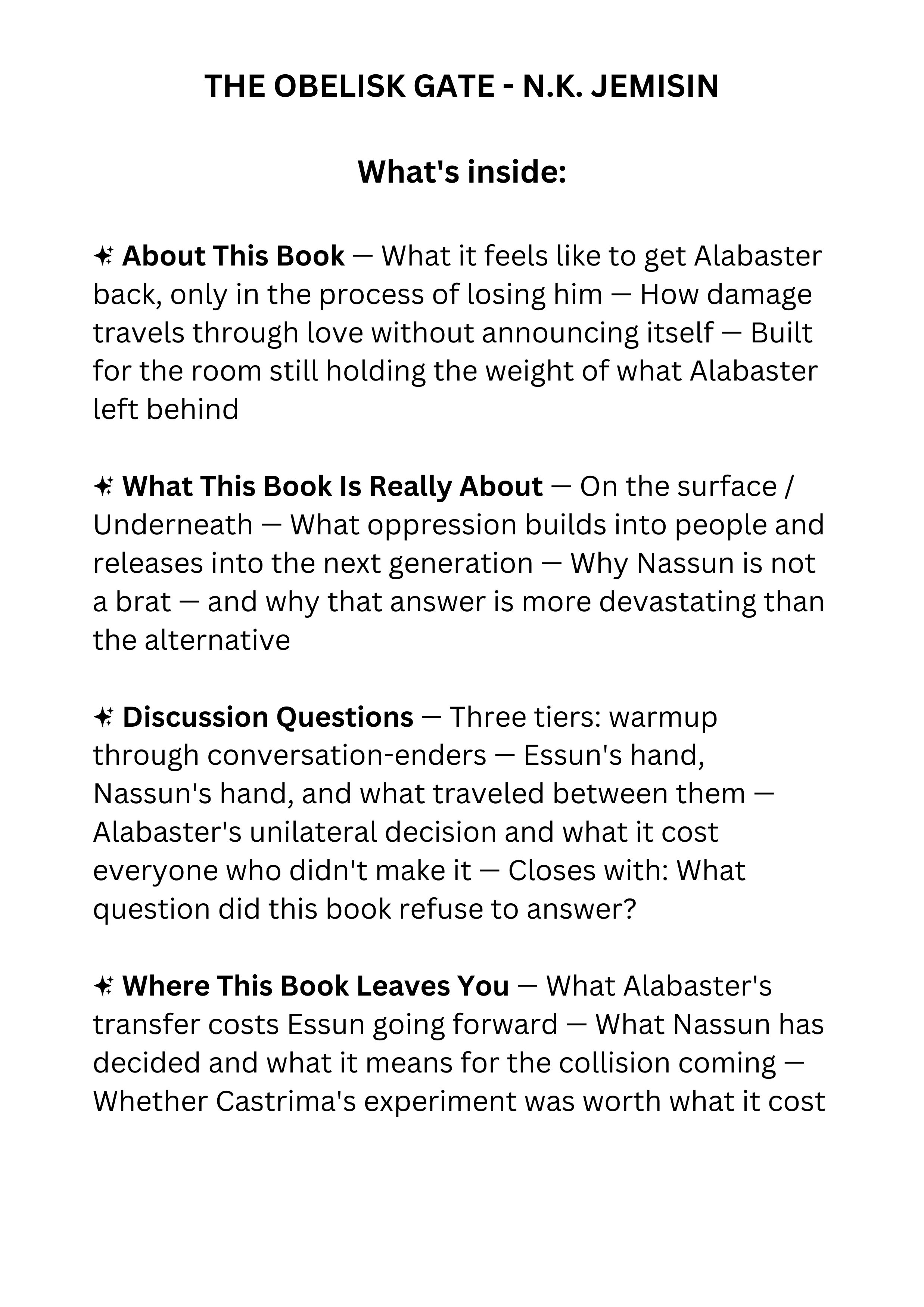
✦ About This Book — What it feels like to get Alabaster back only in the process of losing him — How damage travels through love without announcing itself — Built for the room still holding the weight of what Alabaster left behind
✦ What This Book Is Really About — What oppression builds into people and releases into the next generation — Why Nassun is not a brat — and why that answer is more devastating than the alternative — What Castrima's experiment reveals about coexistence and human fear
✦ Discussion Questions — Three Tiers — Tier 1: Warmup questions that get everyone talking — Tier 2: Essun's hand, Nassun's hand, and what traveled between them — Tier 3: Alabaster's unilateral decision and what it cost everyone who didn't make it — Closes with: What question did this book refuse to answer?
✦ Where This Book Leaves You — What Alabaster's transfer costs Essun going forward — What Nassun has decided and what it means for the collision coming — Whether Castrima's experiment was worth what it cost
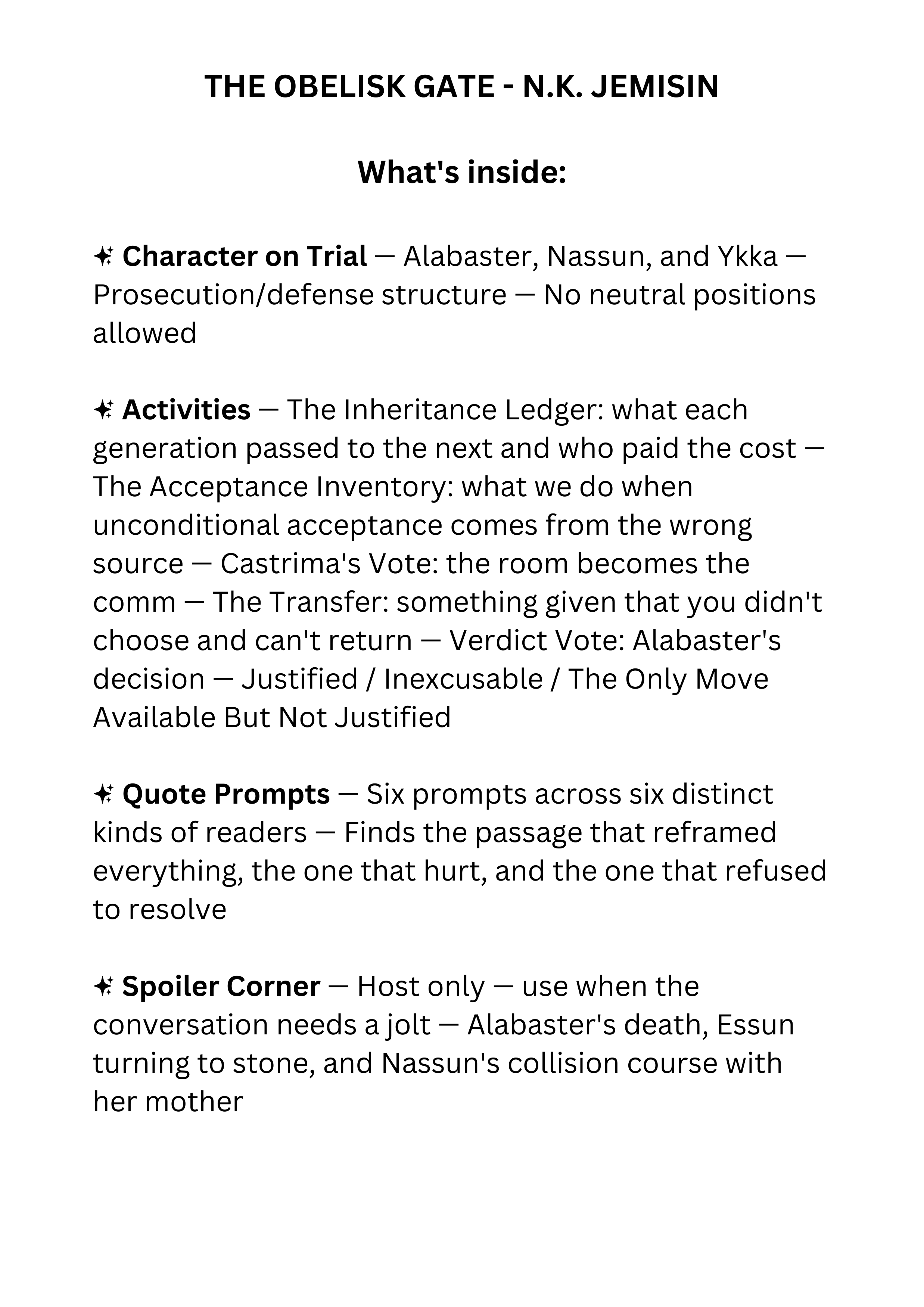
✦ Character on Trial — Alabaster, Nassun, and Ykka — Prosecution/defense structure — Hard position questions with mandatory reversal — No neutral positions allowed
✦ Activities — The Inheritance Ledger: what each generation passed to the next and who paid the cost — The Acceptance Inventory: what we do when unconditional acceptance comes from the wrong source — Castrima's Vote: the room becomes the comm — The Transfer: something given that you didn't choose and can't return — Verdict Vote: Alabaster's decision — Justified / Inexcusable / The Only Move Available But Not Justified
✦ Quote Prompts — Six prompts across six distinct kinds of readers — The passage that reframed everything — The one that hurt — The one that refused to resolve
✦ Spoiler Corner — Host only — use when the conversation needs a jolt — Alabaster's death, Essun turning to stone, and Nassun's collision course with her mother
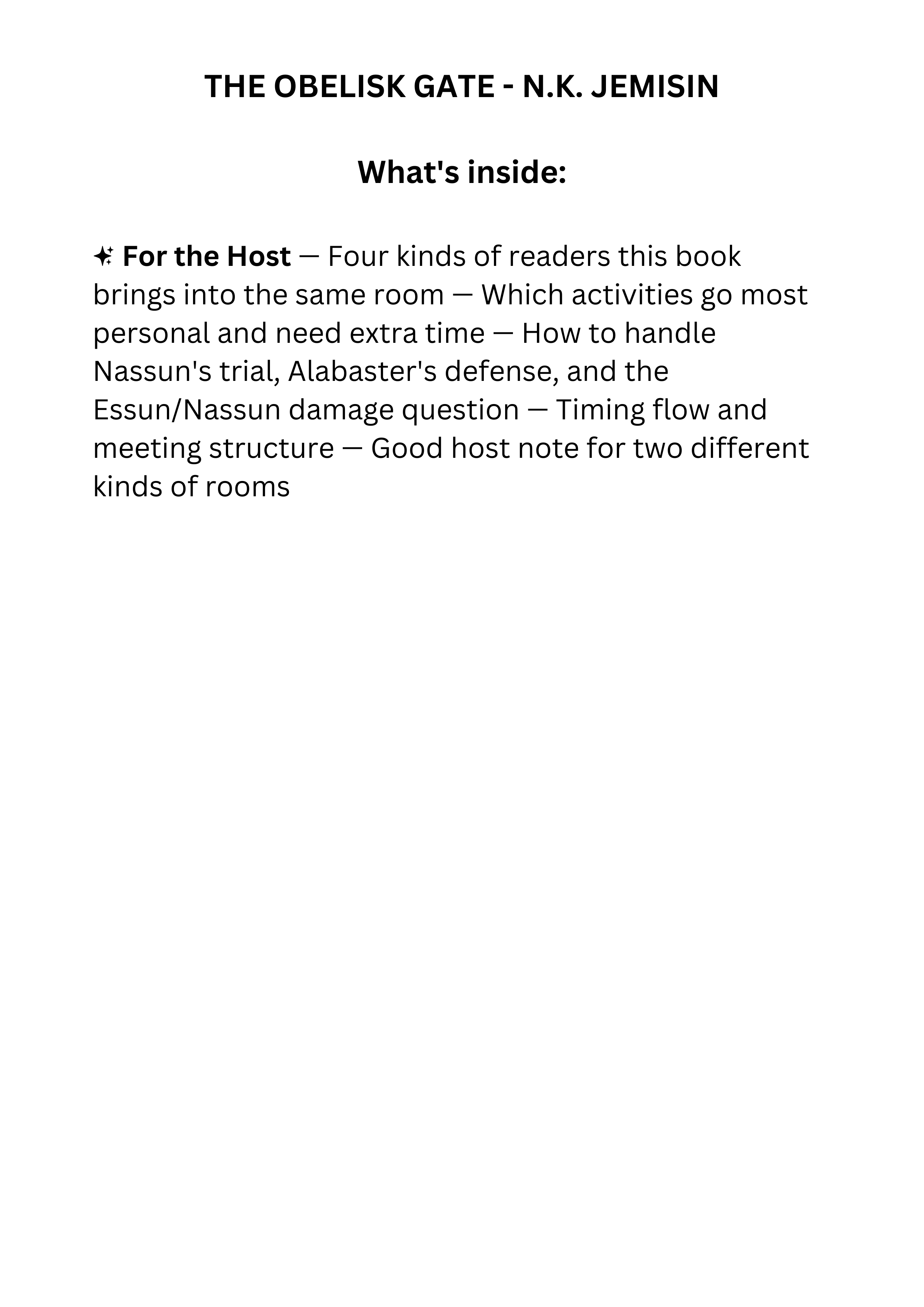
✦ For the Host — Four kinds of readers this book brings into the same room — How to handle Nassun's trial, Alabaster's defense, and the Essun/Nassun damage question — Timing flow and meeting structure — Good host note for two different kinds of rooms
Details — Instant download PDF — Book 2 of the Broken Earth trilogy — pairs with The Fifth Season discussion guide — Personal and single-group use. No redistribution or resale. — Fan-created guide. Not affiliated with or endorsed by N.K. Jemisin or any publisher.
Licensing for classrooms, libraries, and educational programs is available. If you plan to use this guide for a class, reading program, or institutional setting, please contact the shop owner to arrange an appropriate license.
A layered story of power, survival, and oppression in a world that keeps breaking.
The Fifth Season isn't going to ease you in. From the first page, it drops you into a world mid-apocalypse, written in second person, structured in fragments, and building toward a truth that arrives deliberately late and devastating. Most readers figure out what Jemisin is doing somewhere around the moment they can't put it down, despite being completely disoriented. The disorientation is the point.
This is a survival story set inside a fantasy world where oppression isn't background texture — it's infrastructure. A whole civilization built to contain certain people, extract what's useful from them, and punish them for existing at full capacity. The Fulcrum doesn't just control orogenes. It produces them, manages them, and disposes of them on a calculation that has been running for thousands of years. Jemisin doesn't let the reader look away from that calculation. She makes you inhabit it.
The second-person narration isn't a stylistic flex. It's an accusation. You did this. You lost this. You are here now. If your group reads this book and only talks about the plot they'll have missed half of what it's doing. This kit is designed to get the room to the other half.
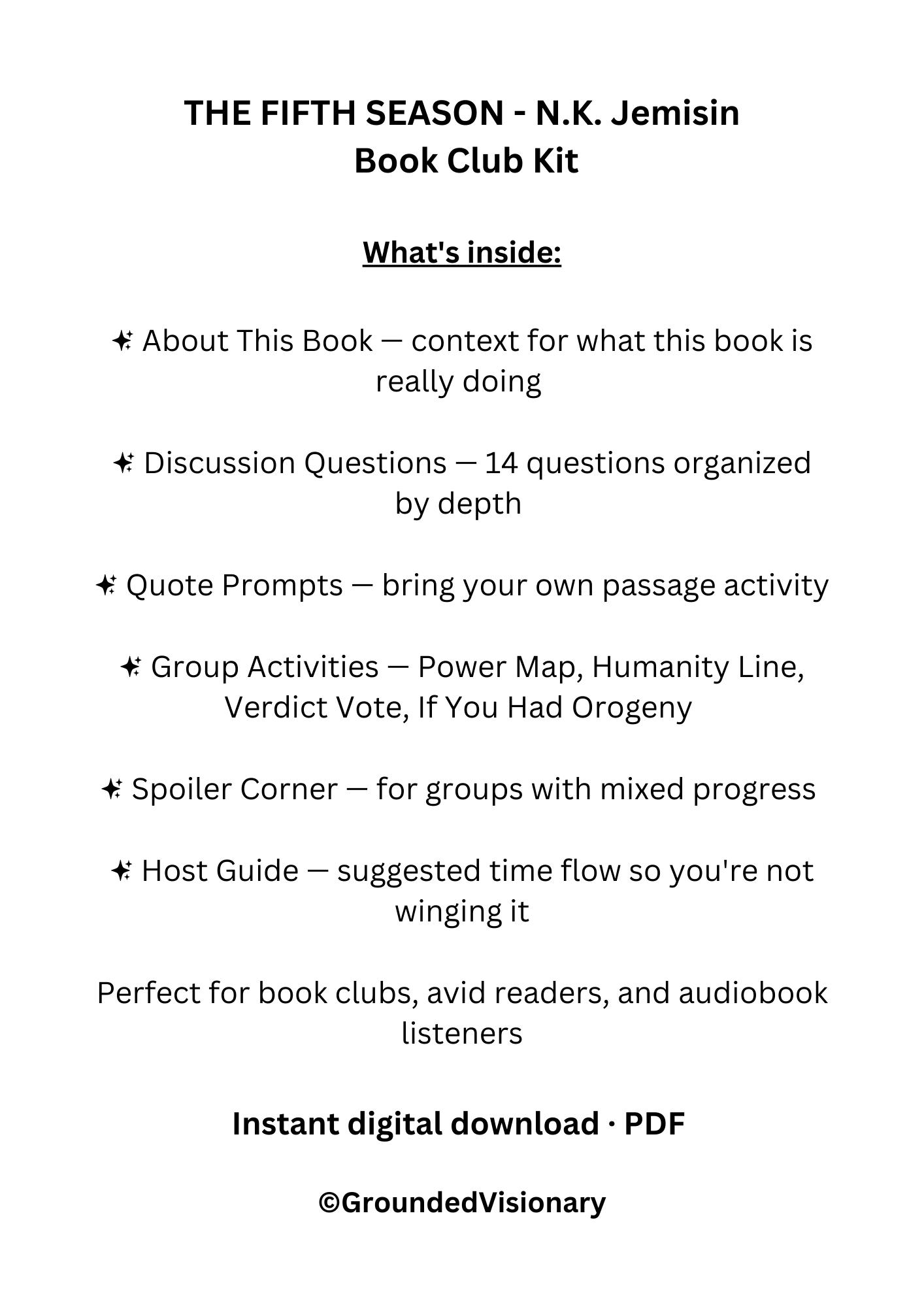
✦ What's Inside
✦ About This Book — A world built to contain certain people — Oppression as infrastructure not background — Why the form is doing as much work as the content
✦ What This Book Is Really About — Power, compliance, and survival — The second-person narration as accusation not stylistic choice — What the system is actually built to do and who pays for it
✦ Discussion Questions — Three Tiers — Tier 1: Warmup questions that get everyone talking — Tier 2: What resistance looks like when survival depends on compliance — Tier 3: Personal, uncomfortable, unresolvable — Closes with: What question did this book leave sitting in your chest?
✦ Where This Book Leaves You — The fractured timeline as argument about trauma — What it costs to dismantle something holding people down and holding the world together — Who has been telling this story and why
✦ Character on Trial — Essun, Alabaster, and Schaffa — Prosecution/defense structure — Hard position questions with mandatory reversal — No neutral positions allowed
✦ Activities — Power Map: physical, institutional, informational, social — The Humanity Line — Verdict Vote: In this world, morality is a luxury — If You Had Orogeny — Cost Ledger: what the system collected and who paid it
✦ Quote Prompts — Five prompts across different emotional entry points — The passage that built the world — The one that broke the reader — The one that arrived too late
✦ Spoiler Corner — Host only — three escalation questions assuming full knowledge of the ending
✦ For the Host — How this book divides the room and why that's useful — Which activities go most personal and need extra time — Timing flow and meeting structure
Details — Instant download PDF — Personal and single-group use. No redistribution or resale. — Fan-created guide. Not affiliated with or endorsed by N.K. Jemisin or any publisher.
Licensing for classrooms, libraries, and educational programs is available. If you plan to use this guide for a class, reading program, or institutional setting, please contact the shop owner to arrange an appropriate license.
The Broken Earth trilogy begins with a woman who has lost her son and ends with a daughter who saved a world she almost destroyed. In between N.K. Jemisin does something that takes three books to fully understand — she puts you inside a story in second person, tells you that you did this and you lost this and you are here now, and doesn't tell you who is speaking or why until the very end. By the time you know, you have already been inside Essun's life long enough that the revelation doesn't feel like a twist. It feels like something you should have known all along.
This kit is not a summary of three books. It is the conversation that only becomes possible after the last page of The Stone Sky — when you finally have all three books in the room at once and can ask what they mean together that none of them could mean alone.
The Broken Earth trilogy is one argument made in three movements. The Fifth Season asks what a broken system does to the people it decides are useful. The Obelisk Gate asks what those people do to each other when survival requires it. The Stone Sky asks whether any of it can be undone — and what it costs the people who try. This kit was built for the room that finished the trilogy and couldn't stop thinking about it. Not just about the ending — about Alabaster's plan and who paid for it, about what Hoa's narration was actually doing across three books, about whether the victory Jemisin delivers is an act of hope or the most honest thing she could have said about what breaking cycles of harm actually costs the people who break them.
This kit was built for the room that read all three books and is still sitting with the ending. It was built for the conversation that starts with whether Alabaster had the right to crack the world and ends somewhere none of you expected.
Please note: This is a standalone trilogy-level discussion kit built around the conversation all three books make together. It is not a bundle of the individual GroundedVisionary guides for The Fifth Season, The Obelisk Gate, and The Stone Sky. Those guides are available separately in the shop and go deep on each book individually. This kit goes wide — across all three books, across all three names, across the full arc of what Jemisin built.
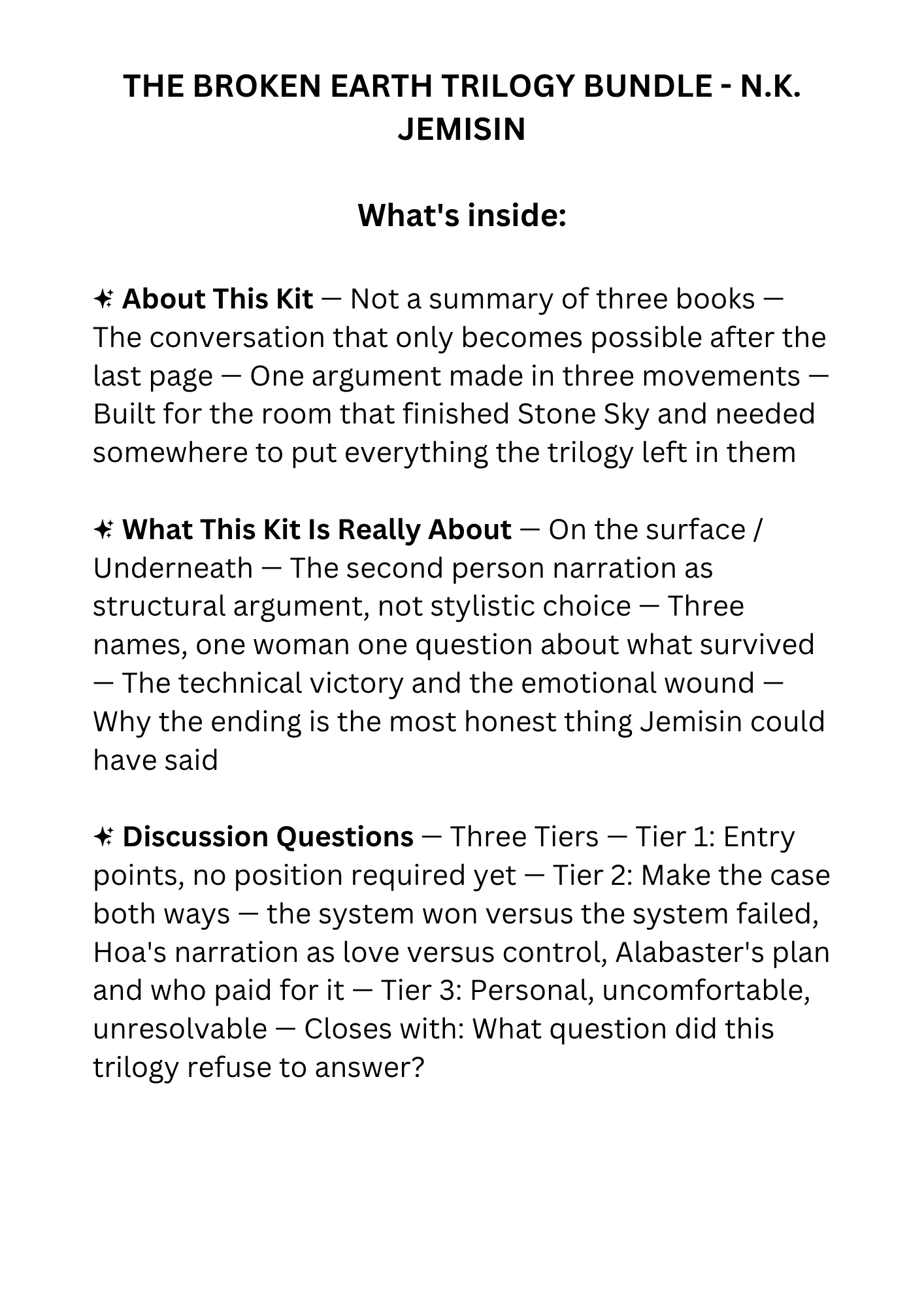
✦ What's Inside
✦ About This Kit — Not a summary of three books — The conversation that only becomes possible after the last page — One argument made in three movements — Built for the room that finished Stone Sky and needed somewhere to put everything the trilogy left in them
✦ What This Kit Is Really About — The second person narration as structural argument not stylistic choice — Three names, one woman, one question about what survived — The technical victory and the emotional wound — Why the ending is the most honest thing Jemisin could have said
✦ Discussion Questions — Three Tiers — Tier 1: Entry points, no position required yet — Tier 2: Make the case both ways — the system won versus the system failed, Hoa's narration as love versus control, Alabaster's plan and who paid for it — Tier 3: Personal, uncomfortable, unresolvable — Closes with: What question did this trilogy refuse to answer?
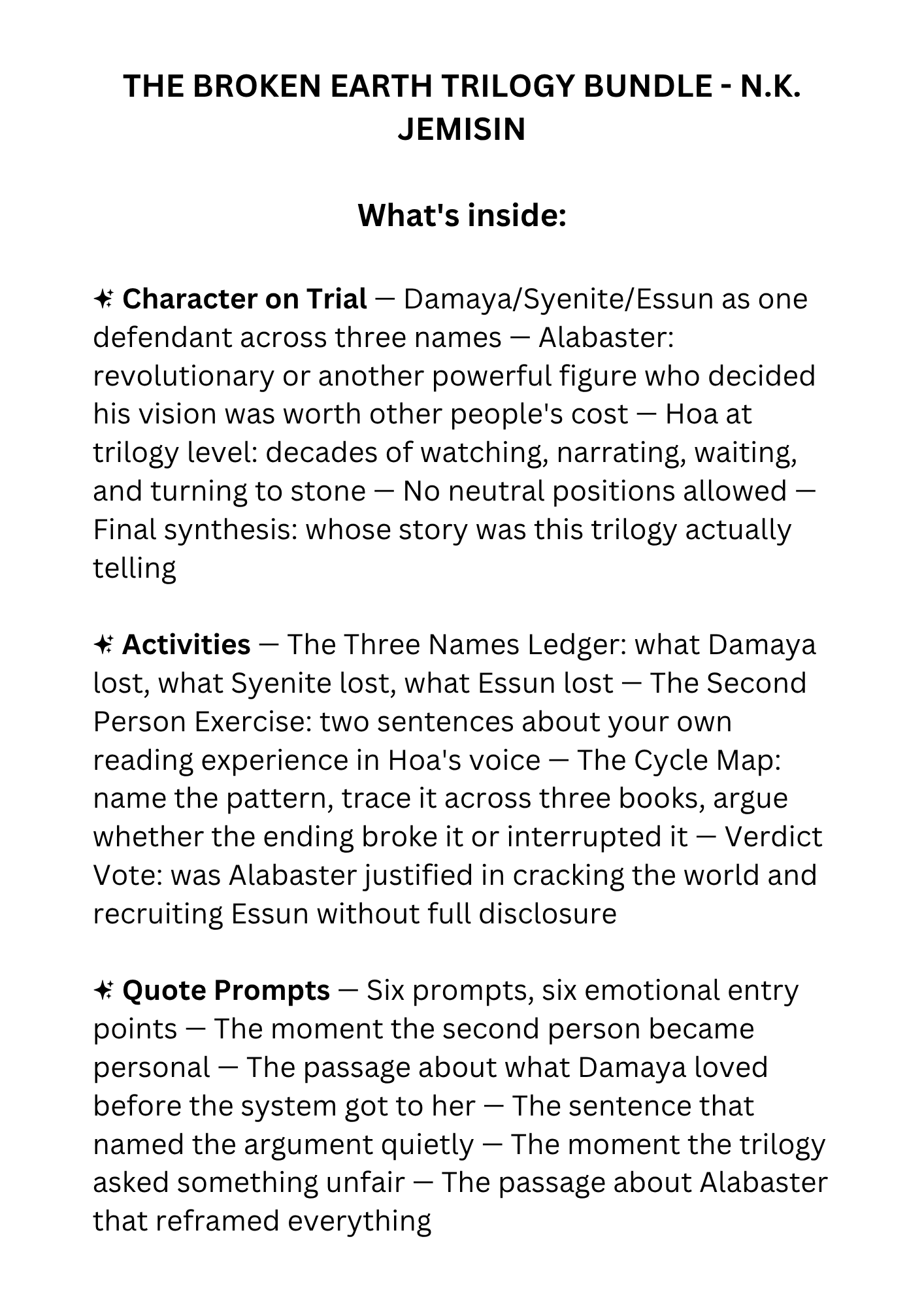
✦ Character on Trial — Damaya/Syenite/Essun as one defendant across three names — Alabaster: revolutionary or another powerful figure who decided his vision was worth other people's cost — Hoa at trilogy level: decades of watching, narrating, waiting, and turning to stone — No neutral positions allowed — Final synthesis: whose story was this trilogy actually telling
✦ Activities — The Three Names Ledger: what Damaya lost, what Syenite lost, what Essun lost — The Second Person Exercise: two sentences about your own reading experience in Hoa's voice — The Cycle Map: name the pattern, trace it across three books, argue whether the ending broke it or interrupted it — Verdict Vote: was Alabaster justified in cracking the world and recruiting Essun without full disclosure
✦ Quote Prompts — Six prompts, six emotional entry points — The moment the second person became personal — The passage about what Damaya loved before the system got to her — The passage about Alabaster that reframed everything
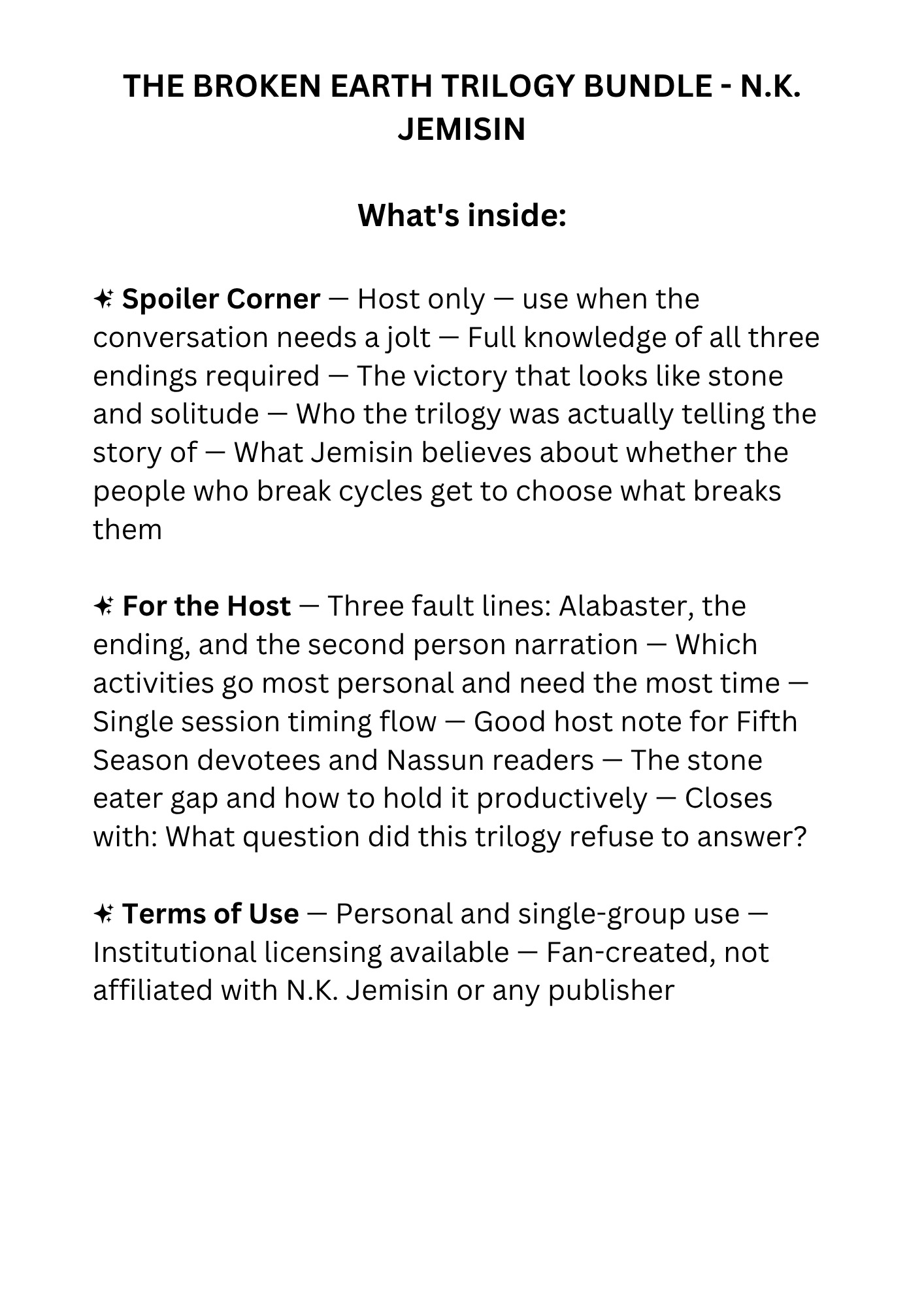
✦ Spoiler Corner — Host only — full knowledge of all three endings required — The victory that looks like stone and solitude — Who the trilogy was actually telling the story of — What Jemisin believes about whether the people who break cycles get to choose what breaks them
✦ For the Host — Three fault lines: Alabaster, the ending, and the second person narration — Timing flow for a single session — Good host note for Fifth Season devotees and Nassun readers — The stone eater gap and how to hold it productively
Details — Instant download PDF — 20+ pages, print-ready — Personal and single-group use. No redistribution or resale. — Fan-created guide. Not affiliated with or endorsed by N.K. Jemisin or any publisher.
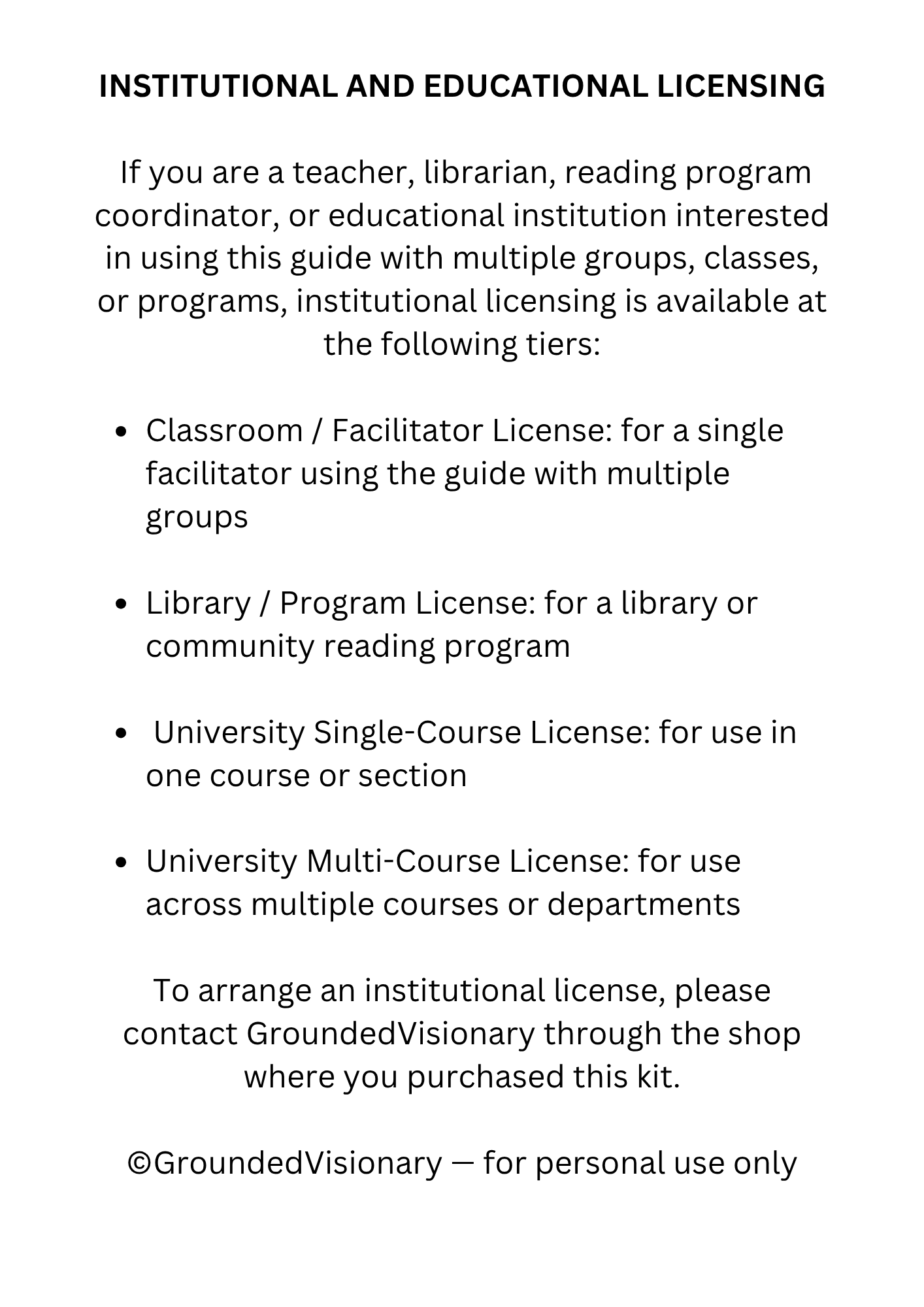
Licensing for classrooms, libraries, and educational programs is available. If you plan to use this guide for a class, reading program, or institutional setting, please contact the shop owner to arrange an appropriate license.
No results found
No results match your search. Try removing a few filters.