 Image 1 of 3
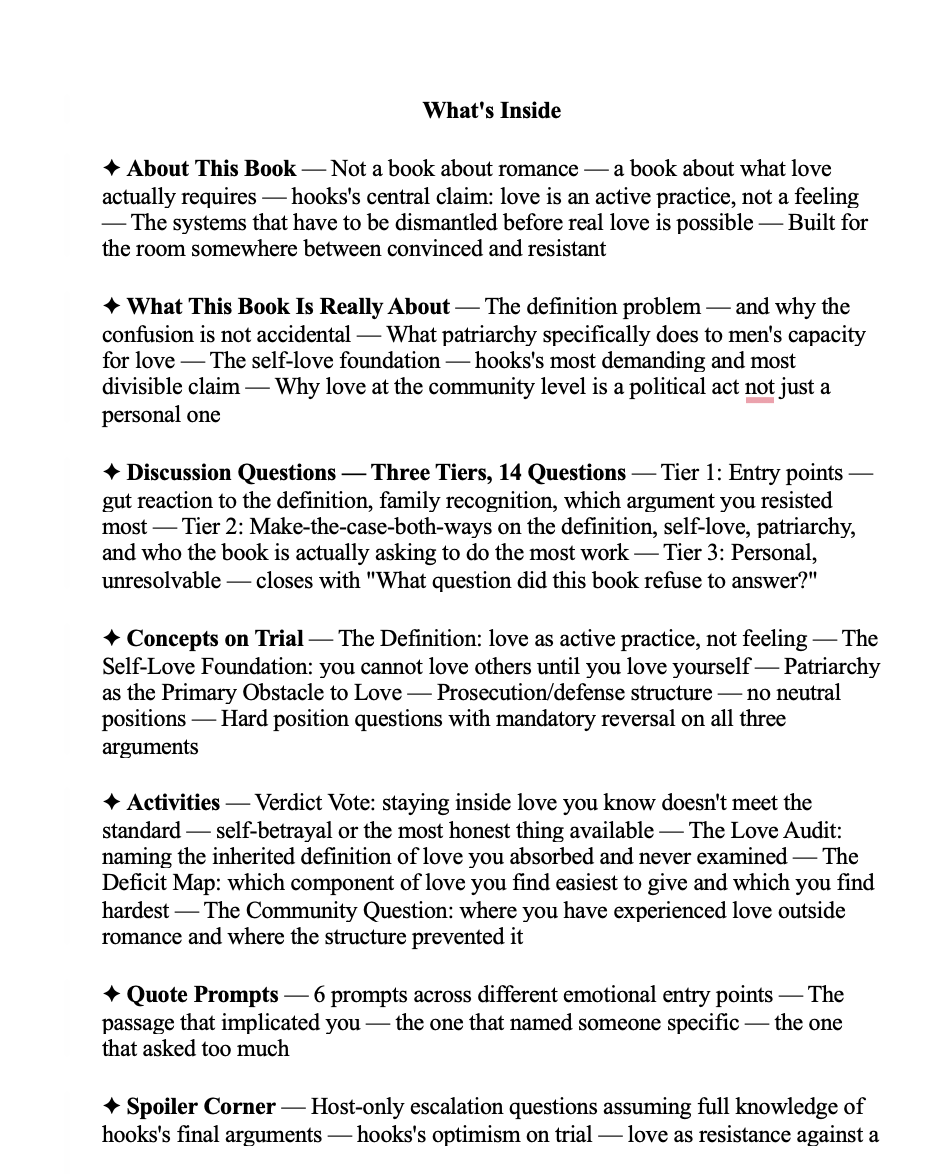 Image 2 of 3
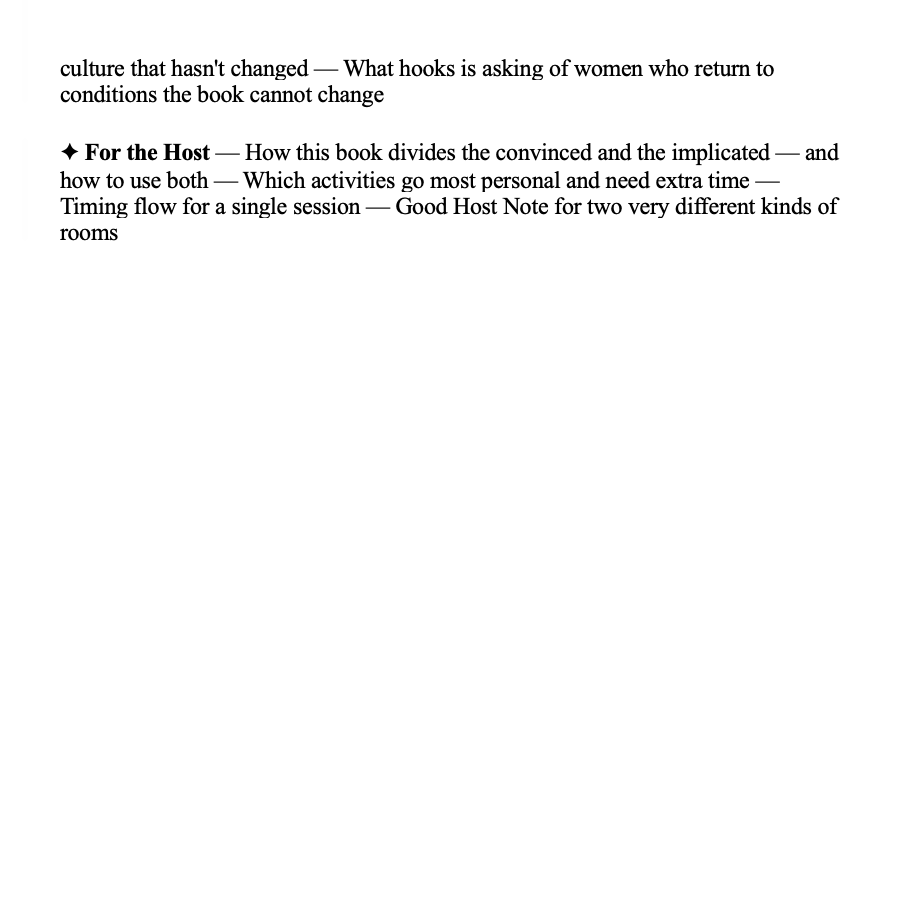 Image 3 of 3
All About Love — Bell Hooks | Book Club Discussion Guide
Most books about love begin with romance. This one begins with a definition — and the definition is the argument. bell hooks says love is not a feeling. It is a practice. It is the active choice to extend yourself toward another person's growth through care, respect, trust, honesty, and commitment. If those things are not present, what you have is not love. It may be an attachment. It may be need. It may be habit, fear, or something you were taught to call love because nobody around you had ever seen the real thing either. But it is not love.
That is a hard claim, and Hooks knows it. She is not writing for people who want to feel good about the love they already have. She is writing for people willing to sit with the possibility that much of what they have called love — in their families, their relationships, their friendships, their communities — was something else wearing love's name. What hooks this book, which almost no other writer on love manages, is refusing to let the personal stay personal. The reason so many people struggle to love and be loved is not individual failure. It is systemic. Patriarchy taught men to dominate rather than connect and taught women to accept domination as devotion. Greed built a culture that commodifies intimacy and calls the transaction romance. Self-betrayal gets handed down through generations as the definition of loyalty. Hooks is not interested in helping you navigate those systems more gracefully. She is asking you to dismantle them first.
This kit was built for the room that finished this book, somewhere between convinced and resistant, and knows that both positions are worth examining. Not the room that wants to be validated in what it already believes about love. The room is willing to ask whether what it has been calling love actually meets the standard hooks are setting, and what it would cost to close that gap. That room will be divided. The readers who finish this book feeling vindicated and the readers who finish it feeling implicated are both in there, and the most honest conversation happens when neither side gets to stay comfortable.
What's Inside
✦ About This Book — Not a book about romance — a book about what love actually requires — hooks's central claim: love is an active practice not a feeling — The systems that have to be dismantled before real love is possible — Built for the room somewhere between convinced and resistant
✦ What This Book Is Really About — The definition problem — and why the confusion is not accidental — What patriarchy specifically does to men's capacity for love — The self-love foundation — hooks's most demanding and most divisible claim — Why love at the community level is a political act, not just a personal one
✦ Discussion Questions — Three Tiers, 14 Questions — Tier 1: Entry points — gut reaction to the definition, family recognition, which argument you resisted most — Tier 2: Make-the-case-both-ways on the definition, self-love, patriarchy, and who the book is actually asking to do the most work — Tier 3: Personal, unresolvable — closes with "What question did this book refuse to answer?"
✦ Concepts on Trial — The Definition: love as active practice not feeling — The Self-Love Foundation: you cannot love others until you love yourself — Patriarchy as the Primary Obstacle to Love — Prosecution/defense structure — no neutral positions allowed — Hard position questions with mandatory reversal on all three arguments
✦ Activities — Verdict Vote: staying inside love you know doesn't meet the standard — self-betrayal or the most honest thing available — The Love Audit: naming the inherited definition of love you absorbed and never examined — The Deficit Map: which component of love you find easiest to give and which you find hardest — The Community Question: where you have experienced love outside romance and where the structure prevented it
✦ Quote Prompts — 6 prompts across different emotional entry points — The passage that implicated you — the one that named someone specific — the one that asked too much
✦ Spoiler Corner — Host-only escalation questions assuming full knowledge of hooks's final arguments — hooks's optimism on trial — love as resistance against a culture that hasn't changed — What hooks is asking of women who return to conditions the book cannot change
✦ For the Host — How this book divides the convinced and the implicated — and how to use both — Which activities go most personal and need extra time — Timing flow for a single session — Good Host Note for two very different kinds of rooms
Details — Instant download PDF — 20+ pages, print-ready — Personal and single-group use — Fan-created discussion guide — Not affiliated with or endorsed by the estate of bell hooks or any publisher
Licensing for classrooms, libraries, and educational programs is available. If you plan to use this guide for a class, reading program, or institutional setting, please contact the shop owner to arrange an appropriate license.
This kit was built for the room that finished All About Love and needed somewhere to put everything it stirred.
Most books about love begin with romance. This one begins with a definition — and the definition is the argument. bell hooks says love is not a feeling. It is a practice. It is the active choice to extend yourself toward another person's growth through care, respect, trust, honesty, and commitment. If those things are not present, what you have is not love. It may be an attachment. It may be need. It may be habit, fear, or something you were taught to call love because nobody around you had ever seen the real thing either. But it is not love.
That is a hard claim, and Hooks knows it. She is not writing for people who want to feel good about the love they already have. She is writing for people willing to sit with the possibility that much of what they have called love — in their families, their relationships, their friendships, their communities — was something else wearing love's name. What hooks this book, which almost no other writer on love manages, is refusing to let the personal stay personal. The reason so many people struggle to love and be loved is not individual failure. It is systemic. Patriarchy taught men to dominate rather than connect and taught women to accept domination as devotion. Greed built a culture that commodifies intimacy and calls the transaction romance. Self-betrayal gets handed down through generations as the definition of loyalty. Hooks is not interested in helping you navigate those systems more gracefully. She is asking you to dismantle them first.
This kit was built for the room that finished this book, somewhere between convinced and resistant, and knows that both positions are worth examining. Not the room that wants to be validated in what it already believes about love. The room is willing to ask whether what it has been calling love actually meets the standard hooks are setting, and what it would cost to close that gap. That room will be divided. The readers who finish this book feeling vindicated and the readers who finish it feeling implicated are both in there, and the most honest conversation happens when neither side gets to stay comfortable.
What's Inside
✦ About This Book — Not a book about romance — a book about what love actually requires — hooks's central claim: love is an active practice not a feeling — The systems that have to be dismantled before real love is possible — Built for the room somewhere between convinced and resistant
✦ What This Book Is Really About — The definition problem — and why the confusion is not accidental — What patriarchy specifically does to men's capacity for love — The self-love foundation — hooks's most demanding and most divisible claim — Why love at the community level is a political act, not just a personal one
✦ Discussion Questions — Three Tiers, 14 Questions — Tier 1: Entry points — gut reaction to the definition, family recognition, which argument you resisted most — Tier 2: Make-the-case-both-ways on the definition, self-love, patriarchy, and who the book is actually asking to do the most work — Tier 3: Personal, unresolvable — closes with "What question did this book refuse to answer?"
✦ Concepts on Trial — The Definition: love as active practice not feeling — The Self-Love Foundation: you cannot love others until you love yourself — Patriarchy as the Primary Obstacle to Love — Prosecution/defense structure — no neutral positions allowed — Hard position questions with mandatory reversal on all three arguments
✦ Activities — Verdict Vote: staying inside love you know doesn't meet the standard — self-betrayal or the most honest thing available — The Love Audit: naming the inherited definition of love you absorbed and never examined — The Deficit Map: which component of love you find easiest to give and which you find hardest — The Community Question: where you have experienced love outside romance and where the structure prevented it
✦ Quote Prompts — 6 prompts across different emotional entry points — The passage that implicated you — the one that named someone specific — the one that asked too much
✦ Spoiler Corner — Host-only escalation questions assuming full knowledge of hooks's final arguments — hooks's optimism on trial — love as resistance against a culture that hasn't changed — What hooks is asking of women who return to conditions the book cannot change
✦ For the Host — How this book divides the convinced and the implicated — and how to use both — Which activities go most personal and need extra time — Timing flow for a single session — Good Host Note for two very different kinds of rooms
Details — Instant download PDF — 20+ pages, print-ready — Personal and single-group use — Fan-created discussion guide — Not affiliated with or endorsed by the estate of bell hooks or any publisher
Licensing for classrooms, libraries, and educational programs is available. If you plan to use this guide for a class, reading program, or institutional setting, please contact the shop owner to arrange an appropriate license.
This kit was built for the room that finished All About Love and needed somewhere to put everything it stirred.