No Heroes. No Villains. Just Choices.
No Heroes. No Villains. Just Choices.
Filters
Terry McMillan didn't write a book about four women looking for love. She wrote a book about what women are taught to sacrifice in exchange for partnership — and what happens when the exchange rate turns out to be a lie. Waiting to Exhale gets filed under girlfriend fiction and left there. This guide was built for the room that knows better.
The four women at the center of this novel — Savannah, Bernadine, Robin, and Gloria — are not four versions of the same character. There are four completely different philosophies about how to survive want. Savannah manages vulnerability with composure that serves more as armor than as a standard. Bernadine built an entire life around a man and a marriage and discovered too late that she had disappeared inside it. Robin is self-aware enough to diagnose every relationship she enters while she is still in it — and enters them anyway, because loneliness has its own logic. Gloria is the anchor, the least performative of the four, the woman who has made peace with the others who are still fighting toward. Together they form a portrait of what it looks like when women are told that waiting — patiently, correctly, quietly — is the path to being chosen.
This kit doesn't start with the fire. It starts with the belief system that made the fire inevitable — and it doesn't let anyone in the room off the hook, including the reader who watched the movie and thought she knew the story. The guide is built for both: the women who read this book in 1992 and carried it for thirty years, and the younger reader who comes in ready to judge these women's choices through a contemporary lens. The best conversation happens when both groups are in the same room, comparing what they received.
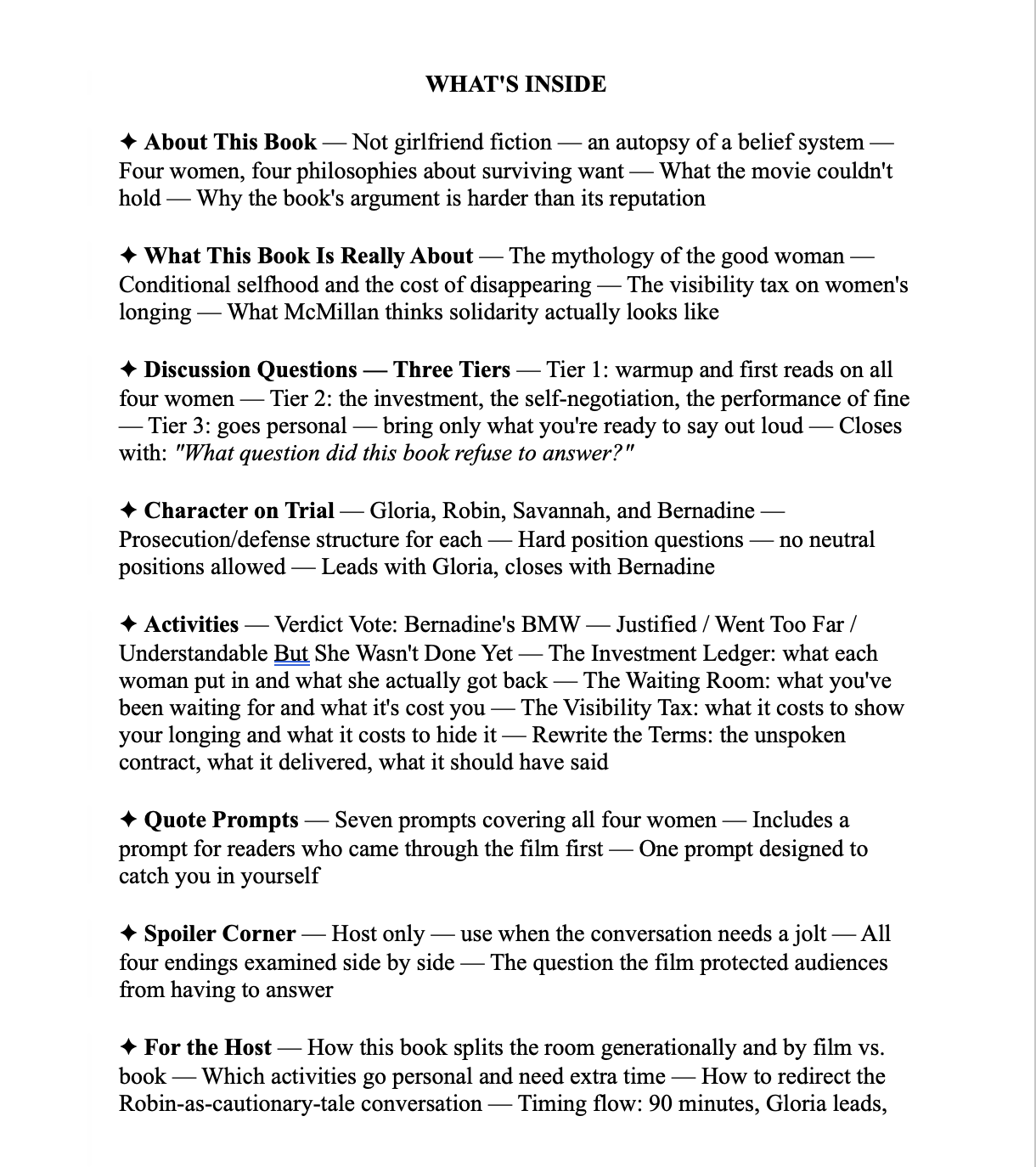
✦ About This Book — Not girlfriend fiction — an autopsy of a belief system — Four women, four philosophies about surviving want — What the movie couldn't hold — Why the book's argument is harder than its reputation
✦ What This Book Is Really About — The mythology of the good woman — Conditional selfhood and the cost of disappearing — The visibility tax on women's longing — What McMillan thinks solidarity actually looks like
✦ Discussion Questions — Three Tiers — Tier 1: warmup and first reads on all four women — Tier 2: the investment, the self-negotiation, the performance of fine — Tier 3: goes personal — bring only what you're ready to say out loud — Closes with: "What question did this book refuse to answer?"
✦ Character on Trial — Gloria, Robin, Savannah, and Bernadine — Prosecution/defense structure for each — Hard position questions — no neutral positions allowed — Leads with Gloria, closes with Bernadine
✦ Activities — Verdict Vote: Bernadine's BMW — Justified / Went Too Far / Understandable But She Wasn't Done Yet — The Investment Ledger: what each woman put in and what she actually got back — The Waiting Room: what you've been waiting for and what it's cost you — The Visibility Tax: what it costs to show your longing and what it costs to hide it — Rewrite the Terms: the unspoken contract, what it delivered, what it should have said
✦ Quote Prompts — Seven prompts covering all four women — Includes a prompt for readers who came through the film first — One prompt designed to catch you in yourself
✦ Spoiler Corner — Host only — use when the conversation needs a jolt — All four endings examined side by side — The question the film protected audiences from having to answer
✦ For the Host — How this book splits the room generationally and by film vs. book — Which activities go personal and need extra time — How to redirect the Robin-as-cautionary-tale conversation — Timing flow: 90 minutes, Gloria leads, Bernadine closes — Two room types: women who read it in 1992 vs. first-time readers
Details: Instant download — PDF delivered immediately at purchase. 20+ pages, print-ready. Licensed for personal and single-group use. Fan-created discussion guide — not affiliated with or endorsed by Terry McMillan or her publisher.
Licensing for classrooms, libraries, and reading programs is available. If you plan to use this guide in an institutional or educational setting, please contact the shop to arrange an appropriate license.
Beloved is not a ghost story. It is an argument that slavery's deepest violence was not physical but psychological, a total war on the right to know yourself, to remember, to love, to want. The ghost that shows up at Sethe's door is not a haunting. It is what happens when trauma this complete refuses to stay in the past.
This is one of the most important novels in the American literary canon, and it is also one of the hardest to discuss without either flattening it into a debate about Sethe's choice or retreating into reverence. Morrison is not asking you to judge Sethe. She is asking you to understand the system that made her decision feel like the only available act of protection. That is a much harder question, and it is the one this book refuses to let you leave behind.
The room this kit was built for is willing to sit with what the novel is actually asking — not to reach a verdict, but to understand what made one necessary. It is the room that can hold Sethe's killing, Baby Suggs's collapsed theology, Paul D's tobacco tin, Denver's slow walk off the porch, and ask what Morrison is saying about survival, memory, love, and what we owe each other when the thing that happened cannot be undone.
The discussion will be divided. Every room that reads this novel eventually has to decide what to do with Sethe, and the readers who arrive wanting to debate her choice and the readers who arrive already devastated by it are both right, and both need somewhere to go. Both positions are in this kit. Neither is dismissed. The goal is not a verdict on Sethe. The goal is to ask what the novel is actually saying.
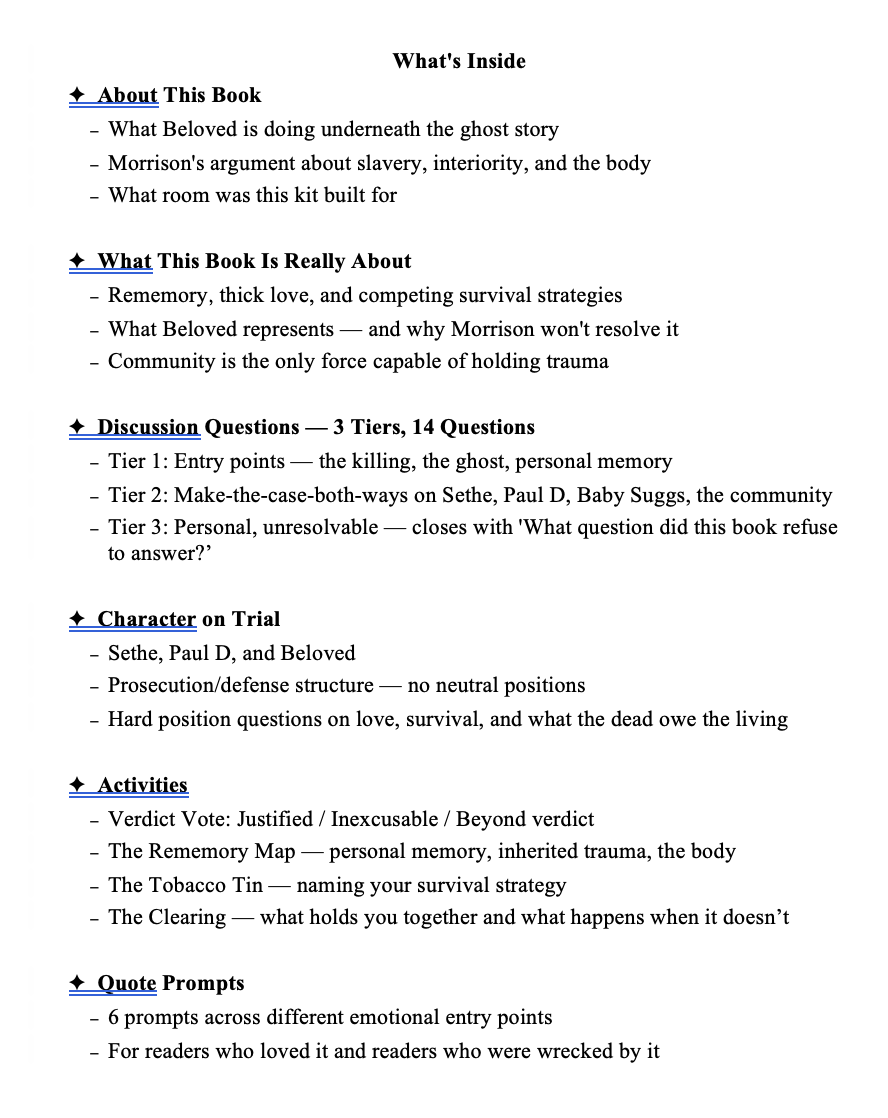
What's Inside
✦ About This Book — What Beloved is doing underneath the ghost story — Morrison's argument about slavery, interiority, and the body — What room this kit was built for
✦ What This Book Is Really About — Rememory, thick love, and competing survival strategies — What Beloved represents — and why Morrison won't resolve it — Community as the only force capable of holding trauma
✦ Discussion Questions — Three Tiers, 14 Questions — Tier 1: Entry points — the killing, the ghost, the slow reveal — Tier 2: Make-the-case-both-ways on Sethe, Paul D, Baby Suggs, and the community — Tier 3: Personal, unresolvable — closes with "What question did this book refuse to answer?"
✦ Character on Trial — Sethe, Paul D, and Beloved — Prosecution/defense structure — no neutral positions — Hard position questions on love, survival, and what the dead owe the living
✦ Activities — Verdict Vote: Justified / Inexcusable / Beyond Verdict — The Rememory Map — personal memory, inherited trauma, the body — The Tobacco Tin — naming your survival strategy — The Clearing — what holds you together and what happens when it doesn't
✦ Quote Prompts — 6 prompts across different emotional entry points — For readers who loved it and readers who were wrecked by it
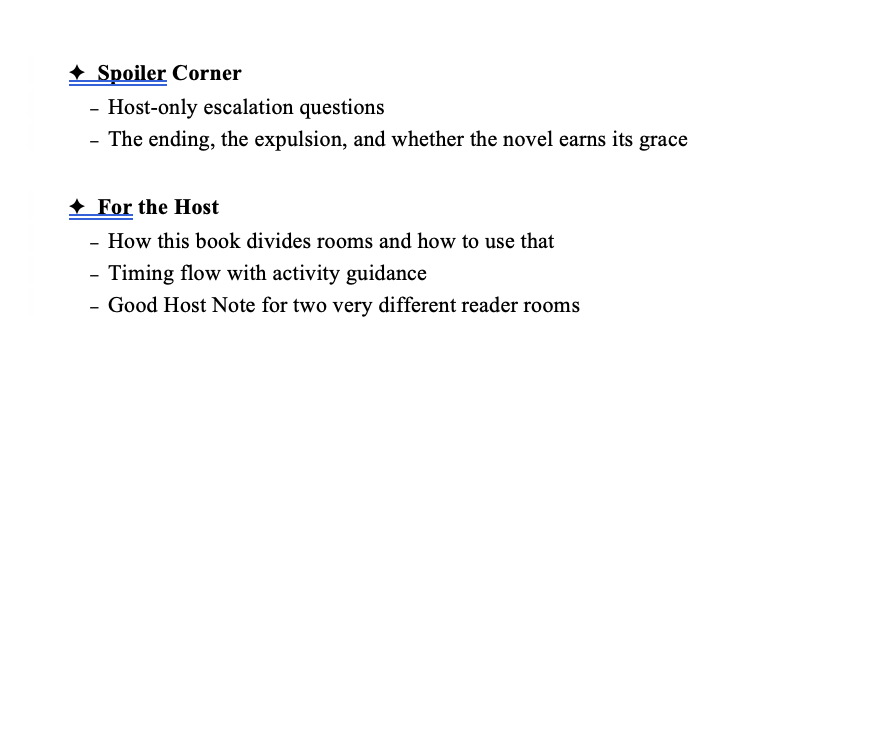
✦ Spoiler Corner — Host-only escalation questions — The ending, the expulsion, and whether the novel earns its grace
✦ For the Host — How this book divides rooms and how to use that — Timing flow with activity guidance — Good Host Note for two very different reader rooms
Details — Instant download PDF — Personal and single-group use — Fan-created discussion guide — Not affiliated with or endorsed by Toni Morrison, her estate, or her publisher
Licensing for classrooms, libraries, and educational programs is available. If you plan to use this guide for a class, reading program, or institutional setting, please contact the shop owner to arrange an appropriate license.
This kit was built for the room that finished Beloved and needed somewhere to put everything the book left in them.
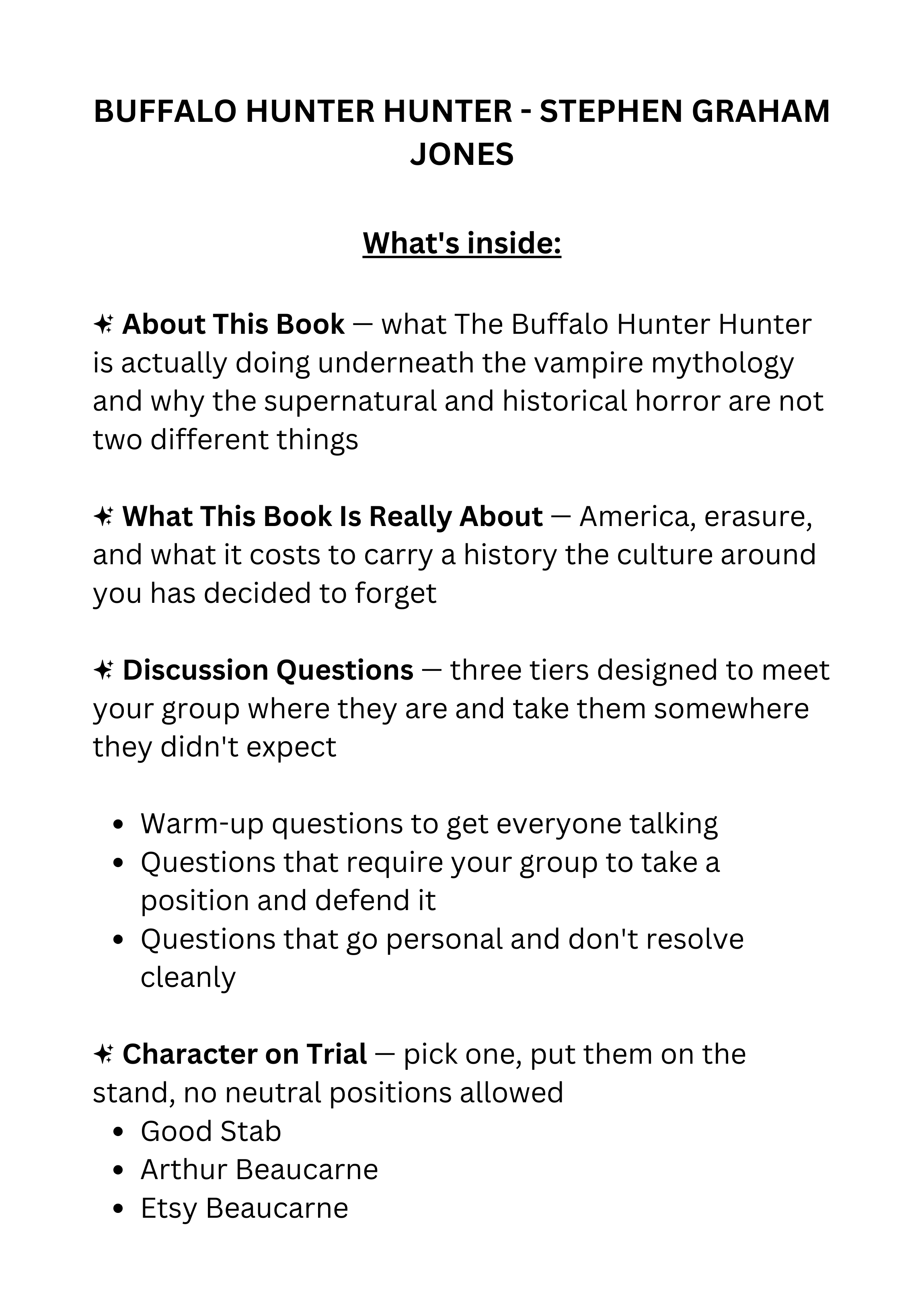
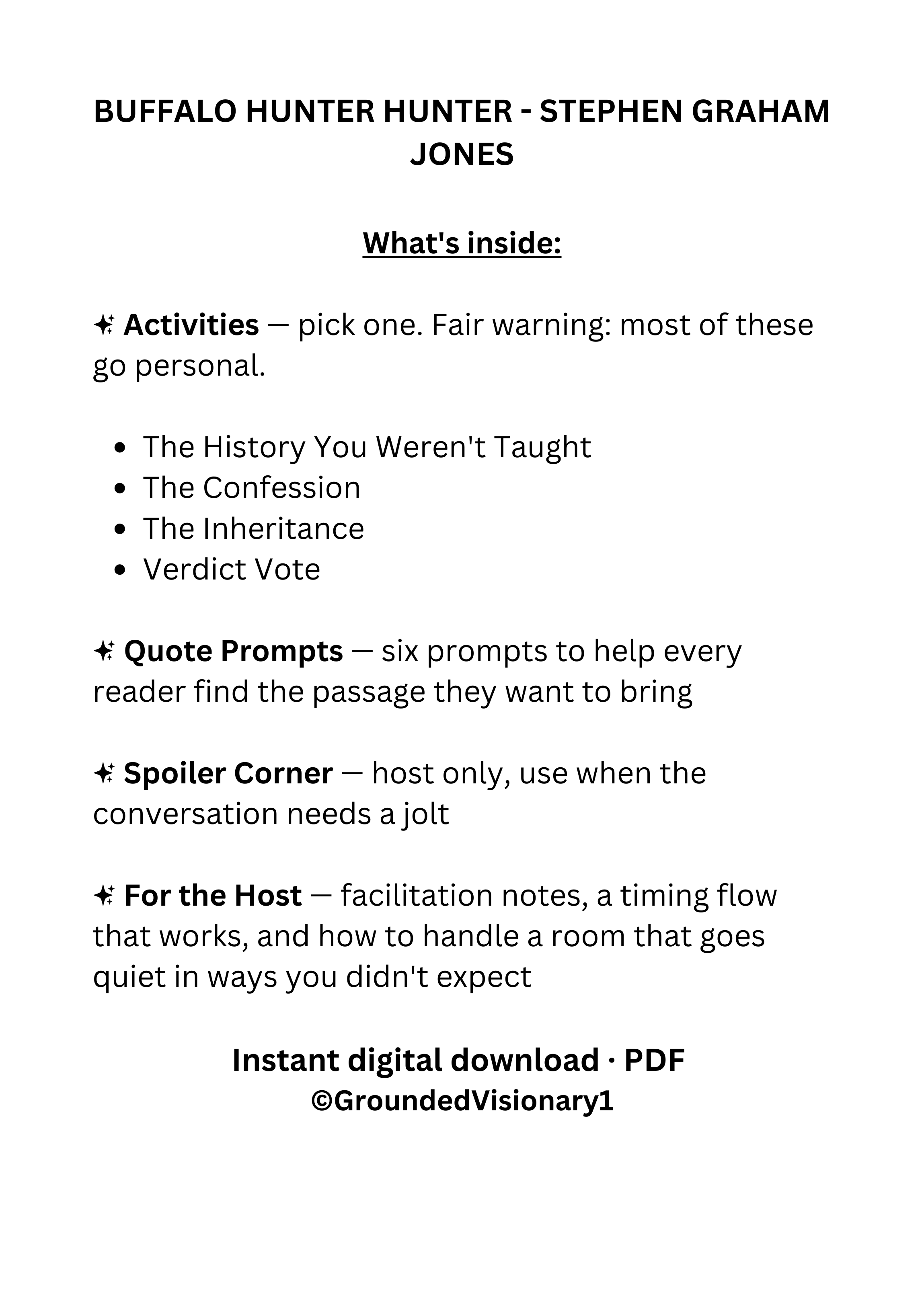
The Buffalo Hunter Hunter opens with a diary found inside a wall. Written in 1912 by a Lutheran pastor named Arthur Beaucarne, it contains the confession of a Blackfeet man named Good Stab. What Good Stab has to confess is not what you expect. And what he became — something unkillable, something that hunts the men destroying his world — is not a departure from history. It's a consequence of it.
This is not a vampire story. Or rather — it is, but that's not what it's doing.
The Marias Massacre was real. The near-extinction of the buffalo was real. The erasure of Blackfeet history was real. Stephen Graham Jones, an enrolled member of the Blackfeet Nation, takes that history and builds something on top of it that the horror genre rarely attempts: a story where the monster makes complete sense, where the world that created him is the thing that should frighten you most, and where justice is not a resolution but a question the book keeps asking until the last page.
This kit was written for the book club that wants to talk about all of it. The creature horror and the historical horror. The confession that spans a century. What gets passed down through bloodlines nobody asked to inherit. And what it means to sit with a history that was deliberately buried and is now in your hands.
✦ What's Inside
✦ About This Book — What The Buffalo Hunter Hunter is actually doing underneath the vampire mythology — Why the supernatural and historical horror are not two different things — Built for the room that wants to sit with history that was deliberately buried
✦ What This Book Is Really About — America, erasure, and what it costs to carry a history the culture around you has decided to forget — Why the monster makes complete sense — The world that created him as the thing that should frighten you most
✦ Discussion Questions — Three Tiers — Tier 1: Warmup questions to get everyone talking — Tier 2: Questions that require taking a position and defending it — Tier 3: Questions that go personal and don't resolve cleanly — Closes with: What question did this book refuse to answer?
✦ Character on Trial — Good Stab, Arthur Beaucarne, Etsy Beaucarne — No neutral positions allowed — Prosecution/defense structure
✦ Activities — The History You Weren't Taught — The Confession — The Inheritance — Verdict Vote — Fair warning: most of these get personal
✦ Quote Prompts — Six prompts to help every reader find the passage they want to bring — The moment the horror stopped being supernatural — The passage where the history became undeniable
✦ Spoiler Corner — Host only — use when the conversation needs a jolt
✦ For the Host — Facilitation notes and timing flow — How to handle a room that goes quiet in ways you didn't expect
Details — Instant download PDF — 27 pages, print-ready — Personal and single-group use. No redistribution or resale. — Fan-created guide. Not affiliated with or endorsed by Stephen Graham Jones or any publisher.
Licensing for classrooms, libraries, and educational programs is available. If you plan to use this guide for a class, reading program, or institutional setting, please contact the shop owner to arrange an appropriate license.
Same situation as The Substitution Order and World War Z — early format. But this kit is actually stronger than those two. The About This Book and What This Book Is Really About pages are solid, the discussion questions are genuinely good, the activities are specific and well designed, and the Spoiler Corner has three real escalation questions. It's not at current template standard but it's closer than the others.
Option A still applies — write the listing honestly for what's there, flag for rebuild later.
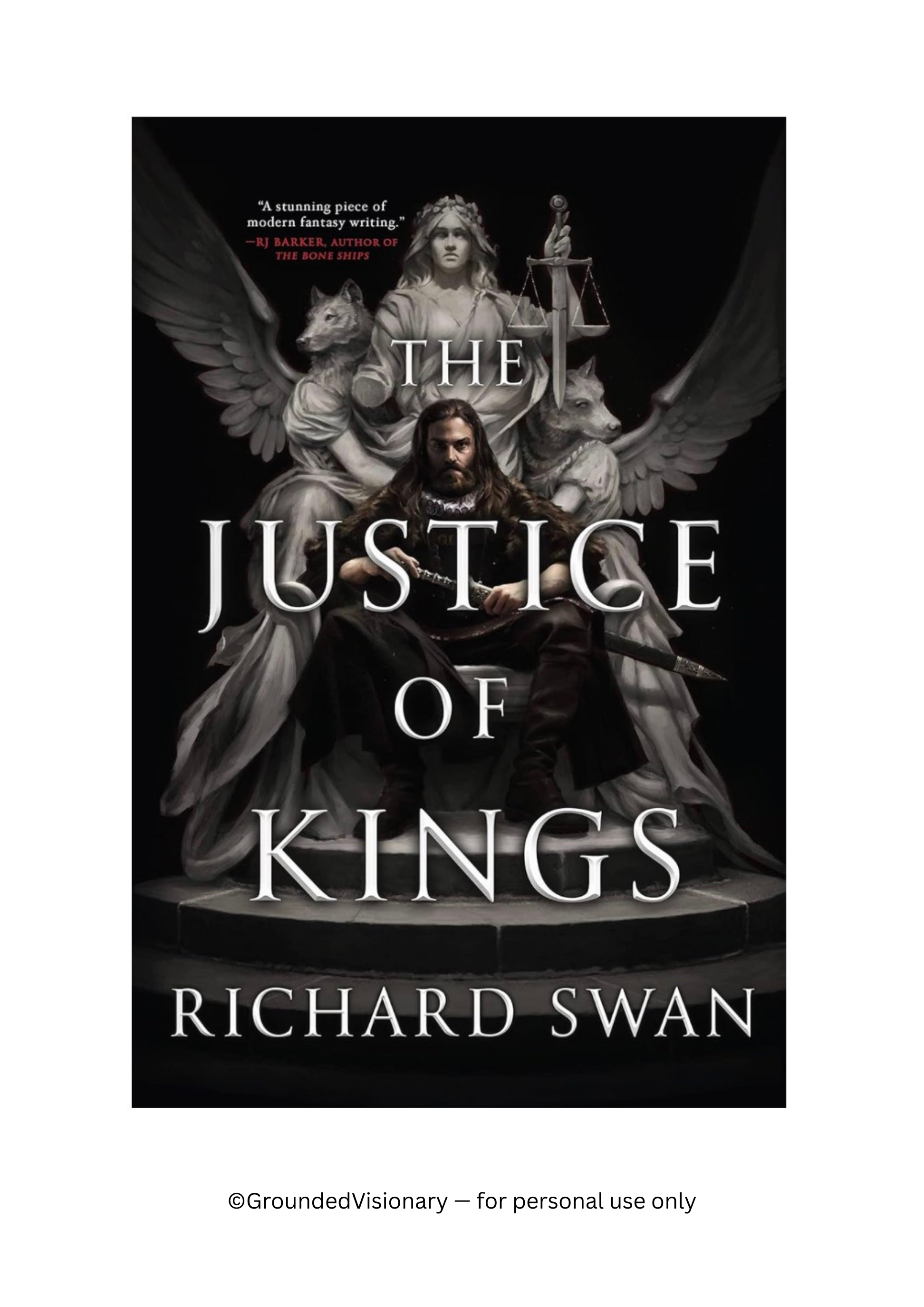
REWORKED LISTING — THE JUSTICE OF KINGS
The Justice of Kings starts with a premise that sounds almost procedural: a magistrate travels the countryside administering justice, moving from case to case, making sure the law is applied fairly and without favor. And then you realize that in a world where power is always looking for ways to bend the rules, a man who genuinely won't bend is the most dangerous person in any room he enters.
Sir Konrad Vonvalt is that man. He has legal authority, some unsettling magical abilities, and an absolute commitment to the law that reads less like virtue and more like a force of nature. He doesn't love people. He loves justice. And the book is quietly, carefully asking whether that's enough — or whether it's its own kind of blindness.
The story is told through Helena Sedanka, Vonvalt's clerk, looking back on events she lived through as a young woman. That framing matters. She's not just a narrator — she's a person who loved someone, outgrew them, and is still working out what she thinks about both. This is a fantasy novel about the law, but what it's really about is what happens when the institutions we trust to protect us start being used as weapons instead — and whether a man whose entire identity is built around the law can see that happening until it's too late.
This kit was built for the room that finished this book and wants to argue about Vonvalt — whether he's a hero, a liability, or something the book refuses to resolve cleanly.
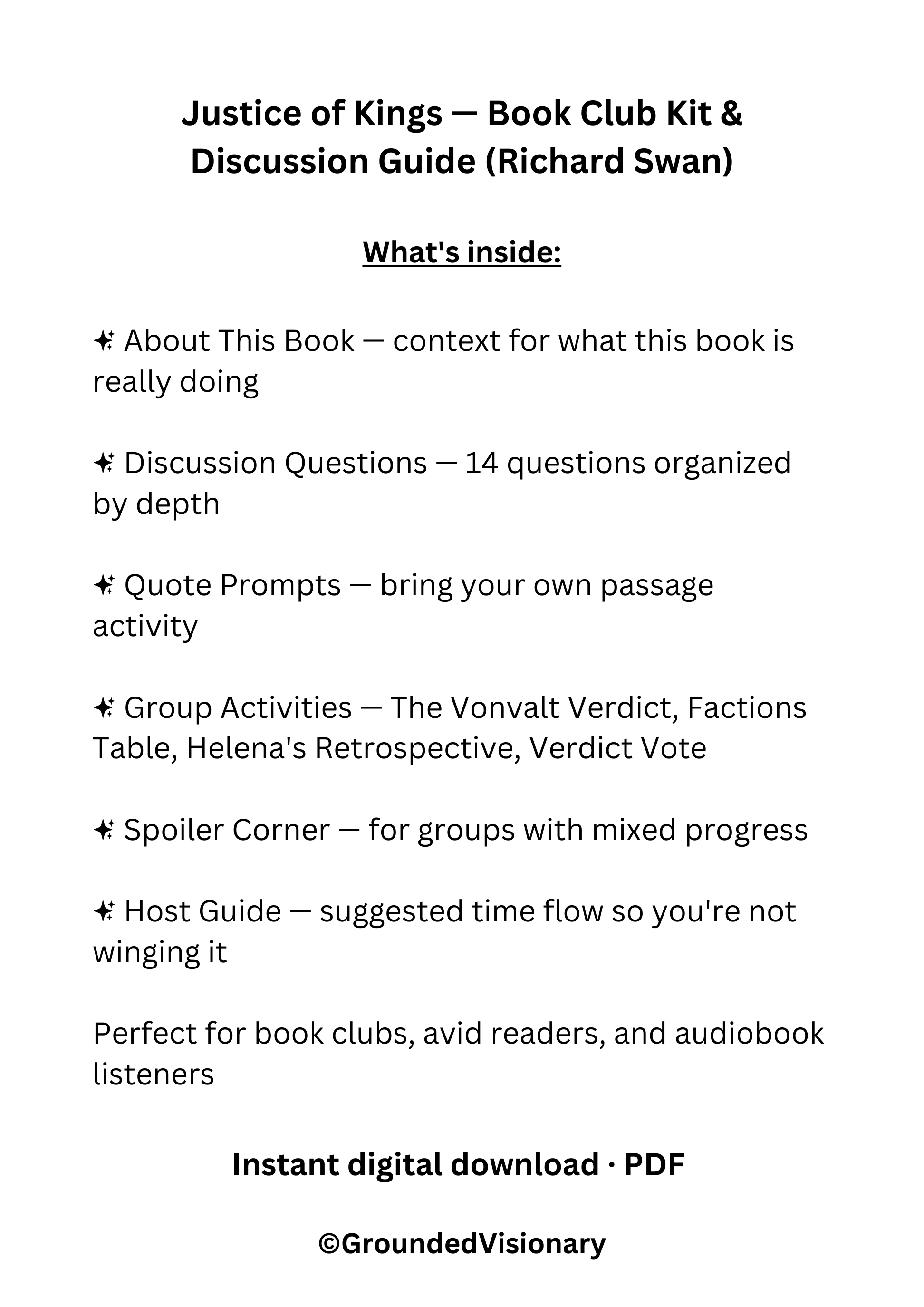
✦ What's Inside
✦ About This Book — A magistrate who won't bend in a world built on bending — Why a man who loves justice more than people is the most dangerous kind — Helena's narration and why the framing changes everything
✦ What This Book Is Really About — What Vonvalt's rigidity costs him and the people around him — How Helena's narration changes what we think we're seeing in real time — The Eddard Stark problem: a man of absolute principle in a world of flexible morality — What the factions are actually fighting over — not power, but the definition of what law is for
✦ Discussion Questions — Three Tiers — Tier 1: Warmup questions including what drew you in and whether you trusted Helena — Tier 2: Vonvalt's commitment to law vs. people, Helena's shifting feelings, Bressinger's loyalty, what the supernatural elements say about power outside the law — Tier 3: The Eddard Stark problem, Helena narrating in retrospect, where the gap between what institutions are supposed to do and what they actually do is widest — Closes with: What question did this book refuse to answer?
✦ Activities — The Vonvalt Verdict: one of Vonvalt's decisions — Just / Unjust / Technically correct but wrong — The Factions Table: map what each faction believes the law is for, place each character under their faction, ask who is most honest about what they actually believe — Helena's Retrospective: what does she regret, what is she grateful for, what hasn't she resolved — and does she tell this story fairly? — Verdict Vote: one moment where the law produced an outcome — Ethical / Unethical / Understandable but wrong
✦ Quote Prompts — Five prompts across different emotional entry points — The moment Vonvalt's commitment felt like strength — The moment that same commitment felt like a blindspot — The scene where Helena sees something Vonvalt can't — or won't
✦ Spoiler Corner — Host option — three questions for groups who finished — Whether the ending changed how you read Vonvalt's certainty throughout — Who Helena becomes after this — and whether she's who Vonvalt thought she could be — What the final pages changed about the factions and what they were actually fighting over
✦ For the Host — The cases are not the point — anchor discussion in character and institution — Name Helena's retrospective framing upfront so the group pays attention to how she tells the story — Timing flow for a single session
Details — Instant download PDF — Personal and single-group use. No redistribution or resale. — Fan-created guide. Not affiliated with or endorsed by Richard Swan or any publisher.
Licensing for classrooms, libraries, and educational programs is available. If you plan to use this guide for a class, reading program, or institutional setting, please contact the shop owner to arrange an appropriate license.
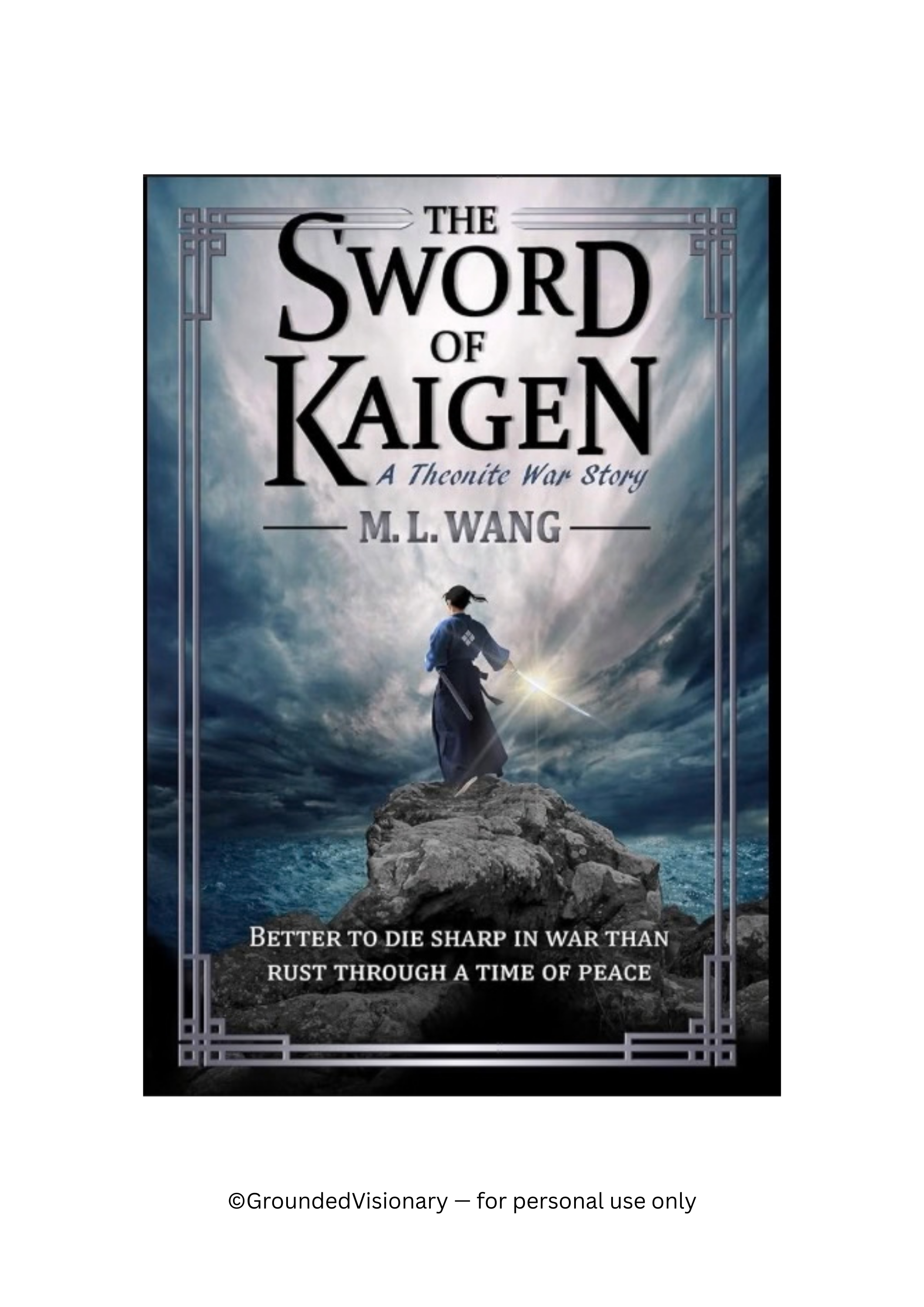
This book looks like a fantasy novel. Elemental powers, warrior clans, and an isolated mountain village with a proud martial tradition. That's the surface. Underneath it is a story about a woman who was exceptional, who buried it completely to become a wife and mother inside a culture that required her silence, and who gets no choice but to become herself again when the world breaks open around her.
Misaki is the book's real argument. Not the invasion. Not the propaganda. Not even the son that the book builds and then breaks your heart with. The real story is fifteen years of silence from a woman who knew the truth — about herself, about the village, about the empire using them all — and chose to keep it anyway. The Sword of Kaigen is a fantasy novel, the way a fire is a light source. Technically accurate. Mostly beside the point.
The conversations this book generates are not generic. They're about what we bury to fit into the roles we're assigned. About whether the explanation is the same as an excuse when it comes to the people who damage us. About what it costs to tell the truth into a system that was built to absorb it. About a marriage that spent fifteen years performing itself and then, in the snow over a son's pyre, finally had the conversation it always needed to have.
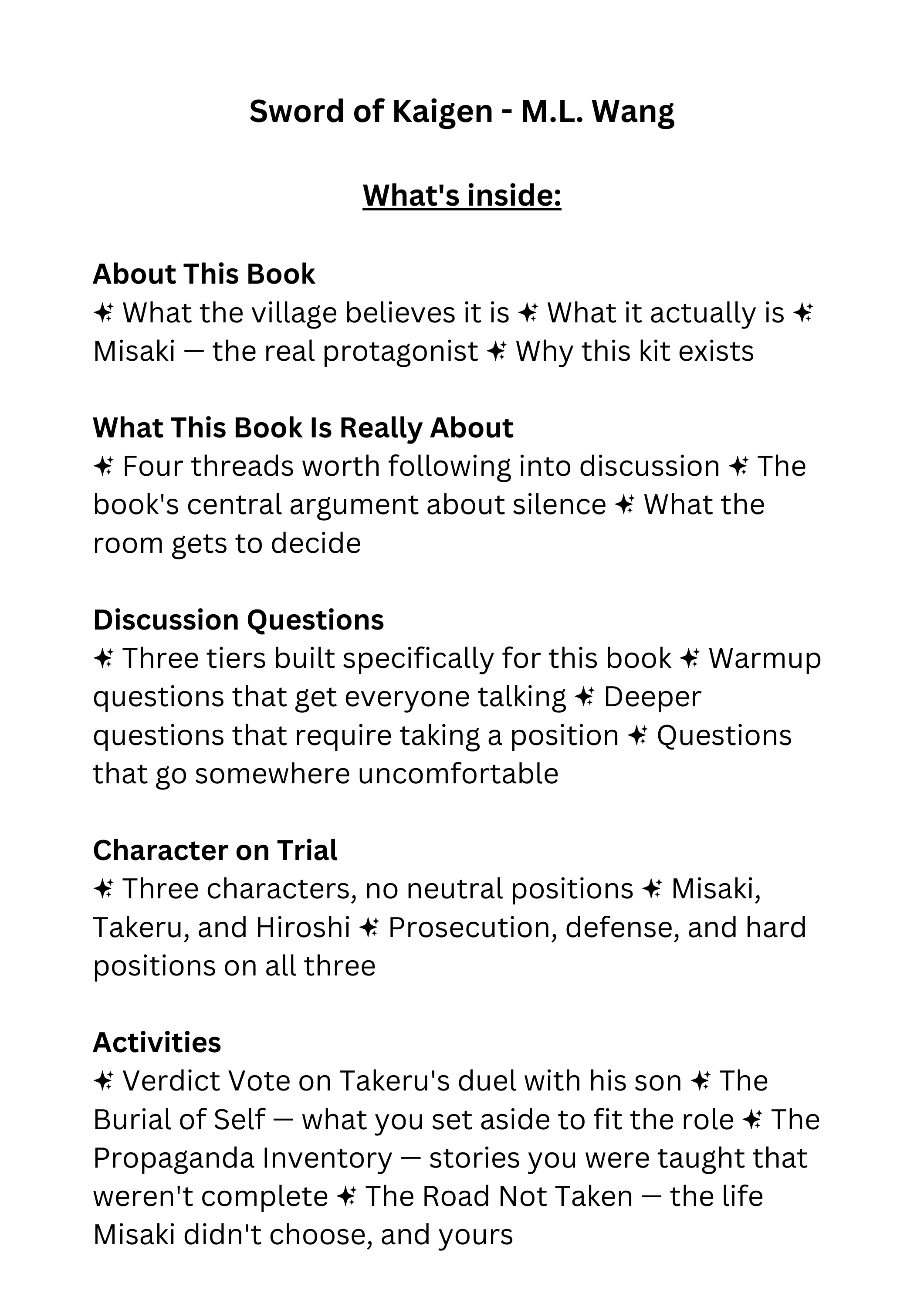
✦ What's Inside
✦ About This Book — What the village believes it is and what it actually is — Why Misaki is the real protagonist — The fantasy novel that is mostly beside the point
✦ What This Book Is Really About — Four threads worth following into discussion — Silence as survival strategy and as cost — The central argument the book is making about what we bury to belong
✦ Discussion Questions — Three Tiers — Tier 1: Warmup questions that get everyone talking — Tier 2: Deeper questions requiring a position and a defense — Tier 3: Personal, uncomfortable, unresolvable — Closes with: What question did this book refuse to answer?
✦ Character on Trial — Misaki, Takeru, and Hiroshi — Prosecution/defense structure — Hard position questions with mandatory reversal — No neutral positions allowed
✦ Activities — Verdict Vote: Takeru's duel with his son — The Burial of Self: what you buried to fit the role assigned to you — The Propaganda Inventory: what the village was told and what it cost them to believe it — The Road Not Taken: what Misaki's life looks like if she never came to Kaigen
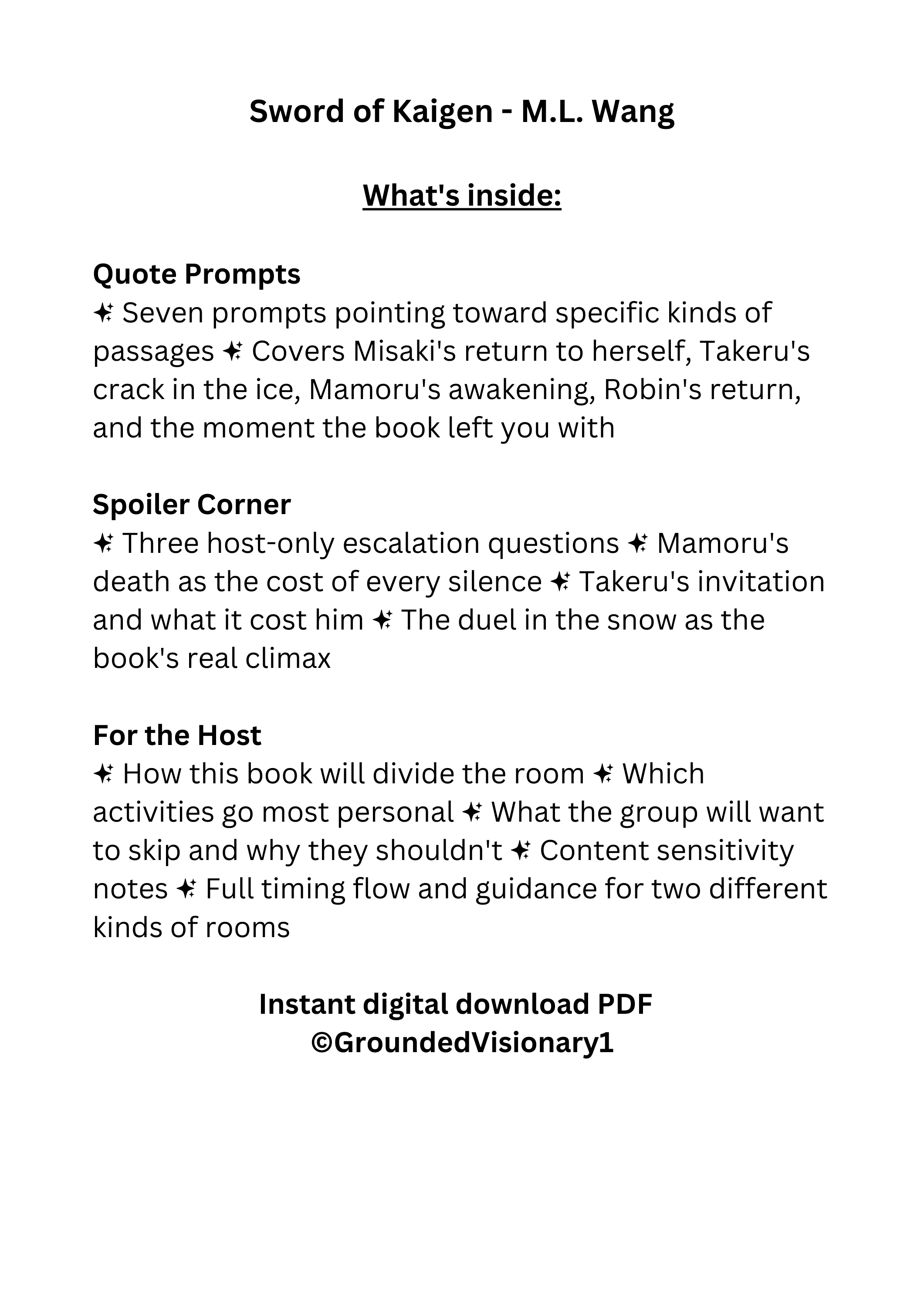
✦ Quote Prompts — Seven prompts pointing toward specific kinds of passages — The passage where Misaki's silence became legible — The moment the fantasy stopped being the point — The sentence that named what fifteen years of performance costs
✦ Spoiler Corner — Host only — three escalation questions for when the conversation needs a jolt — Mamoru's death and what it unlocks — Takeru's invitation and what it reveals about the marriage — The duel in the snow as the book's real climax
✦ For the Host — Facilitation notes and content sensitivity flags — Full timing flow and guidance for two different kinds of rooms
Details — Instant download PDF — Personal and single-group use. No redistribution or resale. — Fan-created guide. Not affiliated with or endorsed by M.L. Wang or any publisher.
Licensing for classrooms, libraries, and educational programs is available. If you plan to use this guide for a class, reading program, or institutional setting, please contact the shop owner to arrange an appropriate license.
No results found
No results match your search. Try removing a few filters.