Harriet A. Washington spent years in medical journals and experimental reports that had gone largely undisturbed. What she found was not a collection of isolated incidents. What she found was a system.
J. Marion Sims is considered the father of modern gynecology. The techniques he pioneered were developed by operating repeatedly on enslaved Black women without consent and without anesthesia — because the medical establishment had decided Black people felt less pain. That is not a footnote to the history of American medicine. That is the history of American medicine. Washington traces that history from slavery through Tuskegee through government biological warfare testing on Black communities through contemporary pharmaceutical research. Her argument is not that these are separate horrors. Her argument is that they are the same horror expressed across four centuries by an institution that has never fully reckoned with what it built on.
This kit was built for the room that can handle that argument. Not the room that wants to be reassured that things are better now — Washington addresses that too, and her answer is complicated — but the room willing to sit with what American medicine was built on and ask what that means for what it is now. Washington ends her book not with condemnation but with a complicated ask: she wants Black Americans to participate in medical research despite everything she has just documented. This kit was built to make sure the room argues about whether that ask is reasonable — and what it reveals about where the burden of repair actually lives.
This kit was built for the room that finished Medical Apartheid and needed somewhere to put everything the book left in them.
Content note: This guide discusses medical experimentation on enslaved people, forced sterilization, grave robbing, government biological warfare testing on Black communities, and the ongoing health consequences of four centuries of medical racism. These are not incidental to Washington's argument — they are the argument. Please consider your group's readiness for this material before purchasing.
✦ What's Inside
✦ About This Book — Not a history of isolated incidents — A system documented across four centuries — The body not safe in life and not safe in death — Built for the room that can handle what American medicine was built on
✦ What This Book Is Really About — The myth of Black pain tolerance from Sims to today — Grave robbing as policy not aberration — Tuskegee as the most documented example of a pattern not the exception — The government chose bald eagles over Black Americans and documented it — Eugenics American style and its influence on Nazi Germany — Washington's complicated final ask
✦ Discussion Questions — Three Tiers — Tier 1: Entry points, no position required yet — Tier 2: Make the case both ways — Sims's legacy, Tuskegee as container or reckoning, where the burden of repair lives — Tier 3: Personal, uncomfortable, unresolvable — Closes with: What question did this book refuse to answer?
✦ Character on Trial — J. Marion Sims: the father of modern gynecology and what that title was built on — The Tuskegee Public Health Service: the institution not the individual — The American Medical Establishment: four centuries of documented harm — No neutral positions allowed — Final synthesis: what would genuine accountability actually look like
✦ Activities — The Body Ledger: what was taken that has never been returned or repaired — The Informed Consent Exercise: one sentence of what genuine disclosure would have required — The Pattern Map: trace one thread from slavery to the present without it breaking — The Personal Reckoning: lived experience, family stories, the moment Washington's documentation became personal — Verdict Vote: is Washington's final ask reasonable
✦ Quote Prompts — Six prompts, six emotional entry points — The passage that reframed something you thought you understood — The moment the weight of the pattern required you to stop — The sentence where the through line became undeniable
✦ Spoiler Corner — Host only — full knowledge of the entire book required — The cover-up of the Tuskegee cover-up — The bald eagles decision and where accountability lives — Washington's ending and whether it places the burden of repair on the people who were harmed
✦ For the Host — Three fault lines: Washington's ending, individual versus institutional accountability, and proximity — How to hold space for medical professionals in the room — How to hold space for the room that arrives already angry — Timing flow for a single session
✦ Bonus Host Guide — A free facilitation toolkit included with every purchase
Details — Instant download PDF — 20+ pages, print-ready — Personal and single-group use. No redistribution or resale. — Fan-created guide. Not affiliated with or endorsed by Harriet A. Washington or any publisher.
Licensing for classrooms, libraries, and educational programs is available. If you plan to use this guide for a class, reading program, or institutional setting, please contact the shop owner to arrange an appropriate license.
Harriet A. Washington spent years in medical journals and experimental reports that had gone largely undisturbed. What she found was not a collection of isolated incidents. What she found was a system.
J. Marion Sims is considered the father of modern gynecology. The techniques he pioneered were developed by operating repeatedly on enslaved Black women without consent and without anesthesia — because the medical establishment had decided Black people felt less pain. That is not a footnote to the history of American medicine. That is the history of American medicine. Washington traces that history from slavery through Tuskegee through government biological warfare testing on Black communities through contemporary pharmaceutical research. Her argument is not that these are separate horrors. Her argument is that they are the same horror expressed across four centuries by an institution that has never fully reckoned with what it built on.
This kit was built for the room that can handle that argument. Not the room that wants to be reassured that things are better now — Washington addresses that too, and her answer is complicated — but the room willing to sit with what American medicine was built on and ask what that means for what it is now. Washington ends her book not with condemnation but with a complicated ask: she wants Black Americans to participate in medical research despite everything she has just documented. This kit was built to make sure the room argues about whether that ask is reasonable — and what it reveals about where the burden of repair actually lives.
This kit was built for the room that finished Medical Apartheid and needed somewhere to put everything the book left in them.
Content note: This guide discusses medical experimentation on enslaved people, forced sterilization, grave robbing, government biological warfare testing on Black communities, and the ongoing health consequences of four centuries of medical racism. These are not incidental to Washington's argument — they are the argument. Please consider your group's readiness for this material before purchasing.
✦ What's Inside
✦ About This Book — Not a history of isolated incidents — A system documented across four centuries — The body not safe in life and not safe in death — Built for the room that can handle what American medicine was built on
✦ What This Book Is Really About — The myth of Black pain tolerance from Sims to today — Grave robbing as policy not aberration — Tuskegee as the most documented example of a pattern not the exception — The government chose bald eagles over Black Americans and documented it — Eugenics American style and its influence on Nazi Germany — Washington's complicated final ask
✦ Discussion Questions — Three Tiers — Tier 1: Entry points, no position required yet — Tier 2: Make the case both ways — Sims's legacy, Tuskegee as container or reckoning, where the burden of repair lives — Tier 3: Personal, uncomfortable, unresolvable — Closes with: What question did this book refuse to answer?
✦ Character on Trial — J. Marion Sims: the father of modern gynecology and what that title was built on — The Tuskegee Public Health Service: the institution not the individual — The American Medical Establishment: four centuries of documented harm — No neutral positions allowed — Final synthesis: what would genuine accountability actually look like
✦ Activities — The Body Ledger: what was taken that has never been returned or repaired — The Informed Consent Exercise: one sentence of what genuine disclosure would have required — The Pattern Map: trace one thread from slavery to the present without it breaking — The Personal Reckoning: lived experience, family stories, the moment Washington's documentation became personal — Verdict Vote: is Washington's final ask reasonable
✦ Quote Prompts — Six prompts, six emotional entry points — The passage that reframed something you thought you understood — The moment the weight of the pattern required you to stop — The sentence where the through line became undeniable
✦ Spoiler Corner — Host only — full knowledge of the entire book required — The cover-up of the Tuskegee cover-up — The bald eagles decision and where accountability lives — Washington's ending and whether it places the burden of repair on the people who were harmed
✦ For the Host — Three fault lines: Washington's ending, individual versus institutional accountability, and proximity — How to hold space for medical professionals in the room — How to hold space for the room that arrives already angry — Timing flow for a single session
✦ Bonus Host Guide — A free facilitation toolkit included with every purchase
Details — Instant download PDF — 20+ pages, print-ready — Personal and single-group use. No redistribution or resale. — Fan-created guide. Not affiliated with or endorsed by Harriet A. Washington or any publisher.
Licensing for classrooms, libraries, and educational programs is available. If you plan to use this guide for a class, reading program, or institutional setting, please contact the shop owner to arrange an appropriate license.
 Image 1 of 7
 Image 2 of 7
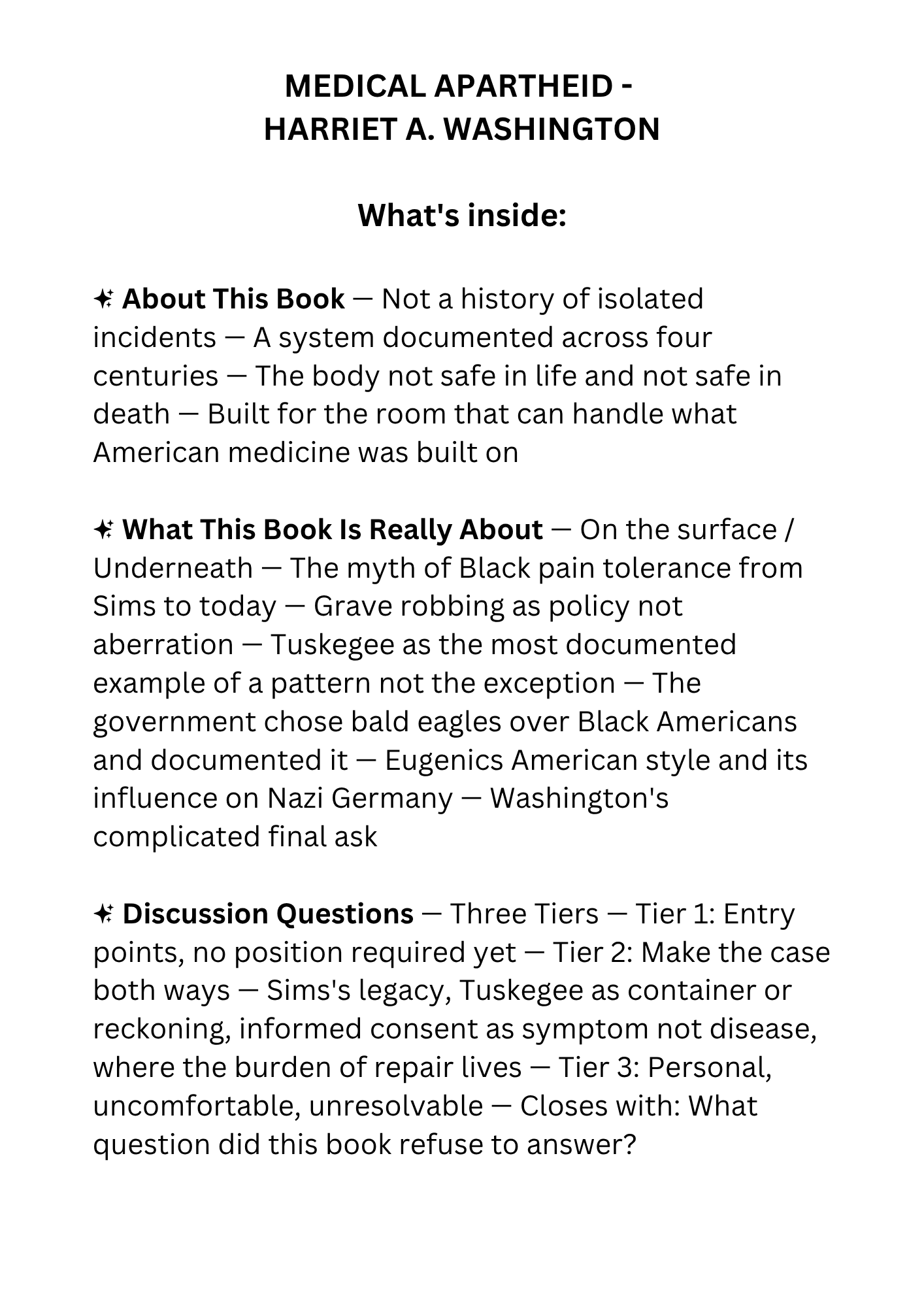 Image 3 of 7
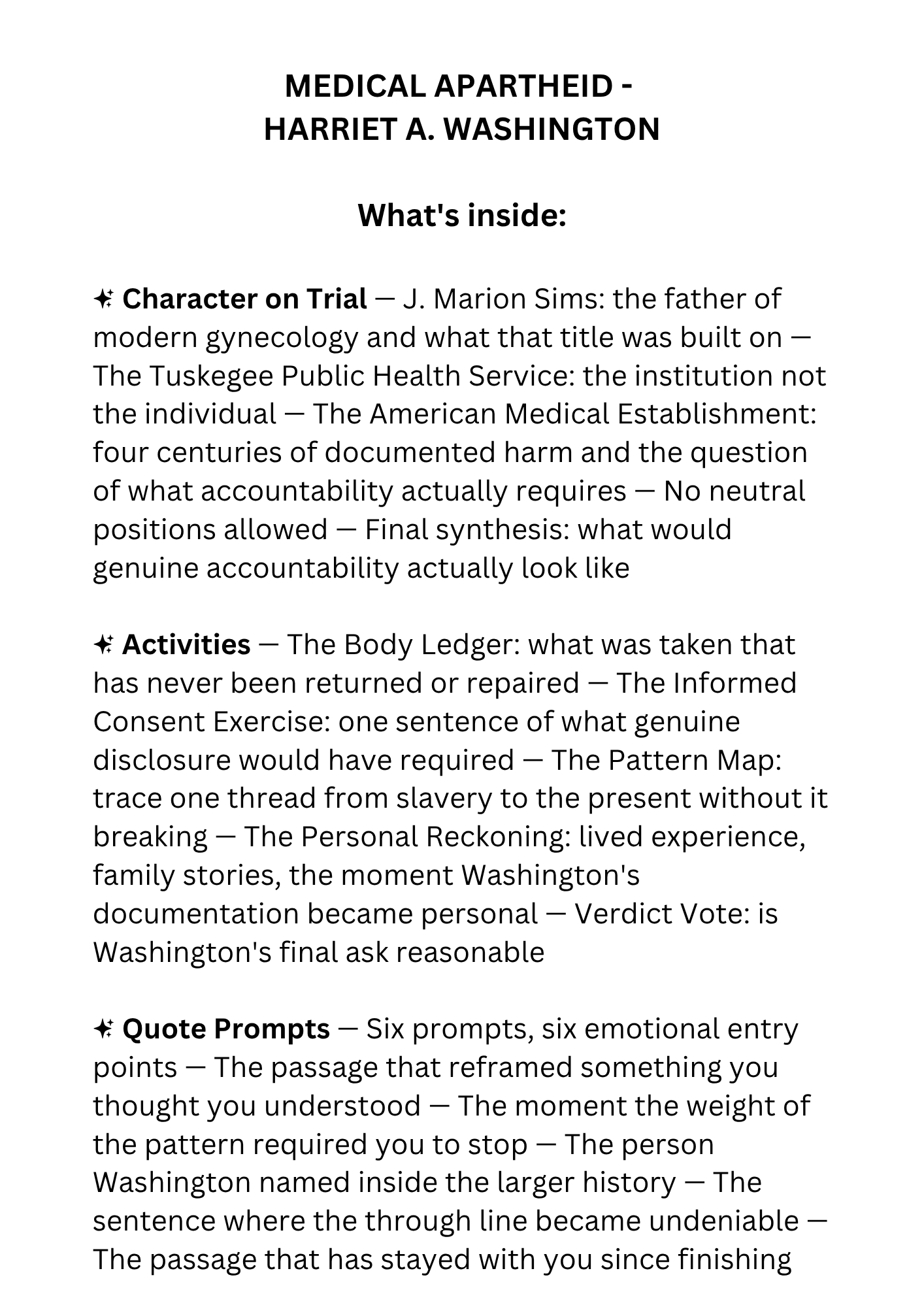 Image 4 of 7
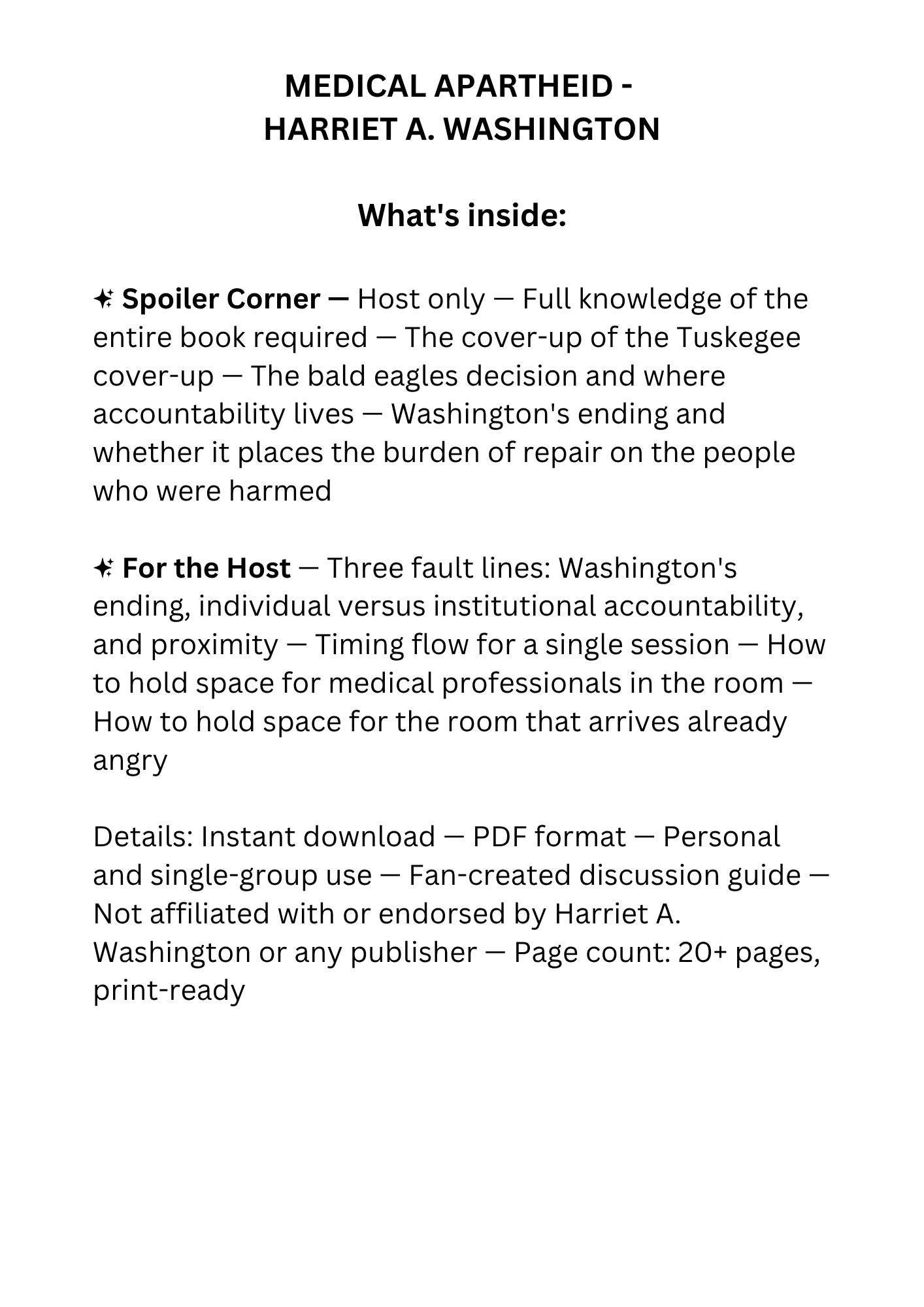 Image 5 of 7
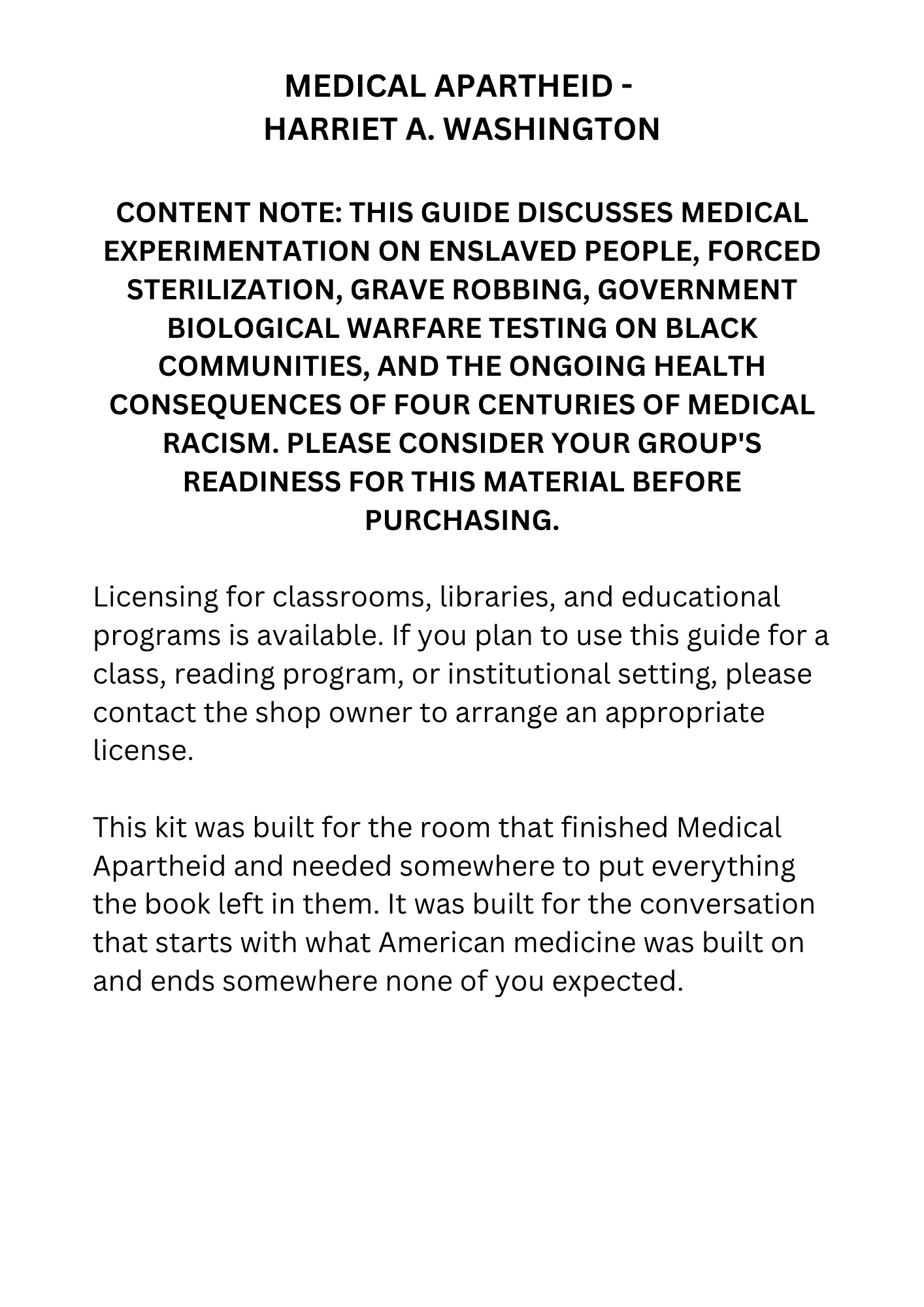 Image 6 of 7
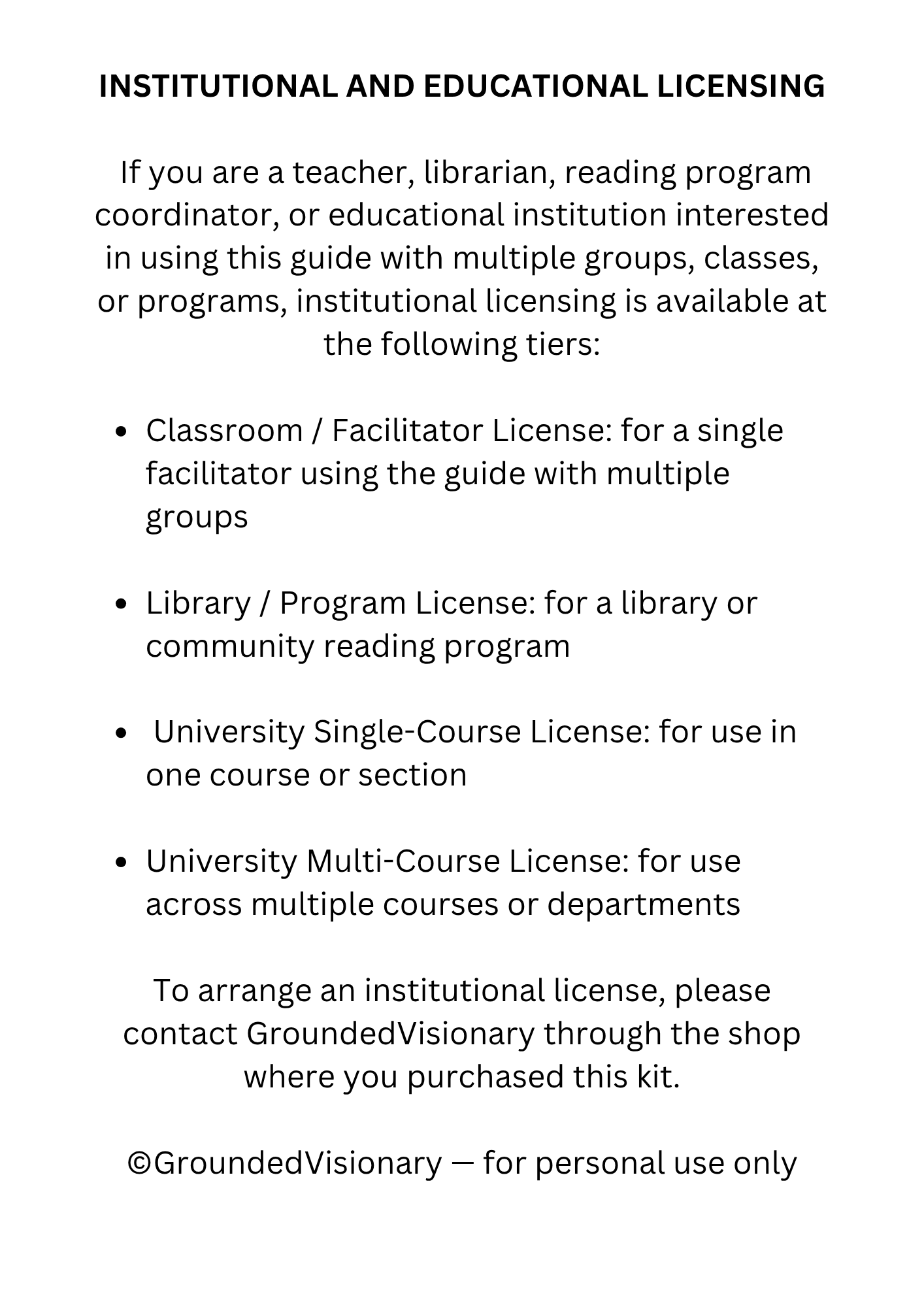 Image 7 of 7