The Broken Earth trilogy begins with a woman who has lost her son and ends with a daughter who saved a world she almost destroyed. In between N.K. Jemisin does something that takes three books to fully understand — she puts you inside a story in second person, tells you that you did this and you lost this and you are here now, and doesn't tell you who is speaking or why until the very end. By the time you know, you have already been inside Essun's life long enough that the revelation doesn't feel like a twist. It feels like something you should have known all along.
This kit is not a summary of three books. It is the conversation that only becomes possible after the last page of The Stone Sky — when you finally have all three books in the room at once and can ask what they mean together that none of them could mean alone.
The Broken Earth trilogy is one argument made in three movements. The Fifth Season asks what a broken system does to the people it decides are useful. The Obelisk Gate asks what those people do to each other when survival requires it. The Stone Sky asks whether any of it can be undone — and what it costs the people who try. This kit was built for the room that finished the trilogy and couldn't stop thinking about it. Not just about the ending — about Alabaster's plan and who paid for it, about what Hoa's narration was actually doing across three books, about whether the victory Jemisin delivers is an act of hope or the most honest thing she could have said about what breaking cycles of harm actually costs the people who break them.
This kit was built for the room that read all three books and is still sitting with the ending. It was built for the conversation that starts with whether Alabaster had the right to crack the world and ends somewhere none of you expected.
Please note: This is a standalone trilogy-level discussion kit built around the conversation all three books make together. It is not a bundle of the individual GroundedVisionary guides for The Fifth Season, The Obelisk Gate, and The Stone Sky. Those guides are available separately in the shop and go deep on each book individually. This kit goes wide — across all three books, across all three names, across the full arc of what Jemisin built.
✦ What's Inside
✦ About This Kit — Not a summary of three books — The conversation that only becomes possible after the last page — One argument made in three movements — Built for the room that finished Stone Sky and needed somewhere to put everything the trilogy left in them
✦ What This Kit Is Really About — The second person narration as structural argument not stylistic choice — Three names, one woman, one question about what survived — The technical victory and the emotional wound — Why the ending is the most honest thing Jemisin could have said
✦ Discussion Questions — Three Tiers — Tier 1: Entry points, no position required yet — Tier 2: Make the case both ways — the system won versus the system failed, Hoa's narration as love versus control, Alabaster's plan and who paid for it — Tier 3: Personal, uncomfortable, unresolvable — Closes with: What question did this trilogy refuse to answer?
✦ Character on Trial — Damaya/Syenite/Essun as one defendant across three names — Alabaster: revolutionary or another powerful figure who decided his vision was worth other people's cost — Hoa at trilogy level: decades of watching, narrating, waiting, and turning to stone — No neutral positions allowed — Final synthesis: whose story was this trilogy actually telling
✦ Activities — The Three Names Ledger: what Damaya lost, what Syenite lost, what Essun lost — The Second Person Exercise: two sentences about your own reading experience in Hoa's voice — The Cycle Map: name the pattern, trace it across three books, argue whether the ending broke it or interrupted it — Verdict Vote: was Alabaster justified in cracking the world and recruiting Essun without full disclosure
✦ Quote Prompts — Six prompts, six emotional entry points — The moment the second person became personal — The passage about what Damaya loved before the system got to her — The passage about Alabaster that reframed everything
✦ Spoiler Corner — Host only — full knowledge of all three endings required — The victory that looks like stone and solitude — Who the trilogy was actually telling the story of — What Jemisin believes about whether the people who break cycles get to choose what breaks them
✦ For the Host — Three fault lines: Alabaster, the ending, and the second person narration — Timing flow for a single session — Good host note for Fifth Season devotees and Nassun readers — The stone eater gap and how to hold it productively
Details — Instant download PDF — 20+ pages, print-ready — Personal and single-group use. No redistribution or resale. — Fan-created guide. Not affiliated with or endorsed by N.K. Jemisin or any publisher.
Licensing for classrooms, libraries, and educational programs is available. If you plan to use this guide for a class, reading program, or institutional setting, please contact the shop owner to arrange an appropriate license.
The Broken Earth trilogy begins with a woman who has lost her son and ends with a daughter who saved a world she almost destroyed. In between N.K. Jemisin does something that takes three books to fully understand — she puts you inside a story in second person, tells you that you did this and you lost this and you are here now, and doesn't tell you who is speaking or why until the very end. By the time you know, you have already been inside Essun's life long enough that the revelation doesn't feel like a twist. It feels like something you should have known all along.
This kit is not a summary of three books. It is the conversation that only becomes possible after the last page of The Stone Sky — when you finally have all three books in the room at once and can ask what they mean together that none of them could mean alone.
The Broken Earth trilogy is one argument made in three movements. The Fifth Season asks what a broken system does to the people it decides are useful. The Obelisk Gate asks what those people do to each other when survival requires it. The Stone Sky asks whether any of it can be undone — and what it costs the people who try. This kit was built for the room that finished the trilogy and couldn't stop thinking about it. Not just about the ending — about Alabaster's plan and who paid for it, about what Hoa's narration was actually doing across three books, about whether the victory Jemisin delivers is an act of hope or the most honest thing she could have said about what breaking cycles of harm actually costs the people who break them.
This kit was built for the room that read all three books and is still sitting with the ending. It was built for the conversation that starts with whether Alabaster had the right to crack the world and ends somewhere none of you expected.
Please note: This is a standalone trilogy-level discussion kit built around the conversation all three books make together. It is not a bundle of the individual GroundedVisionary guides for The Fifth Season, The Obelisk Gate, and The Stone Sky. Those guides are available separately in the shop and go deep on each book individually. This kit goes wide — across all three books, across all three names, across the full arc of what Jemisin built.
✦ What's Inside
✦ About This Kit — Not a summary of three books — The conversation that only becomes possible after the last page — One argument made in three movements — Built for the room that finished Stone Sky and needed somewhere to put everything the trilogy left in them
✦ What This Kit Is Really About — The second person narration as structural argument not stylistic choice — Three names, one woman, one question about what survived — The technical victory and the emotional wound — Why the ending is the most honest thing Jemisin could have said
✦ Discussion Questions — Three Tiers — Tier 1: Entry points, no position required yet — Tier 2: Make the case both ways — the system won versus the system failed, Hoa's narration as love versus control, Alabaster's plan and who paid for it — Tier 3: Personal, uncomfortable, unresolvable — Closes with: What question did this trilogy refuse to answer?
✦ Character on Trial — Damaya/Syenite/Essun as one defendant across three names — Alabaster: revolutionary or another powerful figure who decided his vision was worth other people's cost — Hoa at trilogy level: decades of watching, narrating, waiting, and turning to stone — No neutral positions allowed — Final synthesis: whose story was this trilogy actually telling
✦ Activities — The Three Names Ledger: what Damaya lost, what Syenite lost, what Essun lost — The Second Person Exercise: two sentences about your own reading experience in Hoa's voice — The Cycle Map: name the pattern, trace it across three books, argue whether the ending broke it or interrupted it — Verdict Vote: was Alabaster justified in cracking the world and recruiting Essun without full disclosure
✦ Quote Prompts — Six prompts, six emotional entry points — The moment the second person became personal — The passage about what Damaya loved before the system got to her — The passage about Alabaster that reframed everything
✦ Spoiler Corner — Host only — full knowledge of all three endings required — The victory that looks like stone and solitude — Who the trilogy was actually telling the story of — What Jemisin believes about whether the people who break cycles get to choose what breaks them
✦ For the Host — Three fault lines: Alabaster, the ending, and the second person narration — Timing flow for a single session — Good host note for Fifth Season devotees and Nassun readers — The stone eater gap and how to hold it productively
Details — Instant download PDF — 20+ pages, print-ready — Personal and single-group use. No redistribution or resale. — Fan-created guide. Not affiliated with or endorsed by N.K. Jemisin or any publisher.
Licensing for classrooms, libraries, and educational programs is available. If you plan to use this guide for a class, reading program, or institutional setting, please contact the shop owner to arrange an appropriate license.
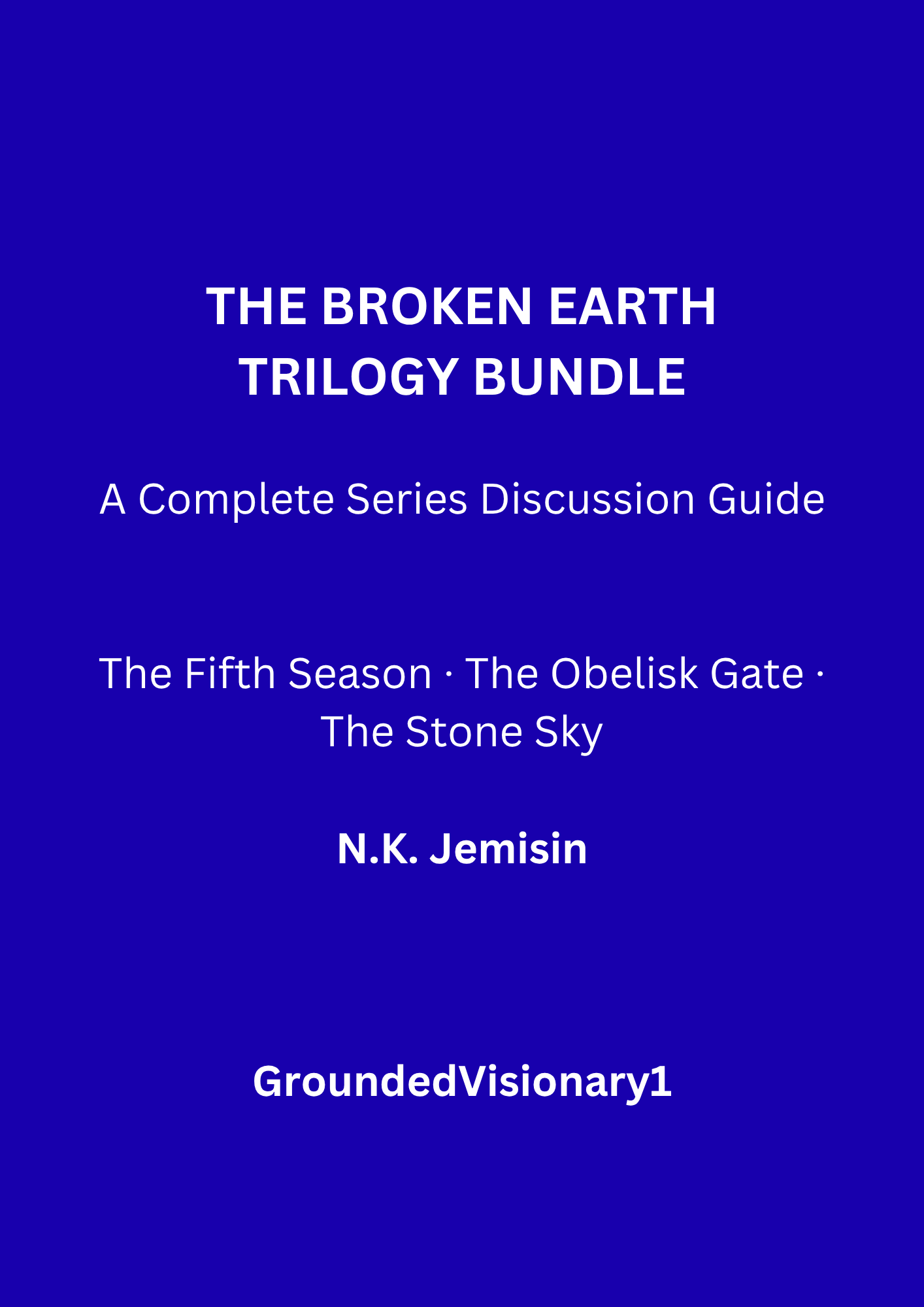 Image 1 of 6
 Image 2 of 6
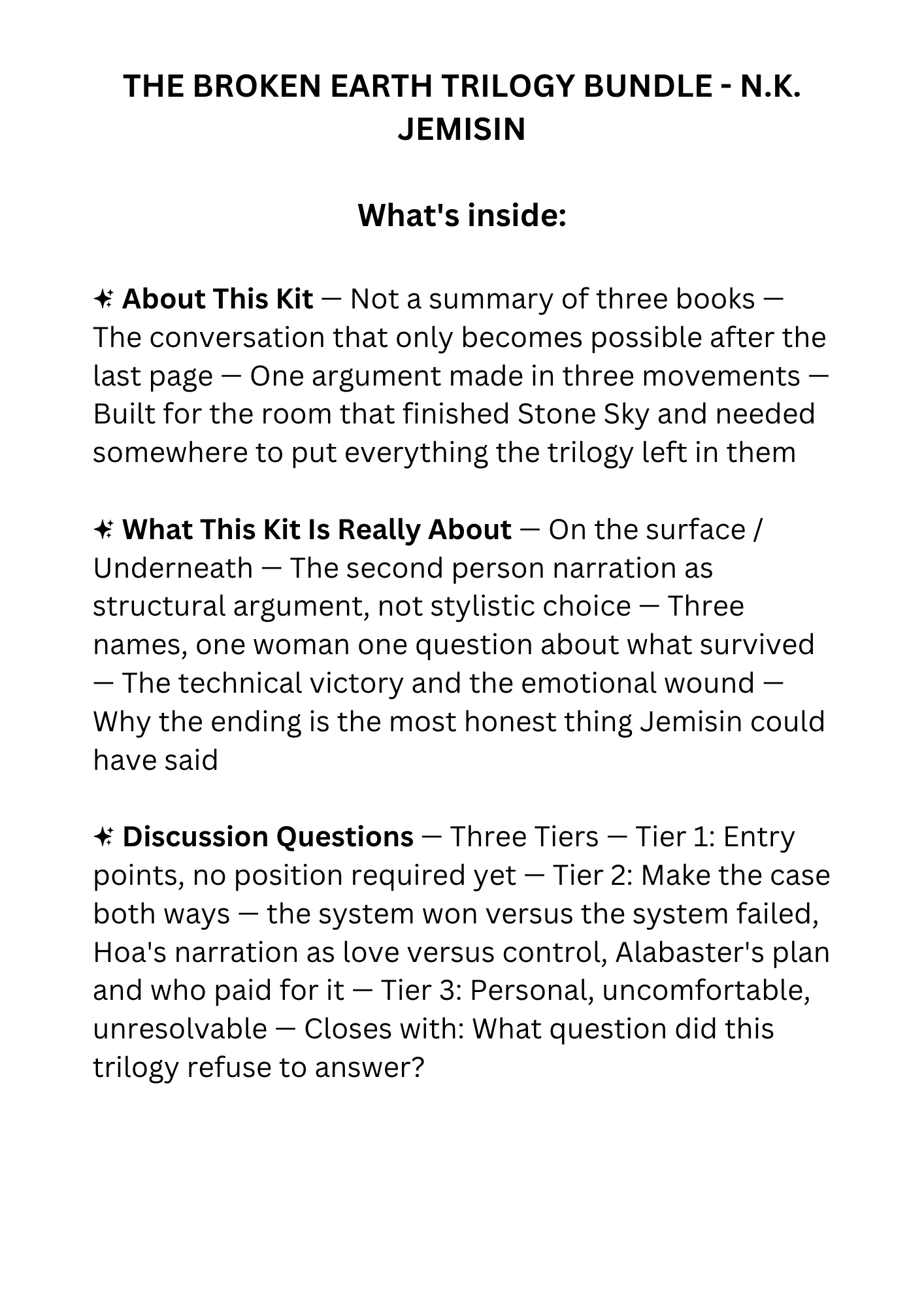 Image 3 of 6
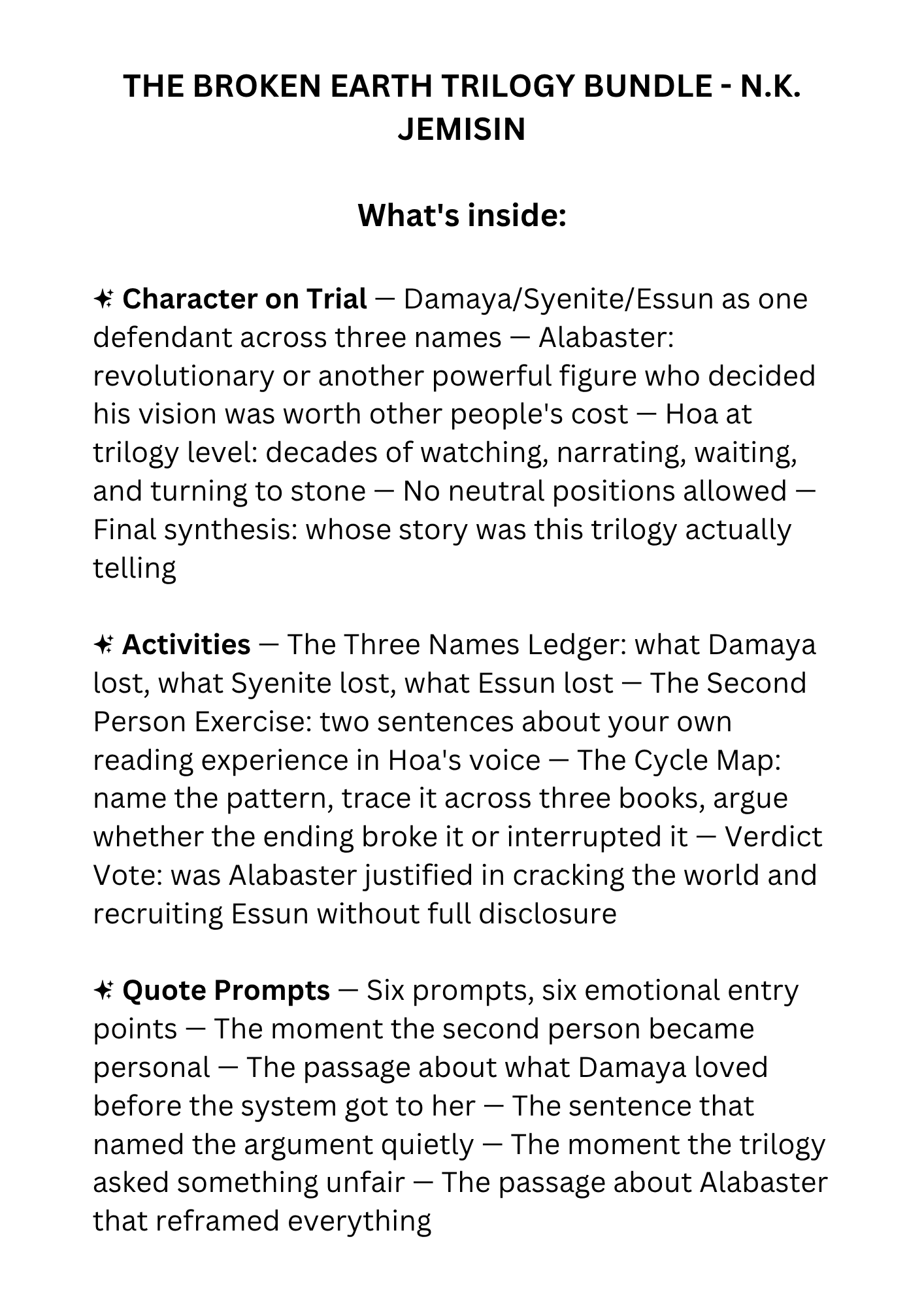 Image 4 of 6
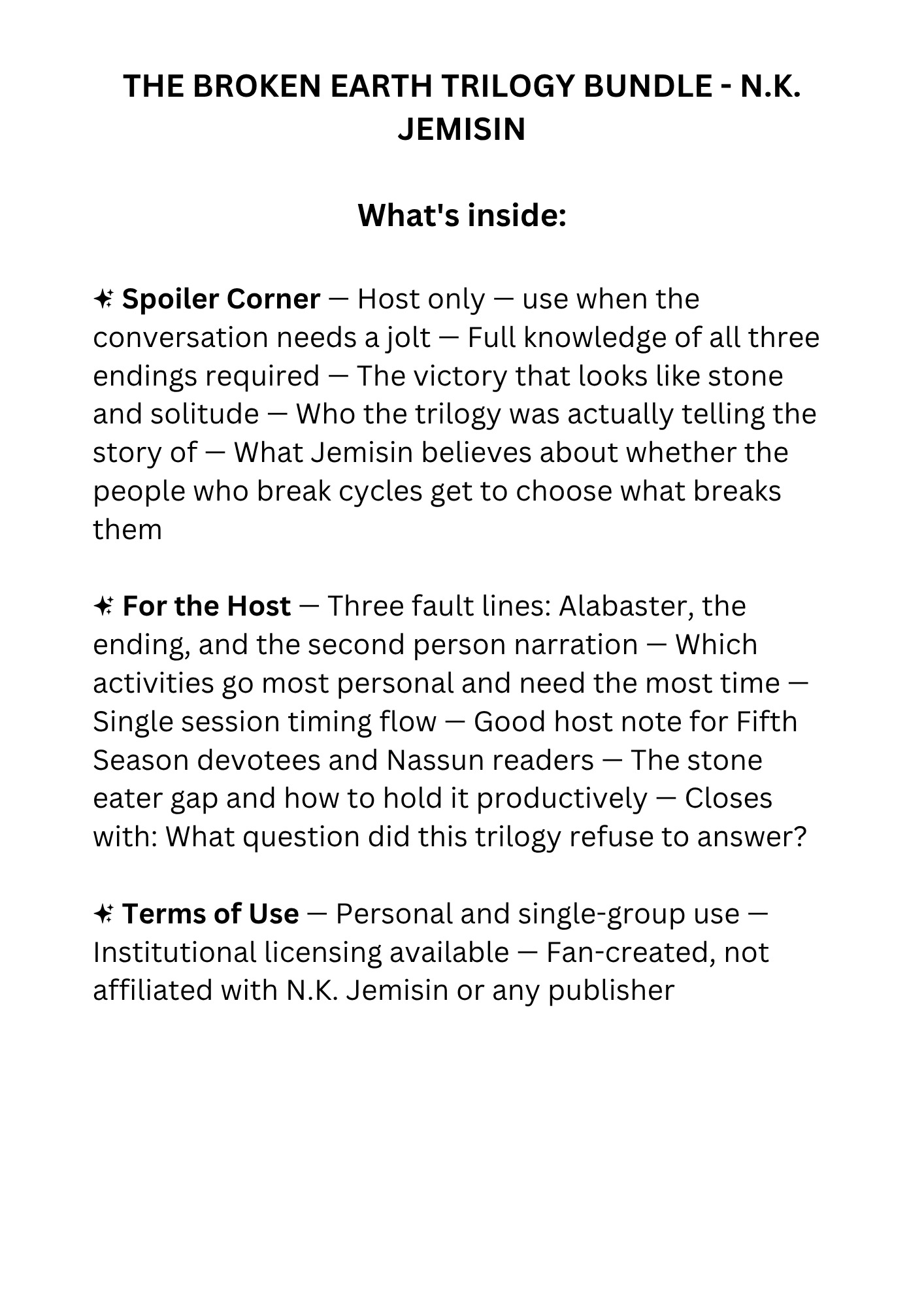 Image 5 of 6
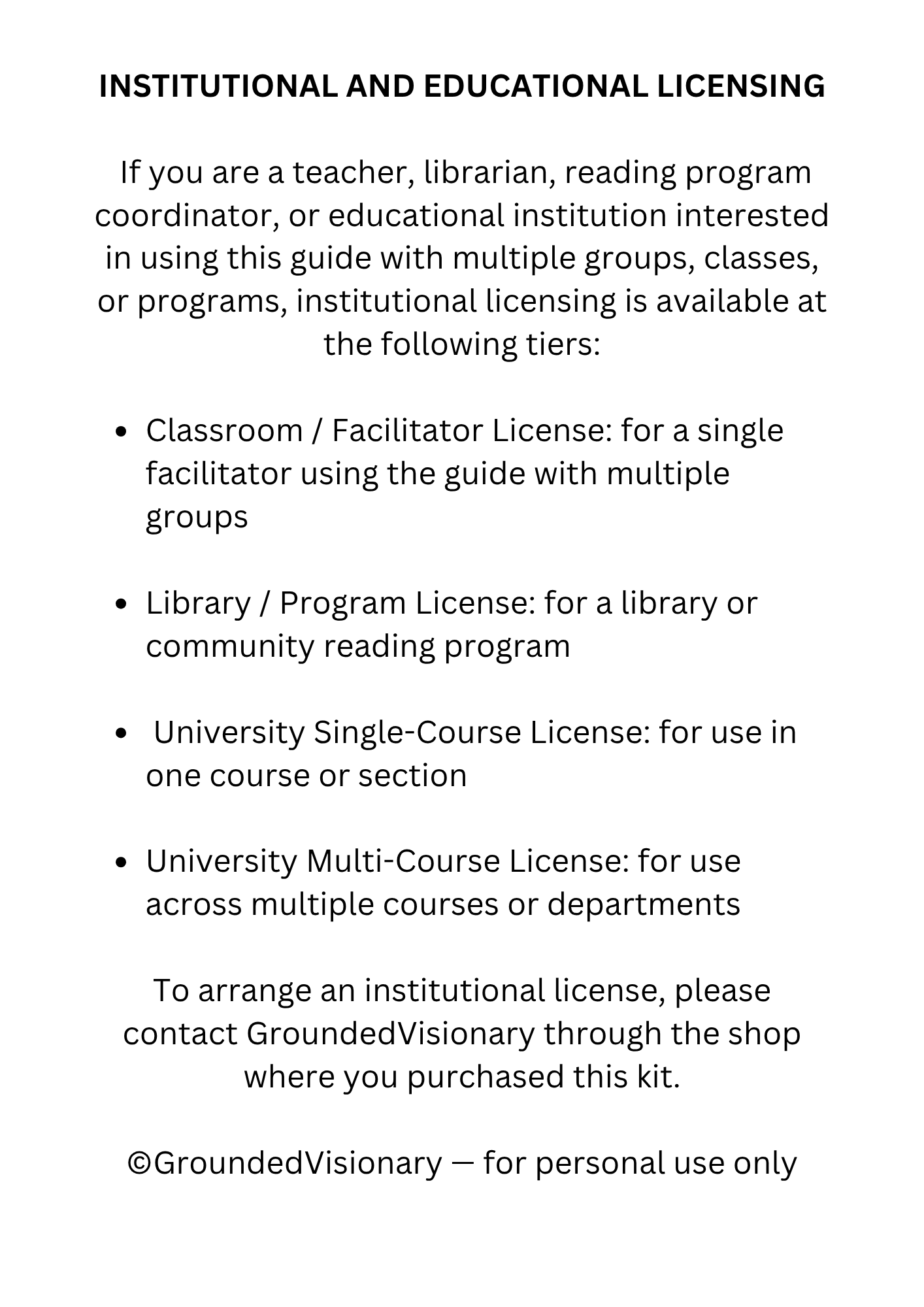 Image 6 of 6