Power, Systems & Control
Power, Systems & Control
Filters
Octavia Butler does not begin Wild Seed in America. She does not begin it in slavery. She begins in 1690 West Africa, with Anyanwu, a three-hundred-year-old Igbo healer and shapeshifter living freely, on her own terms, in the village she has protected for generations. That choice is the novel's first argument: Black existence before the Atlantic world's racial architecture. Before colonization. Before the hierarchy that would follow. Butler plants her story there on purpose.
Then Doro arrives. He is four thousand years old, a survivor who jumps between bodies — consuming each life, moving on — and he has spent those millennia building a breeding program: communities of extraordinary people, carefully selected and paired across generations, working toward something he calls a stronger humanity. He finds Anyanwu and recognizes immediately what she is. He wants her in his program. He wants her children. He wants her.
Most readers find Doro compelling before they find him monstrous. Butler builds that sympathy deliberately — his loneliness is genuine, his affection for Anyanwu is real, his vision has an internal logic that almost makes sense. That is the trap she is laying. Because Doro's breeding program is not revolutionary. It is eugenics: the conviction that some people have the right to decide which bodies are worthy of reproducing, which lives are useful, and which people are expendable in service of a larger project. The state-sponsored forced sterilization of Black women in America, funded by state and federal programs continuing into the 1970s, operated on identical premises. Butler wrote this novel in 1980. She was not writing about the distant past.
This guide was built for the room that is ready to name what Doro's program is — and to reckon with what it means to have spent half the novel sympathizing with the man who built it. It puts his system on trial. It gives Anyanwu the space her survival deserves. It asks the Body Question that Butler embeds in every chapter. And in the Spoiler Corner, it sits with the ending Butler earns: not justice, not accountability, but the possibility of something changing in one relationship — and the question of whether that is enough.
What's Inside
✦ About This Book — Butler starts in West Africa before slavery, before colonization, before racial hierarchy — Why Doro seems revolutionary until he isn't — The eugenics parallel and why it is not science fiction
✦ What This Book Is Really About — Four threads worth following into discussion — The architecture of ownership, bodily autonomy, and the trap of sympathy — Butler's core argument: power without limits eventually treats people as resources
✦ Discussion Questions — Three Tiers — Tier 1: Entry points for the whole room — Tier 2: Doro's framing versus his logic, Anyanwu's compromise as resistance, and bodily autonomy as the novel's central contest — Tier 3: What sympathy for Doro reveals, the eugenics parallel named directly, and whether strength can exist without domination
✦ Character on Trial — Anyanwu and Doro — Prosecution/defense structure — Hard position questions — No neutral positions allowed
✦ System on Trial: Doro's Breeding Program — Eugenics, slavery, and patriarchy as a single architecture — The state-sponsored sterilization of Black women named directly — What systems currently operating Doro would recognize as his own
✦ Activities — Verdict Vote: what Doro's breeding program actually is — The Survival Ledger: what each survival strategy costs and what it preserves — The Power Audit: having power and having freedom are not the same thing — The Body Question: who gets to decide what your body is for
✦ Quote Prompts — Six prompts covering Doro's dangerous tenderness, Anyanwu's transformation, the breeding program's exposed logic, immortal loneliness, Butler's live wire, and Anyanwu's power on her own terms
✦ Spoiler Corner — Host-only escalation questions — Anyanwu's threat and where power actually lives — Whether Doro's emotional capitulation is accountability or something less — Whether love can exist inside a relationship where one person has treated the other as property
✦ For the Host — How this book divides the room along one fault line that matters — Which activities go most personal and need extra time — Timing flow for a 90-minute meeting — Good host note for Butler fans versus first-time Butler readers
Details: Instant download PDF. 20+ pages, print-ready. Licensed for personal and single-group use. This is a fan-created discussion guide and is not affiliated with, endorsed by, or connected to the Octavia Butler estate or any publisher.
Licensing for classrooms, libraries, and educational programs is available. If you plan to use this guide for a class, reading program, or institutional setting, please contact the shop to arrange an appropriate license.
Everyone remembers the cells. Almost no one remembered her.
The Immortal Life of Henrietta Lacks is the story of a scientific miracle — the first human cells to survive and replicate outside the body — and the Black woman they were taken from in 1951, at Johns Hopkins, without her knowledge or consent. Her cells helped build modern medicine and generated billions. Her family grew up in poverty and weren't compensated for over seventy years. This is a book that leaves a room angry. This kit gives that anger somewhere to go.
It's built for the group that wants to argue honestly — about consent, race, medicine, money, and who gets remembered and how. Not a worksheet. A structured, uncomfortable, genuinely good conversation.
Inside the kit:
About This Book and What This Book Is Really About — the argument running underneath the science
Three tiers of discussion questions, from warm-up to the ones you save for when the conversation gets good
Character on Trial — Henrietta, Deborah, and Rebecca Skloot, prosecution and defense, no neutral positions allowed
Four activities, including the Cost Ledger and a Verdict Vote on the 2023 Thermo Fisher settlement
Six quote prompts for six different kinds of readers
A host-only Spoiler Corner for when the room needs a jolt
A full For the Host section — facilitation notes, a timing flow, and guidance for two very different kinds of rooms
Plus an interactive Living Companion (scan the QR code inside) to run live during your meeting
Instant download PDF. Personal and single-group use.
Institutional and educational licensing available; just reach out through the shop.

Tananarive Due did not begin with a story idea. She began with a name — her great-uncle Robert Stephens, who died at the Dozier School for Boys in Marianna, Florida, and was largely forgotten in family memory. The Dozier School operated from 1900 to 2011. Over more than a century, boys — disproportionately Black boys — were beaten, abused, disappeared, and buried in unmarked graves while the institution kept running behind the language of reform, discipline, and correction. Due wrote The Reformatory to pull one forgotten child back from that erasure. What she built in his name is a ghost story that is really a reckoning.
The real horror in this novel is not the haints. It is the system. The Gracetown School for Boys is not an accident — it is a machine, and Due is precise about how machines like it operate: through law, procedure, authority, religion, and the cooperation of ordinary people who know what is happening and keep the institution running anyway. Robert Stephens Jr. is twelve years old when he is sent there for defending his sister from a white boy. The horror begins before he ever reaches the gates, because the world has already decided he is punishable. His sister Gloria fights from the outside with everything she has. The dead boys who never made it out fight from wherever the dead go when institutions refuse to mourn them. This is a novel about what Black childhood costs when the legal system becomes the monster — and about what fiction can do when official history has failed the people it was supposed to record.
This guide was built for the room that is ready to sit with all of it — the horror, the history, the haints, and the harder question underneath: is witness enough when accountability was never available? It names the Dozier School directly. It puts the institution on trial. It gives Gloria the space the novel gives her. And in the Spoiler Corner, it asks the question Due's novel earns the right to ask: what are the dead owed by the living who finally remember them?
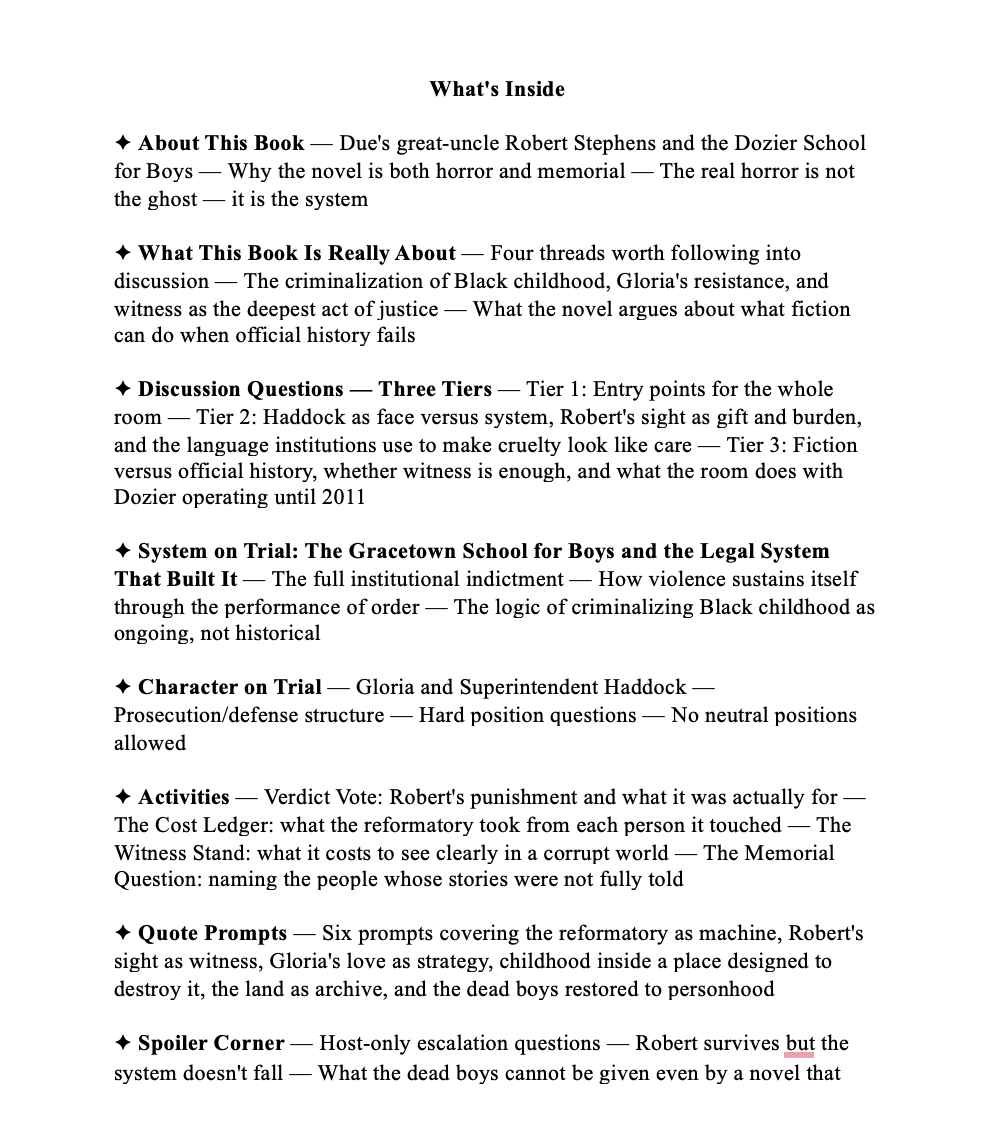
What's Inside
✦ About This Book — Due's great-uncle Robert Stephens and the Dozier School for Boys — Why the novel is both horror and memorial — The real horror is not the ghost — it is the system
✦ What This Book Is Really About — Four threads worth following into discussion — The criminalization of Black childhood, Gloria's resistance, and witness as the deepest act of justice — What the novel argues about what fiction can do when official history fails
✦ Discussion Questions — Three Tiers — Tier 1: Entry points for the whole room — Tier 2: Haddock as face versus system, Robert's sight as gift and burden, and the language institutions use to make cruelty look like care — Tier 3: Fiction versus official history, whether witness is enough, and what the room does with Dozier operating until 2011
✦ System on Trial: The Gracetown School for Boys and the Legal System That Built It — The full institutional indictment — How violence sustains itself through the performance of order — The logic of criminalizing Black childhood as ongoing, not historical
✦ Character on Trial — Gloria and Superintendent Haddock — Prosecution/defense structure — Hard position questions — No neutral positions allowed
✦ Activities — Verdict Vote: Robert's punishment and what it was actually for — The Cost Ledger: what the reformatory took from each person it touched — The Witness Stand: what it costs to see clearly in a corrupt world — The Memorial Question: naming the people whose stories were not fully told
✦ Quote Prompts — Six prompts covering the reformatory as machine, Robert's sight as witness, Gloria's love as strategy, childhood inside a place designed to destroy it, the land as archive, and the dead boys restored to personhood
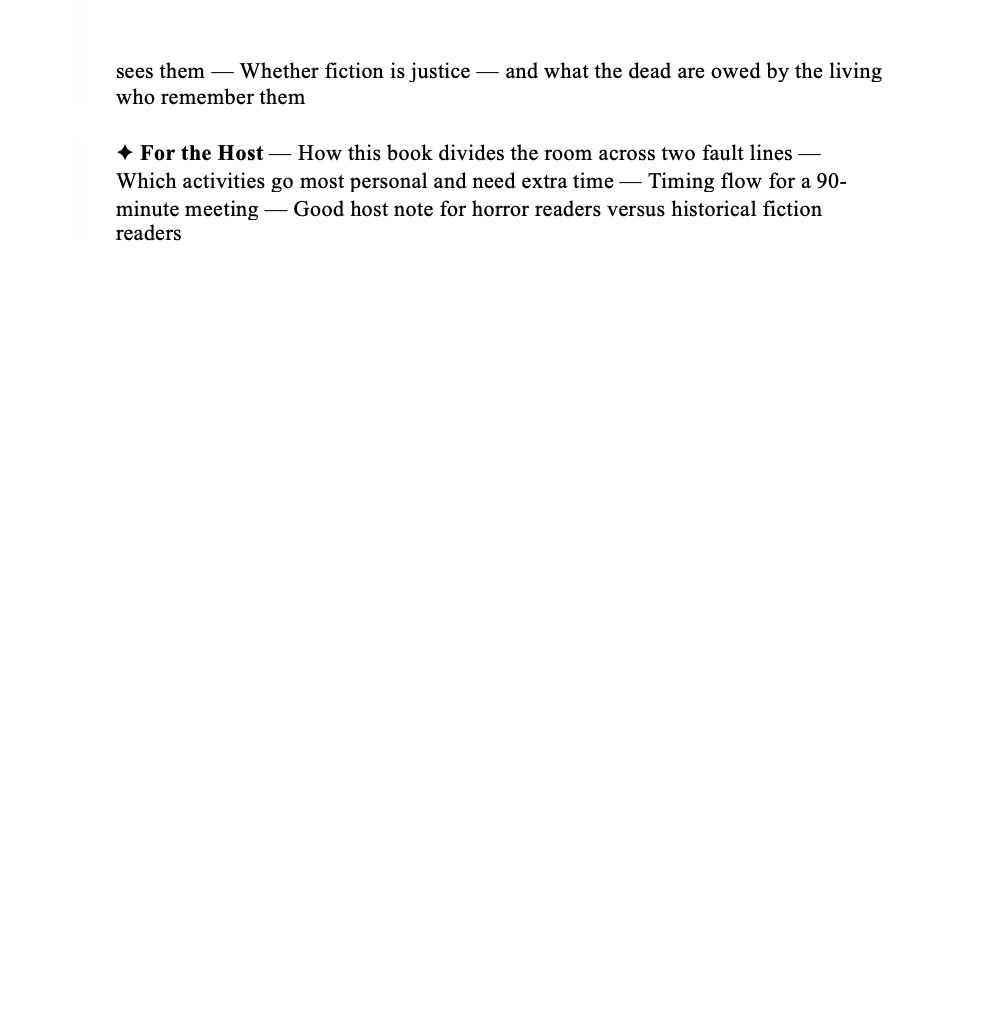
✦ Spoiler Corner — Host-only escalation questions — Robert survives but the system doesn't fall — What the dead boys cannot be given even by a novel that sees them — Whether fiction is justice — and what the dead are owed by the living who remember them
✦ For the Host — How this book divides the room across two fault lines — Which activities go most personal and need extra time — Timing flow for a 90-minute meeting — Good host note for horror readers versus historical fiction readers
Kimberly Jones did not write a protest book. She wrote an indictment — and she built it around a Monopoly game. If you played four hundred rounds and had to hand over every dollar you earned, watched your properties get burned when you started winning, got penalized for resisting, and then got told you simply weren't trying hard enough — how would you win? That question is not rhetorical. It is the architecture of this book, and it is exactly the kind of question a room full of readers needs a guide built specifically to handle.
How We Can Win is short, urgent, and precise — 192 pages that connect slavery, Reconstruction's betrayal, Tulsa, redlining, mass incarceration, and present-day wealth inequality into a single, cumulative argument. Jones is not asking readers to feel bad about history. She is asking them to understand how the rules of American wealth were written, who wrote them, and who has been expected to play fairly ever since. That distinction — between feeling something and understanding something — is where most conversations about this book stall. This guide was built to push past the stall.
The discussion this book generates is not the one most groups expect. The room will not divide between people who believe racism is real and people who don't. It will divide between people who agree with Jones's diagnosis and people who agree with her diagnosis but resist her remedy — and that second conversation is the one worth having. This kit is designed to find that fault line early and follow it all the way to the end.
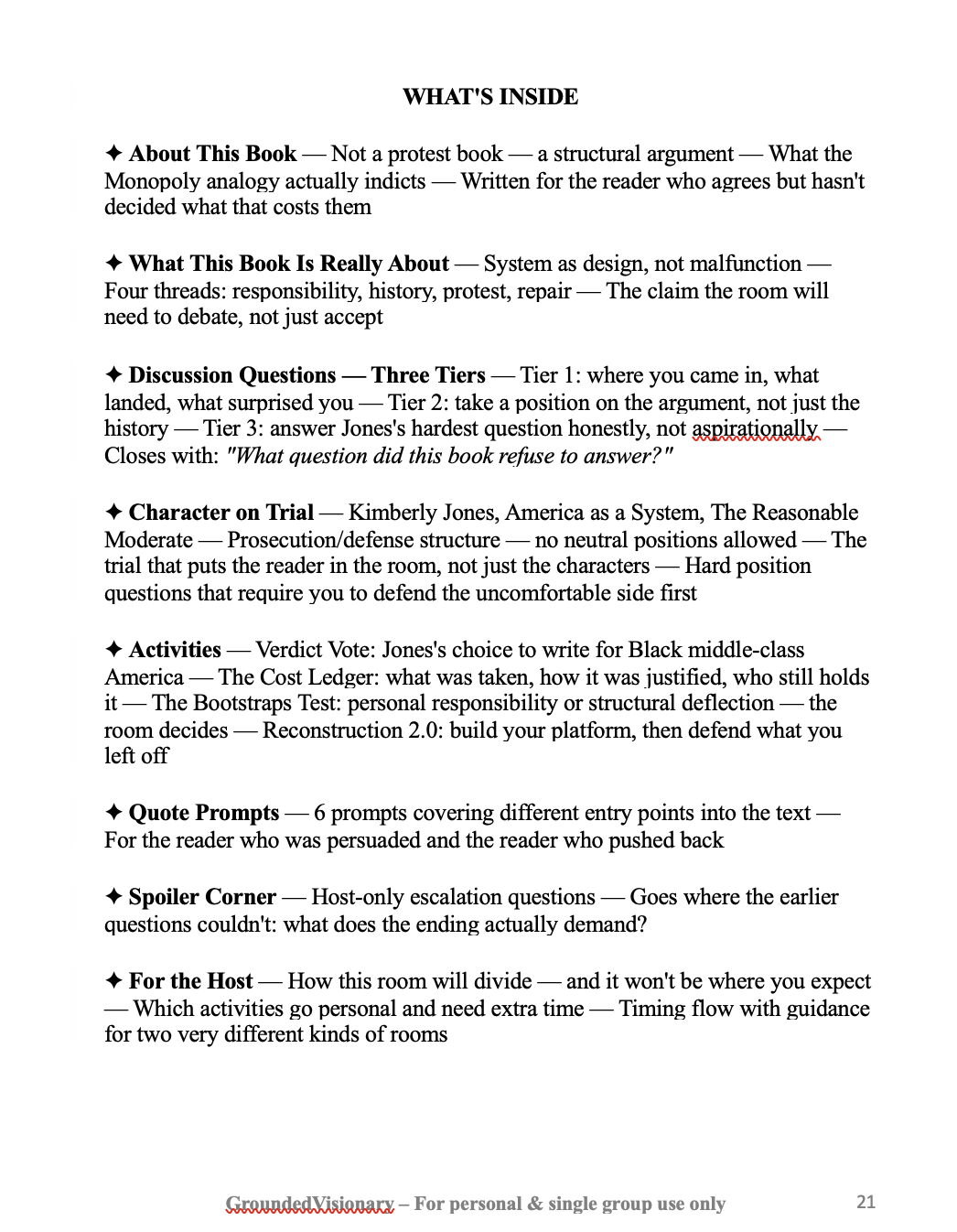
✦ About This Book & What It's Really About — What the Monopoly analogy actually indicts — System as design, not malfunction — The claim the room will need to debate, not just accept
✦ Discussion Questions — Three Tiers — Tier 1: where you came in, what landed, what surprised you — Tier 2: take a position on the argument, not just the history — Tier 3: answer Jones's hardest question honestly, not aspirationally — Closes with: "What question did this book refuse to answer?"
✦ Character on Trial — Kimberly Jones, America as a System, The Reasonable Moderate — Prosecution/defense structure — no neutral positions allowed — The trial that puts the reader in the room, not just the characters — Hard position questions that require you to defend the uncomfortable side first
✦ Activities — Verdict Vote: Jones's choice to write for Black middle-class America — The Cost Ledger: what was taken, how it was justified, who still holds it — The Bootstraps Test: personal responsibility or structural deflection — the room decides — Reconstruction 2.0: build your platform, then defend what you left off
✦ Quote Prompts — 6 prompts covering different entry points into the text — For the reader who was persuaded and the reader who pushed back
✦ Spoiler Corner — Host-only escalation questions — Goes where the earlier questions couldn't: what does the ending actually demand?
✦ For the Host — How this room will divide — and it won't be where you expect — Which activities go personal and need extra time — Timing flow with guidance for two very different kinds of rooms
Details: Instant download PDF. 20+ pages, print-ready. Licensed for personal and single-group use. Fan-created guide — not affiliated with or endorsed by Kimberly Jones or her publisher. Licensing for classrooms, libraries, and educational programs is available — contact the shop to arrange.
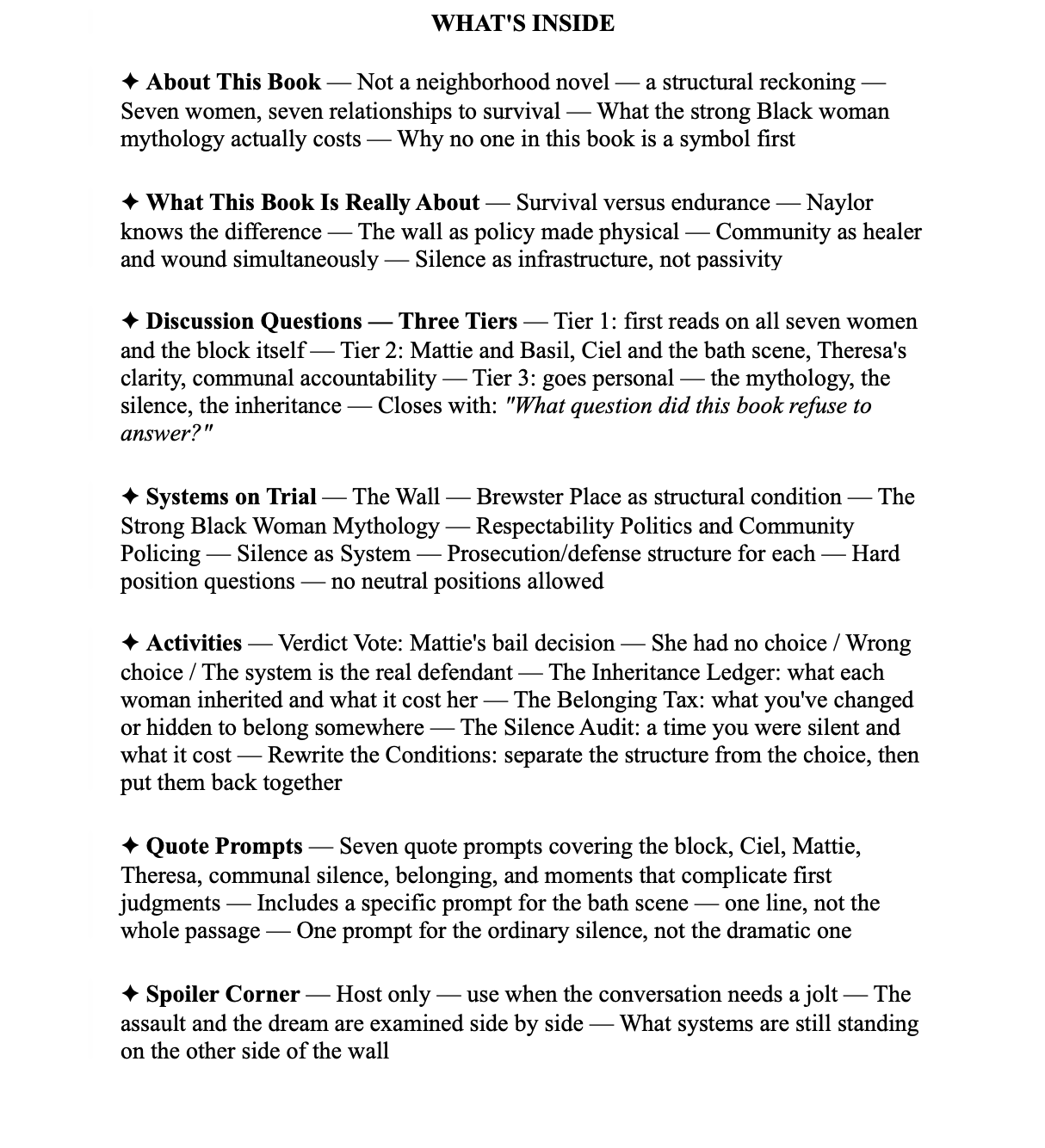

Gloria Naylor didn't write a novel about a neighborhood. She wrote a reckoning about what happens to Black women when the world gives them no soft place to land — and then judges how they survive the fall. The Women of Brewster Place gets called a community portrait, a friendship story, a tragedy.
The seven women at the center of this novel arrived at Brewster Place the way people arrive at last resorts: after something else failed, after someone left, after the options narrowed down to this. Mattie Michael, who has lost everything once already and rebuilt it with her hands. Ciel, who disappeared so completely inside her love for Eugene that Mattie had to physically hold her back into her own body. Etta Mae, who understood early that beauty was currency, has been calculating the interest ever since. Kiswana, who chose Brewster Place from a position of privilege and is still learning what it means to inherit a struggle versus select one. Cora Lee, whose relationship to motherhood is more complicated than the judgment the block passes on her. And Lorraine and Theresa — who are not the side plot, not the tragedy, not the lesbian couple in the book, but Naylor's most precise and devastating argument about what communities do to the people they decide don't belong.
This discussion guide puts systems on trial, not characters. The wall goes on trial. The strong Black woman mythology goes on trial. Respectability politics and the silence that makes violence possible go on trial. Because Naylor's argument is structural — these women were failed before they made a single choice — and the guide is built to hold that argument without letting anyone in the room off the hook, including the reader.
✦ About This Book — Not a neighborhood novel — a structural reckoning — Seven women, seven relationships to survival — What the strong Black woman mythology actually costs — Why no one in this book is a symbol first
✦ What This Book Is Really About — Survival versus endurance — Naylor knows the difference — The wall as policy made physical — Community as healer and wound simultaneously — Silence as infrastructure, not passivity
✦ Discussion Questions — Three Tiers — Tier 1: first reads on all seven women and the block itself — Tier 2: Mattie and Basil, Ciel and the bath scene, Theresa's clarity, communal accountability — Tier 3: goes personal — the mythology, the silence, the inheritance — Closes with: "What question did this book refuse to answer?"
✦ Systems on Trial — The Wall — Brewster Place as structural condition — The Strong Black Woman Mythology — Respectability Politics and Community Policing — Silence as System — Prosecution/defense structure for each — Hard position questions — no neutral positions allowed
✦ Activities — Verdict Vote: Mattie's bail decision — She had no choice / Wrong choice / The system is the real defendant — The Inheritance Ledger: what each woman inherited and what it cost her — The Belonging Tax: what you've changed or hidden to belong somewhere — The Silence Audit: a time you were silent and what it cost — Rewrite the Conditions: separate the structure from the choice, then put them back together
✦ Quote Prompts — Seven prompts covering all seven women — Includes a specific prompt for the bath scene — one line, not the whole passage — One prompt for the ordinary silence, not the dramatic one
✦ Spoiler Corner — Host only — use when the conversation needs a jolt — The assault and the dream are examined side by side — What systems are still standing on the other side of the wall
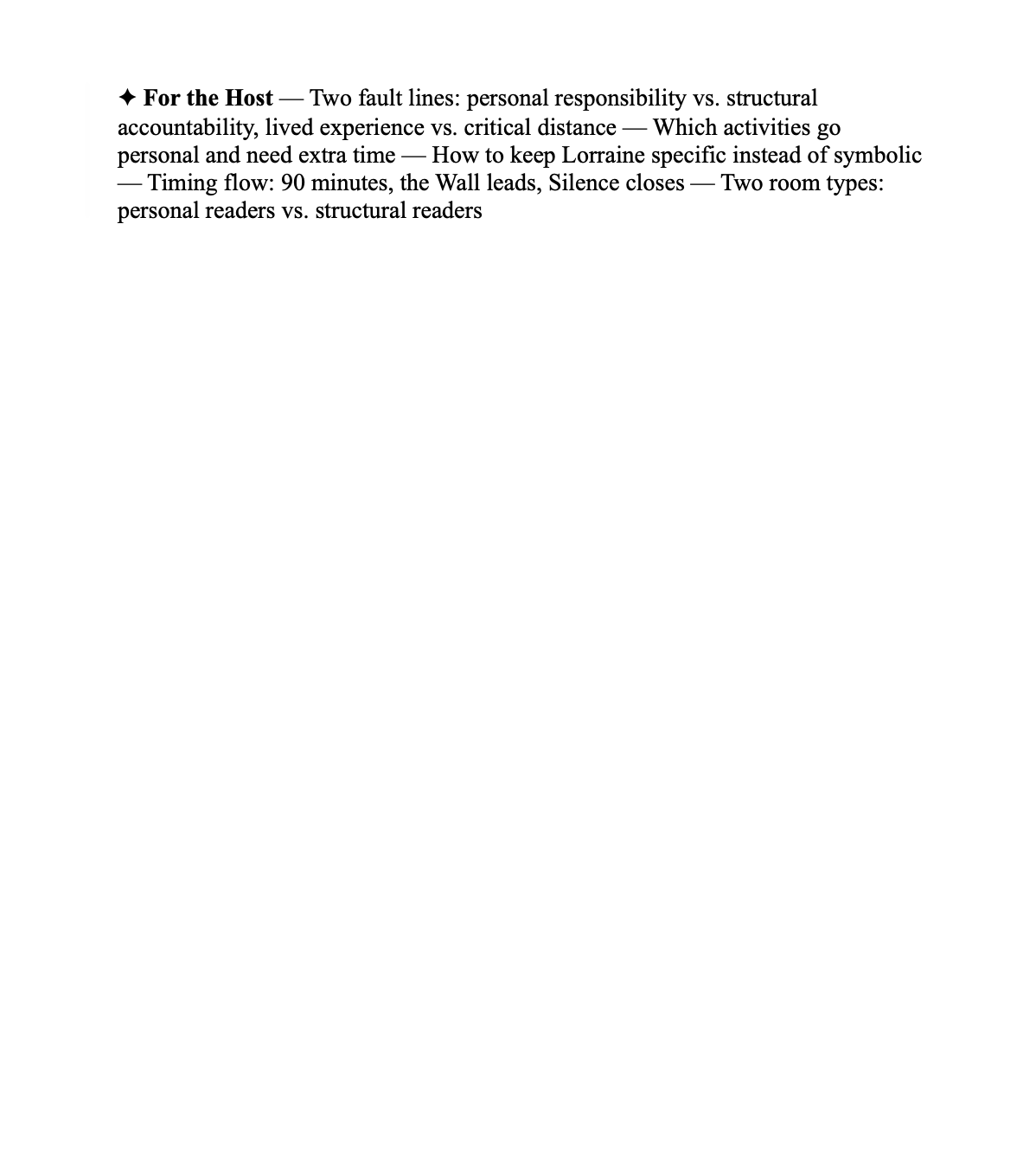
✦ For the Host — Two fault lines: personal responsibility vs. structural accountability, lived experience vs. critical distance — Which activities go personal and need extra time — How to keep Lorraine specific instead of symbolic — Timing flow: 90 minutes, the Wall leads, Silence closes — Two room types: personal readers vs. structural readers
Details: Instant download — PDF delivered immediately at purchase. 20+ pages, print-ready. Licensed for personal and single-group use. Fan-created discussion guide — not affiliated with or endorsed by Gloria Naylor or her publisher.
Licensing for classrooms, libraries, and reading programs is available. If you plan to use this guide in an institutional or educational setting, please contact the shop to arrange an appropriate license.

Isabel Wilkerson spent fifteen years on this book. She interviewed more than 1,200 people, followed three of them from birth to death, drove one to medical appointments, and sat with another as he was dying in the hospital. None of them lived to see it published. That devotion to three ordinary people is itself an argument — that the Great Migration, one of the largest internal movements of people in American history, belongs to the people who lived it and not just to the historians who cataloged it.
Between 1915 and 1970, six million Black Americans left the South. They left sharecropping, Jim Crow, and the constant threat of racial violence for cities that had never seen them in those numbers and were not always prepared to welcome them. Ida Mae Brandon Gladney left Mississippi in 1937 after watching her husband's cousin be beaten nearly to death over a suspicion that was never proven. George Swanson Starling fled Florida in 1945 in the middle of the night with grove owners threatening to kill him for organizing fruit pickers for better wages. Robert Joseph Pershing Foster drove alone through the desert Southwest in 1953, refused at motel after motel because he was Black, and arrived in Los Angeles with almost nothing and the intention of building everything.
Wilkerson insists these people chose to leave. They were not simply pushed out. They looked at what the South was offering and decided it was not enough. That insistence on agency matters — because it places the responsibility for what made leaving necessary squarely on the system that produced those conditions. And it places the question of what the migrants found when they arrived squarely on the North that promised them something and delivered it halfway
This kit was built for the room where this book was finished, with the specific grief of a story this important being so underreported for so long. It was also built for the room that came to it as family history — one or two generations removed from someone who made this journey and found their own inheritance documented on the page. Both rooms deserve the same conversation. Both rooms are welcome here.
What's Inside:
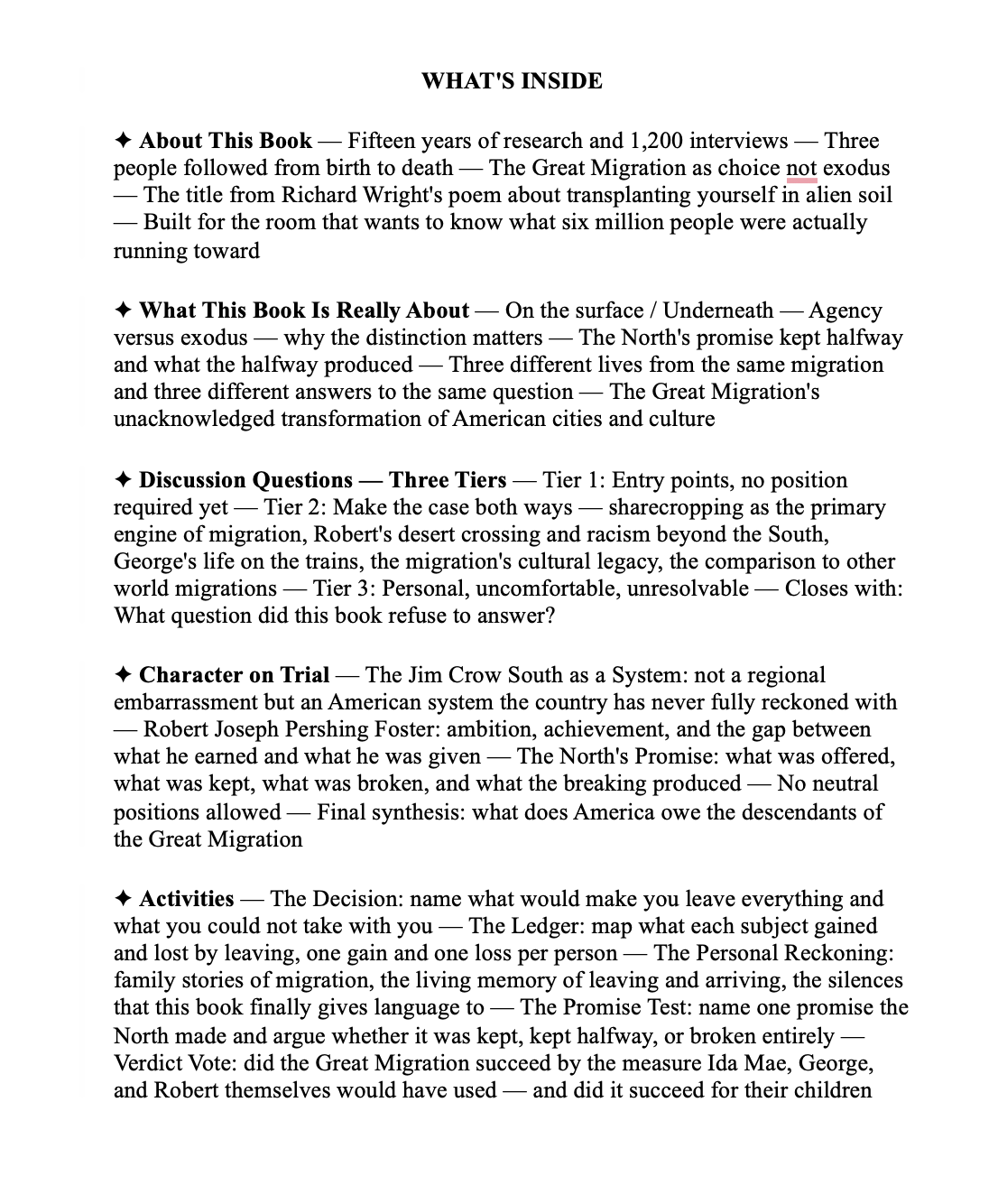
✦ About This Book — Fifteen years of research and 1,200 interviews — Three people followed from birth to death — The Great Migration as choice not exodus — The title from Richard Wright's poem about transplanting yourself in alien soil — Built for the room that wants to know what six million people were actually running toward
✦ What This Book Is Really About — On the surface / Underneath — Agency versus exodus and why the distinction matters — The North's promise kept halfway and what the halfway produced — Three different lives from the same migration and three different answers to the same question — The Great Migration's unacknowledged transformation of American cities and culture
✦ Discussion Questions — Three Tiers — Tier 1: Entry points, no position required yet — Tier 2: Make the case both ways — sharecropping as the primary engine of migration, Robert's desert crossing and racism beyond the South, George's life on the trains, the migration's cultural legacy, the comparison to other world migrations — Tier 3: Personal, uncomfortable, unresolvable — Closes with: What question did this book refuse to answer?
✦ Character on Trial — The Jim Crow South as a System: not a regional embarrassment but an American system the country has never fully reckoned with — Robert Joseph Pershing Foster: ambition, achievement, and the gap between what he earned and what he was given — The North's Promise: what was offered, what was kept, what was broken, and what the breaking produced — No neutral positions allowed — Final synthesis: what does America owe the descendants of the Great Migration
✦ Activities — The Decision: name what would make you leave everything and what you could not take with you — The Ledger: map what each subject gained and lost by leaving — The Personal Reckoning: family stories of migration, the living memory of leaving and arriving, the silences this book finally gives language to — The Promise Test: name one promise the North made and argue whether it was kept, kept halfway, or broken entirely — Verdict Vote: did the Great Migration succeed by the measure Ida Mae, George, and Robert themselves would have used — and did it succeed for their children
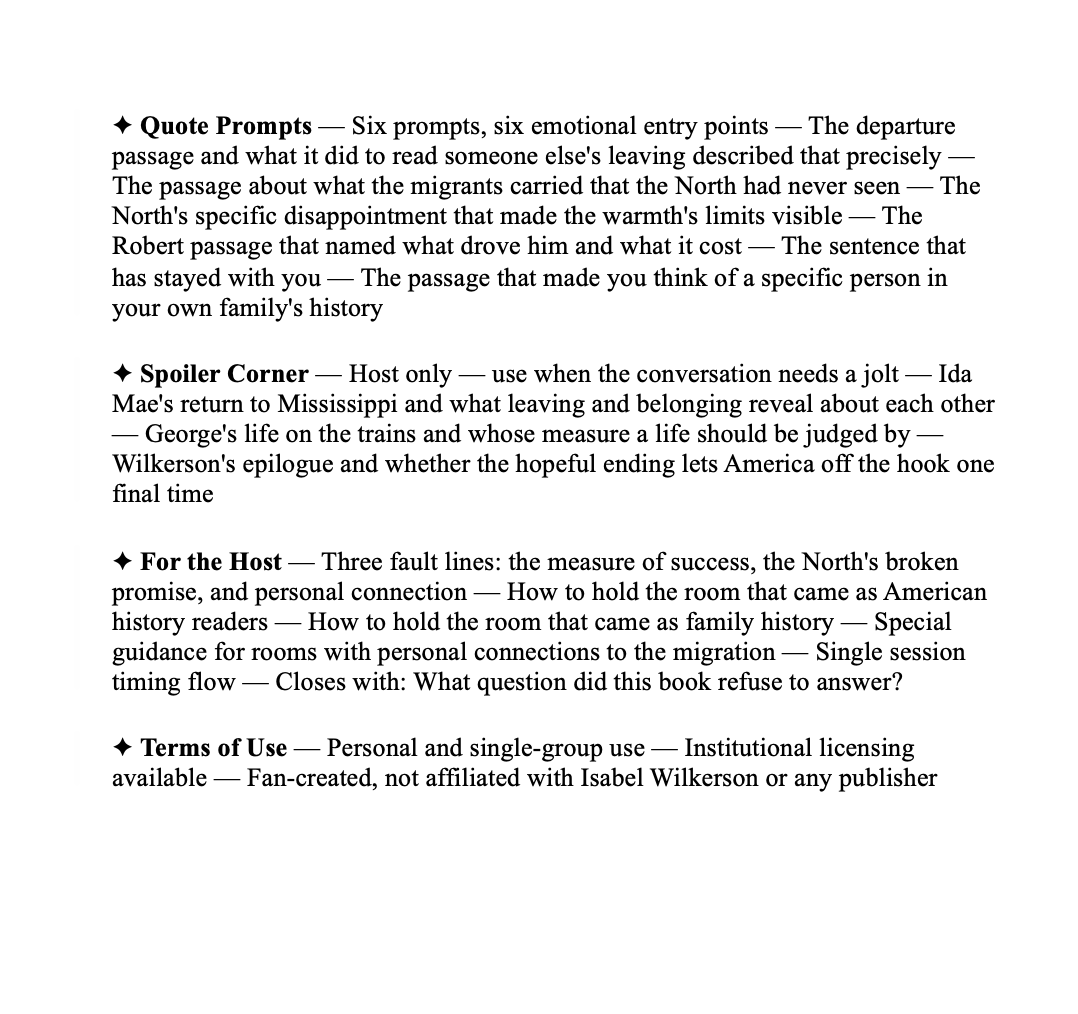
✦ Quote Prompts — Six prompts, six emotional entry points — The departure passage and what it did to read someone else's leaving described that precisely — The passage about what the migrants carried that the North had never seen — The North's specific disappointment that made the warmth's limits visible — The Robert passage that named what drove him and what it cost — The sentence that has stayed with you — The passage that made you think of a specific person in your own family's history
✦ Spoiler Corner — Host only — Full knowledge of the entire book including the epilogue required — Ida Mae's return to Mississippi and what leaving and belonging reveal about each other — George's life on the trains and whose measure a life should be judged by — Wilkerson's epilogue and whether the hopeful ending lets America off the hook one final time
✦ For the Host — Three fault lines: the measure of success, the North's broken promise, and personal connection — How to hold the room that came as American history readers — How to hold the room that came as family history — Special guidance for rooms with personal connections to the migration — Timing flow for a single session
Details: Instant download — PDF format — Personal and single-group use — Fan-created discussion guide — Not affiliated with or endorsed by Isabel Wilkerson or any publisher — Page count: 20+ pages, print-ready
Content note: This guide discusses racial terror and the threat of lynching, the economic exploitation of sharecropping, Jim Crow's specific humiliations, housing discrimination and redlining in the North, and the deliberate concentration of urban poverty. These are not background details — they are Wilkerson's argument. Please consider your group's readiness for this material before purchasing.
Licensing for classrooms, libraries, and educational programs is available. If you plan to use this guide for a class, reading program, or institutional setting, please contact the shop owner to arrange an appropriate license.
This kit was built for the room that finished The Warmth of Other Suns and needed somewhere to put everything the book left in them. It was built for the conversation that starts with what six million people left and ends somewhere none of you expected.
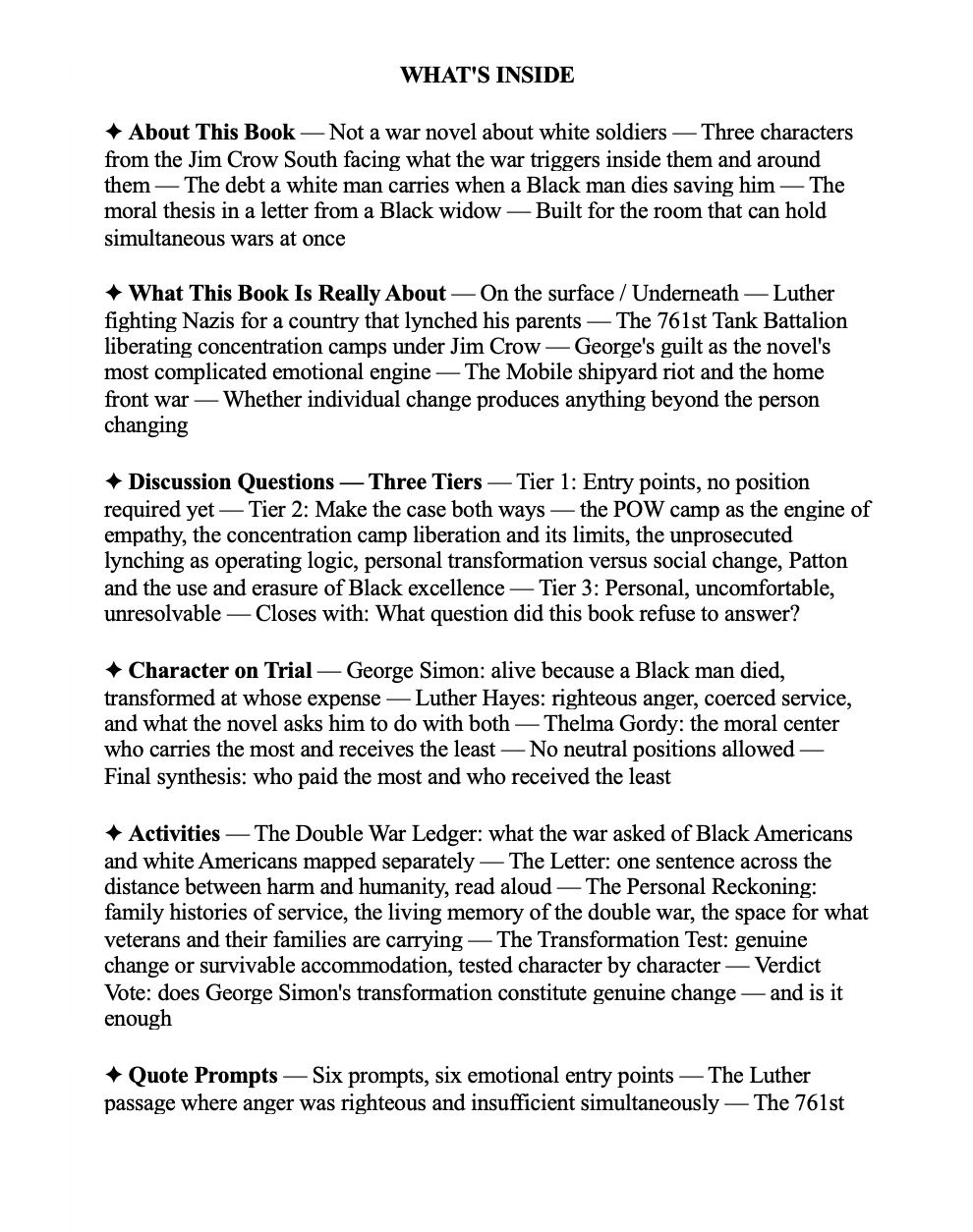
The United States fought two wars during World War II. One was against fascism overseas. The other was the war Black Americans were already fighting at home — against lynching, segregation, economic exclusion, and a legal system that protected white violence and prosecuted Black survival. Leonard Pitts Jr. does not let you forget that both wars were happening simultaneously. This is not a novel about one war. It is a novel about what America asked of three people from the Jim Crow South — and what it cost each of them to answer.
George Simon is an affluent white Marine who survives Pearl Harbor because a Black messman named Gordy pulls him to safety and dies doing it. That debt — a white man alive because a Black man is dead — is what the novel hands George and watches him figure out what to do with. Thelma Gordy is the widow left behind, furious at the Navy for trying to use her husband's death as a recruitment tool for a country that never protected him. Luther Hayes is Thelma's brother who as a child watched his parents be lynched by a mob whose leader was never prosecuted — and who joins the Army not out of patriotism but to avoid prison, and ends up fighting Nazis in Europe with the all-Black 761st Tank Battalion while his own country maintains the racial order the Nazis were trying to export.
Pitts is asking one question across all three of them — what does it take to change someone's mind about race? Not a polite change. Not a theoretical one. The kind of change that costs something. The kind that requires the person changing to reckon with what they were before they changed. This kit was built for the room that finished this novel sitting with the gap between what these three people deserved and what the country delivered — and needed somewhere to put everything the book left in them.
The discussion in this room will divide. Every room that reads this novel eventually has to decide what to think about a white man transformed by a Black man's death and a Black woman's letter who returns home to the same system that produced him — changed inside in ways the novel does not show us challenging outside. Both the prosecution and the defense of his transformation are in this kit. Neither is dismissed. The goal is not to reach a verdict on George Simon. The goal is to ask what change is worth when the system that needed changing is still standing.
What's Inside:
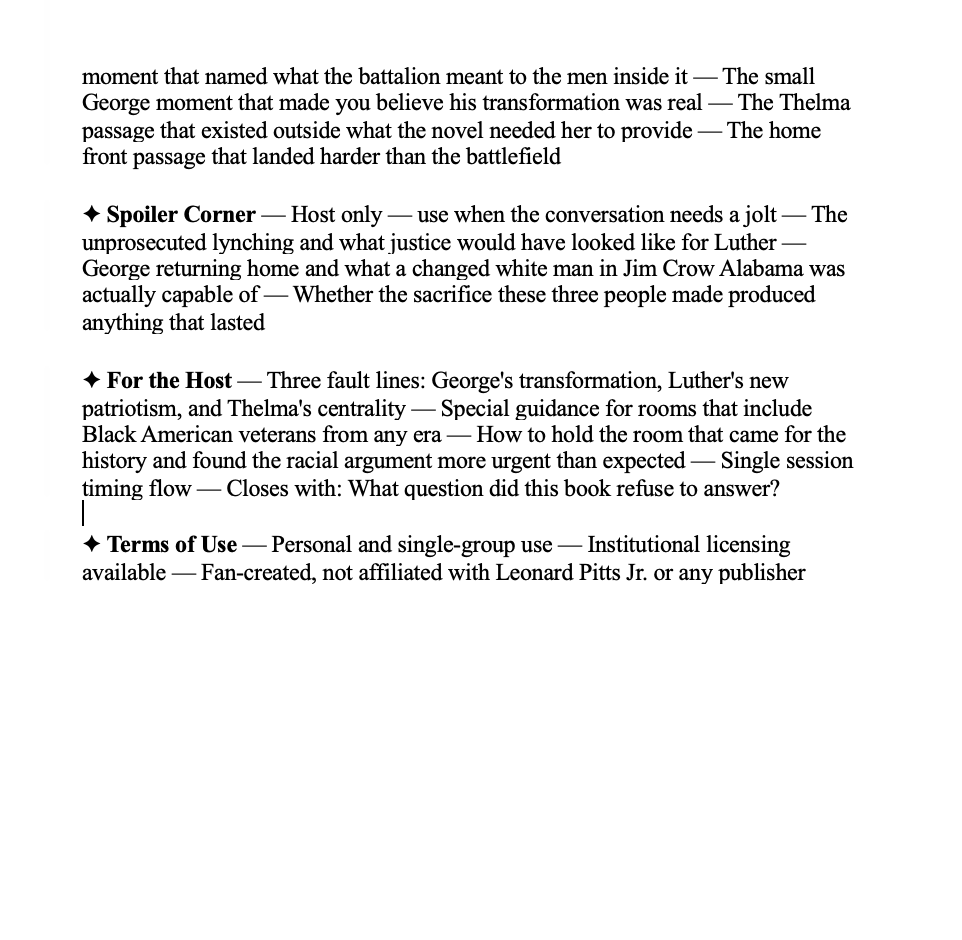
✦ About This Book — Not a war novel about white soldiers — Three characters from the Jim Crow South facing what the war triggers inside them and around them — The debt a white man carries when a Black man dies saving him — The moral thesis in a letter from a Black widow — Built for the room that can hold simultaneous wars at once
✦ What This Book Is Really About — On the surface / Underneath — Luther fighting Nazis for a country that lynched his parents — The 761st Tank Battalion liberating concentration camps under Jim Crow — George's guilt as the novel's most complicated emotional engine — The Mobile shipyard riot and the home front war — Whether individual change produces anything beyond the person changing
✦ Discussion Questions — Three Tiers — Tier 1: Entry points, no position required yet — Tier 2: Make the case both ways — the POW camp as the engine of empathy, the concentration camp liberation and its limits, the unprosecuted lynching as operating logic, personal transformation versus social change, Patton and the use and erasure of Black excellence — Tier 3: Personal, uncomfortable, unresolvable — Closes with: What question did this book refuse to answer?
✦ Character on Trial — George Simon: alive because a Black man died, transformed at whose expense — Luther Hayes: righteous anger, coerced service, and what the novel asks him to do with both — Thelma Gordy: the moral center who carries the most and receives the least — No neutral positions allowed — Final synthesis: who paid the most and who received the least
✦ Activities — The Double War Ledger: what the war asked of Black Americans and white Americans mapped separately — The Letter: one sentence across the distance between harm and humanity, read aloud — The Personal Reckoning: family histories of service, the living memory of the double war, the space for what veterans and their families are carrying — The Transformation Test: genuine change or survivable accommodation, tested character by character — Verdict Vote: does George Simon's transformation constitute genuine change — and is it enough
✦ Quote Prompts — Six prompts, six emotional entry points — The Luther passage where anger was righteous and insufficient simultaneously — The 761st moment that named what the battalion meant to the men inside it — The small George moment that made you believe his transformation was real — The Thelma passage that existed outside what the novel needed her to provide — The home front passage that landed harder than the battlefield
✦ Spoiler Corner — Host only — Full knowledge of the entire novel required — The unprosecuted lynching and what justice would have looked like for Luther — George returning home and what a changed white man in Jim Crow Alabama was actually capable of — Whether the sacrifice these three people made produced anything that lasted
✦ For the Host — Three fault lines: George's transformation, Luther's new patriotism, and Thelma's centrality — Special guidance for rooms that include Black American veterans from any era — Timing flow for a single session — How to hold the room that came for the history and found the racial argument more urgent than expected
Details: Instant download — PDF format — Personal and single-group use — Fan-created discussion guide — Not affiliated with or endorsed by Leonard Pitts Jr. or any publisher — Page count: 20+ pages, print-ready
Content note: This guide discusses lynching, racial violence, Japanese POW camp conditions, the Mobile Alabama shipyard race riot, and the liberation of a Nazi concentration camp. These are not incidental to Pitts's argument — they are the argument. Please consider your group's readiness for this material before purchasing.
Licensing for classrooms, libraries, and educational programs is available. If you plan to use this guide for a class, reading program, or institutional setting, please contact the shop owner to arrange an appropriate license.
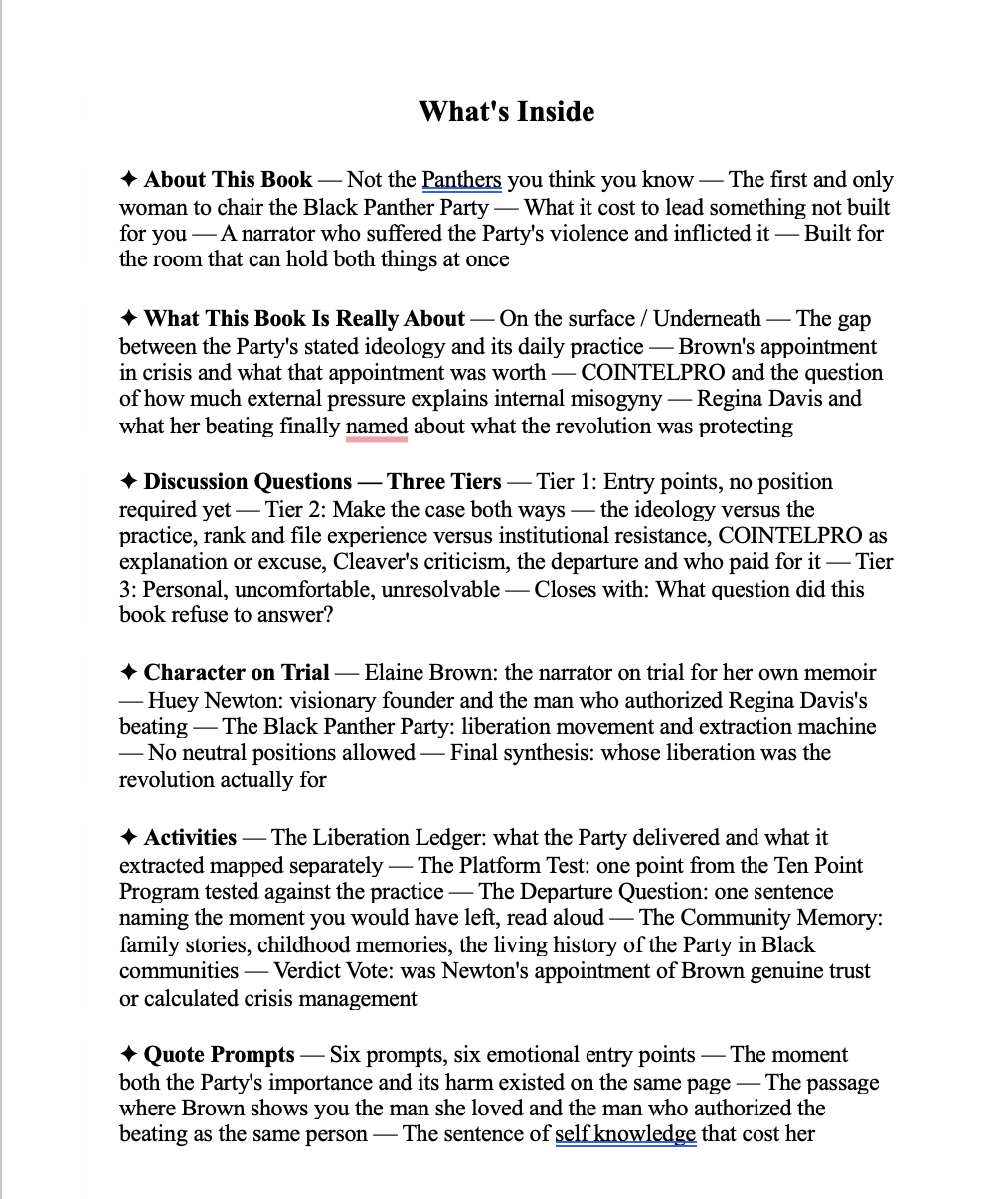
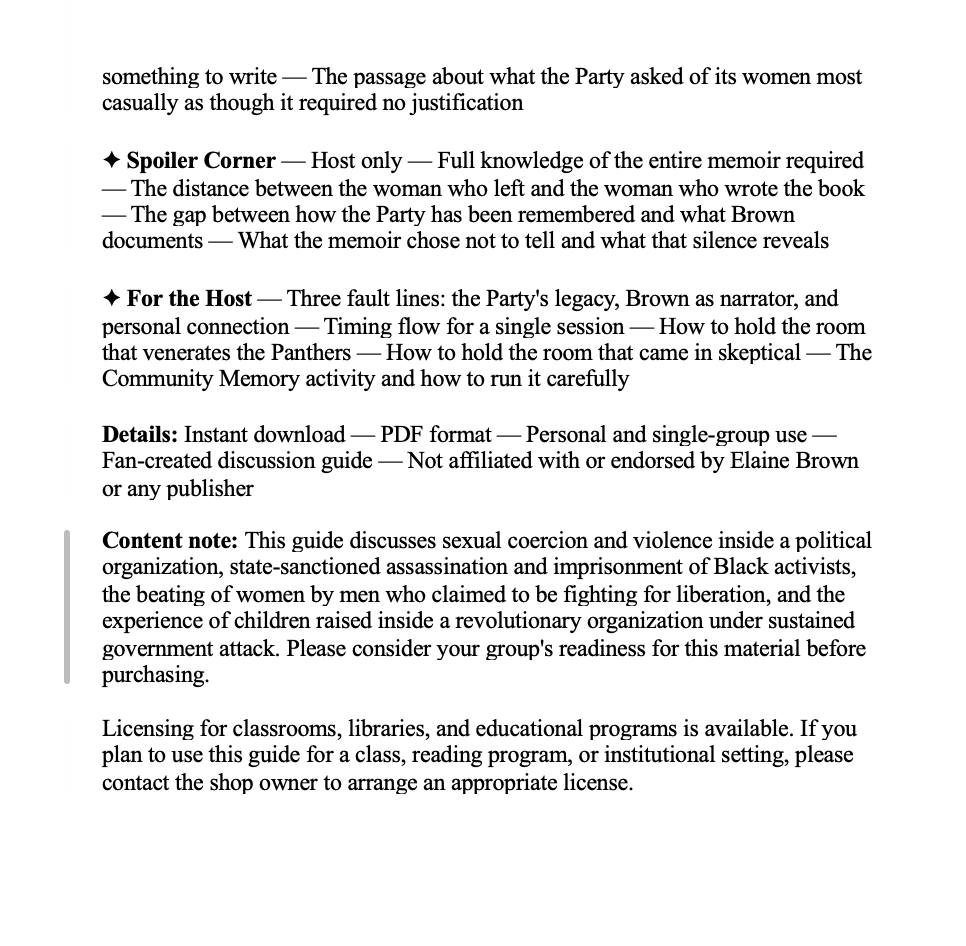
Elaine Brown walked into the Black Panther Party's general assembly in August 1974 and announced her leadership with these words: "I have all the guns and all the money. I can withstand challenge from without and from within. Am I right, Comrade?" She was the first and only woman to chair the Black Panther Party. She would lead it for three years. And she would leave by grabbing her daughter and disappearing — not because the revolution failed but because a woman was beaten for having authority over a man and Huey Newton authorized it and that was the end.
This is not a book about the Black Panther Party the way most people understand the Black Panther Party. It is a book about what it cost to be inside that organization. What it cost to be a woman in a movement that said it believed in liberation while demanding that its women cook, clean, raise children they couldn't spend time with, and accept that a woman who asserted authority was eroding Black manhood. What it cost to rise to the top of that organization and lead it effectively — founding schools, winning mayoral campaigns, expanding community programs — while being told at every level that her leadership was an insult to the men around her.
Brown is not a simple narrator and this kit does not treat her as one. She both suffered the Party's violence and inflicted it. She stayed longer than many readers will think she should have. She left in a way that had costs for the women who remained. The room this kit was built for can hold all of that simultaneously — the genuine importance of what the Black Panther Party built and the genuine harm it did to the women who built it alongside the men whose names history attached to it.
This discussion is going to divide. Every room that reads this memoir eventually has to decide what to do with a revolutionary organization that believed in liberation for some people and extracted the rest. Both positions are in this kit. Neither is dismissed. The goal is not to reach a verdict on the Black Panther Party. The goal is to hold it accountable and understand it at the same time — which is exactly what Brown asks of her readers and exactly what the best book club conversations do.
A deep dive into how government policy quietly—and intentionally—shaped segregation in America.
Residential segregation was not an accident. It was not the result of private prejudice or individual choices made by millions of people over generations. It was the explicit, documented policy of the United States federal government — and Richard Rothstein has the paper trail to prove it.
The Color of Law is not a polemic. It is a prosecution. Rothstein builds his argument the way a lawyer builds a case — policy by policy, agency by agency, map by map — and by the time he's done, the question is no longer whether this happened. The question is what obligation that history creates in the present. That question is harder. This kit was built to help a room sit with it together.
This guide was built for both rooms — the reader who finishes this book confirmed and the reader who finishes it undone — because the most productive conversation happens when both are present at the same time.
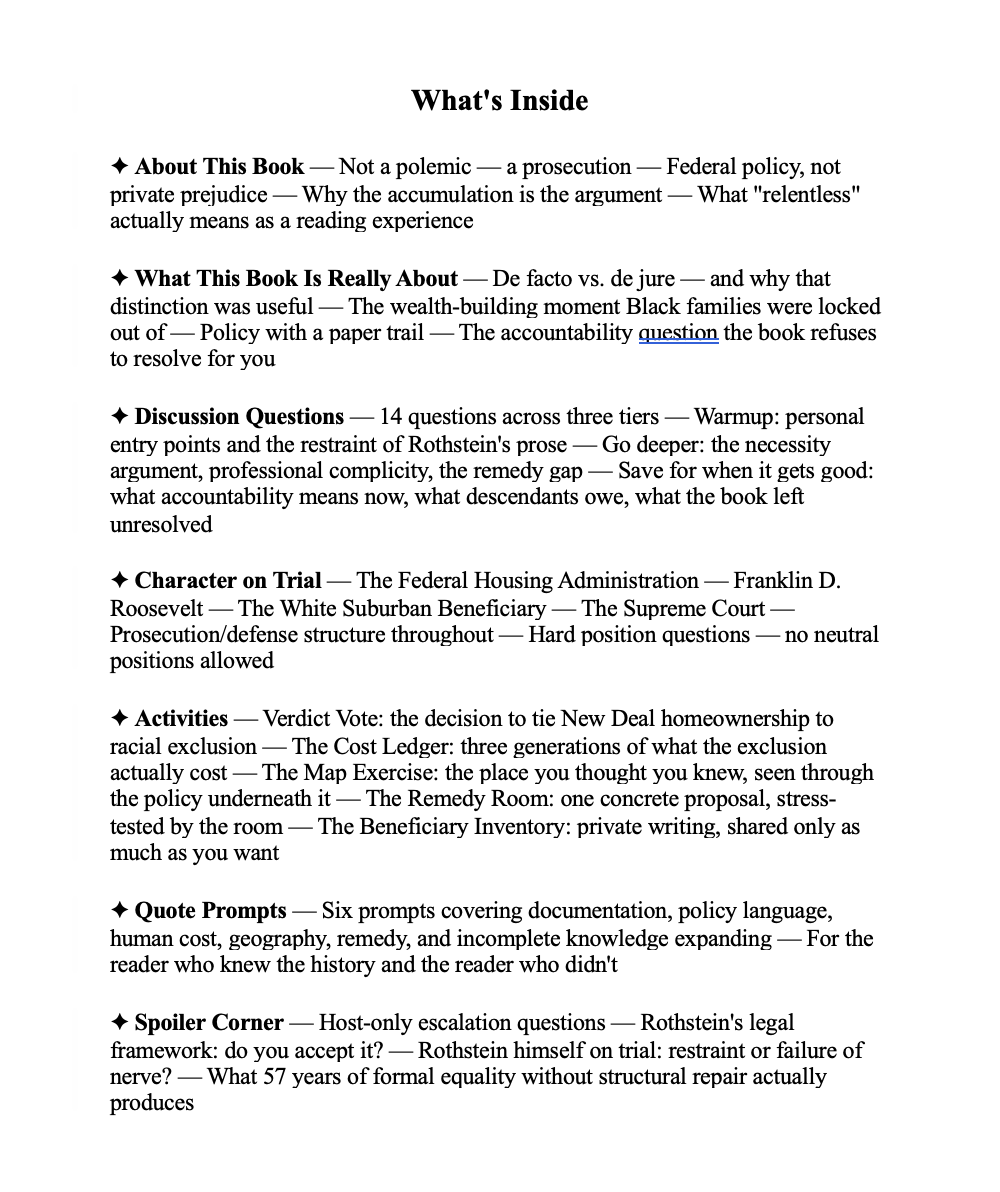
✦ About This Book — why this is a prosecution, not a polemic, and what makes it relentless
✦ What This Book Is Really About — de facto vs. de jure segregation, the wealth-building moment Black families were locked out of, and the accountability question Rothstein refuses to resolve for you
✦ Discussion Questions — 14 questions across three tiers, from personal entry points to the unresolvable questions the book plants and walks away from
✦ Character on Trial — the FHA, FDR, the White Suburban Beneficiary, and the Supreme Court; prosecution/defense structure, hard positions required, no neutral stances
✦ Activities — Verdict Vote, The Cost Ledger, The Map Exercise, The Remedy Room, and The Beneficiary Inventory
✦ Quote Prompts — six prompts covering the reader who came in knowing the history and the reader who didn't
✦ Spoiler Corner — host-only escalation questions including putting Rothstein's own restraint on trial
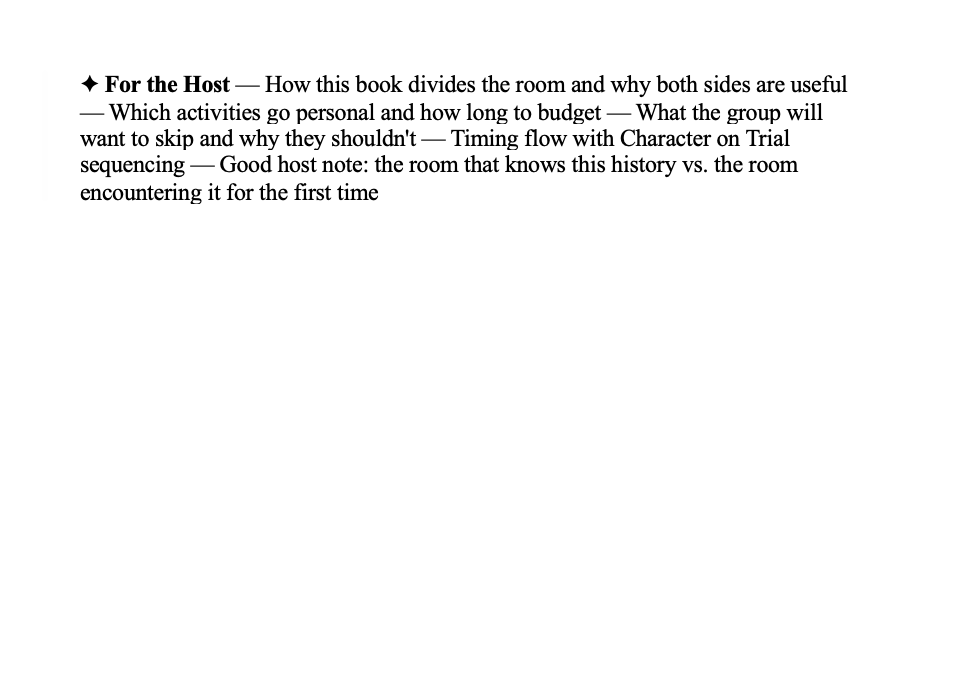
✦ For the Host — facilitation notes, timing flow, and guidance for two very different kinds of rooms
Details: Instant download. PDF delivered immediately after purchase. 20+ pages, print-ready. Personal and single-group use. Fan-created — not affiliated with Richard Rothstein or his publisher.
For classrooms, libraries, and educational programs — contact the shop for institutional licensing.
Built for the room that finishes The Color of Law and doesn't know what to do with what they now know. That's not a comfortable place to be. It's exactly the right place to start.

Octavia Butler set the Parable novels in the 2020s and published the first one in 1993. She wasn't writing science fiction. She was extrapolating from things she could already see — and she put a fifteen-year-old Black girl at the center of the collapse and asked what it takes to build something new when everything around you is actively falling apart. That question still doesn't have a clean answer. This bundle is built for the room that wants to sit with it anyway.
The Parable series is two novels and one unresolved argument. Parable of the Sower follows Lauren Olamina as she survives collapse, forms a philosophy, and arrives at the beginning of something. Parable of the Talents picks up years later, when that beginning has become a movement — and shows you, through the voice of Lauren's daughter, exactly what the movement cost the people who had to live inside it. The two books are not the same kind of story. Reading them together changes what you think you understood about each one separately.
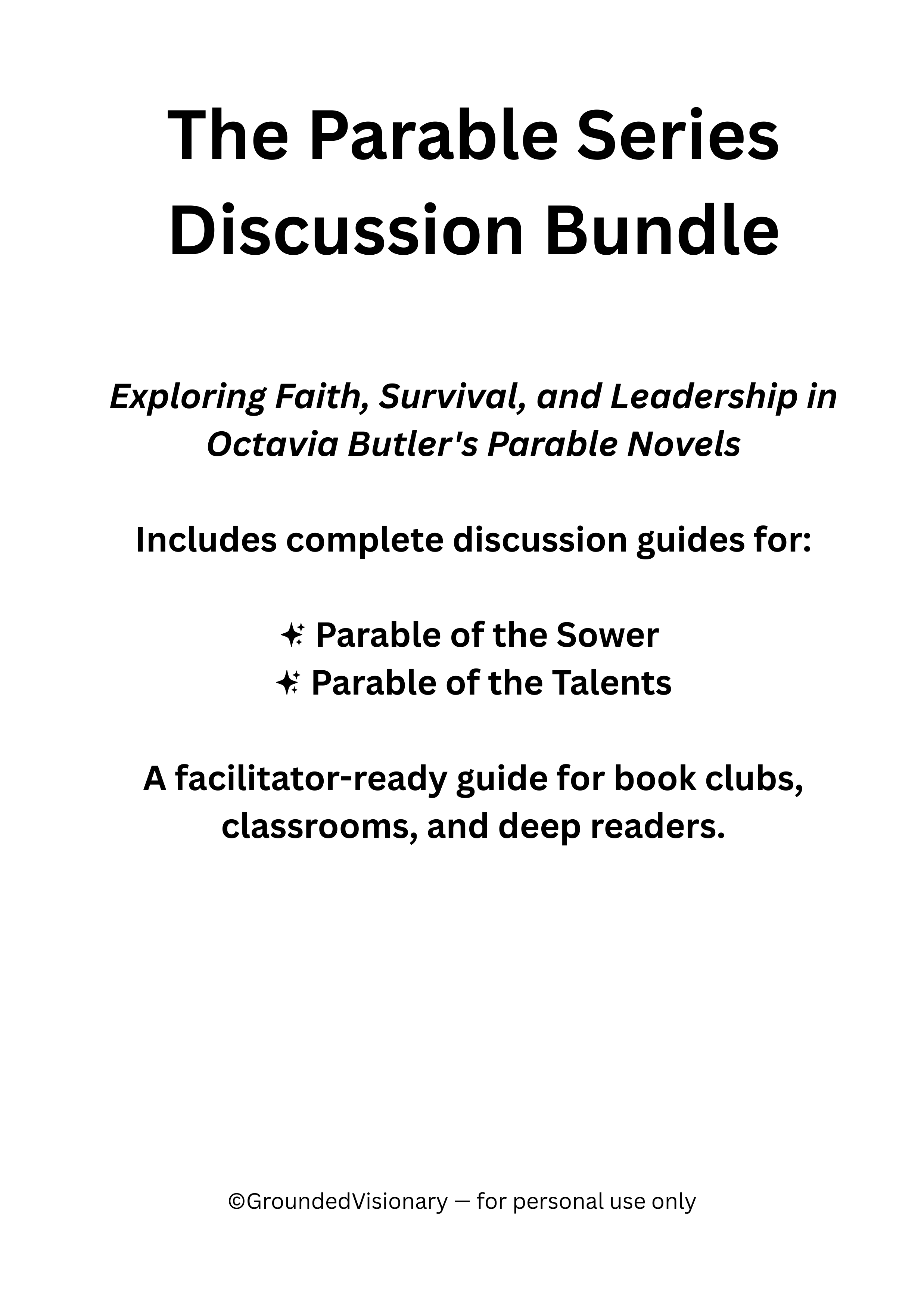
This bundle includes complete discussion guides for both novels plus connecting material designed specifically for readers who have finished the series. Twelve cross-book questions that neither individual guide could ask on its own. A three-session facilitation structure for book clubs moving through both novels in sequence. And a final closer built around the questions Butler left deliberately unresolved — including the third novel she never wrote.
This bundle was built for the room that finished both books and realized the series isn't really about the future. It's about right now — and what we're willing to build inside it.
✦ What's Inside
✦ Complete Discussion Guide — Parable of the Sower — About This Book & What It's Really About — Three-tier discussion questions — Character on Trial: Lauren, Harry, and Zahra — Four activities including Verdict Vote — Quote Prompts, Spoiler Corner, For the Host
✦ Complete Discussion Guide — Parable of the Talents — About This Book & What It's Really About — Three-tier discussion questions — Character on Trial: Lauren, Larkin, Marc, and Bankole — Five activities including Verdict Vote and The Marc Test — Quote Prompts, Spoiler Corner, For the Host
✦ Series Introduction — What the Parable novels are actually arguing — Why the two books need to be read as a sequence
✦ Three-Session Facilitation Structure — Session closers designed to carry questions between meetings — Guidance for single-session and post-read use
✦ Transition Page: From Survival to Legacy — Orients the group between the two novels — Reframes what the second book is doing before discussion begins
✦ Cross-Book Discussion Questions — 12 questions across four sections — The arc of Lauren Olamina across both novels — Earthseed as idea versus institution — Larkin and the question of legacy — What the series leaves unresolved
✦ Where the Parable Series Leaves You — Final closer built around Butler's unresolved questions — Includes the question the third novel was supposed to answer
✦ Bonus Host Guide — A free facilitation toolkit included with every purchase
Details — Instant download PDF — Price reflects both complete individual guides plus all series connecting material — Personal and single-group use. No redistribution or resale. — Fan-created guide. Not affiliated with or endorsed by Octavia Butler's estate or any publisher.
Licensing for classrooms, libraries, and educational programs is available. If you plan to use this guide for a class, reading program, or institutional setting, please contact the shop owner to arrange an appropriate license.

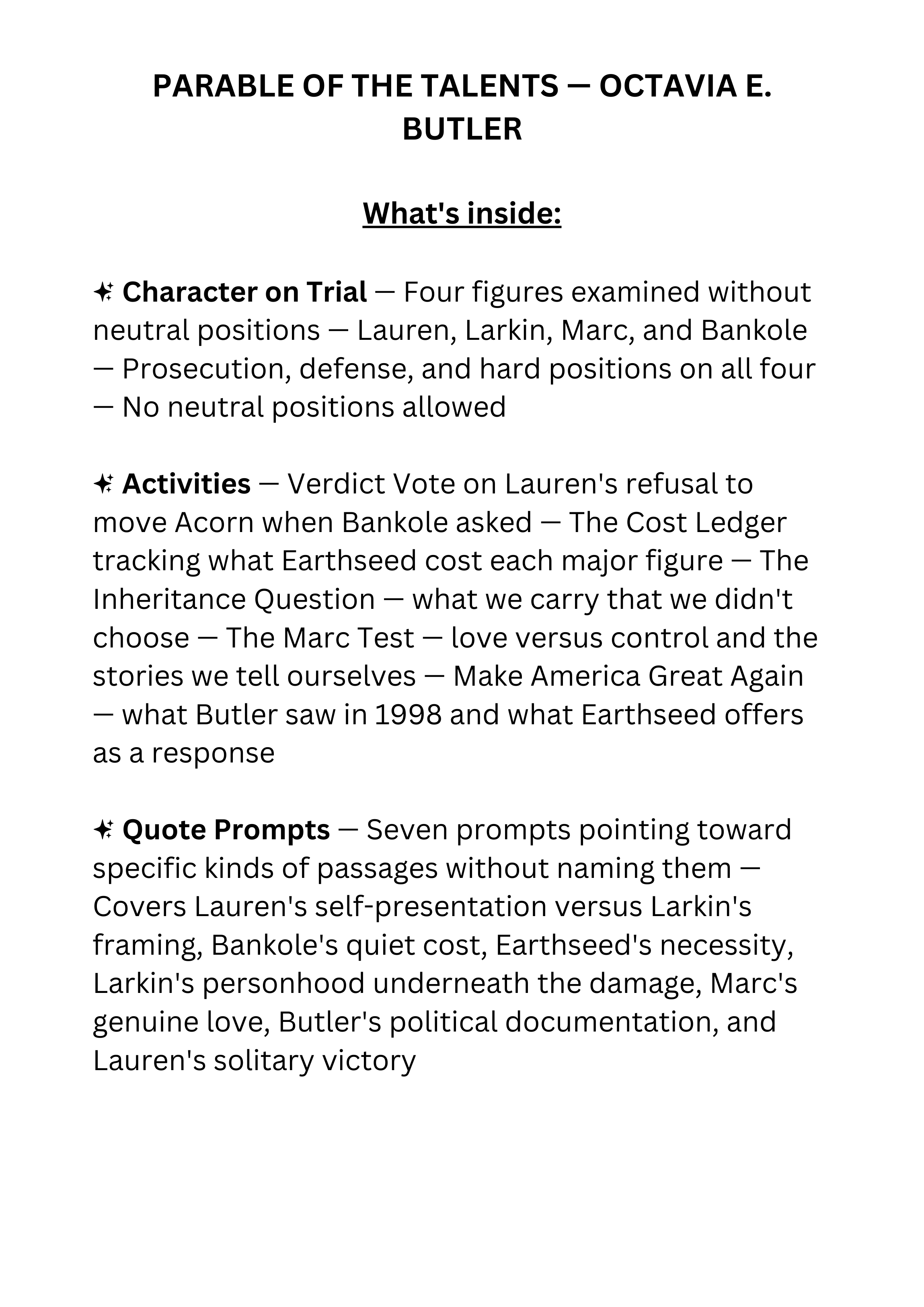
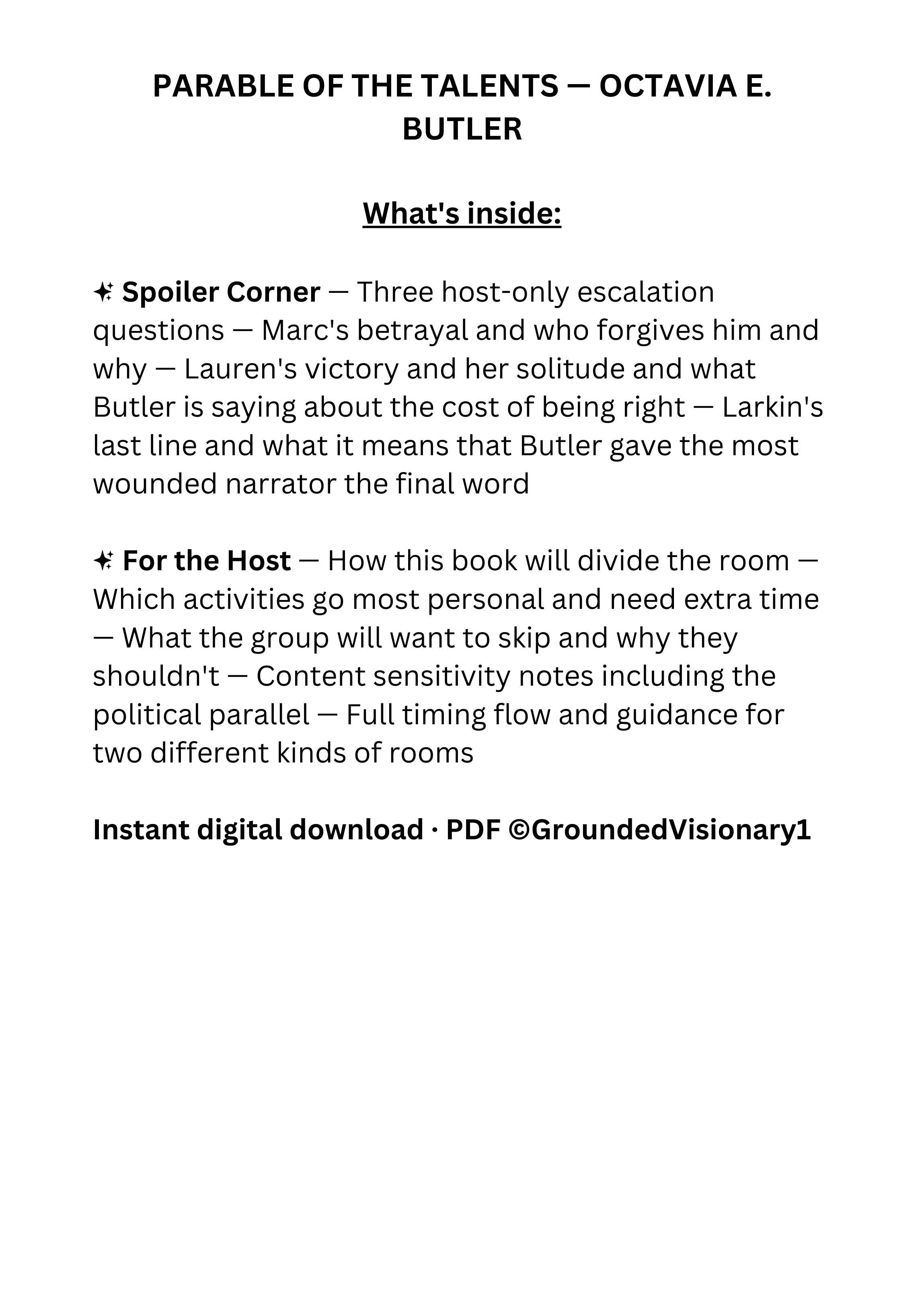
Octavia Butler published this novel in 1998. Her fictional president runs on "Make America Great Again." He uses religious nationalism to justify the enslavement and torture of people he calls heathens. He separates children from their families at the border of his ideology. She was not predicting the future. She was describing a pattern she had already seen — and putting it somewhere people could look at it clearly.
But Parable of the Talents is not primarily a political novel. It is a novel about a woman who was right about everything that mattered and lost almost everyone who mattered in the process of being right. Lauren Olamina builds Earthseed from nothing in a collapsing America, survives enslavement and rape and the violent destruction of her community, spends decades searching for the daughter she lost, and lives to watch humanity leave Earth for the stars exactly as she always said it would. She wins. She is also standing alone at the finish line.
The novel is told through Lauren's journals — assembled, arranged, and framed by Larkin, the daughter Lauren lost as an infant and never fully recovered. Everything the reader receives from Lauren arrives through the hands of a woman who needed her mother to have failed. That is not an accident. Butler built the novel's most uncomfortable question into its structure: whose version of this story are you actually holding?
This kit was built for a room willing to hold Lauren's genuine achievement and her genuine cost simultaneously — without resolving the tension between them into a verdict Butler never delivered.
Note: This guide contains material addressing religious extremism, enslavement, sexual violence, forced separation of children from parents, and political violence consistent with the novel's content. A content warning page is included at the front of the guide with specific facilitation guidance for hosts.
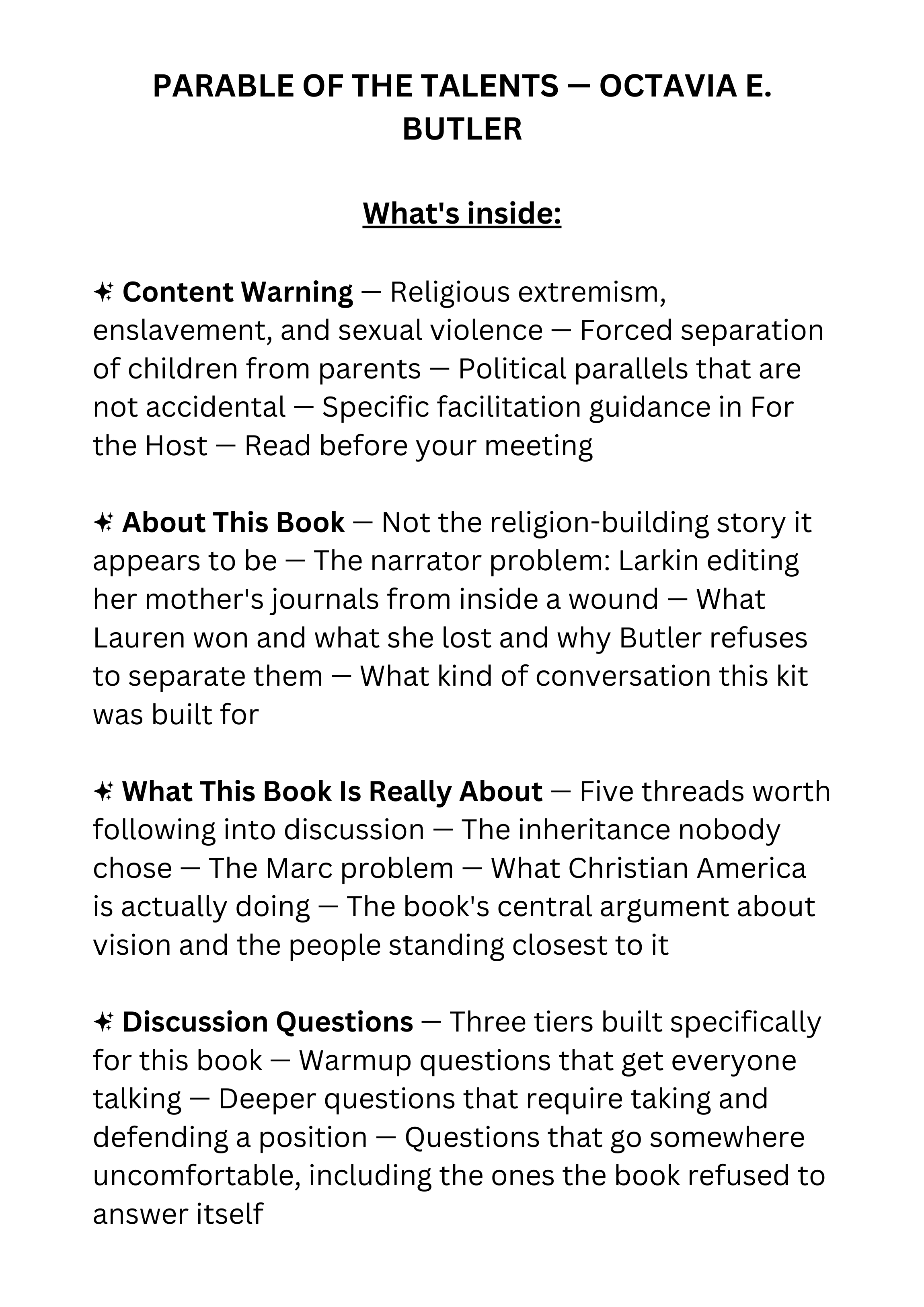
✦ What's Inside
✦ Content Warning — Religious extremism, enslavement, sexual violence — Forced separation of children from parents — Political violence — Facilitation guidance included for hosts
✦ About This Book — Not the religion-building story it appears to be — The narrator problem — whose version are you holding — What Lauren won and what it cost — What kind of conversation this kit was built for
✦ What This Book Is Really About — Five threads worth following into discussion — The inheritance nobody chose — The Marc problem — What Christian America is actually doing in this novel — The book's central argument about vision and cost
✦ Discussion Questions — Three Tiers — Tier 1: Warmup questions that get everyone talking — Tier 2: Deeper questions requiring a position and a defense — Tier 3: Personal, uncomfortable, unresolvable — Closes with: What question did this book refuse to answer?
✦ Character on Trial — Lauren, Larkin, Marc, and Bankole — Prosecution/defense structure — Hard position questions with mandatory reversal — No neutral positions allowed
✦ Activities — Verdict Vote: Lauren's refusal to move Acorn — The Cost Ledger: what the vision cost and who paid it — The Inheritance Question: what Larkin inherited that she didn't choose — The Marc Test: what love looks like when it becomes control — Make America Great Again: what Butler saw and what landed this week
✦ Quote Prompts — Seven prompts pointing toward specific kinds of passages — The passage where Lauren's certainty became its own kind of cost — The moment Larkin's grief reframed everything you thought you understood
✦ Spoiler Corner — Host only — three escalation questions for when the conversation needs a jolt
✦ For the Host — How this book will divide the room — Content sensitivity notes and facilitation guidance — Full timing flow and guidance for two different kinds of rooms
✦ Bonus Host Guide — A free facilitation toolkit included with every purchase
Details — Instant download PDF — 45+ pages, print-ready — Personal and single-group use. No redistribution or resale. — Fan-created guide. Not affiliated with or endorsed by Octavia Butler's estate or any publisher.
Licensing for classrooms, libraries, and educational programs is available. If you plan to use this guide for a class, reading program, or institutional setting, please contact the shop owner to arrange an appropriate license.

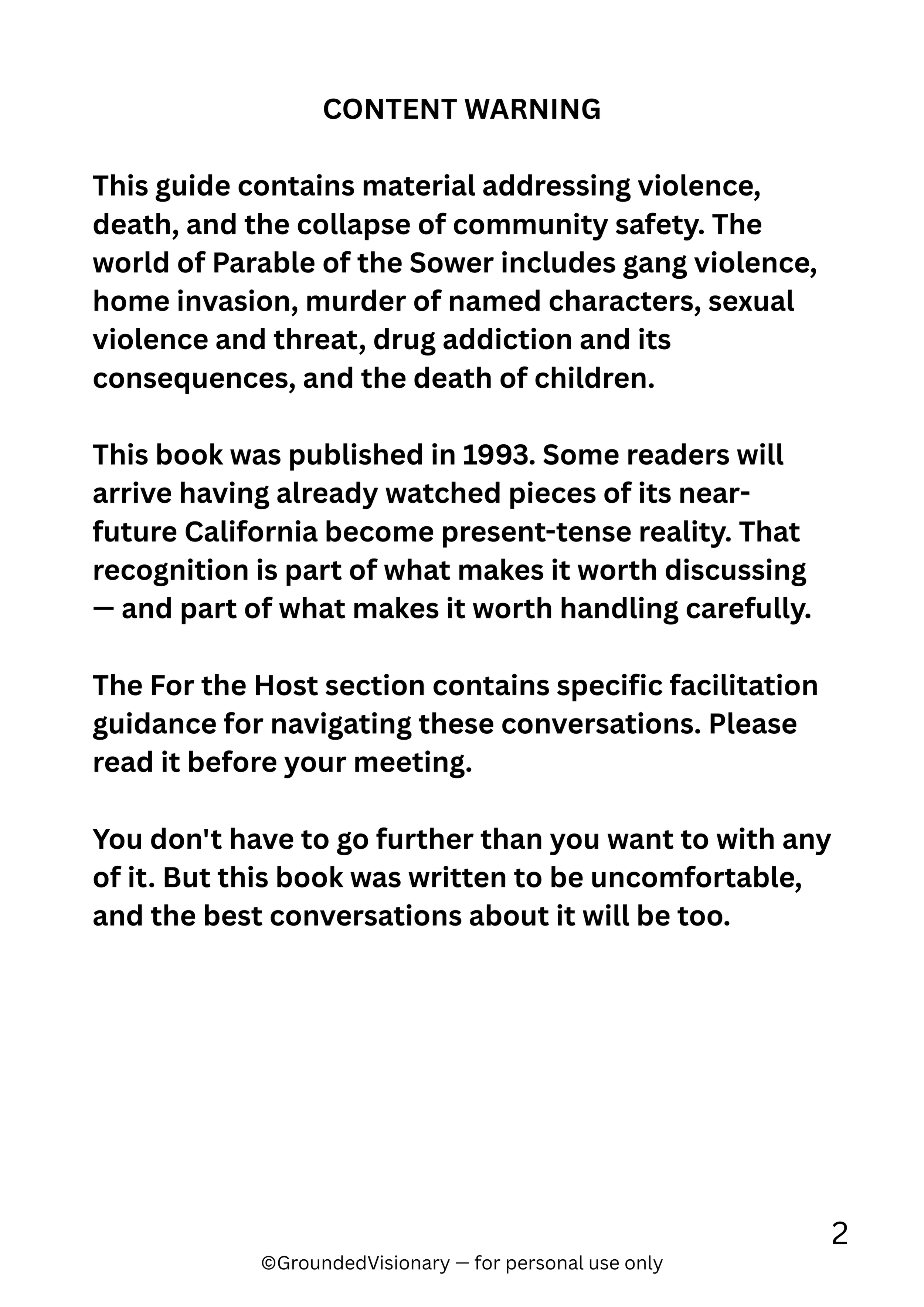
Octavia Butler published this book in 1993. She set it in the 2020s.
Lauren Olamina is fifteen years old and already right about everything that matters. The wall is going to fall. The neighborhood is going to burn. The people who stayed are going to die or scatter. She prepares quietly, recruits carefully, and keeps moving north while feeling every death on that road in her own body. The novel gives her the survival she earned and declines to make it feel clean.
This is not a book about the future. It is a book about what Butler saw coming thirty years ago and what it means to be right. The conversation your book club is about to have is not really about Lauren Olamina. It's about leadership as calculation and risk. It's about what community costs, not just what it gives. It's about the line between preparation and paranoia — and who gets to draw it. And it's about what you do when the thing you built your life around won't hold.
This kit goes there. Not a list of comprehension questions. Not a plot summary dressed up as analysis. A room-ready guide built specifically for this book by someone who read it, felt it, and understood that the conversation it generates is not really about the future at all.
Content note: This guide contains discussion of violence, community collapse, sexual violence and threat, drug addiction, and political parallels that are not accidental. Facilitation guidance is included in the For the Host section.
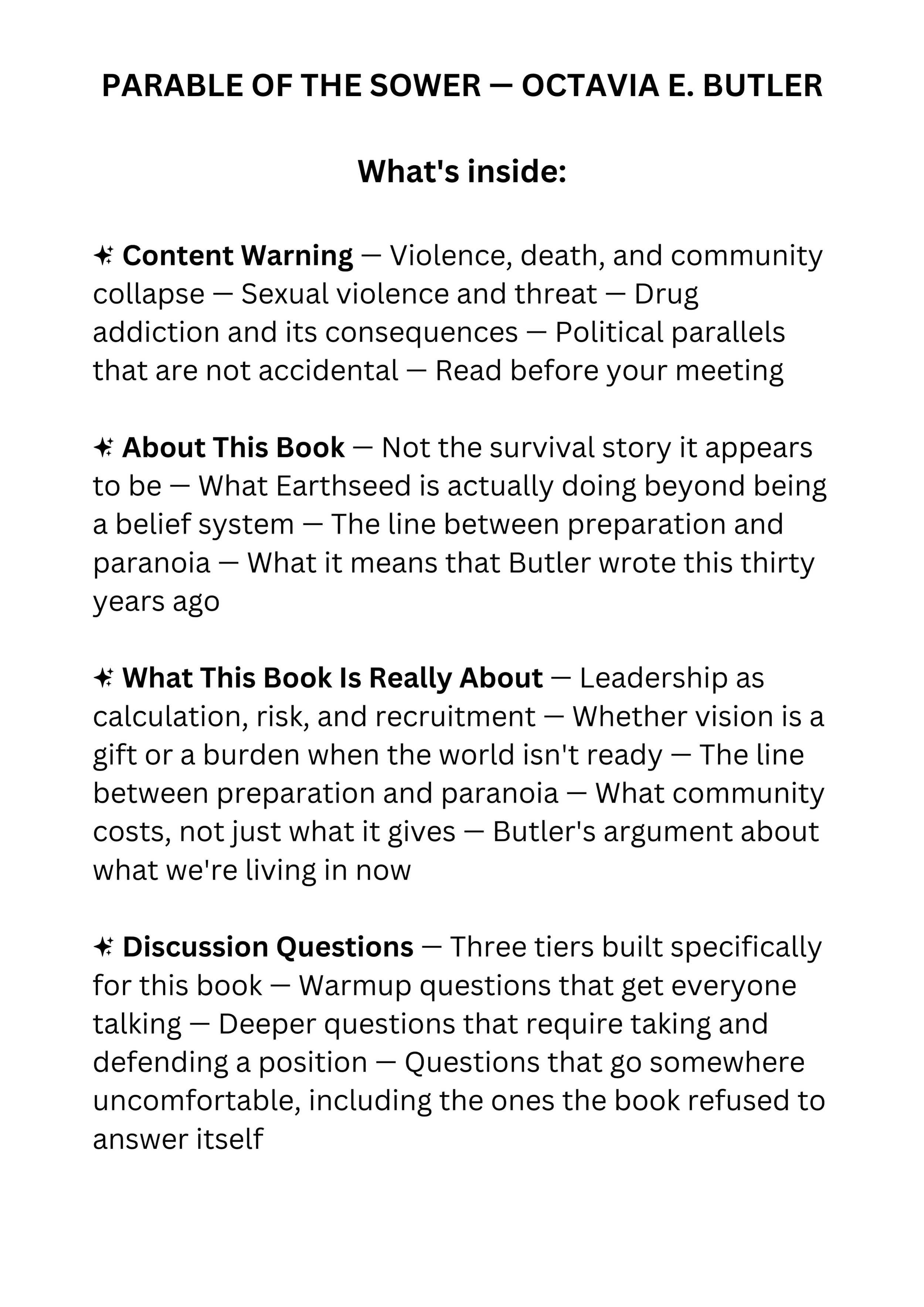
✦ What's Inside
✦ Content Warning — Violence, death, and community collapse — Sexual violence and threat — Drug addiction and its consequences — Political parallels that are not accidental — Facilitation guidance in For the Host
✦ About This Book — What Earthseed is actually doing beyond being a belief system — The line between preparation and paranoia — What it means that Butler wrote this thirty years ago
✦ What This Book Is Really About — Five threads worth following into discussion — Leadership as calculation, risk, and recruitment — What community costs not just what it gives — Butler's argument about what we're living in now
✦ Discussion Questions — Three Tiers — Tier 1: Warmup questions that get everyone talking — Tier 2: Deeper questions requiring a position and a defense — Tier 3: Personal, uncomfortable, unresolvable — Closes with: What question did this book refuse to answer?
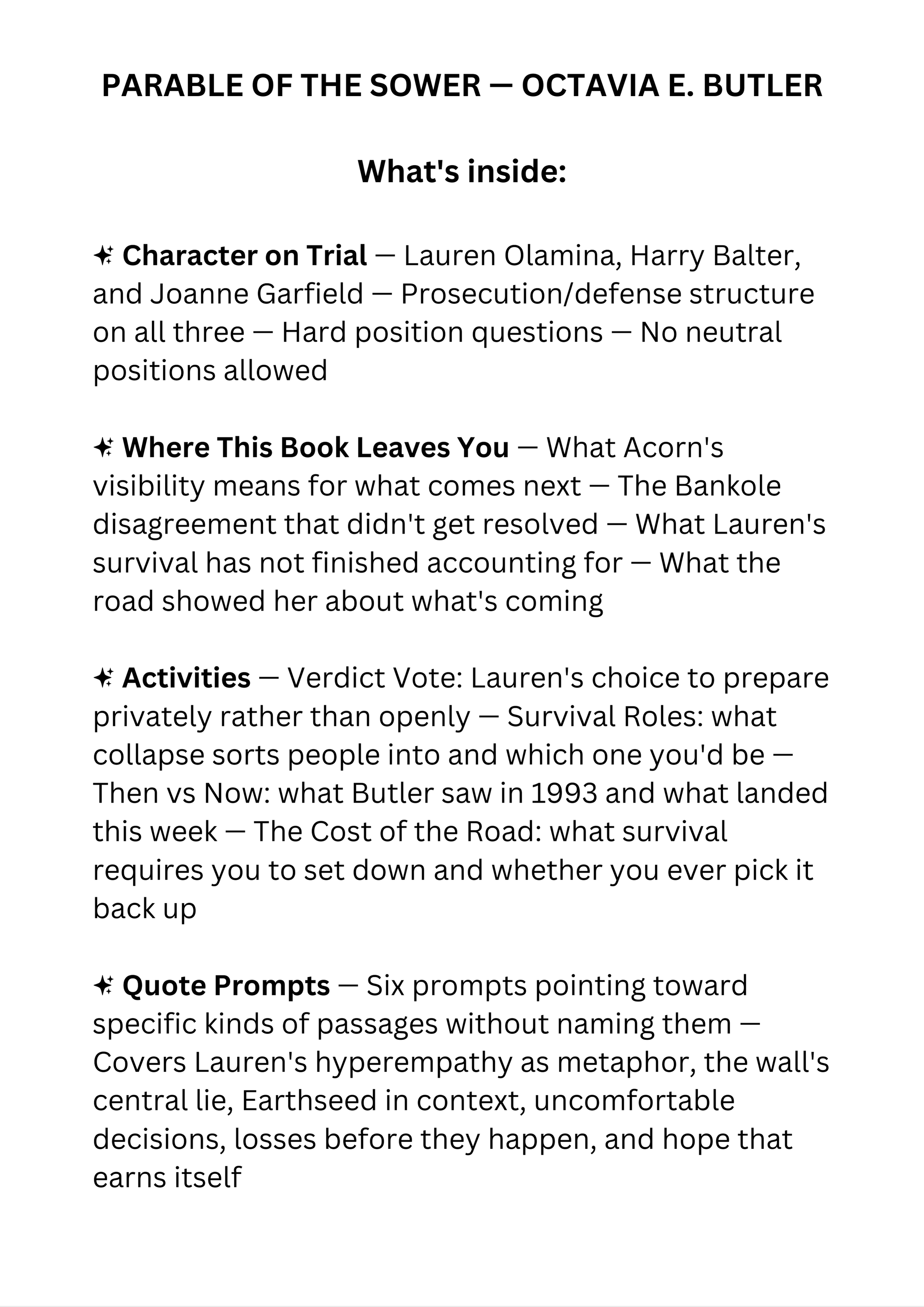
✦ Where This Book Leaves You — What Acorn's visibility means for what comes next — The Bankole disagreement that didn't get resolved — What Lauren's survival has not finished accounting for
✦ Character on Trial — Lauren Olamina, Harry Balter, Joanne Garfield — Prosecution/defense structure — Hard position questions with mandatory reversal — No neutral positions allowed
✦ Activities — Verdict Vote: Lauren's choice to prepare privately rather than openly — Survival Roles: what collapse sorts people into and which one you'd be — Then vs. Now: what Butler saw in 1993 and what landed this week — The Cost of the Road: what survival requires you to set down and whether you ever pick it back up
✦ Quote Prompts — Six prompts across six emotional entry points — Entry points for every kind of reader including the one who found Lauren unsettling — The passage where preparation stopped looking like paranoia — The moment the road cost something that couldn't be picked back up
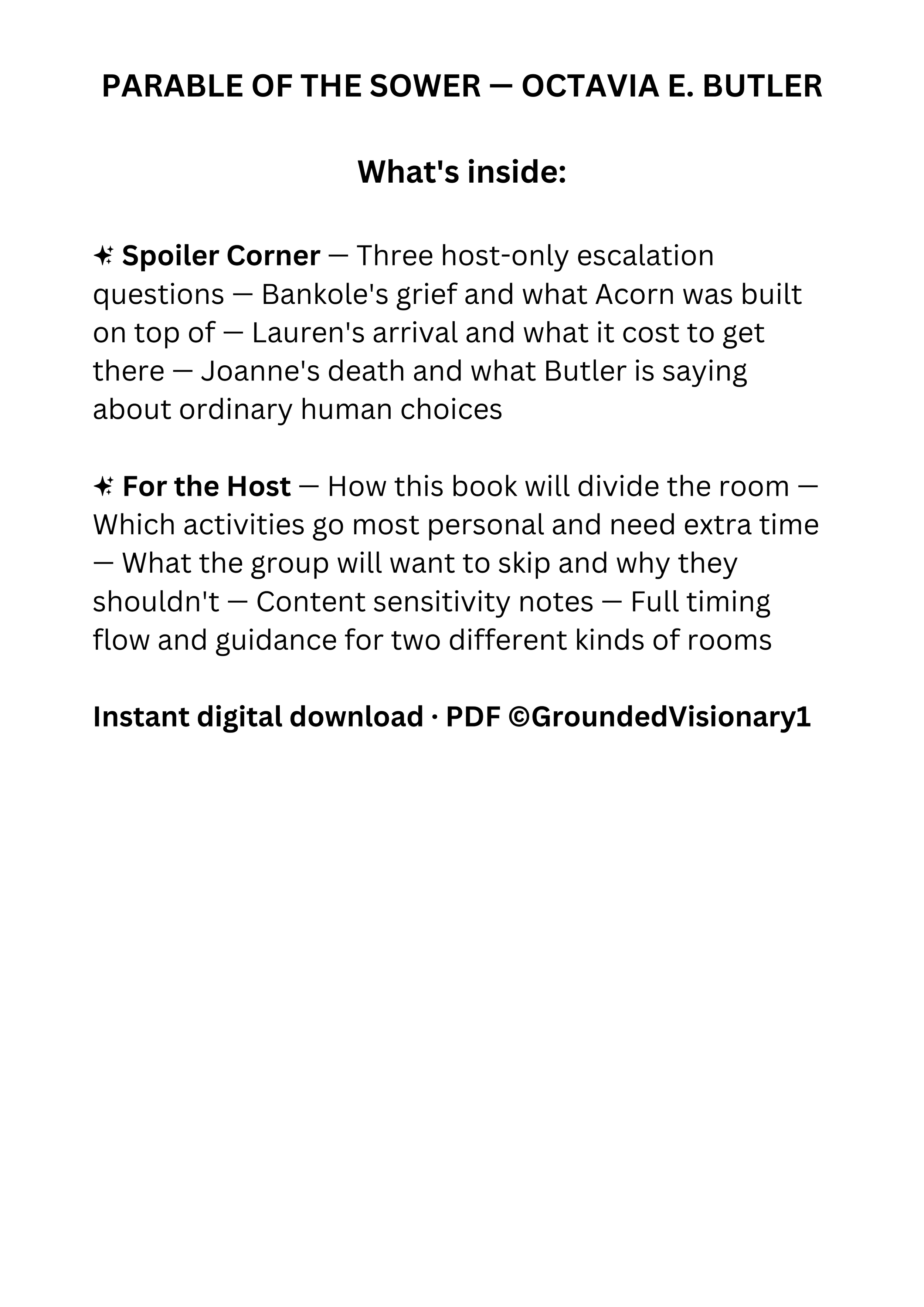
✦ Spoiler Corner — Host only — three escalation questions for when the conversation needs a jolt — Bankole's grief and what Acorn was built on top of — What Butler is saying about ordinary human choices
✦ For the Host — How this book will divide the room and why that's useful — Which activities go most personal and need extra time — What the group will want to skip and why they shouldn't — Full timing flow and guidance for two different kinds of rooms
✦ Bonus Host Guide — A free facilitation toolkit included with every purchase
Details — Instant download PDF — 20+ pages, print-ready — Personal and single-group use. No redistribution or resale. — Fan-created guide. Not affiliated with or endorsed by Octavia Butler's estate or any publisher.
Licensing for classrooms, libraries, and educational programs is available. If you plan to use this guide for a class, reading program, or institutional setting, please contact the shop owner to arrange an appropriate license
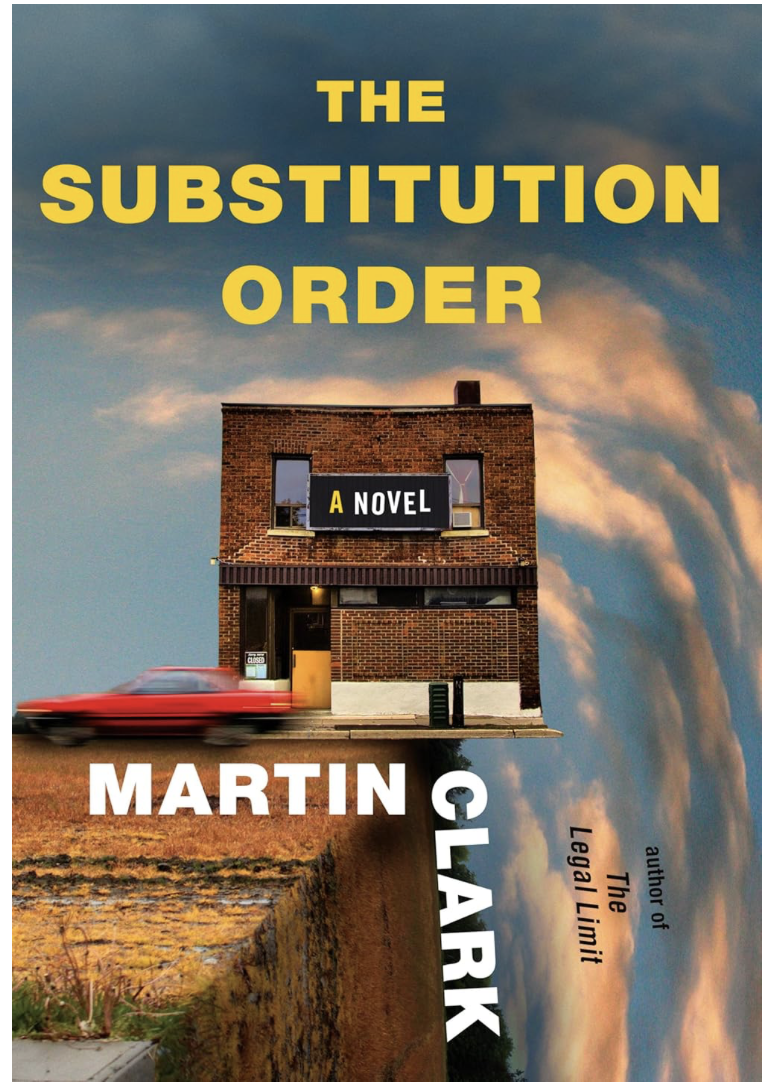
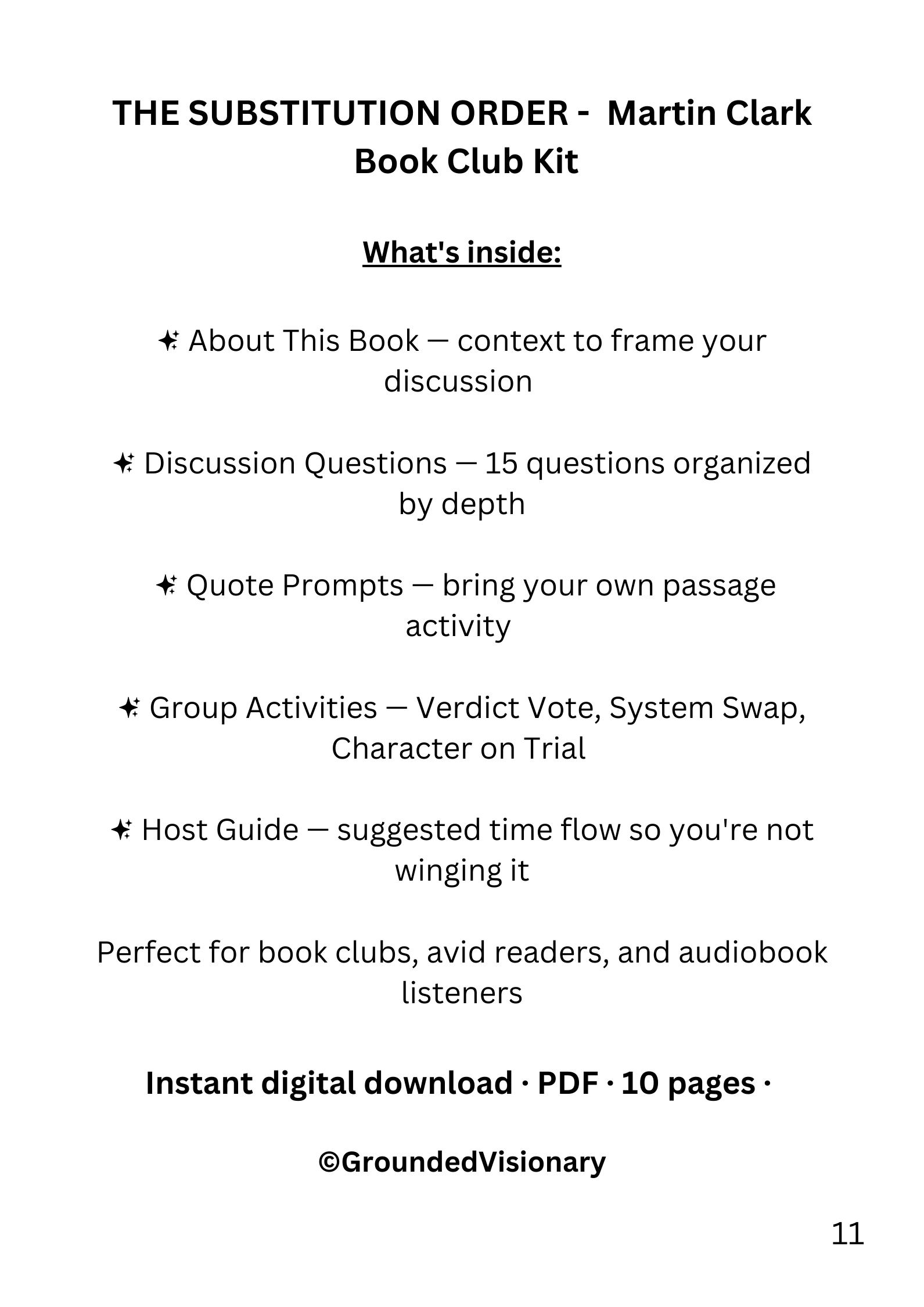
A tense exploration of justice and the systems that decide who matters.
The Substitution Order isn't the legal thriller you think it's going to be. There's no slick courtroom monologue, no dramatic last-minute reveal that fixes everything. What you get instead is a story about a disgraced lawyer named Kevin Moore trying to do right in a system that wasn't built with people like him — or his client — in mind.
This is a book about how power actually works. Not the official version — who holds the gavel, who sits at the bench — but the unofficial version. Who has leverage? Who gets grace? Who gets crushed quietly while everyone looks the other way. The law in this book isn't a clean instrument. It's a system driven by people, and people have agendas, blind spots, and things they're protecting. Martin Clark doesn't pretend otherwise. That's what makes this book worth arguing about.
The discussion this book generates goes after the quiet complicity — the kind where nobody technically did anything wrong, but someone still ended up on the losing end of every decision. It goes after good intentions and the cost they actually entail. It goes after justice as a concept, the book refuses to define cleanly, and asks your room to define it instead.
This kit was built for the room that finished this book with a lot of feelings and nowhere to put them.
✦ What's Inside
✦ About This Book — Not the legal thriller it appears to be — A disgraced lawyer trying to do right in a system not built for him — Built for readers who've watched someone fight hard and still lose ground
✦ What This Book Is Really About — Power — who has it officially and who has it unofficially — Good intentions and what they actually cost — The quiet polite complicity where nobody technically did anything wrong — What justice looks like when it depends entirely on who's driving
✦ Discussion Questions — Three Tiers — Tier 1: Warmup questions that get everyone talking — Tier 2: Who held real power, where tension lived, whether good intentions made things worse — Tier 3: Whether the system is broken, workable, or just dependent on who's driving — Closes with: What question did this book refuse to answer?
✦ Activities — Verdict Vote: one major character decision — ethical, unethical, or understandable but wrong — System Swap: one key scene reimagined in a different context — big city vs. small town, wealthy client vs. broke one — Character on Trial: one character's choices on trial, two argue for, two argue against, everyone else is the jury
✦ Quote Prompts — Six prompts pointing toward specific kinds of passages — The moment power showed up without anyone raising their voice — The scene where the real conflict was happening just under the surface of the official one — The passage that made you think: this is exactly how people actually are
✦ For the Host — Suggested timing flow for a single session — Which questions to prioritize and which to save — How to let the conversation breathe
✦ Bonus Host Guide — A free facilitation toolkit included with every purchase
Details — Instant download PDF — Personal and single-group use. No redistribution or resale. — Fan-created guide. Not affiliated with or endorsed by Martin Clark or any publisher.
Licensing for classrooms, libraries, and educational programs is available. If you plan to use this guide for a class, reading program, or institutional setting, please contact the shop owner to arrange an appropriate license.

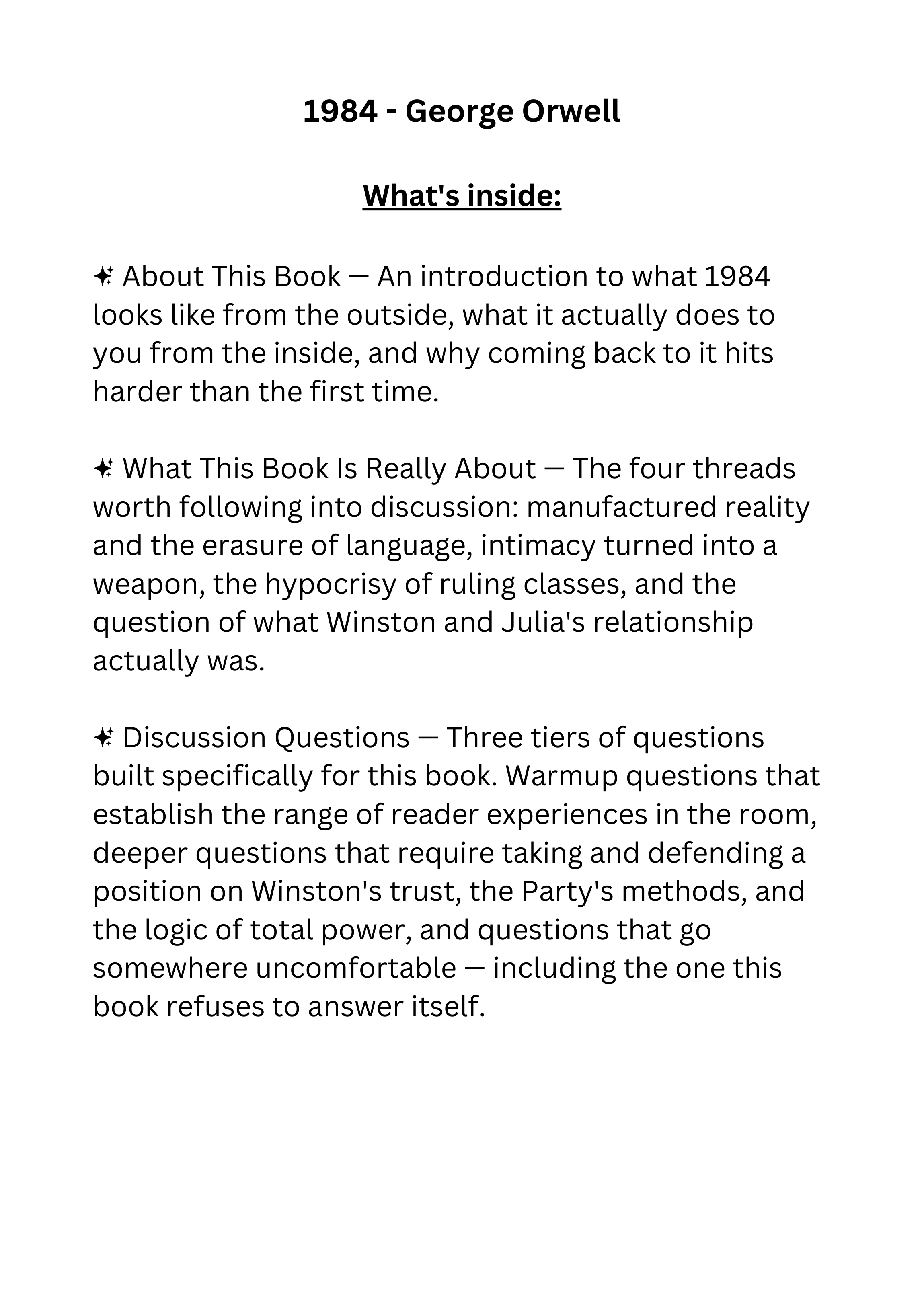
A chilling exploration of control, surveillance, and how truth can be rewritten.
1984 has been so thoroughly absorbed into the language of political warning that it can feel more like a reference point than a story — something you cite rather than something you feel. This kit exists for the room that comes in thinking they already know what Orwell was saying, and leaves having a harder time than they expected explaining why it doesn't apply right now.
This book is not primarily about surveillance. It's about what happens when a system gains enough control over language, history, and fear to remake a person from the inside out — not just break them, but rebuild them into something that genuinely loves what it was made to love. The telescreens are almost beside the point. The real mechanism is what happens inside Winston's mind long before the Ministry of Love gets hold of him. A book club that only talks about Big Brother as metaphor will miss the psychological machinery underneath — the paranoia that exhausts you, the trust that destroys you, the love story that turns out to be the most effective lever the Party had all along.
This kit was built to go there. Not just to the politics. To the mechanisms.
This kit was built for the room that comes in thinking 1984 is a warning from the past — and leaves arguing about whether it's a description of the present. That argument is the point.
✦ What's Inside
✦ About This Book — What 1984 looks like from the outside — What it actually does to you from the inside — Why coming back to it hits harder than the first time
✦ What This Book Is Really About — Manufactured reality and the erasure of language — Intimacy turned into a weapon — The hypocrisy of ruling classes across every era — What Winston and Julia's relationship actually was
✦ Discussion Questions — Three Tiers — Tier 1: Warmup questions that establish the range of reader experiences — Tier 2: Winston's trust, the Party's methods, and the logic of total power — Tier 3: Personal, uncomfortable, unresolvable — Closes with: What question did this book refuse to answer?
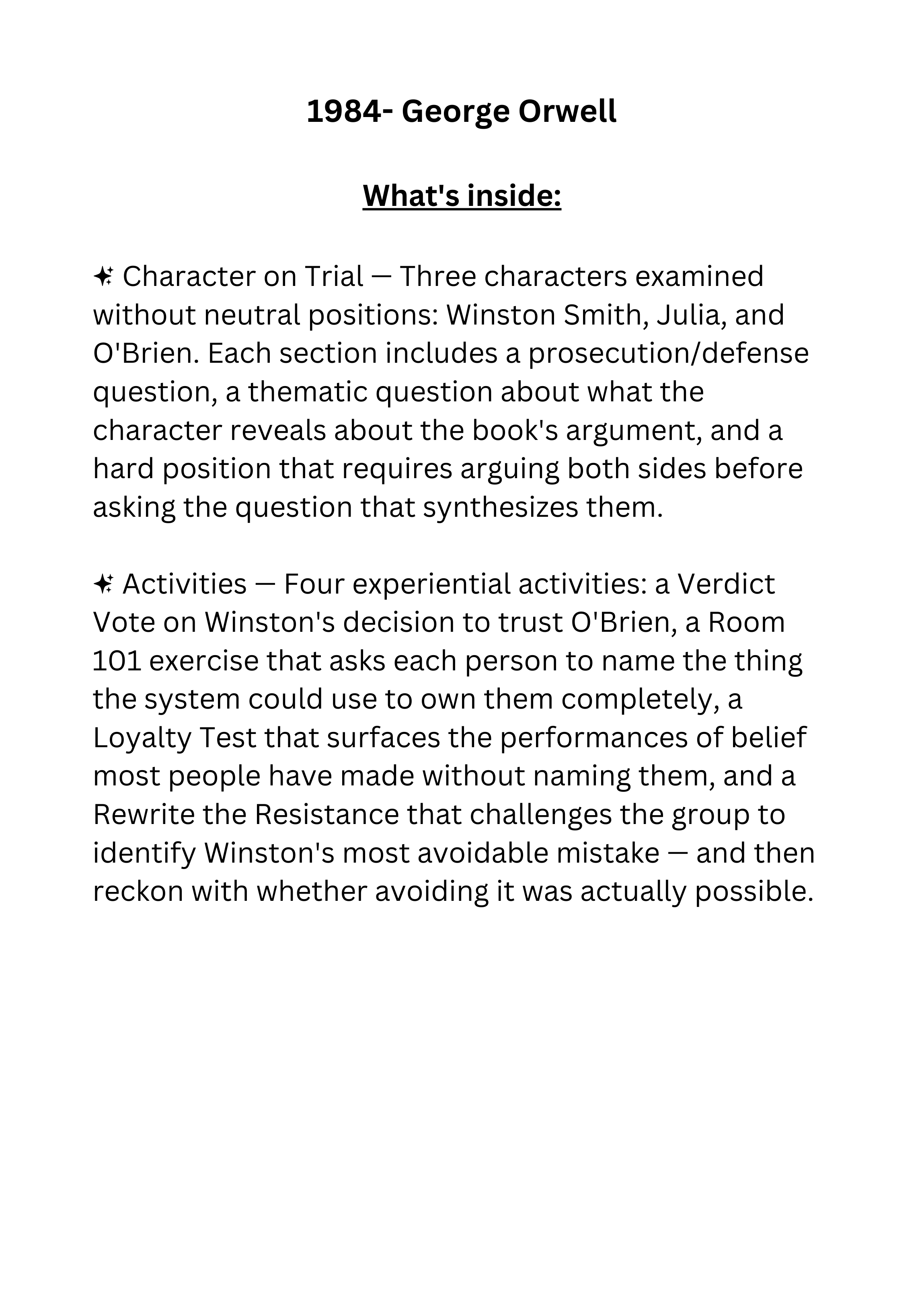
✦ Character on Trial — Winston Smith, Julia, O'Brien — Prosecution/defense structure — Hard position questions with mandatory reversal — No neutral positions allowed
✦ Activities — Verdict Vote: Winston's decision to trust O'Brien — Room 101: the thing the system could use to own you completely — The Loyalty Test: the performances of belief most people have made without naming them — Rewrite the Resistance: Winston's most avoidable mistake — and whether avoiding it was possible
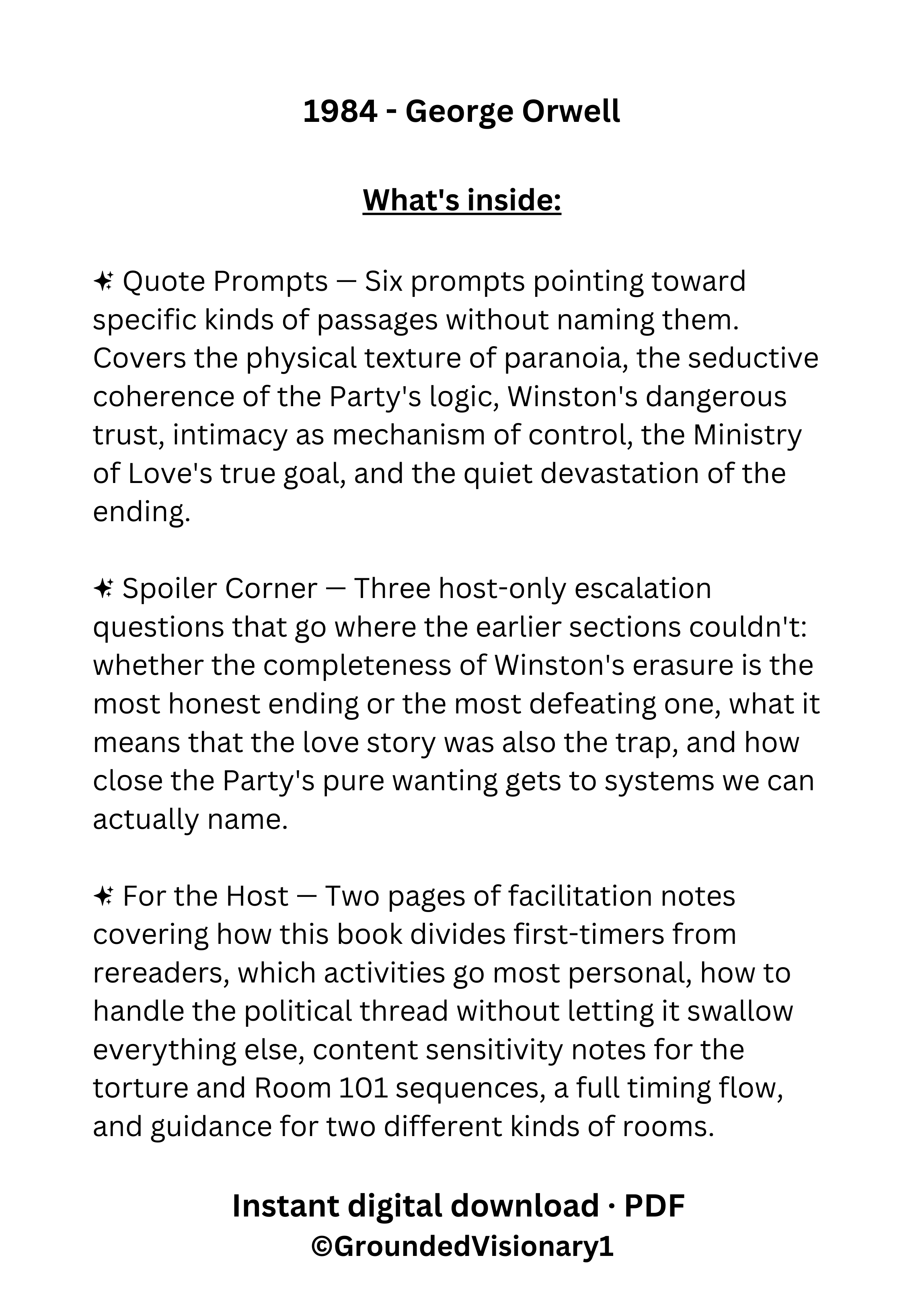
✦ Quote Prompts — Six prompts across six emotional entry points — The physical texture of paranoia — The seductive coherence of the Party's logic — The quiet devastation of the ending
✦ Spoiler Corner — Host only — three escalation questions for when the conversation needs a jolt — Whether Winston's erasure is the most honest ending or the most defeating one — What it means that the love story was also the trap — How close the Party's logic gets to systems we can actually name
✦ For the Host — How this book divides first-timers from rereaders — How to handle the political thread without letting it swallow everything else — Content sensitivity notes for the torture and Room 101 sequences — Full timing flow and guidance for two different kinds of rooms
✦ Bonus Host Guide — A free facilitation toolkit included with every purchase
Details — Instant download PDF — 20+ pages, print-ready — Personal and single-group use. No redistribution or resale. — Fan-created guide. Not affiliated with or endorsed by the Orwell estate or any publisher.
Licensing for classrooms, libraries, and educational programs is available. If you plan to use this guide for a class, reading program, or institutional setting, please contact the shop owner to arrange an appropriate license.
No results found
No results match your search. Try removing a few filters.